If you want clean detail, stacking and shipping, royal icing wins. If you want the cookie to taste like a treat the moment someone bites it, buttercream wins. Most people pick wrong because the words icing and frosting get used interchangeably in recipes, so ask for the wrong thing.
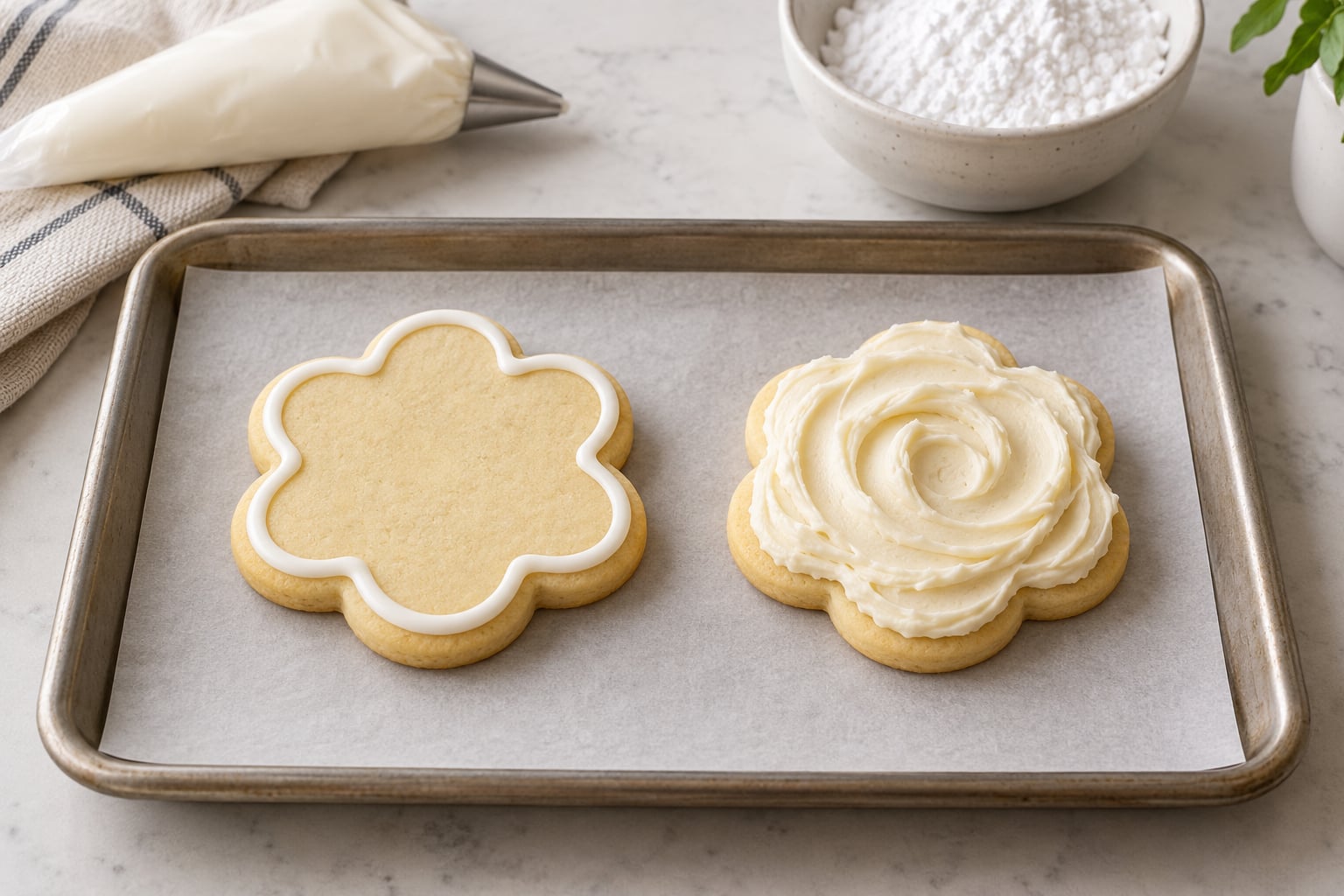
Here is the actual difference. Royal icing is powdered sugar held together by egg white or meringue powder, and it dries to a hard shell you can stack and box. Buttercream is whipped butter and powdered sugar, sometimes with milk, and it stays soft and creamy with no drying step at all.
A third option sits between them: crusting buttercream, which tastes like buttercream but skins over enough to stack and package. Once you know that exists, royal icing vs buttercream for cookies becomes a much easier call.
Table of Contents
- Royal Icing vs Buttercream for Cookies at a Glance
- Taste and Texture: Which Frosting Tastes Better on Cookies?
- Appearance and Decorating Technique
- Royal icing gives the clean lines
- Buttercream covers faster and pipes soft borders
- The middle path: crusting buttercream
- Drying, Handling, and Storage
- How long each one needs before you can touch it
- Stacking, boxing and shipping
- How long finished cookies keep
- Cost, Ingredients, and Allergy Considerations
- What each frosting costs to make
- Eggs, dairy, gluten and nuts
- Is cookie icing the same as royal icing?
- Which Should You Choose?
- Frequently Asked Questions
- Is royal icing or buttercream better for cookies?
- Can you use buttercream frosting for sugar cookies?
- How long does royal icing take to dry?
- Why is my royal icing not setting?
- Is royal icing or buttercream better for beginners?
- What icing do professional bakers use?
- Conclusion
Royal Icing vs Buttercream for Cookies at a Glance
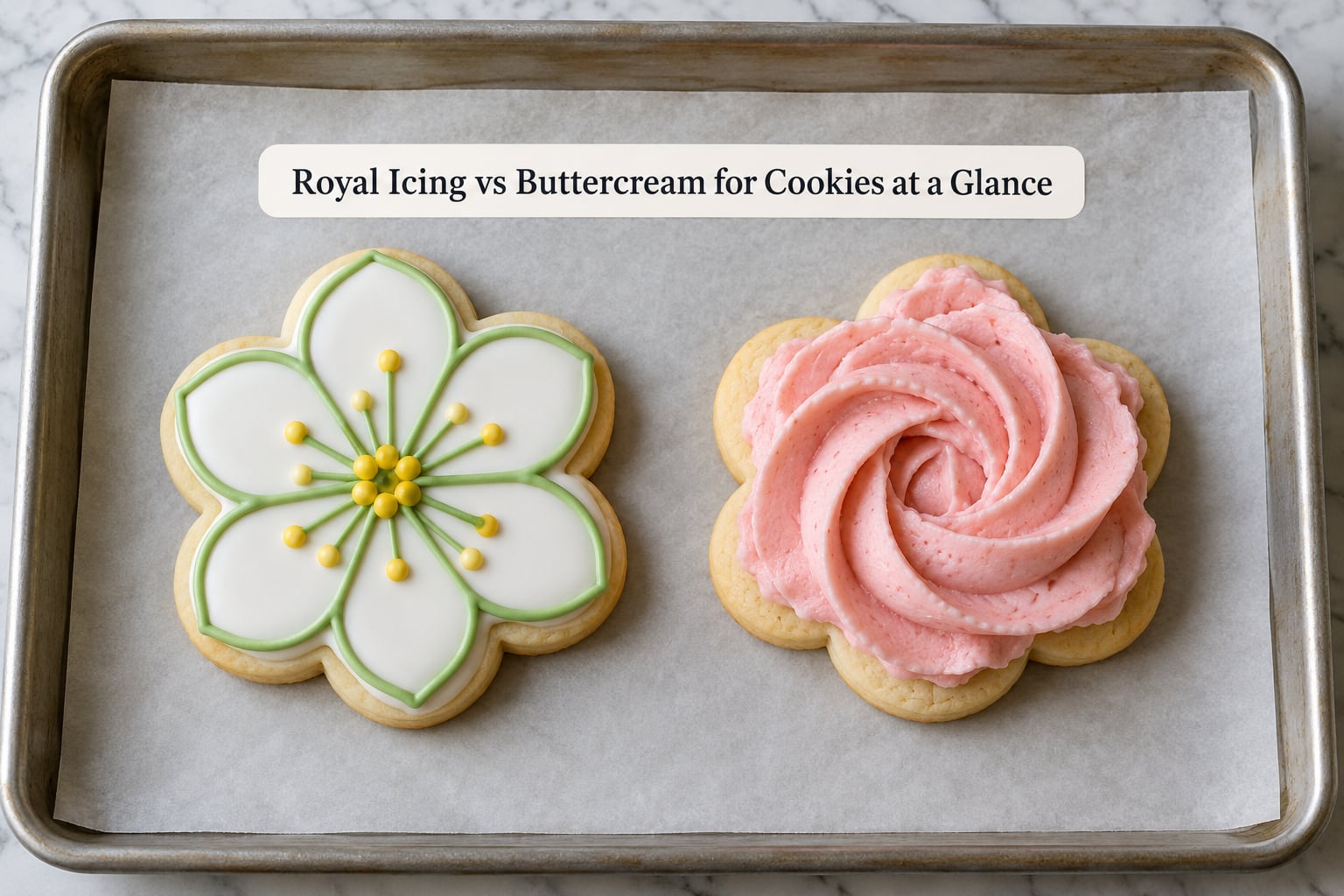
| Criterion | Royal Icing | Buttercream |
|---|---|---|
| Taste | Very sweet, faintly vanilla, hard shell over the cookie | Rich and buttery, flavour comes from the butter and any extract |
| Texture | Dries rock hard, snaps when bitten | Stays soft and creamy in a warm room |
| Dry time | About 8 hours, longer in humid weather | None, though crusting versions need 6 to 12 hours |
| Stacking | Safe once fully dry, lay parchment between layers | Soft buttercream smudges and shifts |
| Shipping | The reliable choice for parcels and gifts | Only if it is a crusting recipe and boxed cold |
| Storage life | Up to 2 weeks sealed when made with meringue powder | Cookies about 3 days at room temperature in one layer |
| Piping | Holds fine tips, outlines and flood well | Great for borders and swirls, thinner detail needs stiffening |
| Cost per batch | Cheapest, mostly sugar and a spoon of meringue powder | Higher, butter is the expensive line item |
| Difficulty | Fiddly, thin icing cracks and thick icing breaks tips | Forgiving, easy to thin and to redo |
| Allergens | Egg white unless made with meringue powder | Milk, and often nuts on shared equipment |
Taste and Texture: Which Frosting Tastes Better on Cookies?
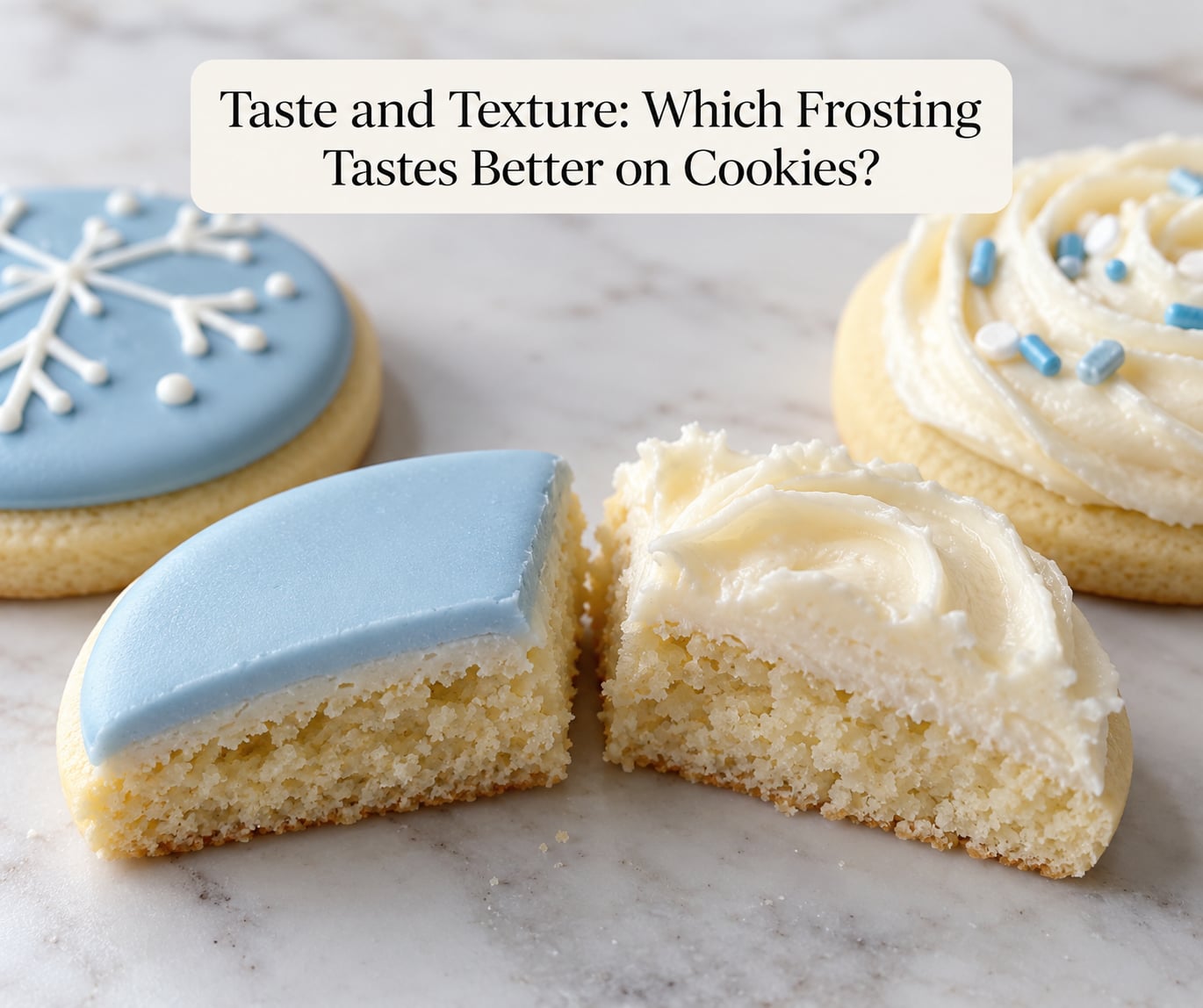
Taste is where the two split hardest, and it is the reason most people end up preferring buttercream without ever saying so.
Royal icing is sweet on its own terms. The powdered sugar carries most of the flavour, so any vanilla or almond extract you add is a whisper rather than a statement. Once it dries, the icing becomes a firm shell, and biting through it takes real pressure. Plenty of cookie decorators say the icing gets so hard it is uncomfortable on teeth, and the usual habit is to pick the icing off first and eat the bare cookie underneath.
Buttercream tastes like what it is made from. A good American buttercream with real butter and a little vanilla is rich and rounded, and it softens as it sits, so the last bite of a cookie tastes like the first. That softer bite also makes it forgiving on cookies that are still slightly warm.
Pairing matters more than people expect. Royal icing suits sturdy cookies, cutout shapes and anything that will be handled. Buttercream flatters a soft or crumbly cookie, but very thin cookies can bulge under it, so give it a moment to set or use a thin crumb coat.
Chocolate chip cookies and snickerdoodles lean buttercream. Gingerbread, shortbread shapes and anything going into a gift box lean royal icing.
Appearance and Decorating Technique
Royal icing gives the clean lines
Royal icing is the right medium when the design matters more than the bite. Because it dries rather than staying workable, it holds a piped outline overnight, a flood that levels out, and painted detail that will not smear when you move the tray.
The basic technique is outline then flood. Pipe the outline, let it sit a minute, then flood the middle with thinner icing so it levels itself. Work in a bowl wiped spotless of grease, since even a trace of fat stops it setting properly, and rest a damp cloth over the surface of the icing while you work so it does not crust over and grab colour.
Use gel food colouring rather than liquid drops. A drop of gel goes further and will not thin the icing, which is the usual reason beginners end up with runny royal icing and a flooded design.
Buttercream covers faster and pipes soft borders
Buttercream is a spread-and-cover frosting first. It fills a surface quickly, which matters when you have forty cookies to finish before an event. It also takes flavour and colour easily, and it can be thinned with a splash of milk or thickened with more sugar whenever you need to change direction.
Thin buttercream for spreading, medium for a rounded border, thick for flowers and stars. A star tip that holds its shape at room temperature is the sign that a buttercream is stiff enough for anything other than a flat layer.
Small disposable piping bags are the easiest tool for detail work, whichever frosting you use. Tip numbers matter more than people expect: a small round for outlines, a star for borders, and a fine tip for writing.
The middle path: crusting buttercream
Crusting buttercream is the answer for anyone who wants the taste of buttercream and the handling of royal icing. It is a buttercream with a little corn starch in it, so a thin skin forms on top while the inside stays creamy.
The rule is to air-dry it for 6 to 12 hours before touching, stacking or packaging. Do not over-thin it with cream, because too much liquid will stop a skin forming at all. Keep it loosely covered while you work so the surface stays workable.
Drying, Handling, and Storage
How long each one needs before you can touch it
Royal icing needs roughly 8 hours at room temperature before it is safe to handle, and humid weather pushes that further. Buttercream needs no drying at all. Crusting buttercream sits in between at 6 to 12 hours.
If your cookies are crumbly, flood them only after a 15 to 20 minute set. Flooding too early pushes crumbs up through the icing and gives you a speckled background.
Work backwards from the date. For a party on Saturday, decorate Thursday evening for buttercream or early Friday for royal icing. For a shipping order, finish at least two days ahead so the icing is fully cured before it goes in a box.
Stacking, boxing and shipping
Dried royal icing cookies can be stacked with parchment or wax between the layers. That is the main reason it dominates gift boxes and parcels, since it survives a car journey and a bumpy courier trip without turning to paste.
Soft buttercream cookies should be stored in a single layer, because the frosting from the cookie above will mark the one below within hours. If you must ship buttercream, use a crusting recipe, let it crust completely, box with parchment and cushioning, and expect it to be softer on arrival.
Humidity is the quiet enemy of both. It slows royal icing and softens a buttercream crust, so avoid leaving finished cookies in a warm car or a humid porch.
How long finished cookies keep
Meringue-powder royal icing is shelf-stable for up to 2 weeks when stored airtight in a grease-free container. Buttercream cookies keep about 3 days at room temperature in a single layer, and the buttercream itself keeps roughly 2 weeks refrigerated.
Refrigerating buttercream cookies is a trade. They firm up nicely but the frosting goes a little dull, and condensation when they come back out can dull it further.
Cost, Ingredients, and Allergy Considerations
What each frosting costs to make
Royal icing is the cheaper batch by a clear margin. A typical mix is mostly confectioners’ sugar with a spoonful of egg white or meringue powder, and a batch covers a surprising number of cookies.
Buttercream costs more because butter is the expensive line, and a Swiss or Italian meringue version adds sugar and a cooking step on top. You also spend more on it because good coverage takes a heavier coat.
Equipment is roughly equal for either. Both want a piping bag, a few tips and gel colouring, so the real cost difference is in the ingredients, not the kit.
Eggs, dairy, gluten and nuts
Traditional royal icing uses raw egg white, which means avoiding it for anyone avoiding raw egg. Meringue powder royal icing solves that and is also what makes the icing shelf-stable rather than fridge-dependent.
Buttercream brings in milk, so it is out for anyone avoiding dairy, unless you use a plant-based recipe. Shared equipment is the hidden risk in nut allergy households, since nut butters and nut cross-contact on worktops are common in home kitchens.
For an allergy-aware bake, meringue-powder royal icing baked in a nut-free kitchen is usually the safest finish that still stacks and travels.
Is cookie icing the same as royal icing?
No, and this is the mix-up behind a lot of disappointing cookies.
| Frosting | How it behaves |
|---|---|
| Royal icing | Dries hard, stacks, ships, keeps up to 2 weeks sealed |
| Cookie icing | Tubes that set on the surface but stay soft underneath, never stack |
| Buttercream | Stays creamy, no drying step, about 3 days at room temperature |
| Fondant | Rollable and mouldable for 3D work, dries firm but is chewy |
Which Should You Choose?
Choose royal icing when the cookies need to survive. That covers shipping, gifting, wedding and party favours, wedding cookie boxes, cookie decorating parties where people take work home, anything stacked in layers, and any batch that will sit on a table for more than a few hours. It is also the calmer choice for cutout shapes and detailed work you want to look professional.
Choose buttercream when taste leads. Serve buttercream cookies the same day, at room temperature, and let people eat them straight off the tray. It suits cupcakes, snack cakes, soft cookies, warm cookies straight from the oven, and beginners who would rather not fight a consistency that runs when you look at it wrong.
Choose crusting buttercream when you want both, or when you are somewhere in between: a batch that needs to travel a short distance, stack loosely, or be sold at a weekend market without the full commitment of royal icing.
If you are selling at a market, think about the customer, not your own preference. Royal icing looks more like a gift and survives the trip to a table across town. Buttercream sells on taste, and a buyer who bites one on the spot will usually prefer it. Plenty of small bakers run both lines for exactly that reason.
Frequently Asked Questions
Is royal icing or buttercream better for cookies?
Buttercream is better if taste comes first and the cookies will be eaten within a day or two at room temperature. Royal icing is better if the cookies need to stack, travel, be shipped or sit out longer, because it dries hard and holds detail. Crusting buttercream is the compromise when you want a soft taste but still need cookies that handle.
Can you use buttercream frosting for sugar cookies?
Yes, but only a crusting buttercream if you plan to stack or package them. Plain American buttercream stays soft and will slide off or smear. Crusting buttercream skins over after 6 to 12 hours of air-drying, which is enough for light stacking. Spread it thinly on thin cookies so they do not buckle underneath.
How long does royal icing take to dry?
About 8 hours at room temperature for a thin flood, and up to 12 hours for thicker layers or piped detail. Humid weather stretches that further. The surface will feel dry long before the icing is firm all the way through, so test a piped detail at the edge with a light finger before you commit to stacking.
Why is my royal icing not setting?
The usual causes are a trace of grease in the bowl or on the spatula, too much thinning liquid, or under-whipped egg white. Wipe the bowl with alcohol or vinegar and dry it before you start, colour with gel rather than liquid drops, and check the ten second rule: if the icing slides off the spatula and has not started to slump back within about ten seconds, it is too thin and needs more powdered sugar.
Is royal icing or buttercream better for beginners?
Buttercream is the easier starting point because it can be thinned or stiffened at any moment and mistakes can be scraped off and reused. Royal icing is harder to learn, since consistency cannot be corrected once it is right and small detail work needs steady hands. Begin with outlines and a simple flood on royal icing before you attempt anything fine.
What icing do professional bakers use?
It depends on the job, and most bakers use more than one. Royal icing for detailed, durable and shipped work. Swiss or Italian meringue buttercream when taste and a smooth finish matter most, such as cakes and cupcakes. Canned cookie icing is used for speed on large batches. Professionals pick per order rather than having one standard.
Conclusion
Start with buttercream if you are cooking to be eaten, and royal icing if you are baking to be given or delivered. That single question, taste today or transport later, settles it faster than any table on this page. When the answer is genuinely in between, make a crusting buttercream and you will not have to compromise on either count.