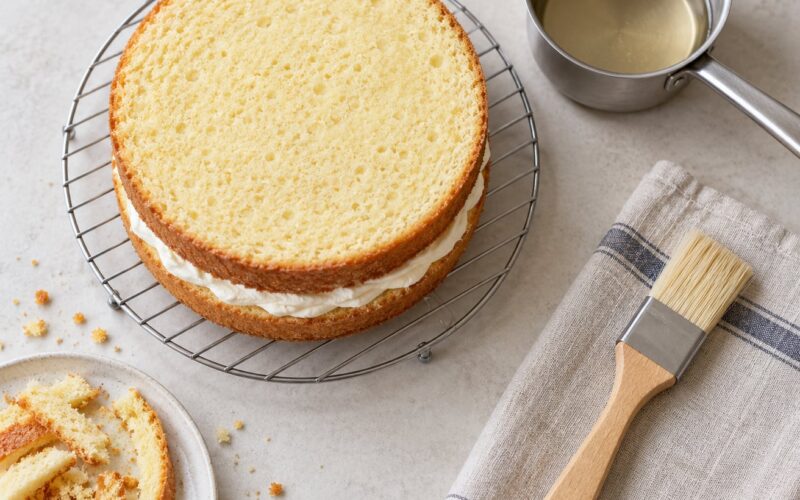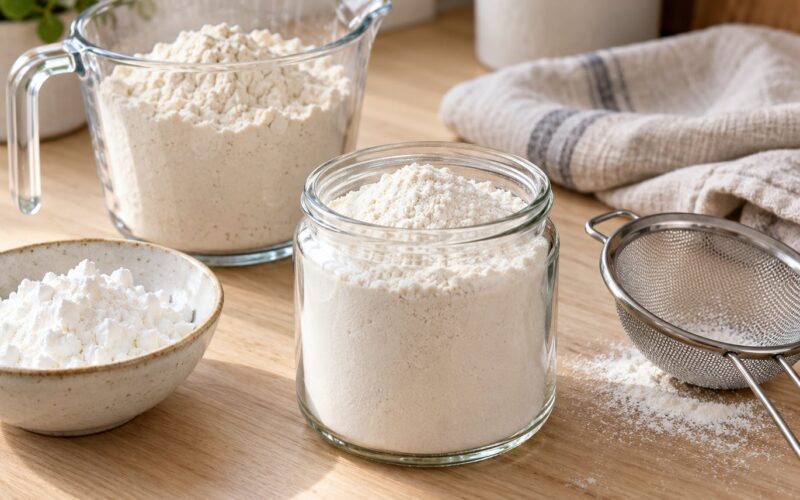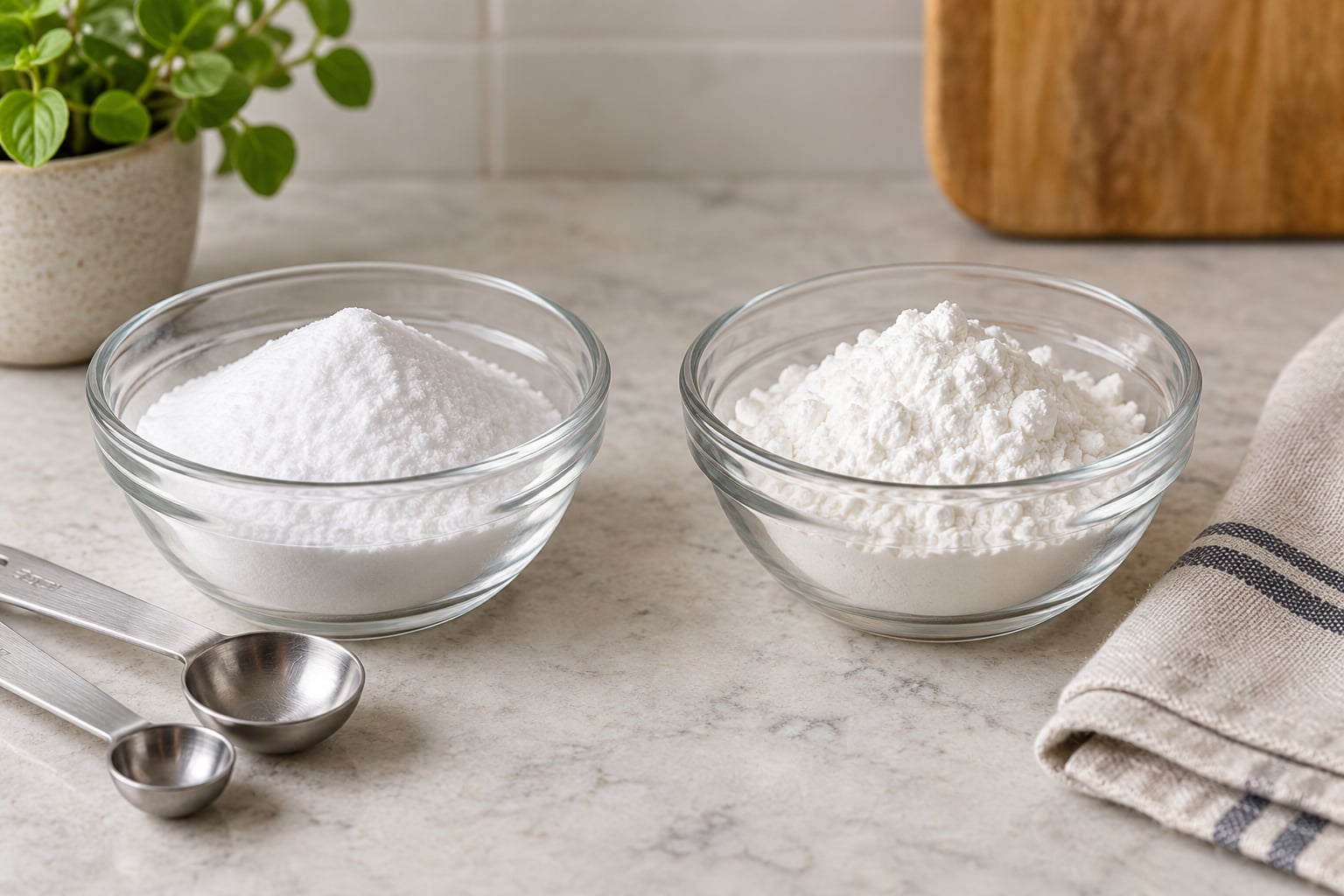
Baking soda is pure sodium bicarbonate and needs an acidic ingredient in the batter to start working. Baking powder already contains that acid, so it activates on its own with liquid and heat. Baking soda is also roughly three to four times stronger, which is why the wrong one turns up as a metallic taste or a heavy, flat crumb.
That single difference explains most of the disappointing cakes I have seen come out of home kitchens. Someone ran out of baking powder, reached for the orange box of soda, and baked a rhubarb cake that never rose properly. Others used three times too much powder in a recipe built for soda and got a cake that tasted like dish soap.
Here is the difference between baking soda and baking powder in cakes, explained without the chemistry headache, along with how much to use, when you can substitute one for the other and what to do when your cake sinks.
Table of Contents
- What Is the Difference Between Baking Soda and Baking Powder in Cakes at a Glance
- What Each Leavener Does in Cake Batter
- Baking soda: sodium bicarbonate, and nothing else
- Baking powder: soda, dry acid and starch in one scoop
- The difference in plain terms
- Why Baking Powder Contains Baking Soda
- How Baking Soda and Baking Powder React Differently
- How Much to Use in a Cake
- Can You Substitute One for the Other?
- Which Should You Choose?
- Frequently Asked Questions
- Is baking powder the same as baking soda?
- Is baking powder double-acting?
- How much baking soda can I use in a cake?
- Do baking soda and baking powder expire?
- Why did my cake taste bitter after I added extra baking soda?
- Can I use baking powder in a recipe that calls for baking soda?
- Conclusion
What Is the Difference Between Baking Soda and Baking Powder in Cakes at a Glance
The table below covers composition, activation, strength and the practical measurements. It is the fastest way to see both leaveners side by side.
| What it is | Baking soda | Baking powder |
|---|---|---|
| Common name | Baking soda, bicarbonate of soda, bicarb, bread soda | Baking powder, double-acting baking powder |
| Chemical name | Sodium bicarbonate, NaHCO3 | Sodium bicarbonate with a dry acid salt and starch |
| What is inside | One ingredient: sodium bicarbonate | Sodium bicarbonate, cream of tartar or another dry acid, and usually cornstarch |
| How it activates | Only when it meets an acidic ingredient such as buttermilk, brown sugar or molasses | On contact with any liquid, then a second time in the oven |
| When it acts | Immediately, then stops | Twice: during mixing and during the first minutes of heat |
| Strength | Three to four times stronger than baking powder | Weaker by design, so a normal spoonful is safe |
| Flavour effect | Adds a soapy, alkaline note when it is left unneutralised | Neutral once the soda and acid balance out |
| Browning effect | Raises pH, so the top browns faster and darker | Little effect on colour |
| Amount per cup of flour | About 1/4 teaspoon | About 1 teaspoon |
| Gram weight | 1 teaspoon is roughly 4.6 g | 1 teaspoon is roughly 4 g |
| Best cake types | Chocolate cake with natural cocoa, buttermilk cake, banana bread, molasses and gingerbread, rhubarb and other acidic fruit cakes | Pound cake, sugar cookies, scones, neutral cupcakes, any batter with no acid of its own |
| Shelf life once opened | About 3 months, and it keeps absorbing moisture from the air | About 3 to 6 months, faster if it gets damp |
| Substitution | Replace 1 teaspoon of soda with 3 teaspoons of powder, and expect a lighter, less tangy cake | Replace 1 teaspoon of powder with about 1/3 teaspoon of soda plus an acid such as a spoonful of buttermilk |
What Each Leavener Does in Cake Batter
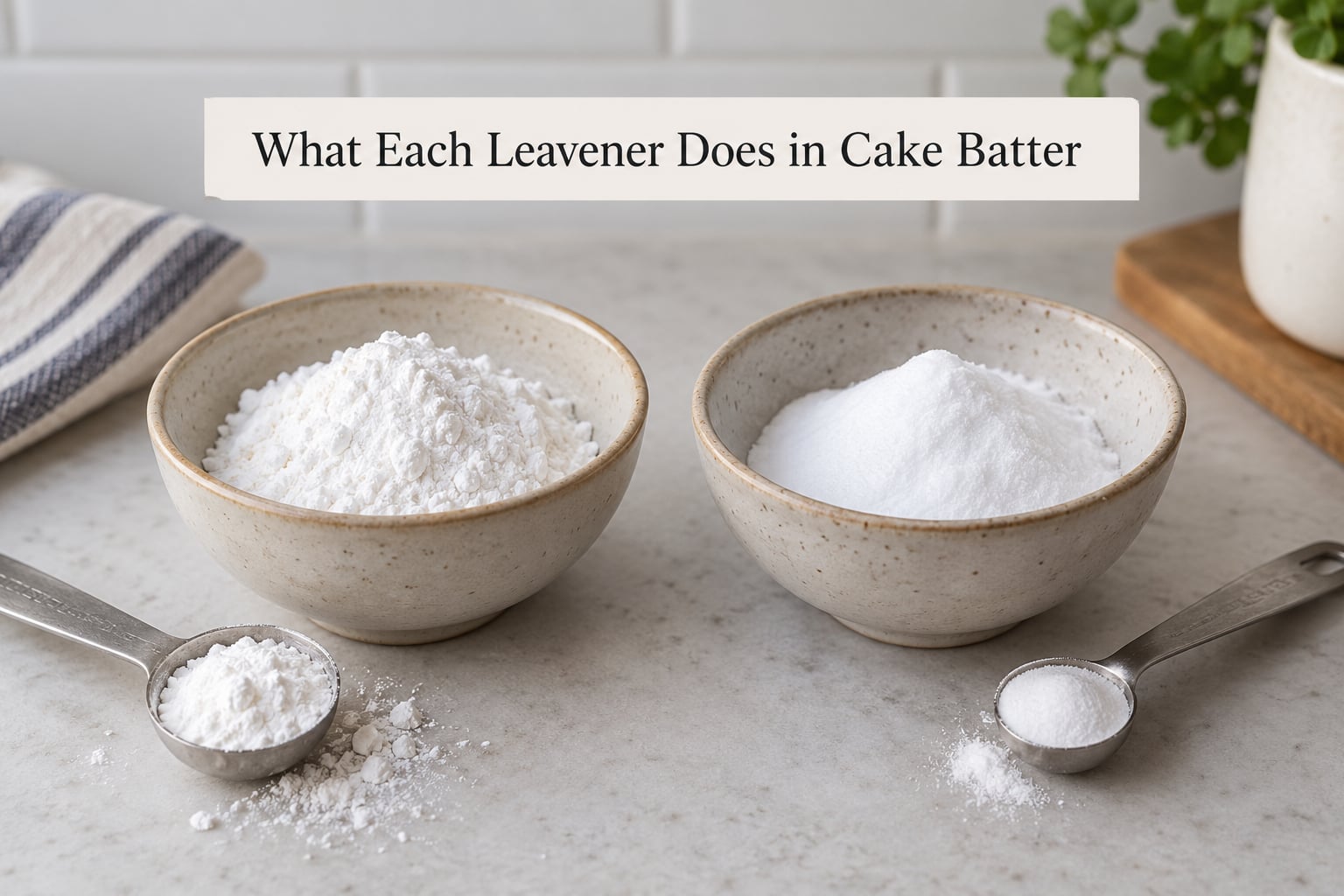
Both leaveners work the same way at the end: they release carbon dioxide gas, and those gas bubbles push the batter upward in the oven. The difference is where the acid that starts the reaction comes from.
Baking soda: sodium bicarbonate, and nothing else
Baking soda is one pure chemical, sodium bicarbonate. It is alkaline on its own and quite tasteless until it reacts, but on its own it will never release gas. It needs something acidic in the bowl to pair with, and that acid is what turns the soda into carbon dioxide bubbles.
A cake formula that calls for soda already carries its acid: buttermilk, yogurt, sour cream, brown sugar, molasses, honey, lemon juice, vinegar, applesauce or natural cocoa powder. In those batters, soda is the right tool.
Baking powder: soda, dry acid and starch in one scoop
Baking powder is a pre-blended mix. Take one teaspoon of it apart and you will find roughly a third sodium bicarbonate, a third dry acid such as cream of tartar, and a little cornstarch to keep the acid and the base from clumping together in the box.
Cream of tartar is the dry, powdered form of tartaric acid. Because it travels with the soda in the same scoop, baking powder needs no help from your recipe. Liquid is enough to set it off, which is why a neutral batter with no buttermilk and no brown sugar still rises properly.
The difference in plain terms
Baking powder carries its own acid. Baking soda borrows acid from the recipe. That single fact explains the whole difference between baking soda and baking powder in cake batters, and it also explains why one is measured in teaspoons and the other in tablespoons.
Why Baking Powder Contains Baking Soda
Without baking soda inside it, baking powder would have nothing to react with. The soda is the engine, and the packaged acid is the starter. Every commercial baking powder is built around sodium bicarbonate for that reason.
Modern baking powder is double-acting, which means it goes off twice. The first reaction happens as soon as liquid hits the powder and wets the acid and soda. The second reaction kicks in once the batter reaches oven heat, usually somewhere above 80C, when more of the acid dissolves and the remaining gas is released.
That two-stage design is why baking powder keeps working through the bake instead of fizzing out in the first ten seconds. Older single-acting powder reacts only once, with liquid, which is why batters made with it can rise and then collapse as they cool.
One detail matters for your pantry. The acid in baking powder only reacts while it stays dry. Scoop it into a container, let it sit near the stove, or spill a bit of water into the box, and the two halves have already met. That is freshness testing in a nutshell, and more on it below.
How Baking Soda and Baking Powder React Differently
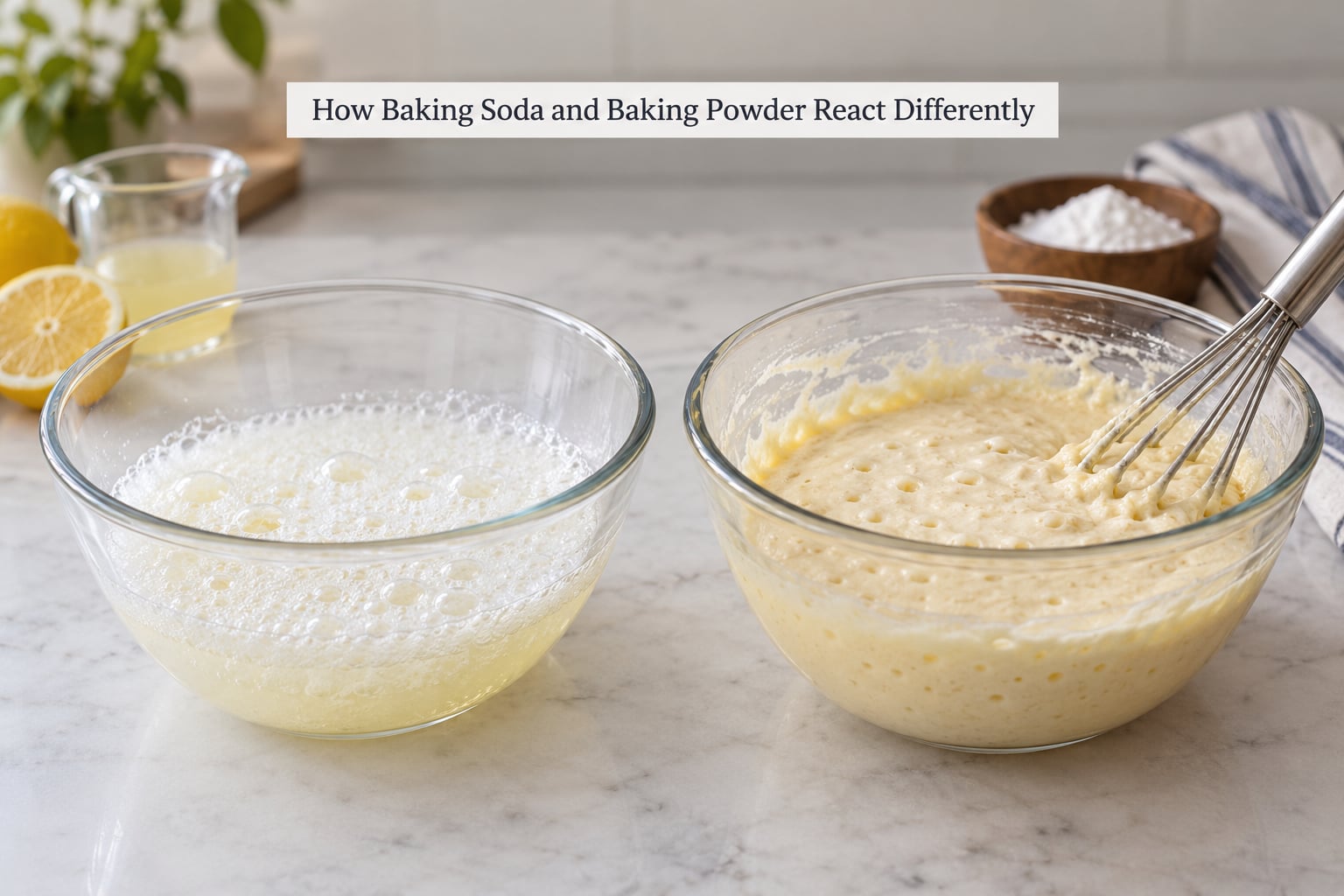
Soda fires once, fast. Baking powder fires twice, slower and longer. Everything else follows from that timing.
When baking soda meets its acid, the reaction is immediate. Gas comes off in the first seconds of mixing and mostly stops. A baking soda batter goes into the oven with less lift left in it, which is why those cakes tend to be denser and firmer, and why the crumb is more open but the overall volume lower.
One useful bit of everyday chemistry: if you add vinegar to soda, or warm water to baking powder, you get the same reaction. That is the classic school volcano demonstration, and it is the same gas doing the same job inside a cake.
There is a flavour consequence too. When soda reacts fully, it leaves nothing behind. When soda is over-supplied and the acid runs out, the leftover sodium forms compounds with a soapy or metallic mouthfeel, and the alkaline batter browns faster and darker on top. This is the same reason alkaline dough makes a blonder biscuit and why a blueberry cake can turn green around the fruit.
That flavour trap runs both ways. A Reddit thread in r/Cooking recounts a baker substituting sodium bicarbonate for baking powder in a rhubarb cake, and the result was a flat failure. Rhubarb is acidic, so the soda did react, but with the wrong strength and timing for a recipe built around powder.
How Much to Use in a Cake
The difference between baking soda and baking powder in cakes shows up in the measuring spoon as much as the chemistry. If your recipe calls for a teaspoon of one and you reach for a tablespoon of the other, the batter changes completely.
Good starting points per cup of flour:
- Baking soda: about 1/4 teaspoon for a light cake, up to 1/2 teaspoon for a quick bread or a strongly acidic batter such as molasses or chocolate.
- Baking powder: about 1 teaspoon per cup of flour. Double-acting powder is already diluted with starch, so a full teaspoon is a normal, balanced amount.
For scaling with a kitchen scale, 1 teaspoon of baking soda weighs about 4.6 g and 1 teaspoon of baking powder about 4 g. That is a small difference, but it explains why converting grams without converting the leavener can quietly skew a cake.
Treat tablespoon recipes with care. Some older quick-bread formulas call for a tablespoon of baking powder per cup, which is three times the modern guideline, and they also carry far more sugar and fat. If you halve such a recipe, halve the leavener too, or use a trusted newer formula instead.
Test your leaveners before you rely on them.
- Test baking powder: put a teaspoon into half a cup of hot water. Vigorous bubbling straight away means it is fresh. A weak fizz means replace it.
- Test baking soda: stir a teaspoon into a tablespoon of vinegar or lemon juice. Instant foam means it still has its bite.
- Check the open date: if the box has been open a year or so, treat it as a maybe and run one of the tests above.
- Store it dry: a tight container in a cool cupboard, never above the stove or the sink, because baking soda drinks moisture out of the air.
Can You Substitute One for the Other?
Yes, with the standard three-to-one rule and one caveat that most guides skip. For every teaspoon of baking soda called for, use three teaspoons of baking powder.
That works because baking powder is roughly a third soda by weight. The three-parts-powder figure is there to deliver roughly the same amount of lifting power in the bowl.
Here is the caveat. The rule only matches the soda. It ignores the acid already sitting inside the powder, and that acid does real work: it neutralises some of the soda, which is exactly what keeps the cake from tasting soapy. So a cake converted with three teaspoons of powder may end up lower, lighter in colour and less tangy than the original.
Going the other direction is messier. Replacing a teaspoon of baking powder with soda alone means you must also supply the acid, or you will get a metallic, soapy batter that rises in a rush and then sinks. If you must do it, add about a tablespoon of buttermilk or sour cream alongside roughly 1/3 teaspoon of soda.
Startlingly often, the better move is not to convert at all. Experienced bakers push back hard on the habit of automatically adding both leaveners to everything, because there is no universal ratio and the second leavener usually only muddies the balance. Follow the formula first.
When a cake does go wrong, the symptom tells you which mistake you made.
| Symptom | Most likely cause | What to change next time |
|---|---|---|
| Dense, shortbread-like crumb | Not enough lift: stale leavener, no acid for the soda, or an under-leavened formula | Test the leavener, check the flour weight, follow the stated amount exactly |
| Sunken middle | Rise too fast then collapse: too much soda, or too much powder in a formula already containing an acid | Reduce the leavener, check oven temperature with an oven thermometer |
| Gummy or sticky texture | Batter under-leavened at the mixing stage, so the starch never set around enough gas | Make sure the acid and soda are fully combined before flour goes in |
| Soapy or metallic aftertaste | Soda with nothing to neutralise it | Add the missing acid, or use powder instead and drop the leavener by three-quarters |
| Very dark top, faintly bitter crumb | Over-alkaline batter | Cut the soda, add a spoonful of acid, and watch the bake a few minutes earlier |
Which Should You Choose?
Use baking powder when your batter has no acid of its own. Pound cakes, scones, sugar cookies and plain vanilla cupcakes rely on the powder to bring its own acid and start working the moment the liquid lands.
Use baking soda when the recipe already brings acid. Buttermilk cakes, banana bread, gingerbread, molasses puddings, rhubarb and any fruit cake that would otherwise taste flat all fall into this group.
For chocolate cake, the type of cocoa decides the leavener. Natural cocoa powder is acidic and leaves a cake that tastes more bitter and less sweet, so it pairs with baking soda to lift and to balance. Dutch-process cocoa has been treated with alkali and is already neutral, so it works fine with baking powder.
Some recipes call for both, and they have a reason. A vanilla cupcake that wants a taller rise plus a slightly deeper flavour can carry a small amount of soda alongside its powder, with enough acid in the formula to neutralise the soda. Two leaveners are not automatically better, but they are not random either. Read the ratio the recipe gives you.
One last practical note: baking soda does more than cake. It is useful for whitening laundry, scrubbing stovetops, clearing a slow drain with hot water and deodorising a fridge, since the same alkalinity that neutralises smells also cuts grease. Keep a second box in the utility room so the baking one never goes stale.
Frequently Asked Questions
Is baking powder the same as baking soda?
No. Baking soda is pure sodium bicarbonate. Baking powder is a blend that already contains sodium bicarbonate plus a dry acid such as cream of tartar and a little cornstarch. That packaged acid is what lets baking powder work with nothing more than liquid and heat, while baking soda needs an acidic ingredient from the recipe itself.
Is baking powder double-acting?
Almost all baking powder sold today is. Double-acting means it reacts once when liquid is added and a second time as the batter heats past roughly 80C. That second stage is why modern cakes rise higher and hold their structure through cooling, whereas older single-acting powder reacts only with liquid and can collapse.
How much baking soda can I use in a cake?
About 1/4 teaspoon per cup of flour for a light cake, and up to 1/2 teaspoon for quick breads or very acidic batters such as molasses or rhubarb. More than that rarely helps because the acid in the formula runs out, and the leftover soda turns the batter alkaline, giving you a metallic aftertaste and a darker top.
Do baking soda and baking powder expire?
Both lose strength once opened, usually within three to six months, because the powder absorbs moisture from the air. Test baking powder in half a cup of hot water and test baking soda in vinegar. If either gives a weak reaction instead of a strong fizz, buy a new box. Unopened, both keep far longer.
Why did my cake taste bitter after I added extra baking soda?
Extra soda without extra acid leaves alkalinity in the batter that the recipe never intended. It tastes soapy or metallic and pushes the top to brown faster and darker. There is no way to remove it after baking. Next time, follow the stated measurement exactly, or convert the soda to baking powder at three times the amount instead of adding more.
Can I use baking powder in a recipe that calls for baking soda?
Yes, and it is the safer direction of the swap. Use three times the amount of baking powder for each teaspoon of baking soda called for. Expect a slightly lighter, less deeply coloured cake and a milder flavour, because the dry acid inside the powder neutralises more of the base than the original formula did.
Conclusion
The whole argument fits in one line: baking soda is the base and needs an acid beside it, while baking powder ships with its own acid and needs only liquid and heat. Everything else, including the three-to-one swap and the soapy aftertaste, follows from that.
So before you change anything, bake the recipe exactly as written with the leavener it names. If your box is old, test it in hot water or vinegar. If you genuinely need to substitute, use three parts baking powder for every part baking soda and expect a paler, milder cake rather than an identical one.