A kitchen scale makes better cakes because volume measurement drifts, and a cup of flour can land anywhere from roughly 120 g to over 140 g depending on how you scoop it and which cup you use. That swing changes the flour-to-fat-to-leavening balance in your batter, so the cake rises less evenly, bakes denser, and turns out drier. Weighing every ingredient in grams removes that guesswork and makes batch number three look like batch number one.
I started weighing after a chocolate layer cake came out fine, then a little dense, then slightly dry, all from the same recipe card. The only thing that had changed was how full the measuring cup was that day. Once I started weighing flour, butter, and sugar, the results settled down.
Table of Contents
- What Does a Kitchen Scale Improve in Cake Baking?
- How Accurate Measurements Create a Better Cake
- Flour density is not a constant
- Extra flour is the usual culprit
- Small errors compound
- Why a Kitchen Scale Beats Volume Cups
- How to Use a Kitchen Scale for Cake Recipes
- Check that your scale is still accurate
- Common Weight and Volume Equivalents for Baking
- Common Mistakes When Weighing Cake Ingredients
- Do You Need a Kitchen Scale for Every Cake?
- Frequently Asked Questions
- Do I need a kitchen scale to make good cakes?
- Are grams more accurate than cups for cake ingredients?
- What type of kitchen scale is best for baking?
- How do I convert a cup measurement to grams?
- Should I weigh flour with or without sifting it?
- Can I use a kitchen scale for butter and other liquid ingredients?
- Conclusion
What Does a Kitchen Scale Improve in Cake Baking?
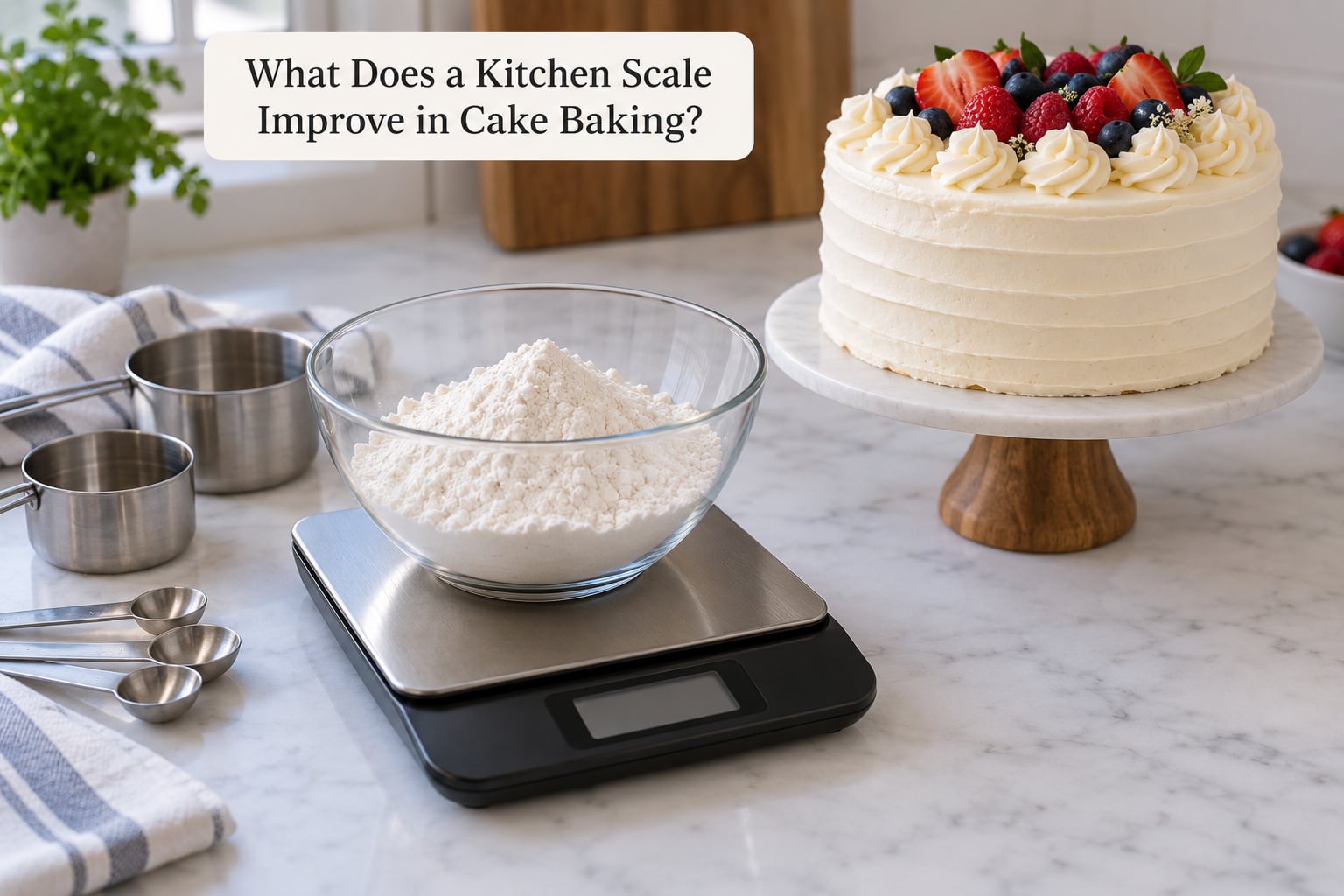
A scale makes better cakes because it measures mass instead of space. Every recipe ratio in cake batter is calibrated by weight, so a scale lets you hit those numbers exactly rather than guessing at how full a cup is. That single change fixes more problems than most people expect.
Here is what accurate weighing actually changes in the finished cake:
- Rise. Leavening has to match the amount of batter it is lifting. Too much flour and the gas has more dough to push against, so the cake bakes shorter and denser.
- Even crumb. A correctly hydrated batter spreads its crumb evenly from edge to centre. An unbalanced one bakes with tight, gummy patches.
- Tender texture. Flour carries gluten, and a little extra flour is what turns a soft cake into something that chews like a doorstop.
- Moisture that lasts. When the sugar-to-flour ratio is right, the cake stays tender on day two instead of drying out overnight.
- Flat, level layers. Batter of consistent thickness bakes level, which matters enormously when you are stacking three of them.
- Frosting that behaves. Buttercream and whipped ganache both depend on fat ratio. Weigh the butter and the frosting spreads where you want it.
This is not only for people who bake every weekend. If you bake four times a year, accuracy matters more, not less, because you have fewer attempts to learn a recipe by memory. With no repeat bakes to average out your mistakes, one scoop-and-sweep cup is one whole cake that is slightly off.
For frequent bakers, the win is different. Weight lets you scale a recipe up for a birthday or halve it for two without doing mental arithmetic on fractions of cups, and it makes your own notes reusable. If a cake came out right, you know exactly what right weighs.
How Accurate Measurements Create a Better Cake
Cake batter is a formula. Flour provides the structure, butter and eggs provide the tenderness, sugar feeds the browning and the crumb, and baking powder or soda provides the gas. Those ingredients only work in balance, and the balance is written in grams.
Flour density is not a constant
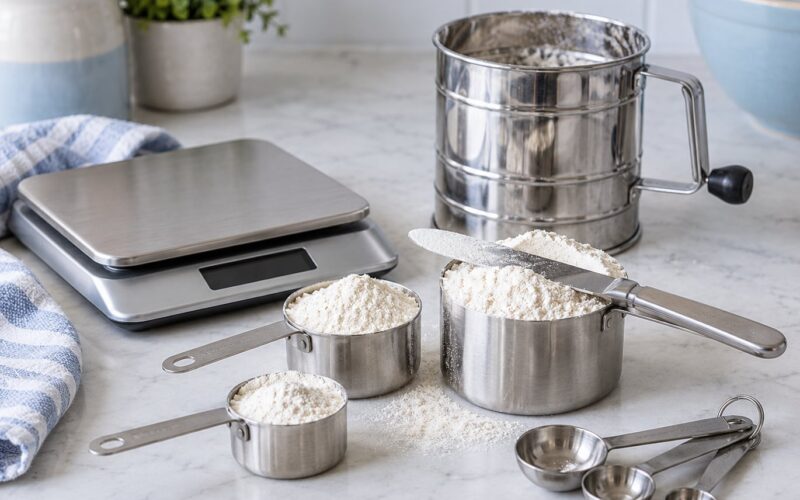
Flour is mostly air until you compact it. Sift it into a cup and it weighs around 120 g. Scoop a heaping cup straight from the bag and pack it down, and the same volume can weigh well over 140 g. Water, cocoa, and chopped chocolate have their own densities, which is why a “cup” is a volume, not a portion.
King Arthur Baking publishes ingredient weight standards, and their reference figure for one cup of all-purpose flour is 120 g. That is the number most established cake formulas were built around, and it is very hard to hit by eye.
Extra flour is the usual culprit
Baker Alice Medrich put it plainly when she wrote that every time you measure flour by volume you are likely to get a different amount, and that too much flour is one of the top reasons for tough, hard, dry cookies and cakes. In cake batter, extra flour means more gluten structure, less fat per unit of starch, and a drier, tighter crumb.
The reverse happens too. Under-weighed flour gives a cake with not quite enough structure to hold itself up, which shows up as a heavy bottom and a top that tears when you unmould it.
Small errors compound
Here is the part that surprises people. A 10 g error in a 240 g flour measurement sounds trivial. But baking soda is dosed in teaspoons, so an extra 20 g of flour shifts your flour-to-leavening ratio without changing the leavening at all, and the gas no longer matches the batter. Twenty grams is under a tenth of a cup, and it is enough to turn a tall cake into a squat one.
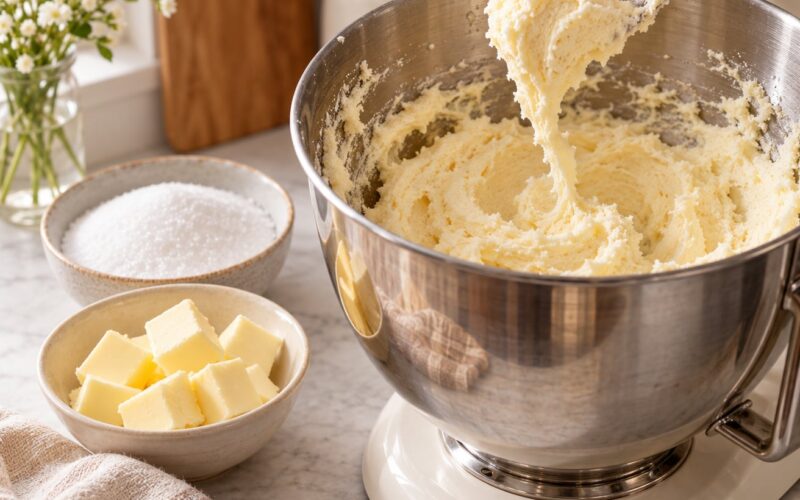
Weighing also stabilises the creaming step. When butter and sugar hit the recipe weight, the air you whip into them is predictable, and the batter puffs to a known volume before it goes in the oven. The oven does not care that your cup was slightly deeper than yesterday’s.
Why a Kitchen Scale Beats Volume Cups
The case against volume is not that cups are useless. It is that a cup measures space, and space tells you nothing about how much ingredient is in it. The table below is the whole argument in short form.
| What you do | What can change | Spread in a 1 cup measure |
|---|---|---|
| Scoop and sweep | Aeration, tapping the cup, how firmly the flour packs | 120 g to 140 g or more |
| Spoon and level | Time spent spooning, flour lost to the spoon | Closer to 120 g, still not exact |
| Packed or damp flour | Humidity, storage, how old the bag is | Can clear 150 g |
| Different measuring cups | Cups are not standardised between manufacturers | A 2016 Food52 test of 11 cups found 193 g to 230 g |
| Weight on a scale | Nothing but your pouring | Within the scale resolution, usually 1 g |
That Food52 figure is the one to remember, because it was not about technique. It was the same recipe, the same flour, and one cup of flour weighed into 11 different measuring cups in 11 different kitchens. The spread was 193 g to 230 g, which is a 37 g difference in a single ingredient.
For cake, that is the difference between a soft layer and a dense one. On The Fresh Loaf forum, bakers weighing flour talk about the same thing from the other side: a scale takes the guesswork out and lets you make small adjustments to the flour and water when a bake does not come out right. You cannot make that adjustment when you do not know what you started with.
Weighing also has the boring, wonderful side benefit that bakers on r/Cooking and r/Baking mention constantly. There is no measuring cup to wash, and much less flour dust in the air, because you are not scooping and dumping.
How to Use a Kitchen Scale for Cake Recipes
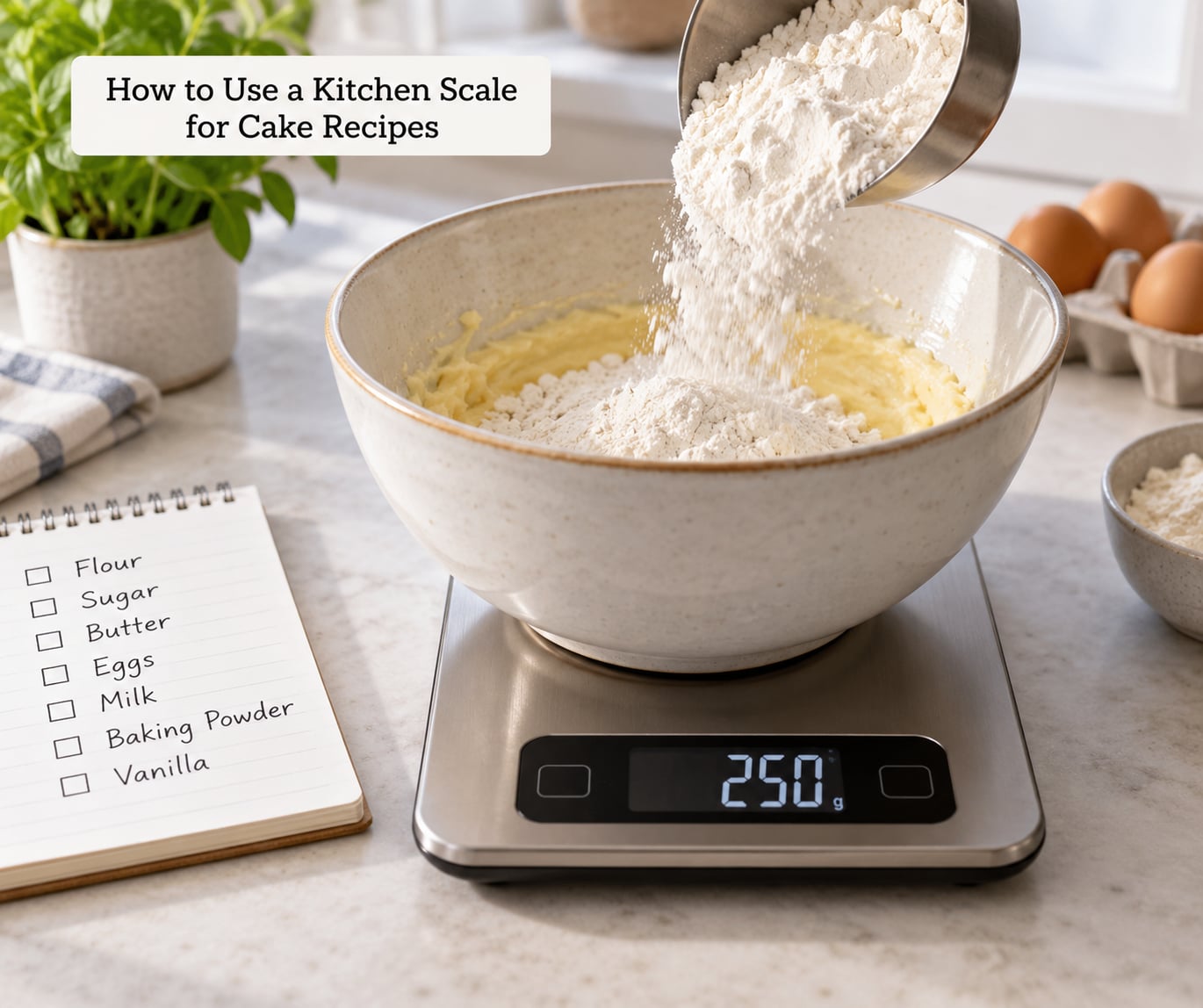
Using a kitchen scale for cake recipes takes about the same time as measuring with cups, and the technique is simple. Set the scale on a flat, hard counter, away from the edge, and let it sit for a minute if it has just moved.
Here is the order that works for me.
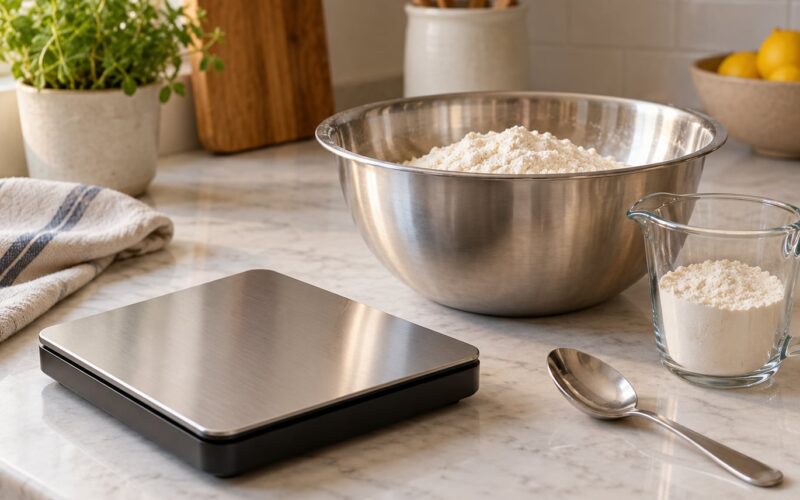
- Put your mixing bowl on the scale and press tare. The display should read zero. Tare means subtract, so you are only ever measuring the ingredient you are adding. If your scale has a hold button, use it so the number does not flicker while you scoop.
- Add ingredients in recipe order. Weigh the flour first, level it off with a knife or spatula at the target weight, then move on. Pouring flour directly into the bowl from the bag creates a dust cloud and piles up in the corners where you cannot see it.
- Try not to lift the bowl while it is on the scale. Every time you pick it up, the reading resets and you have to tare again. Keeping the bowl on the platform for the dry ingredients saves most of the back and forth.
- Switch to grams, not ounces. One gram of resolution equals about 0.035 oz, so ounces quietly round your measurement. If your scale displays both, leave it on grams.
- Weigh small amounts into the bowl, not onto the whole batch. Baking powder, soda, and salt are a few grams each. Add them to whatever is already in the bowl rather than trying to hit 4 g on a loaded scale.
- Weigh eggs in a bowl. Crack the egg onto the scale, read the weight, subtract the shell. Large eggs usually land near 50 g without the shell, and that weight matters more than the label.
For liquids, set the bowl on the scale and pour until the display hits the target. Milk at room temperature is about 1.03 g per ml, so 240 ml of milk is close to 245 g. Water is the easy one at 1 g per ml, which is also why water makes a good accuracy check.
Check that your scale is still accurate
Cheap scales drift, and the only symptom is a bake that suddenly stops working. Testing takes two minutes. Weigh 100 ml of water, which should read about 100 g, and repeat it twice. Then tare an empty bowl, note the zero, and weigh again after a few minutes to see whether it drifts while switched on.
If a 100 ml check is out by more than 2 g, change the batteries first, then test on a different surface. A scale that is out by a fixed amount is a calibration problem; one that walks while it sits is usually a low battery.
Common Weight and Volume Equivalents for Baking
Grams are the target whenever a recipe gives you one. Use this table for the common cake ingredients and as a sanity check when converting something old.
| Ingredient | Volume | Weight |
|---|---|---|
| All-purpose flour | 1 cup | 120 g |
| Cake flour | 1 cup | 120 g |
| Bread flour | 1 cup | 127 g |
| Almond flour | 1 cup | 96 g |
| Granulated sugar | 1 cup | 198 g |
| Brown sugar, packed | 1 cup | 213 g |
| Confectioners sugar | 1 cup | 113 g |
| Butter | 1 stick | 113 g |
| Vegetable oil | 1 cup | 198 g |
| Milk | 1 cup | 227 g |
| Water | 1 cup | 240 g |
| Cocoa powder | 1 cup | 85 g |
| Large egg | 1 egg | about 50 g |
| Baking powder | 1 teaspoon | 4 g |
| Baking soda | 1 teaspoon | 6 g |
| Fine salt | 1 teaspoon | 6 g |
Notice how little the dry ingredients resemble each other and how similar the liquids are. That is the argument in one table: volume treats an ounce of cocoa and an ounce of milk as interchangeable when they behave nothing alike in a batter.
Common Mistakes When Weighing Cake Ingredients
Forgetting to tare. If you add the bowl and the flour together, you have weighed both. Tare with an empty bowl every time you swap vessels.
Weighing over an already-filled bowl. You cannot zero out a sticky batter and then add 120 g of flour to it. Pull the bowl off, tare it, add the flour to the target weight, then carry on.
Treating volume and weight as interchangeable. Converting is not exact. If a recipe lists grams, weigh the grams instead of converting from cups, because the conversion is where the error creeps back in.
Using a scale with too little capacity for the bowl. Most home cakes are fine on a scale that holds 5 kg. If you like to mix the batter directly in the bowl you weigh it in, check that the bowl plus a full cake’s worth of ingredients stays under the limit.
Rounding to ounces. A scale that reads in tenths of an ounce is rounding your flour. Switch the units to grams if your scale allows it.
Buying a scale that only reads to 1 g and expecting it to weigh a teaspoon of yeast. For cakes, 1 g resolution is workable. For yeast, salt, or small amounts of leavening, you want 0.1 g resolution.
Weighing flour packed tight after sifting. Sifting aerates flour, so sifted flour and scooped flour do not weigh the same by volume. If the recipe lists grams for flour, sift it, then weigh it.
Do You Need a Kitchen Scale for Every Cake?
No, and pretending otherwise is how bakers talk themselves out of buying one. If you have never weighed anything, the first time you use a scale for a simple butter cake will still teach you something useful about how heavy a cup of flour really is.
Volume measuring is genuinely fine for a short list of bakes. Chocolate chip cookies with a simple butter base, banana bread, muffins, brownies from a well-tested formula, mug cakes. These have forgiving ratios and plenty of structural margin, and a decent measuring cup plus a knife to level it does the job.
Weighing matters most where the margin is thin. Sponge and chiffon, where too much flour collapses the crumb. Anything with a chemical leavener dosed by the teaspoon. Macarons and meringue, where a couple of grams changes the spread. Gluten-free batters, because there is no gluten to compensate for a heavy hand and the starch ratios are unforgiving. And allergy-restricted recipes generally, where precision is a safety question rather than a quality one.
As for the scale itself, home cake baking does not need a laboratory. A digital scale that holds at least 5 kg, has a tare button, and reads in grams is enough. Add 0.1 g resolution if you make macarons, bread, or anything with yeast or small leavening amounts, and skip the built-in timer and bowl if you never use them.
Long-time bakers on CakeCentral and baking-forums.com say the honest version of this plainly: for simple cakes and cookies, volume plus a good cup is fine. Going back to cups once you have worked with grams feels reckless, mostly because you suddenly know what you are giving up.
Frequently Asked Questions
Do I need a kitchen scale to make good cakes?
No, but it is the single cheapest way to make good cakes repeatable. Volume measuring works fine for simple butter cakes, muffins, and cookies when you level each cup carefully. Weighing matters most for sponge and chiffon cakes, anything with a teaspoon-dosed leavener, and gluten-free batters, where a small flour error changes the crumb. If you only buy one tool for your cake bakes, make it a scale.
Are grams more accurate than cups for cake ingredients?
Grams, by a wide margin. A cup measures space, and how much ingredient sits in that space depends on packing, humidity, and which manufacturer’s cup you own. Food52 weighed one cup of flour into 11 different measuring cups and got everything from 193 g to 230 g. King Arthur Baking’s reference figure for a cup of all-purpose flour is 120 g. Weight removes that uncertainty entirely.
What type of kitchen scale is best for baking?
Look for four things: a tare button, gram display, capacity of at least 5 kg, and non-slip feet. Add 0.1 g resolution if you bake macarons, bread, or anything with yeast, because a 1 g scale cannot measure a teaspoon of yeast precisely. Professional kitchens use platform scales with a bowl on top for the same reason home scales do: you want to weigh into a vessel without lifting it.
How do I convert a cup measurement to grams?
Use a reliable weight chart rather than converting from your own measuring cup, and treat the result as a starting point. For example, a family recipe calling for 2 cups of all-purpose flour becomes about 240 g, and 1 cup of granulated sugar becomes about 198 g. Weigh the ingredient to the converted figure on your next bake, then write your own corrected number next to the recipe. That note is worth more than any chart.
Should I weigh flour with or without sifting it?
Whichever the recipe specifies, because weight changes with sifting. Sifting aerates flour, so the same cup weighs less after sifting than when scooped and packed. If a recipe gives a gram weight, sift first and then weigh to that number. If it gives volume, weigh the flour as you would scoop it. Just be consistent, because mixing the two methods is where sifted-by-volume cakes lose their rise.
Can I use a kitchen scale for butter and other liquid ingredients?
Yes, and for butter it is a real improvement. A stick of butter is 113 g, so weighing beats counting marks on a wrapper that is often wrong. For liquids, set the bowl on the scale, tare it, and pour until the display hits the target. Milk weighs about 227 g per cup and water about 240 g, so a liquid measured by weight in grams is slightly more precise than the cup measure it replaces.
Conclusion
A kitchen scale makes better cakes because it turns a loose guess into a number you can repeat. Cup measurement varies by tens of grams of flour from kitchen to kitchen, and that is enough to shift the rise, the crumb, and the moisture in a layer cake.
Here is what to do first. Bake a familiar recipe by weight on your next go: flour at 120 g per cup equivalent, butter at 113 g a stick, sugar at 198 g a cup, and everything else from the table above. Write the results down, bake it again unchanged, and compare the two against a cake you made by cups. Most people notice the difference on the second slice.
Once you have weighed for a while, cups start to feel like guesswork. That is the point.