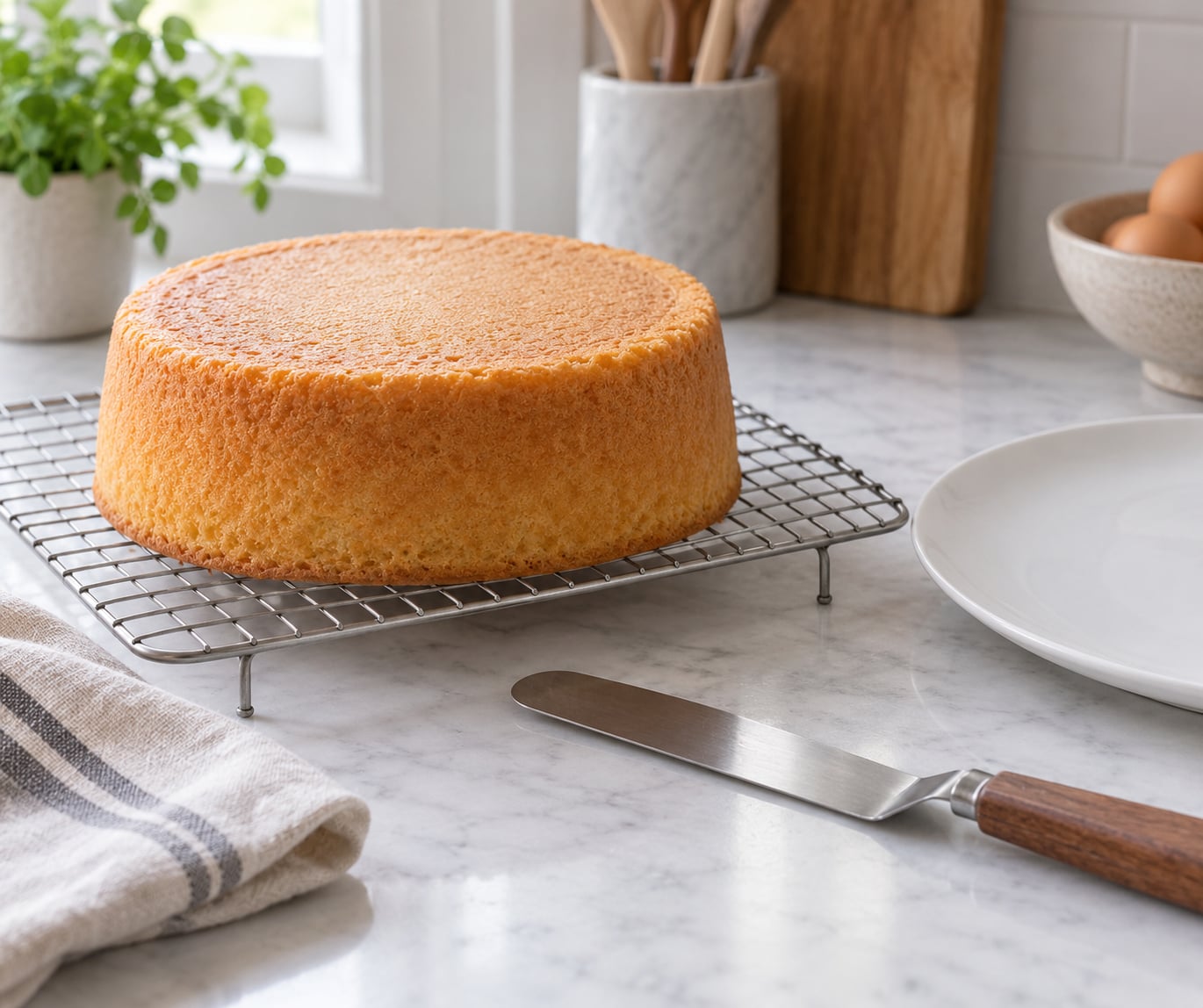
To get a cake out of the pan in one piece, cool it in the pan for 20 to 30 minutes, run a thin knife or offset spatula around the entire edge, lay your serving plate on top, and invert both together in one firm wrist-driven motion. Lift the pan off, then tap and shake gently until the layer drops. The whole job takes about five minutes once the timer is up.
Getting a cake out of the pan in one piece is less about strength than about sequence. A cake grips the metal because the sugars and fats in the batter caramelize against the wall and set into a mechanical seal. Loosen that seal, remove the pan’s grip on gravity, and the layer usually falls on its own.
The mistake almost everyone makes first is waiting too long. Cool a cake all the way to room temperature in the pan and the crumb firms up, the starch tightens, and the seal gets stronger. Bakers on r/bakingfail and r/Baking describe tearing cakes in exactly that scenario far more often than cakes released at 20 minutes.
Below is the method, pan by pan, plus what to do when it refuses to move at all.
Table of Contents
- What You Need
- Step-by-Step
- How to get a cake out of the pan in one piece
- Let the cake cool before touching the pan
- Run a hot, clean towel around the pan if needed
- Check the edges and center for resistance
- Choose a surface larger than the cake
- Invert and support the cake during the flip
- Resettle the cake and let it finish cooling
- Common Mistakes
- Frequently Asked Questions
- How long should a cake cool in the pan before turning it out?
- Can I turn a cake out while it is still warm?
- Why is my cake sticking only around the edge?
- Should I use a knife or offset spatula to loosen a cake?
- What if my cake starts tearing when I try to remove it from the pan?
- How do I move a fragile cake to a serving plate without breaking it?
- Bottom Line
What You Need
The whole operation needs about five tools, and three of them you probably own already. Set them out before the cake comes out of the oven, because the useful window for releasing a warm cake is short and you do not want to be hunting for a spatula with buttery hands.
- A wire cooling rack. It lets air circulate under the cake, so the bottom stops steaming into a soggy layer while you work.
- A thin flexible spatula or a small offset spatula. This is the tool that breaks the seal. A thin butter knife works, but a flexible spatula reaches curved and Bundt walls better and is far less likely to gouge the crumb.
- A plate, board, or turntable larger than the pan. If the receiving surface is even slightly smaller than the cake, its edges hang over and snap as you lower it.
- A clean kitchen towel. Warmed in water and wrapped around the outside of the pan, it is the gentlest of the rescue methods.
- A cutting board. Optional but useful. It gives you a rigid, heat-tolerant landing surface if your counter is marble or laminate you would rather not scorch.
Keep the equipment clean and dry. A floury finger print on the plate is fine, but a smear of butter or shortening on the serving surface will slide the cake right off as you land it. Dry tools matter more than expensive ones here.
Optional but genuinely useful: a strip of parchment paper cut to fit, which acts as a lifting tab under the finished layer, and a turntable, which lets you rotate a fragile cake instead of gripping an edge and risking a crack.
Step-by-Step
How to get a cake out of the pan in one piece
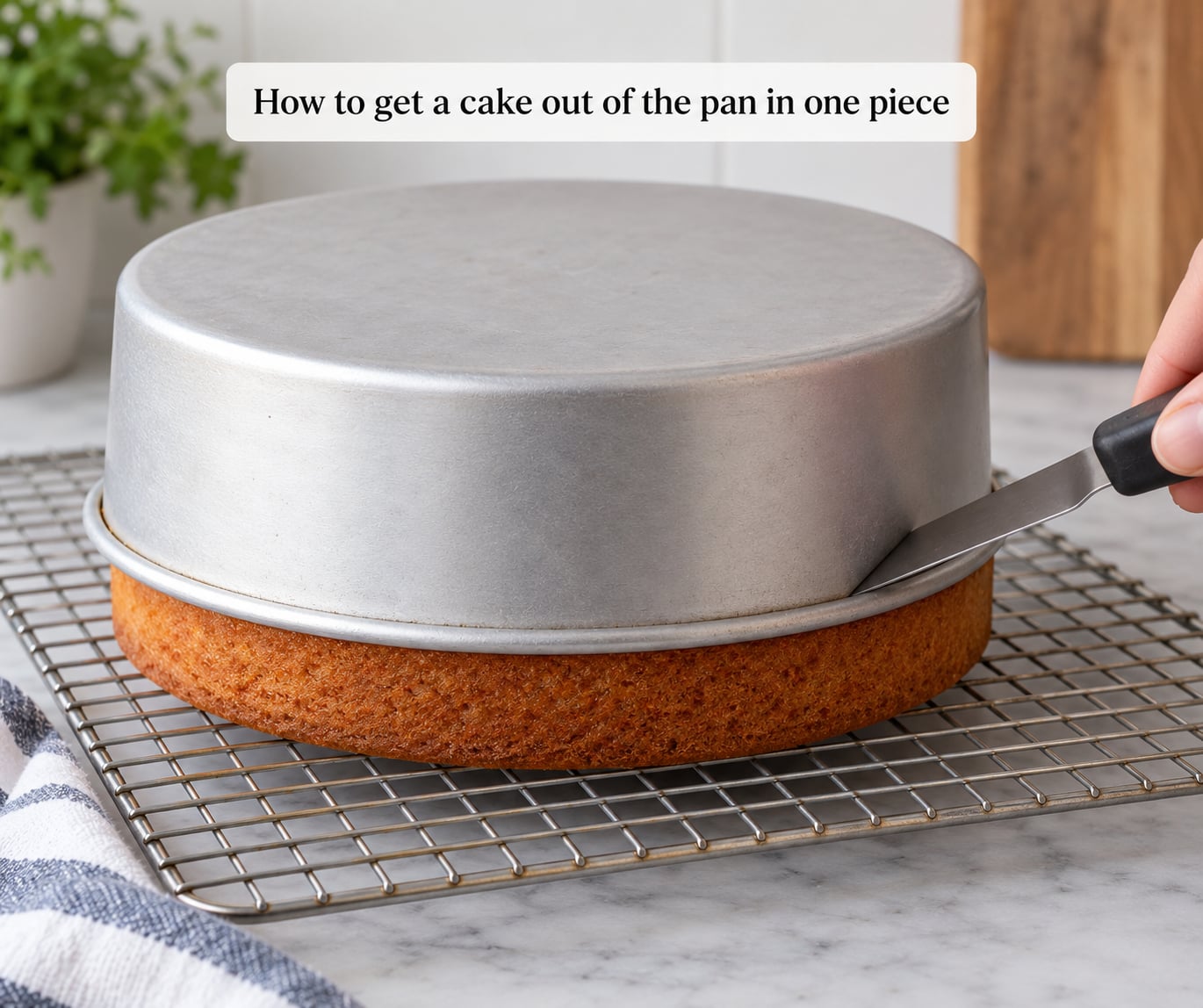
Run a thin knife or offset spatula around the entire perimeter, staying close to the wall so the blade moves through the set skirt of batter rather than into the soft crumb. Work in a full circle rather than prying at one side, because levering at a single spot is what snaps an edge.
You are looking for a thin contraction gap. When the spatula slides with almost no resistance and you can see a sliver of light or the pan’s surface between cake and wall, the perimeter has released. If the blade is punching into soft crumb and leaving a trench, the cake is not cool enough yet. Wait five more minutes and go back in.
Once the full circle is loose, slide the spatula under the cake itself and rest it at an angle against the pan wall, not underneath the whole layer. That way the tool is ready to lever the cake upward if it does not drop on its own, instead of you trying to fish it out with your fingers.
Note the domed part. If your cake has risen high in the center, that dome is the most fragile section and the first thing to crack. Support it with the spatula during the flip rather than letting it hang free.
Let the cake cool before touching the pan
Cool the cake in the pan for 20 to 30 minutes, until the top feels firm and the edges have pulled slightly away from the metal, but the middle still has some give. Thick, dense batters need the full 30. Light sponge cakes release in 10 to 15.
Here is the practical reason that window matters. Fresh out of the oven, the batter is soft and slightly fluid, so a thin cake layer will slump and fold as you try to free it. Sitting too long, the crumb sets firm and the caramelized ring hardens into a stubborn bond. Twenty to thirty minutes is the middle of that road, and it is not a rule so much as a texture check: firm at the edge, still yielding in the center.
| Pan type | Time in the pan before releasing | What tells you it is ready |
|---|---|---|
| Round layer cake, 8 or 9 inch | 10 to 15 minutes | Top springs back lightly when gently pressed |
| Deep layer cake, two layers deep | 20 to 30 minutes | Edges visible and contracted from the wall |
| Bundt or tube pan | 15 to 20 minutes | A knife runs around the tube with no drag |
| 9×13 sheet cake | 10 to 15 minutes | Corners release when the spatula lifts them |
| Loaf or pound cake | 15 to 20 minutes, longer if glazed | Side crust has darkened but not gone hard |
| Cheesecake | At least 1 hour chilled, then refrigerate | Set to the touch with a slight wobble in the center |
Room temperature, not a cold kitchen, is the baseline assumption. If your kitchen is very cool or the cake went straight from a cold oven into a draft, add ten minutes before you start loosening.
Run a hot, clean towel around the pan if needed
If the knife goes around the edge and the cake still does not budge, wrap a clean kitchen towel that has been wrung out in hot water around the outside of the pan, base excluded. The heat expands the metal slightly and softens the set butter or shortening on the wall. Give it 60 to 90 seconds, then re-run the spatula.
Wring the towel until it barely drips. A wet towel leaves a ring of water on your counter and a puddle under the plate, and water plus a hot metal pan on a cold laminate surface can warp the laminate. If your counter needs protecting, set a cutting board down first.
Touch the pan, not the towel, to check it is warm enough. The goal is gentle and even, not scalding. Once the edge gives, slide the spatula back in and lift slightly while you tap the underside of the pan with your knuckles. Many layers release at this point with nothing more dramatic than two firm taps.
If you use a hot towel, reheat it before each pass. A towel that has cooled to room temperature does almost nothing, and bakers often conclude the trick failed when the towel was the problem.
Check the edges and center for resistance
Test an edge with a fingertip before you commit to the flip. A released edge has a small gap and moves independently of the pan wall when you nudge it. A stuck edge has no gap, and the crumb compresses under pressure instead of lifting.
The center tells you about fragility. Press the middle very lightly with two fingers. If it feels set and springs back, the layer can take the flip. If it dimples or feels liquid underneath the crust, it needs more cooling time, and flipping it now will fold the top.
Do this check at three points around the cake, not one. Stickiness is rarely even, and a cake that has released cleanly on three sides and is glued at the fourth will pivot on the free side and tear.
Choose a surface larger than the cake
Get your plate, board, or turntable ready before you flip. The surface needs to be wider than the cake by at least an inch on every side, and it needs to sit at counter height or lower so you are not lifting upward as you turn.
An undersized surface is the quiet cause of a lot of edge damage. When a layer overhangs, the unsupported rim takes the load, bends, and snaps along the overhang line. If you have to tilt the plate to catch the cake, you have already lost the piece you were trying to protect.
Clean the surface thoroughly. A cooling rack set over a baking sheet works well for a single layer because the airflow matters and the sheet catches crumbs. For a delicate layer, lay a sheet of parchment on the rack first, so the rack’s wires cannot press grid lines into the bottom crust as you set it down.
Invert and support the cake during the flip
Treat the plate and the pan as one object. Put your thumb on top of the plate and your fingertips underneath the pan, then turn both over together from your wrist rather than lifting with your arms. The movement is fast and short. A slow, cautious, arm-driven flip is what drops a cake onto its dome.
Set the plate on top of the pan first, centered, with enough overlap to be stable. Slide it around until no part of the cake edge is overhanging the plate by more than a fraction. Then grip.
For large or fragile cakes, use a lower-risk two-hand version. Slide a baking sheet or board against the pan wall, grip the pan on opposite sides with both hands, and turn it over into the board in a single twist. You gain support at the cost of needing a helper for a full sheet cake.
Once inverted, the cake is sitting on the plate but the pan is still around it. Do not pull the pan off. Lift it straight up a few inches, tap the base firmly with your knuckles two or three times, then hold the pan an inch above the cake and shake it gently from side to side. Gravity plus a small jolt is almost always enough. The cake will drop the last fraction of an inch on its own.
Resettle the cake and let it finish cooling
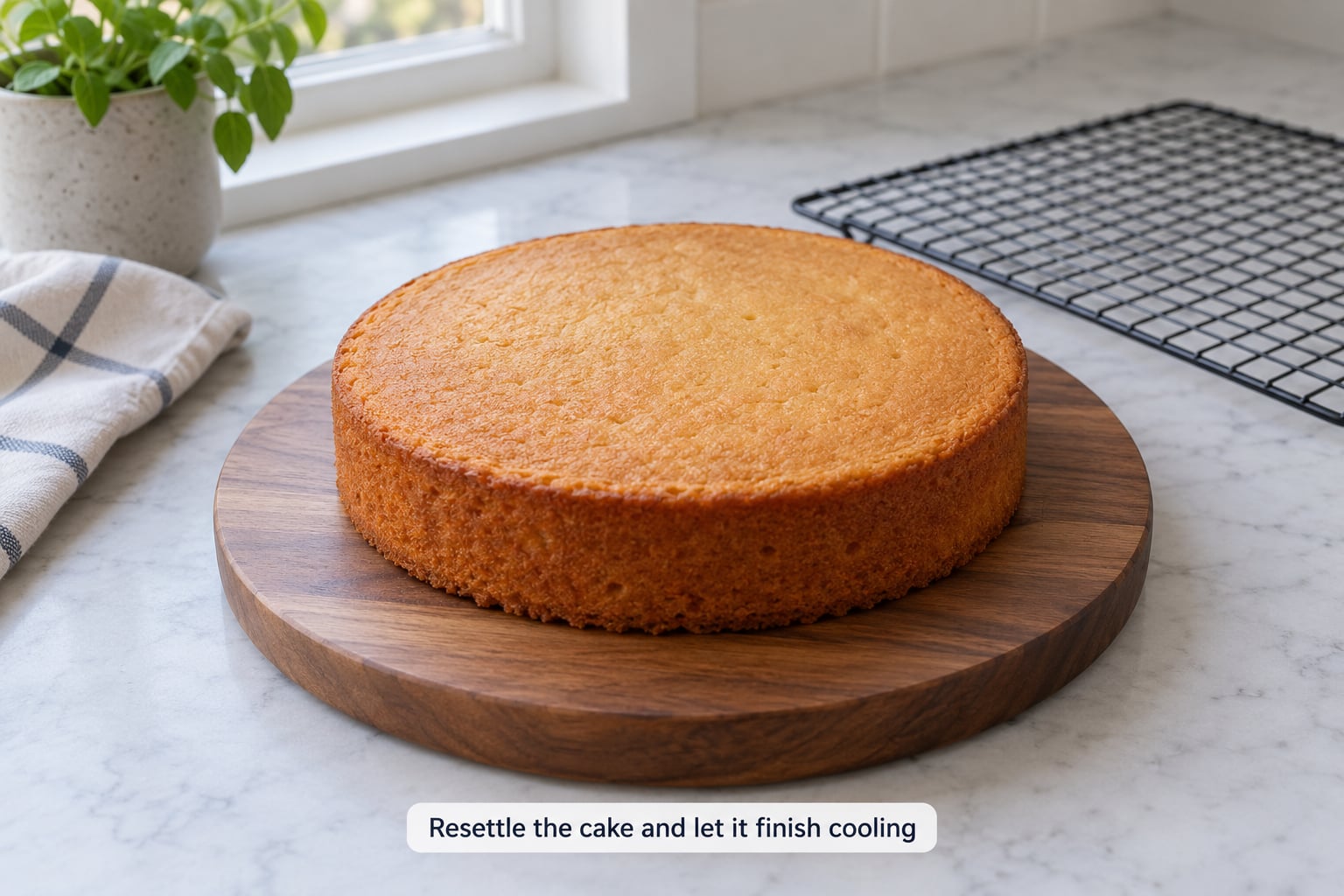
Never pick a just-released cake up by its edge. That is the moment it is most fragile, because the crumb has not re-firmed and the bottom is still warm and soft. Instead, slide the cooling rack onto the plate beside the cake and use a wide spatula to transfer it in one movement, or, if you are working on a turntable, put your hand on the turntable and rotate the whole assembly to inspect the underside.
Finish cooling on the rack, uncovered, for at least an hour before frosting. A cake that still feels even slightly warm will melt buttercream into a slide, drag crumbs across the surface with the spatula, and set the crumb coat soft enough to slide off.
Before you frost, check two things. The crumb should feel completely cool in the center, not just at the edges, and any loose crust at the cut side should be trimmed away rather than left for the frosting to trap. If you are layering, wrap the cooled layer and chill it before stacking, since a cold layer is far less likely to compress under the weight of the one above.
| Pan type | Best release method | Watch out for |
|---|---|---|
| Round layer | Offset spatula around the wall, plate on top, wrist flip | Prying at one side, which snaps the edge |
| Bundt or tube | Grease heavily, run the knife around both the wall and the center tube, tap the base | No flat plate seal, so a Bundt rarely releases on the flip alone |
| 9×13 sheet | Loosen the four edges, cover with a foil-lined baking sheet, flip and lift the pan off | Cutting into the corner where the batter is thin and set |
| Springform, removable bottom | Release the latch, run a knife around the wall, slide the cake sideways off the base | Lifting straight up, which grips the tall sides and shears the layer |
| Loaf or pound | Long warm soak, insert a knife well into each end, then turn out onto a rack | Glazed batters that caramelize hard against the tin |
Two pan types deserve their own note. A Bundt or tube pan has no flat seal, so the plate flip is far less reliable; run the knife around the center tube as well as the outer wall, and be ready to tap and shake rather than expect a clean drop. A springform with a removable bottom should never be flipped at all. Release the latch, run a thin knife around the wall, then slide the cake sideways off the base onto a rack, which is far safer than trying to lift it out of a tall wall.
Common Mistakes
Pulling the cake out too early. Straight from the oven, the crumb is still soft and will fold as you free it. The fix is simple: wait for the edge contraction and the firm top described earlier, and test the center with two fingers before you flip.
Cooling it all the way in the pan. This is the most common and the most counterproductive. The set batter continues firming against the metal, so an hour in the pan can make a cake harder to release than one left for 20 minutes. If you need to wait, turn the cake out at 20 to 30 minutes and complete the cooling on a rack.
Prying at one side. Levering a spatula under a single edge pivots the layer on the free side and tears the crumb along that line. Slide the blade around the full perimeter instead, and use the spatula to lift the whole cake only after the entire circle is free.
Scraping with a sharp knife straight up. Pulling a knife vertically against the wall gouges the set edge and can cut a clean trench straight through the cake’s outer ring. Keep the blade flat and nearly parallel to the side, moving in a circle.
Flipping onto a surface that is too small. An overhanging rim takes the load, bends, and snaps. Use a plate or board at least an inch larger all round, set at counter height, and if you must tilt to catch the cake you have already lost the piece.
Using too much force. The flip is a wrist movement, not an arm lift, and the follow-up is two or three firm taps on the base, not a hard shake. If you are leaning your weight into it, something earlier in the sequence was missed.
Decorating a warm cake. Warm crumb and warm frosting merge, crumbs drag across the surface, and buttercream slides off before it sets. Cool completely first, an hour on a rack for a single layer, and longer for a thick one.
Trying to hide a badly torn cake with frosting. This rarely works on a structural tear, and a crumb coat over a broken section just makes the break obvious in a different light. Repurpose it instead.
When a cake is genuinely stuck, work up this ladder in order and stop at the first step that works.
- Re-run the knife. Go around the full perimeter a second time, closer to the wall than the first pass. Most failures are one loose edge, not a stuck cake.
- Tap and shake. Invert onto the plate, lift the pan a few inches, tap the base with your knuckles, then shake gently. Two or three taps release the majority of stuck layers.
- Hot towel. Wrap a wrung-out hot towel around the pan for 60 to 90 seconds, re-run the knife, and tap again.
- Freezer, 10 to 20 minutes. This is the trick bakers on r/Baking keep rediscovering. Cold contracts the metal pan more than it contracts the cake, and that difference opens a gap along the wall. Set the pan on a wire rack so it chills evenly, then turn out and tap the base with the back of a spoon.
- Warm the pan, 5 to 10 minutes. A shallow sink of hot water, or a damp towel, reverses the effect. Never put a metal cake pan in the microwave empty and never run it with the door open; if you heat water in the microwave, take the pan out first and set it in the hot water outside.
If the cake is already broken, do not throw it. A torn layer works fine as the bottom of a layer cake with frosting filling the gap, a broken Bundt makes excellent cake balls or pops once the pieces are trimmed, and a sheet cake that split becomes a trifle or a cake crumble with the crumbs pressed into a buttered pan and rebaked. Trim the dry torn face off first, then use the rest.
A few release habits pay off next time. Grease the pan generously with vegetable shortening rather than butter, since butter’s milk solids brown and can form a crust that holds on; coat with about a tablespoon of flour for an 8-inch pan, tap out the excess, and patch any bare patches with your finger. A parchment liner is the most reliable option of all, and experienced bakers use it despite the fuss of cutting a circle. A spray with flour in it is the least reliable, and readers on baking forums report it as genuinely hit or miss, especially on moist or fruit batters. A homemade paste of shortening, flour, and a little oil, brushed on and chilled, is more dependable than any of them for a Bundt.
Frequently Asked Questions
How long should a cake cool in the pan before turning it out?
Let the cake cool in the pan for 20 to 30 minutes. You are looking for a top that feels firm to a light touch and edges that have contracted slightly away from the metal, while the center still has a little give. Light sponge cakes release in 10 to 15 minutes, dense loaf and pound cakes need the full 30. Do not wait for a completely cold cake: the crumb firms up, the caramelized ring hardens, and the layer grips harder than it would have at the half-hour mark.
Can I turn a cake out while it is still warm?
You can, and for a very light sponge it sometimes goes better that way, but a fully hot cake is risky. The crumb is still soft and slightly fluid, so a thin layer will fold or slump as you free it. A warm cake also releases more easily because the fat on the pan wall is still soft. Aim for warm rather than hot: out of the oven, then 10 to 30 minutes depending on thickness, until the edges pull away from the pan.
Why is my cake sticking only around the edge?
The sides are where the batter sits longest against hot metal, so sugars and fats there caramelize and set into a hard ring. That ring is what welds the layer to the wall. Dark pans, ovens that run hot, and cakes that bake past the recipe time all make it worse, as do fruit and oil-based batters. Loosen it with a thin spatula held flat against the wall, and next time shorten the bake by a few minutes or drop the oven temperature slightly so the edge does not over-brown.
Should I use a knife or offset spatula to loosen a cake?
A thin offset spatula is the better tool, because its blade flexes to follow a curved wall without cutting into the crumb. A butter knife works on straight-sided round pans if you keep it flat and nearly parallel to the side. Whichever you use, work in a full circle rather than prying at one spot, and go closer to the metal on the second pass than the first. A knife dragged straight up the wall leaves a trench that shows in the finished edge.
What if my cake starts tearing when I try to remove it from the pan?
Stop immediately and lower the cake back into place, because a partial lift is how a whole layer breaks. Let it rest, then re-run the spatula around the full perimeter and try the hot towel method for 60 to 90 seconds before the next attempt. If it is already torn, trim the ragged face off, frost that side toward the filling, and use the layer as the bottom of the cake. Leftover pieces make cake pops, cake balls, or a trifle rather than going in the bin.
How do I move a fragile cake to a serving plate without breaking it?
Never grip it by an edge. A just-released layer is at its weakest because the crumb is warm and has not re-firmed. Slide a wire cooling rack onto the plate and transfer the cake onto it with a wide spatula, or set the rack over the plate and move both together. Working on a turntable is even easier, since you can rotate the whole assembly to check the base without touching the cake. Wait until it is completely cool before moving it anywhere.
Bottom Line
Start the clock. Give the cake 20 to 30 minutes in the pan, not longer, then have your plate or board ready and wider than the pan. Free the entire perimeter with a thin spatula held flat to the wall, invert plate and pan together from the wrist, and finish with two or three taps on the base before a gentle shake.
If it does not move, work up the ladder: knife again, taps, hot towel, 10 to 20 minutes in the freezer, then a warm pan. One of those will do it, and if the layer is already damaged, frost the torn side inward or turn the pieces into cake balls rather than binning a cake that baked well.