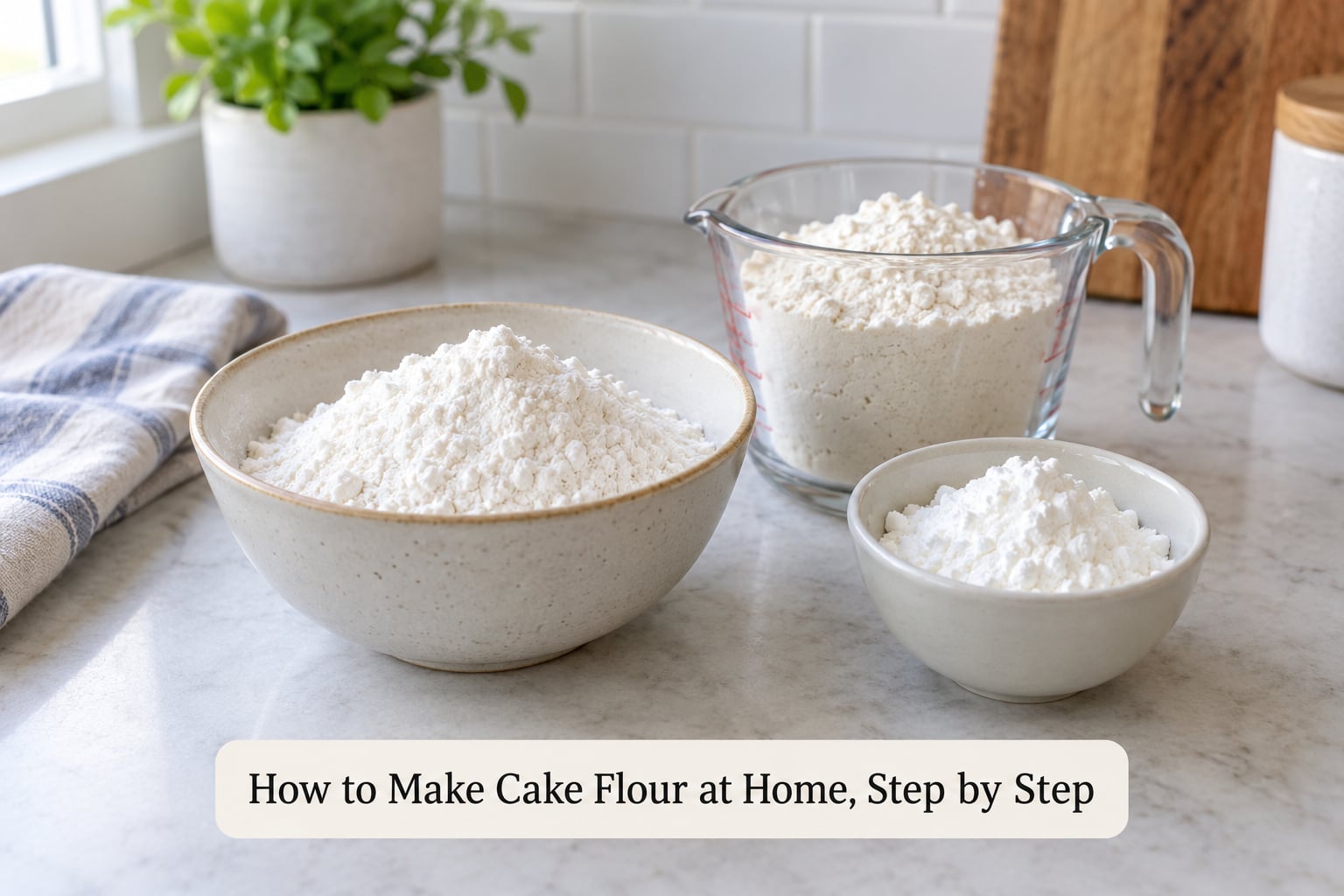
To make cake flour at home, scoop one cup of all-purpose flour, take two tablespoons of it out, and put two tablespoons of cornstarch in its place. That is the whole recipe, and it takes about five minutes. Once you sift the two together, the mix behaves like store-bought cake flour in layer cakes, cupcakes, red velvet and pound cake.
I keep a jar of this on the shelf permanently. It costs the same as the flour I already have, and it saves the panic of a grocery run at 9pm when a layer cake is half mixed.
Table of Contents
- What You Need
- How to Make Cake Flour at Home, Step by Step
- Step 1: Measure the Flour and Cornstarch for One Cup
- Step 2: Sift the Ingredients Together
- Step 3: Use or Store the Cake Flour
- Common Mistakes to Avoid
- Frequently Asked Questions
- Is cake flour just all-purpose flour?
- How much cornstarch do I add to one cup of flour?
- What happens if I use regular flour instead of cake flour?
- What can I use if I don’t have cake flour?
- How long does homemade cake flour last?
- Do you have to sift cake flour?
What You Need
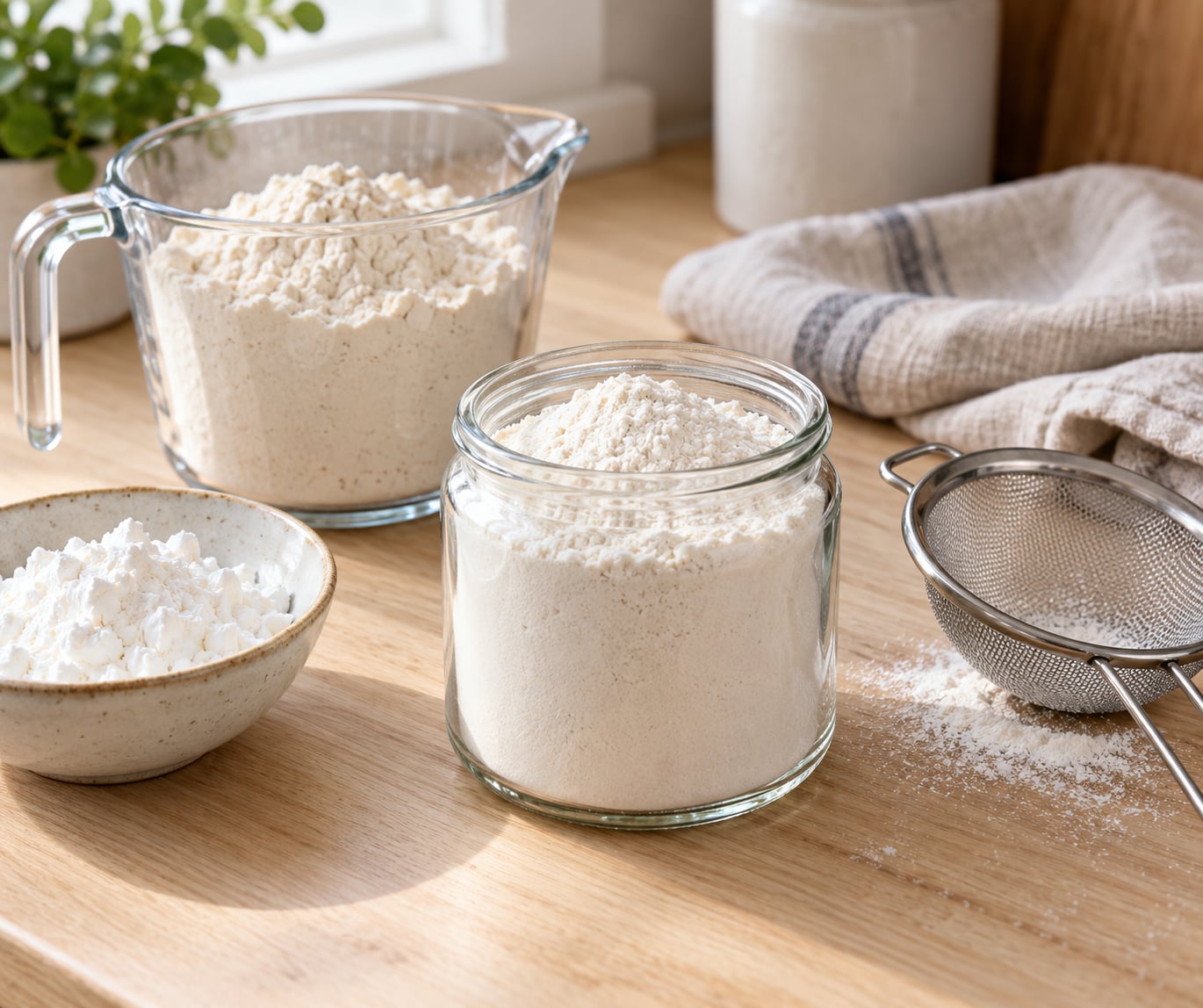
Two ingredients and about four tools. If you have a digital scale, use it — the whole point of the method is precision, and volume scooping is where errors creep in.
- All-purpose flour: a standard bag with 10-12% protein. Organic works fine.
- Cornstarch: plain, unsweetened. This is the only ingredient doing the actual work.
- Measuring cups and tablespoons, plus a knife or bench scraper for leveling.
- Digital food scale, if you have one. Set it to zero before each measure.
- Fine-mesh sieve, or a wire whisk if a sieve is inconvenient.
- Airtight container or glass jar with a lid, for storing a batch.
One note on the flour. High-protein all-purpose brands sit nearer 12%, and the standard two-tablespoon rule was designed around ordinary supermarket flour. A higher-protein bag gives you a slightly tighter crumb. Go to three tablespoons of cornstarch for the same cup if you want to compensate, and use bread flour only if you deliberately want chew — see the mistakes section below.
How to Make Cake Flour at Home, Step by Step
Step 1: Measure the Flour and Cornstarch for One Cup
Fill a one-cup measure with all-purpose flour and level it across the top with the back of a knife. Take out two tablespoons of that flour — that is one-eighth of the cup — and set it aside. Now fill the empty two-tablespoon space with cornstarch, leveled the same way.
The swap works on a simple principle. Gluten forms when two proteins in wheat flour, gliadin and glutenin, meet water and are worked. All-purpose flour carries enough of them to build a network. Cornstarch has none, so every tablespoon you add dilutes the network without changing the volume or the sweetness of the mix. Less developed gluten means a finer, more tender crumb that does not shrink away from the pan sides.
| What you need for 1 cup | Volume | Weight |
|---|---|---|
| All-purpose flour, measured then leveled | 1 cup | about 120 g |
| Flour to remove | 2 tablespoons (1/8 cup) | about 16 g |
| Cornstarch to add | 2 tablespoons | about 16 g |
| Finished cake flour | 1 cup | about 120 g |
Made in a larger batch, the same ratio scales cleanly by volume or by weight.
| Finished cake flour | AP flour, measured | Cornstarch added | Approx. total weight |
|---|---|---|---|
| 1/4 cup | 1/4 cup AP, minus 1 1/2 tbsp | 1 1/2 tbsp | 30 g |
| 1/2 cup | 1/2 cup AP, minus 1 tbsp | 1 tbsp | 60 g |
| 1 cup | 1 cup AP, minus 2 tbsp | 2 tbsp | 120 g |
| 2 cups | 2 cups AP, minus 1/4 cup | 1/4 cup | 240 g |
| 4 cups | 4 cups AP, minus 1/2 cup | 1/2 cup | 480 g |
For context on why the swap matters, here is where the common flours sit on protein content. The lower the number, the more tender the crumb.
| Flour | Approx. protein | Best used for |
|---|---|---|
| Cake flour | 7-9% | Light layer cakes, cupcakes, angel food, chiffon |
| Pastry flour | 8-9% | Tender cookies and pastry, slightly denser cakes |
| All-purpose | 10-12% | Everyday baking, moist fruit cakes |
| Bread flour | 12-14% | Yeast breads, chewy bread |
| Self-rising | about 10% | Convenience biscuits and layer cakes |
Step 2: Sift the Ingredients Together
Tip the cup of flour and the cornstarch into a bowl and sift them together three or four times, pushing through with your fingers each pass. Cornstarch is fine and slightly sticky, and it settles into the low spots of the flour, so one stir is not enough.
A whisk works as well as a sieve, and the difference shows up in consistency rather than chemistry. With a whisk, stir in a figure-eight motion, scrape the bottom every few turns, and expect a marginally coarser blend. Sifting is a touch more even. Either way, keep mixing until no white streaks of cornstarch are visible against the flour.
You will feel the texture change before you see it. Finished cake flour is noticeably softer and looser than plain all-purpose flour, and it slides rather than packs when you press a pinch into it.
Step 3: Use or Store the Cake Flour
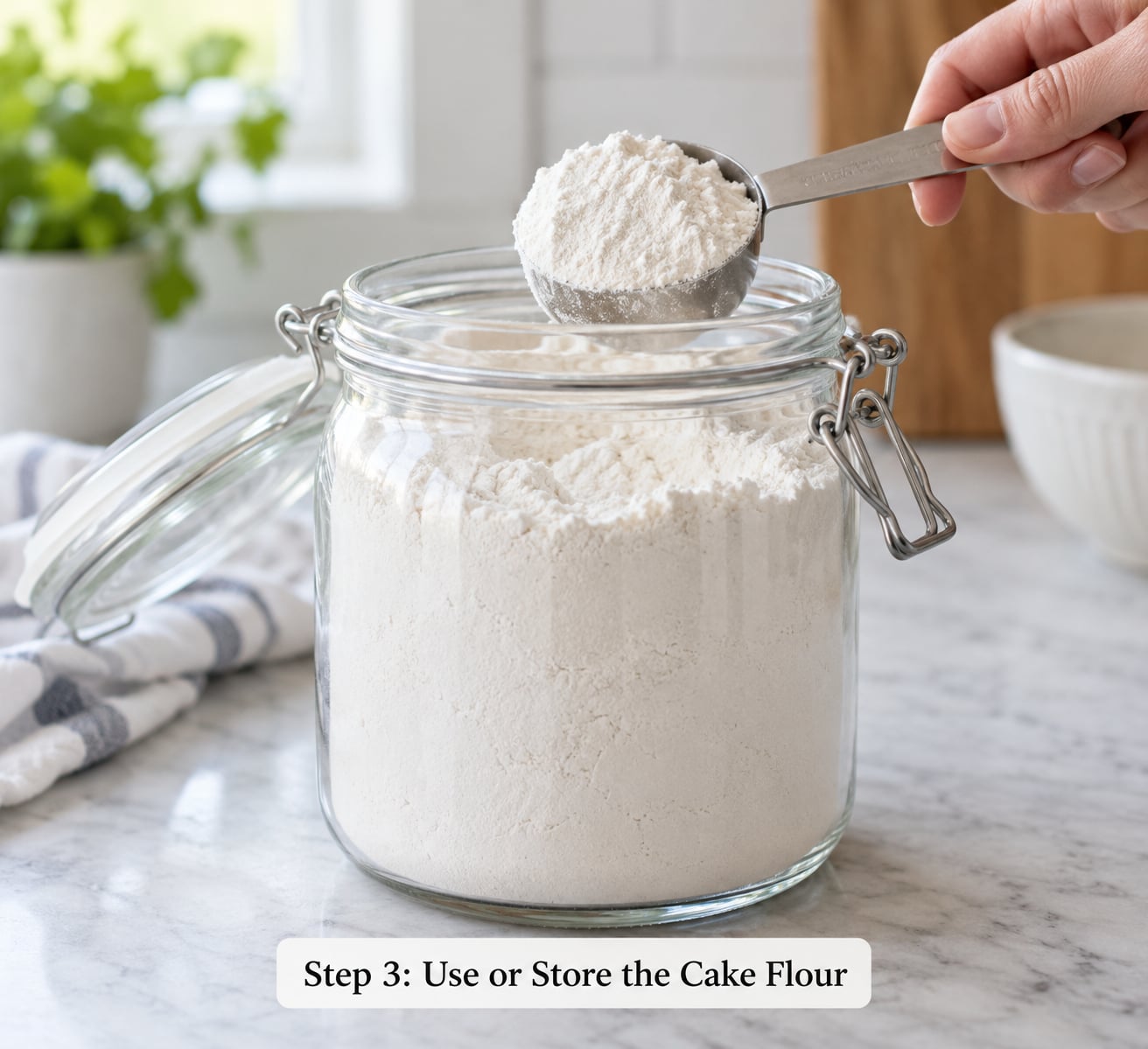
Use the blend immediately, one cup for one cup, wherever a recipe calls for cake flour. Do not sift it again when you add it to the bowl unless the recipe specifically asks for it — over-sifting is a common cause of a dense, tight crumb.
To store it, spoon the blend into an airtight container and keep it in a cool, dry cupboard away from the stove. Label the jar with the date. A homemade batch is fine for two to three months, and most bakers use it well inside that window. Store-bought cake flour carries a much longer date because of milling and packaging standards, not because it behaves differently in the jar.
Two quick freshness checks: the blend should smell faintly sweet and clean, never musty or sour, and it should still pour loosely after a month. If either fails, replace it.
Out of cornstarch? Arrowroot and potato starch substitute one-for-one by volume and behave almost identically in cake batter. Pastry flour is a second choice: it works without any blending at all, but it is a little heavier, so cakes come out denser. For a gluten-free version, combine brown rice flour, white rice flour, arrowroot powder and potato starch in equal parts — expect a more fragile crumb and a slightly shorter rise, and add an extra egg or two for structure.
Common Mistakes to Avoid
Measuring cornstarch by weight alone. Two tablespoons of cornstarch is about 16 g, and a tablespoon of flour is also about 8 g, so the two are easy to confuse on a scale. Weigh the flour, remove 16 g of it, then add 16 g of cornstarch. Do not weigh a tablespoon of each and trust they match — cornstarch is roughly double the weight of the same spoon of flour.
Skipping the sifting. Uneven distribution means some bites get double the cornstarch and some get none, which reads as an uneven crumb. Sift three or four times, or whisk hard with a spatula until the color is uniform.
Swapping it in one-for-one for every recipe. Light cakes love it. Moist, heavy cakes do not always need it: carrot, banana, zucchini and applesauce cakes already get tenderness from their fruit and fat, and adding lower-protein flour can make them slack and spread. Use all-purpose there.
Adjusting the liquid. The substitute does not change how much liquid a recipe needs. If you add extra milk or water to compensate for a crumb that seems dry, you get a gummy center. Fix the flour ratio instead.
Starting from bread flour. Bread flour at 12-14% protein is already closer to a strong flour than a cake one. You can push it toward cake flour with three tablespoons of cornstarch per cup, but plain all-purpose is the honest starting point.
Two habits help more than the rest. Weigh whenever a scale is available, and treat sifting as non-negotiable for anything going into a layer cake.
Frequently Asked Questions
Is cake flour just all-purpose flour?
Not quite. All-purpose flour runs 10-12% protein, while cake flour runs 7-9% and is milled much finer. That protein gap is what separates the two: more protein means more gluten development and a tighter, bready crumb. Homemade cake flour closes that gap by removing a couple of tablespoons of flour and replacing them with cornstarch, which dilutes the protein without changing the volume.
How much cornstarch do I add to one cup of flour?
Two tablespoons, which is one-eighth of a cup. Measure one cup of all-purpose flour, remove two tablespoons of it, then fill that gap with two tablespoons of cornstarch. By weight, that is roughly 120 g of flour minus 16 g, plus 16 g of cornstarch. The finished cup still measures one cup.
What happens if I use regular flour instead of cake flour?
Nothing dramatic, but the crumb will be denser, firmer and slightly more bready. All-purpose flour carries more gluten-forming protein, so the batter tightens as you mix and sets into a firmer structure in the oven. Fine for a pound cake or a rustic loaf-style cake, less ideal for a tall light layer cake where you want maximum tenderness.
What can I use if I don’t have cake flour?
The cornstarch method is the best substitute. Beyond that, arrowroot or potato starch replace cornstarch one-for-one, and pastry flour works on its own for a slightly heavier result. A blend of brown rice flour, white rice flour, arrowroot and potato starch in equal parts works for gluten-free baking, though the crumb will be more fragile.
How long does homemade cake flour last?
About two to three months in an airtight container kept in a cool, dry cupboard. Both ingredients are shelf-stable dry goods, so the limit is really about the blend staying free of moisture and any pantry smells. Label the jar with the date and check that it still smells clean and pours loosely before you bake with it.
Do you have to sift cake flour?
Sifting is the step most people skip and most regret. Cornstarch settles into the flour and leaves visible white streaks unless you work it through, and those streaks bake into an uneven crumb. Sift three or four times, or whisk in a figure-eight motion until no white patches remain. Whisked cake flour works fine, just slightly less uniform.
Start with the simple version: one cup of all-purpose flour, two tablespoons removed, two tablespoons of cornstarch in, sifted four times. Make a double batch, jar it, and the next cake you bake is already covered. Last updated October 2026.