How to make a vegan birthday cake comes down to three swaps: unsweetened plant milk for the dairy, applesauce, aquafaba or ground flaxseed for the eggs, and vegan butter for the butter. Baking soda mixed with apple cider vinegar supplies the lift that eggs would, because the reaction between the two releases carbon dioxide in the batter. Add a chocolate sponge and a properly salted vegan buttercream, and you get a cake nobody at the party will describe as a compromise.
The whole process takes about 90 minutes from cold pan to finished cake, and most of that is oven and cooling time you can spend on something else. This is the method I come back to every year, tweaked slightly each time. It works on a home oven with no special equipment, and it makes a two-layer 9-inch cake that feeds about a dozen.
Party-day timing is the part people get wrong, not the baking. Baking the layers two days ahead, frosting the night before, and chilling the finished cake in the fridge leaves you with almost nothing to do on the day itself other than decorations and candles.
Table of Contents
- What You Need
- Equipment
- Ingredients for the chocolate layers
- Ingredients for the buttercream
- What replaces the eggs, and what job it is doing
- Step-by-Step: How to Make a Vegan Birthday Cake
- Step 1: Prepare the Pans and Oven
- Step 2: Mix the Dry Ingredients
- Step 3: Add the Wet Ingredients
- Step 4: Bake the Cake Layers
- Step 5: Make and Apply the Frosting
- Step 6: Decorate and Serve
- Common Mistakes
- Why is my vegan cake dense and gummy?
- Why is my vegan cake flat or sunk in the middle?
- Why is my vegan cake dry?
- Why is my vegan cake uneven or cracked on top?
- Why is my buttercream split, grainy or unable to hold a shape?
- Frequently Asked Questions
- Can I make a vegan birthday cake without a stand mixer?
- What is the best vegan frosting for a birthday cake?
- Can I replace the eggs in a vegan cake recipe?
- How long does a vegan birthday cake stay fresh?
- Can a vegan birthday cake be made nut-free?
- Can I bake a vegan birthday cake in advance?
- Conclusion
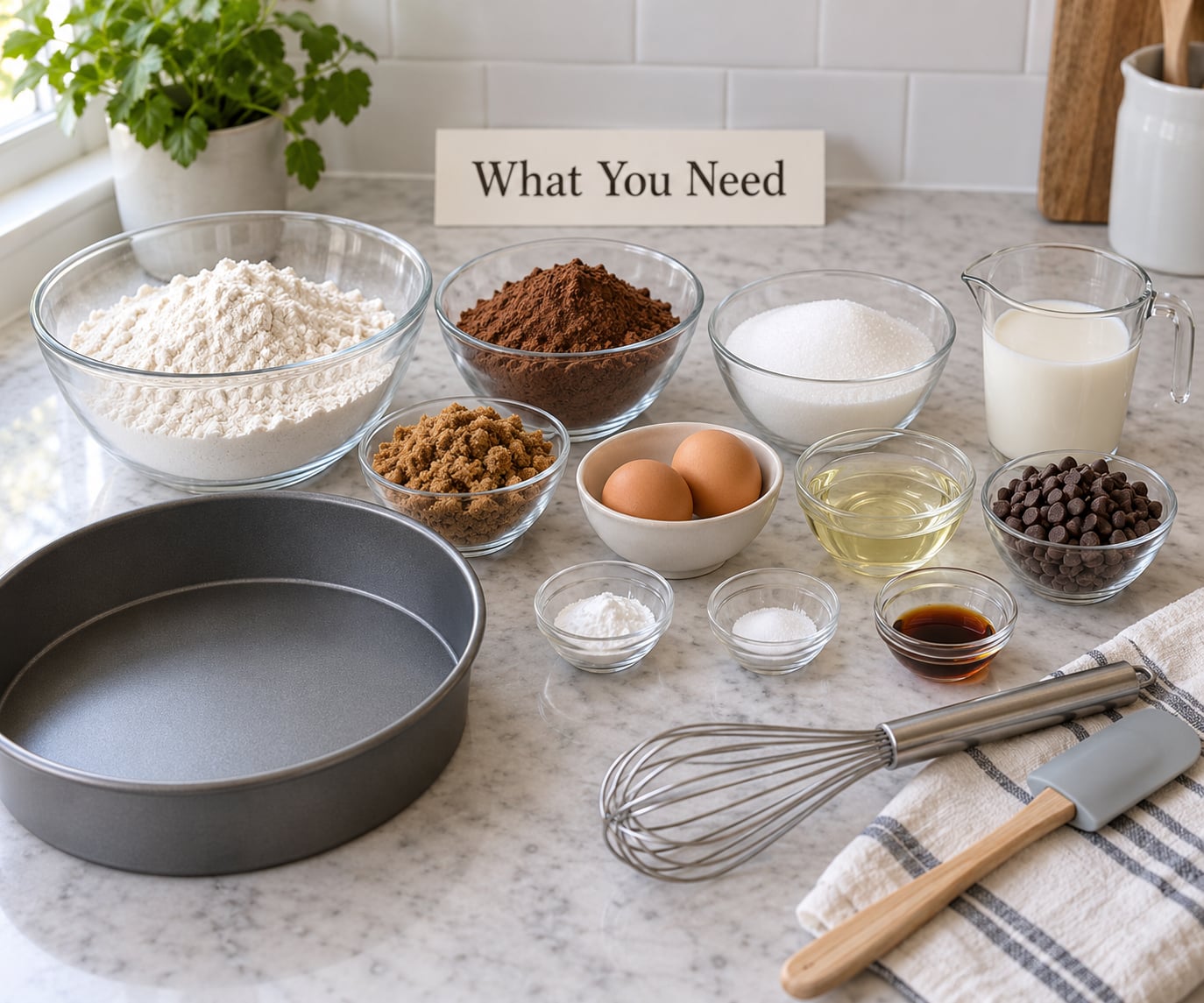
What You Need
Equipment
Two 9-inch round cake pans are the only real requirement. Parchment paper rounds in the bottom of each pan make turning the layers out so much easier than greasing alone.
A stand mixer makes vegan buttercream quicker, but a hand mixer or even a sturdy wooden spoon does the same job. It just takes a few minutes longer to cream room temperature vegan butter until pale and fluffy.
Cooling racks beat a baking tray for the simple reason that air moves under the cake. A flat surface straight from a hot pan is how you get a cracked top or a torn layer.
Ingredients for the chocolate layers
- 200 g (1 3/4 cups plus 2 tbsp) plain all-purpose flour
- 75 g (3/4 cup) unsweetened cocoa powder
- 300 g (1 1/2 cups plus 2 tbsp) granulated sugar, certified vegan or organic
- 2 tsp baking powder
- 2 tsp baking soda
- 1 tsp fine sea salt
- 240 ml (1 cup) unsweetened soy milk or oat milk
- 120 ml (1/2 cup) neutral oil, such as sunflower or grapeseed
- 1 tsp apple cider vinegar
- 120 g (1/2 cup) unsweetened applesauce
- 2 tsp vanilla extract
Soy milk thickens a batter more closely than dairy milk does, so it is my pick for this recipe. Oat milk works well too and reads slightly sweeter. Almond milk is thinner and lighter, which works but can push the crumb a little more open.
Use unsweetened plant milk. Sweetened varieties carry enough added sugar to make the cake cloyingly sweet once the batter goes through the oven.
The sugar line is worth a moment. Some granulated sugar is whitened with bone char, which strict vegans avoid. Organic sugar and sugar labelled certified vegan are processed without animal bone.
Ingredients for the buttercream
- 200 g (1 1/2 cups plus 2 tbsp) powdered sugar
- 115 g (1/2 cup) vegan butter or stick margarine
- 2 tbsp unsweetened soy or oat milk
- 1 tsp vanilla extract
- 1/4 tsp fine sea salt
- 20 g (3 tbsp) unsweetened cocoa powder, for the chocolate frosting
Buy a block-style vegan butter or margarine rather than a soft spread. Check the label for partially hydrogenated oils, which is the thing to avoid in frosting, and check the ingredients list is not simply plant oils and water.
What replaces the eggs, and what job it is doing
This is where most vegan cakes go wrong. An egg does four different things in a batter, and swapping in one substitute for all four is why so many results turn out dense. Match the ingredient to the job instead.
| Job the egg does | Use instead | How much |
|---|---|---|
| Binding and moisture | Unsweetened applesauce | 60 g per egg |
| Binding only | Ground flaxseed plus water | 1 tbsp ground flaxseed and 3 tbsp water per egg, rest 10 minutes |
| Binding only | Chia seeds plus water | 1 tbsp chia and 3 tbsp water per egg, rest 10 minutes |
| Lift and rise | Baking soda plus vinegar | 1 tsp baking soda and 1 tsp vinegar per egg |
| Foam and lift in meringues | Aquafaba, the liquid from a tin of chickpeas | Replace egg white one for one |
Flax and chia bind, they do not lift. Baking soda and vinegar lift, they do not bind or add moisture. Aquafaba whips into stable peaks like egg white, which makes it the right choice for meringue toppings and marshmallow-style decorations.
This chocolate sponge uses applesauce for binding and moisture, with the baking soda and vinegar reaction handling the rise. No flax gel is needed here.
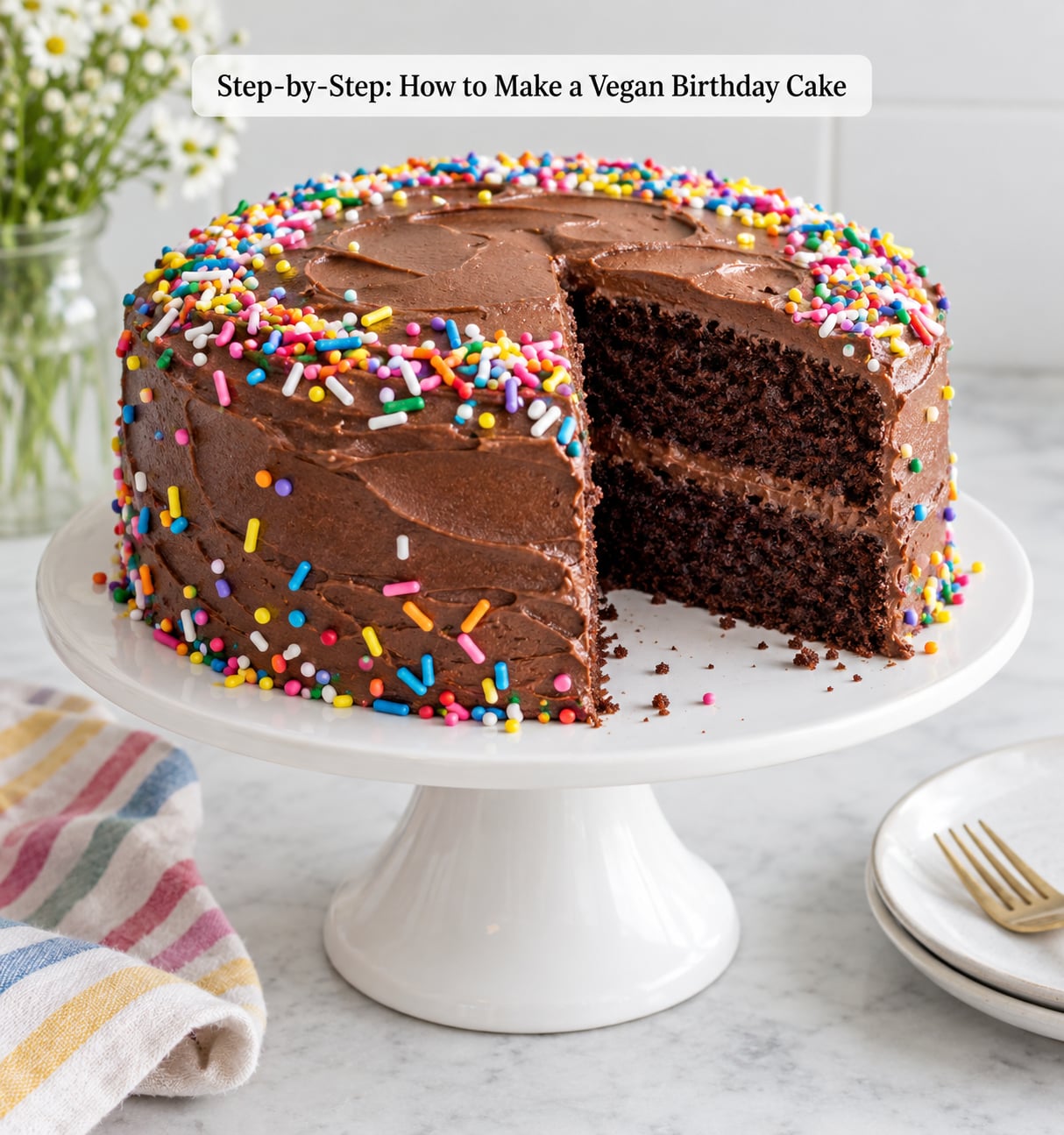
Step-by-Step: How to Make a Vegan Birthday Cake
Step 1: Prepare the Pans and Oven
Heat the oven to 175C (350F) with a fan, or 180C (355F) for a conventional oven. Conventional ovens run hotter, which is a common reason vegan cakes dry out at the edges.
Line the base of each 9-inch pan with a parchment round and brush the sides with a little oil. A thin film is enough. If the batter clings to bare metal, the cake will tear when you try to lift it out.
The pans should be ready before the batter is mixed. Wet batter waits patiently; a cold pan and hot batter is not a fair start, because the batter begins setting against the pan the moment it lands.
Step 2: Mix the Dry Ingredients
Combine the flour, cocoa, sugar, baking powder, baking soda and salt in a large bowl. Sift the cocoa if it has clumps; a single stubborn lump leaves a bitter pocket in the finished crumb.
Whisk for about 30 seconds until no dry patches sit at the bottom of the bowl. You want an even, uniformly brown mixture with no streaks of white flour.
Step 3: Add the Wet Ingredients
In a jug, whisk the soy milk, oil, vinegar and vanilla. Leave it for 5 minutes. The milk will thicken slightly and look faintly curdled, and that is the sign the acid has done its job of priming the baking soda.
Pour the wet into the dry and fold with a spatula until the last streaks of flour disappear. Stop there. Gluten that has been overworked tightens into a dense, gummy crumb, and a plant-based batter has less fat than a conventional one to soften it.
Let the finished batter sit for 5 minutes so the flour hydrates fully before it goes near the oven.
Step 4: Bake the Cake Layers
Divide the batter between the two pans and level the tops with the back of a spatula, tapping each pan once on the counter to settle large air pockets.
Bake for 30 to 35 minutes. Because the batter carries more liquid than an egg-based cake and less fat, it often needs a few minutes longer than a standard sponge, especially in the middle.
It is done when a skewer inserted into the centre comes out with a few damp crumbs rather than wet batter, and the top springs back lightly when pressed. A clean skewer can mean the edges have already begun to dry out, so check slightly early.
Cool in the pans for 10 minutes, then turn out onto a rack. Moving warm cake is what causes tears and domes, so give it the full 10 minutes.
Step 5: Make and Apply the Frosting
Cream the vegan butter on medium speed for 2 to 3 minutes until pale and light. It starts looking grainy and then suddenly turns smooth and fluffy, and that texture is where the air goes.
Add the powdered sugar a quarter of a cup at a time, mixing about 30 seconds between each addition and scraping the bowl down twice. The sifted-in-slow approach is what stops the icing from turning gritty.
Pour in the milk, vanilla and salt, then the cocoa if you want chocolate frosting. Beat 2 more minutes until the colour is even and the frosting holds the trace of a spatula.
A warm or cold cake melts the frosting before you can spread it. Frost a completely cool layer, and if you are in a hurry, refrigerate the layers for 20 minutes first.
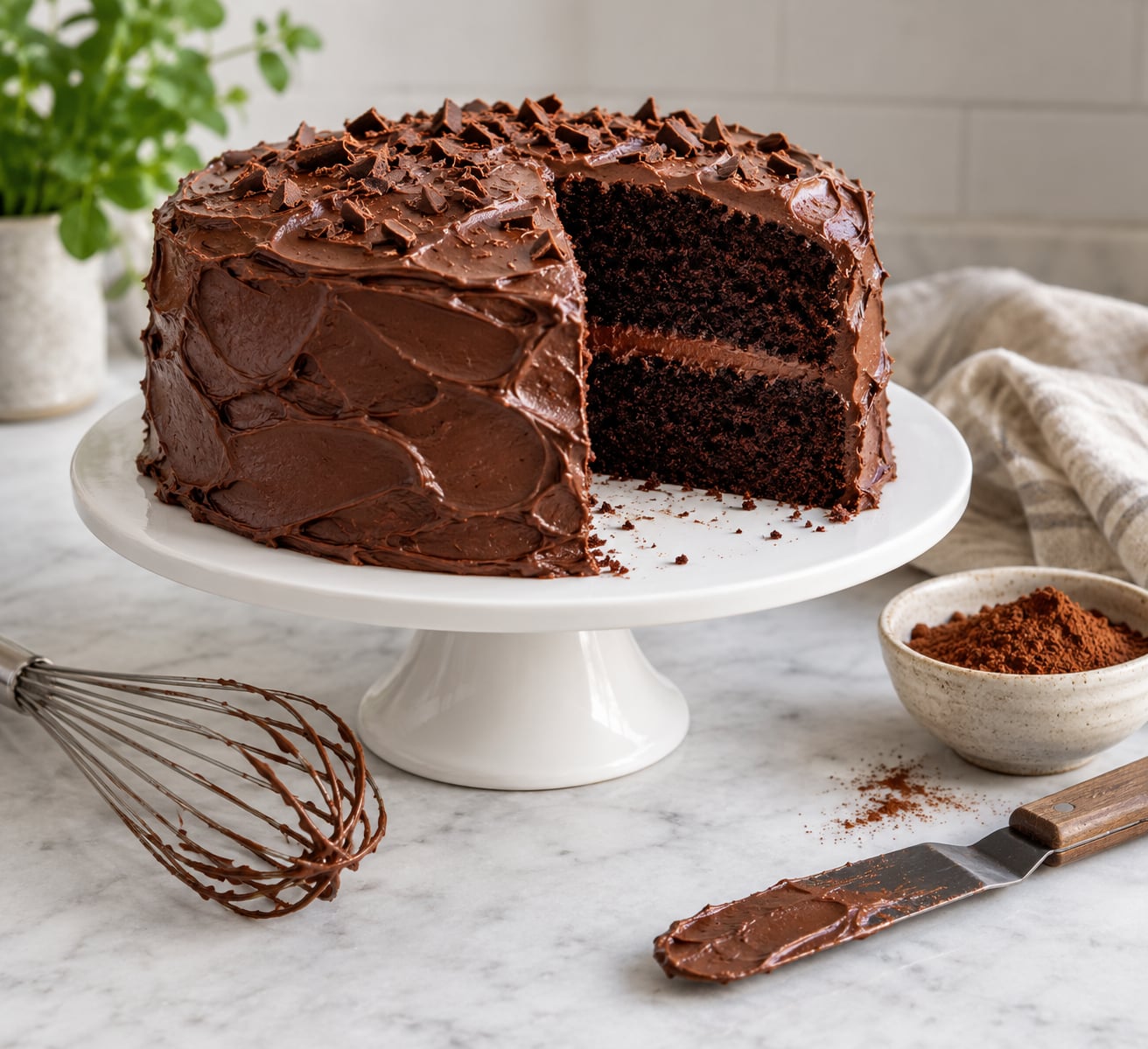
Spread a thin crumb coat on the first layer, press the second layer on top, then frost the whole cake and finish with a clean offset spatula sweep. Chilling the finished cake for 15 minutes before decorating makes the piping far easier.
Step 6: Decorate and Serve
For a beginner, a smooth coat, a scatter of sprinkles and a piped border is a finished cake, not a compromise. Minimal decoration is a style.
- Piped border: fit a large star or open star tip and pipe a continuous ring around the base and top edges. Keep the bag vertical and squeeze with steady pressure.
- Rosettes: a star tip and a squeeze-and-lift motion from one clockwise turn gives you a rosette. Straighten up straight off the bag.
- Sprinkles: press them onto the frosting while it is still tacky rather than scattering them over afterwards.
- Fruit: raspberries and sliced strawberries go on shortly before serving so they do not bleed into the crumb.
- Message: a few piped letters on a small plaque or the top of the cake is plenty.
A chilled cake cuts cleanly. Take it out of the fridge about 20 minutes before slicing, and wipe the knife between cuts.
Store a frosted cake at cool room temperature for up to 2 days, or in the fridge for up to 5 days in a covered box. It freezes well for 3 months unfrosted, wrapped tightly in cling film.
Common Mistakes
Why is my vegan cake dense and gummy?
Three causes account for most dense cakes. Overmixing is the first, and it is the least forgiven. Fold the wet into the dry only until no dry streaks remain, then stop.
Not enough liquid is the second. Mashed banana and extra plant milk are gentler fixes than reaching for more flour, which makes the problem worse.
An underdeveloped rise is the third, usually a stale baking soda or a double-acting powder used at the wrong time. Test your baking powder by adding a spoonful to hot water; it should foam immediately.
Why is my vegan cake flat or sunk in the middle?
A sunken middle means the outside set before the centre could finish rising, which points to too little lift or an oven running hot. Check the baking powder and soda are fresh, and drop the temperature by 15C if your cake browns fast.
Baking the batter too close to the top element also cooks the rim before the centre sets. Move the shelf to the middle of the oven.
Why is my vegan cake dry?
Usually too long in the oven, not too little oil. Plant-based batters hold their moisture differently, and an extra five minutes costs more than it gives. Pull the layers when the skewer shows damp crumbs.
Baking with a fan at a lower temperature than conventional helps here. It softens the crust as well as the crumb.
Why is my vegan cake uneven or cracked on top?
An uneven rise points to batter sitting in the pan for too long after mixing, since the flour hydrates and the baking soda reacts immediately. A domed or cracked top usually means the oven ran too hot in the first ten minutes, when the structure is still setting. Drop the temperature, or wrap a damp cake strip around each pan to insulate the edges.
Why is my buttercream split, grainy or unable to hold a shape?
Grainy frosting means the powdered sugar was added too fast. It dries out the mixture instead of dissolving, and it will never smooth out afterward. Sift it in gradually and beat longer than you think you need to.
Frosting that will not pipe is too stiff. Beat in plant milk a teaspoon at a time until it holds a soft peak. Frosting that slides off the cake is too warm, so chill the cake and the bowl.
Splitting usually means one of two things: the butter was melted rather than softened, or it contains too much water. Soften vegan butter until it dents under a finger with no resistance, and beat until pale before any sugar goes in.
In a warm room, buttercream softens quickly. Move the cake back into the fridge between the decorating and the party, and serve cake that has sat out for no more than 20 minutes.
Frequently Asked Questions
Can I make a vegan birthday cake without a stand mixer?
Yes. Creaming vegan butter by hand with a wooden spoon works, it just takes longer: about 8 to 10 minutes of firm, consistent stirring until the mixture turns pale and fluffy. A hand mixer cuts that to around 3 minutes and is the option most people pick instead. The cake batter itself only needs folding, which is easier by hand anyway. The only job that genuinely needs power is creaming the frosting, and that is the one step worth borrowing a mixer for.
What is the best vegan frosting for a birthday cake?
A salted chocolate vegan buttercream is the reliable choice because it holds a piped shape, survives a warm room better than cream cheese frosting, and covers a crumb properly. Pipeability depends on the butter, not the sugar: use a block vegan butter or margarine with no partially hydrogenated oils. If it is too stiff, add plant milk a teaspoon at a time; if it slumps, add a spoonful of powdered sugar and beat it through.
Can I replace the eggs in a vegan cake recipe?
Yes, but pick the substitute for the job. Applesauce handles binding and moisture at about 60 g per egg. Ground flaxseed or chia mixed with three times its weight in water and rested 10 minutes handles binding alone. Baking soda with vinegar provides lift but no binding. Aquafaba, the liquid from a tin of chickpeas, whips like egg white and is the substitute for meringue. Using one ingredient for all four jobs is what turns a vegan cake dense.
How long does a vegan birthday cake stay fresh?
A frosted cake keeps well at cool room temperature for up to 2 days, covered on a cake board or in a box to protect it from dust. Refrigerated in a covered box it lasts about 5 days, though the crumb firms up a little. Unfrosted layers freeze for 3 months wrapped tightly in cling film, and frosting freezes separately in an airtight tub. Thaw overnight in the fridge rather than on the counter.
Can a vegan birthday cake be made nut-free?
Yes. This recipe contains no nuts as written. The two places nut cross-contamination usually creeps in are the frosting and the decorations, so check that your plant milk, vegan butter and powdered sugar are made in facilities without nuts. Store-bought sprinkles are a common hidden source, as are some chocolate chips used for decoration. For a child with a serious allergy, bake with nut-free ingredients and a clean kitchen rather than relying on substitution alone.
Can I bake a vegan birthday cake in advance?
Yes, and it is the easiest way to calm a party-day schedule. Bake the layers up to two days ahead, cool them completely, then wrap each one in cling film and store at room temperature. Frosting keeps about a week in the airtight tub in the fridge, so make that at most a day ahead too. Frost the cake the day before and refrigerate it, then take it out about 20 minutes before you light the candles.
Conclusion
To make a vegan birthday cake that actually holds up as a birthday cake, do three things first: line your pans and have them ready before you mix, weigh your flour and cocoa rather than scooping them, and treat the folding as finished the moment no dry streaks remain.
Bake one layer a day early to learn your oven, then bake the real cake when you already know how long it takes. That single habit removes most of what goes wrong on a party day.