Swiss meringue buttercream is a frosting made by heating egg whites and sugar together over simmering water, whipping that warm mixture to stiff peaks, then beating in cool butter until it turns silky and spreadable. Learning how to make Swiss meringue buttercream for beginners takes about 40 minutes, and the whole thing hinges on temperature rather than technique. It is not difficult, but it is different from the powdered-sugar buttercreams most people start with.
That difference is worth it. Swiss meringue buttercream is far less sweet, it holds its shape on a warm counter, and it pipes to a sharp, clean finish. It also uses fully cooked egg whites, so there is no raw-egg question when you serve it to kids or someone pregnant. Updated for 2026, this walkthrough covers every stage and what success looks like at each one.
Table of Contents
- What You Need
- Step-by-Step: How to Make Swiss Meringue Buttercream for Beginners
- Step 1: Bring the Ingredients to Room Temperature
- Step 2: Heat the Egg Whites and Sugar
- Step 3: Whip the Meringue Until Cool and Fluffy
- Step 4: Add the Butter Slowly
- Step 5: Finish and Check the Buttercream
- How to Tell the Buttercream Is Ready
- The ribbon test
- The spread test
- The hold test
- How it differs from other buttercreams
- A quick smoothing test
- How to Use and Store Swiss Meringue Buttercream
- Common Mistakes and Easy Fixes
- Grainy or gritty frosting
- Frosting tastes only of butter
- Curdled, split, or soupy buttercream
- Stiff frosting that will not spread
- Meringue that never reaches stiff peaks
- Undercooked, thin meringue base
- Decorating tips that avoid the next problem
- Frequently Asked Questions
- What temperature should Swiss meringue buttercream egg whites reach?
- Why is my Swiss meringue buttercream grainy, and how do I fix it?
- How long should I whip Swiss meringue buttercream for a beginner?
- Can I use Swiss meringue buttercream between cake layers?
- Can Swiss meringue buttercream be made ahead and frozen?
- Conclusion
What You Need
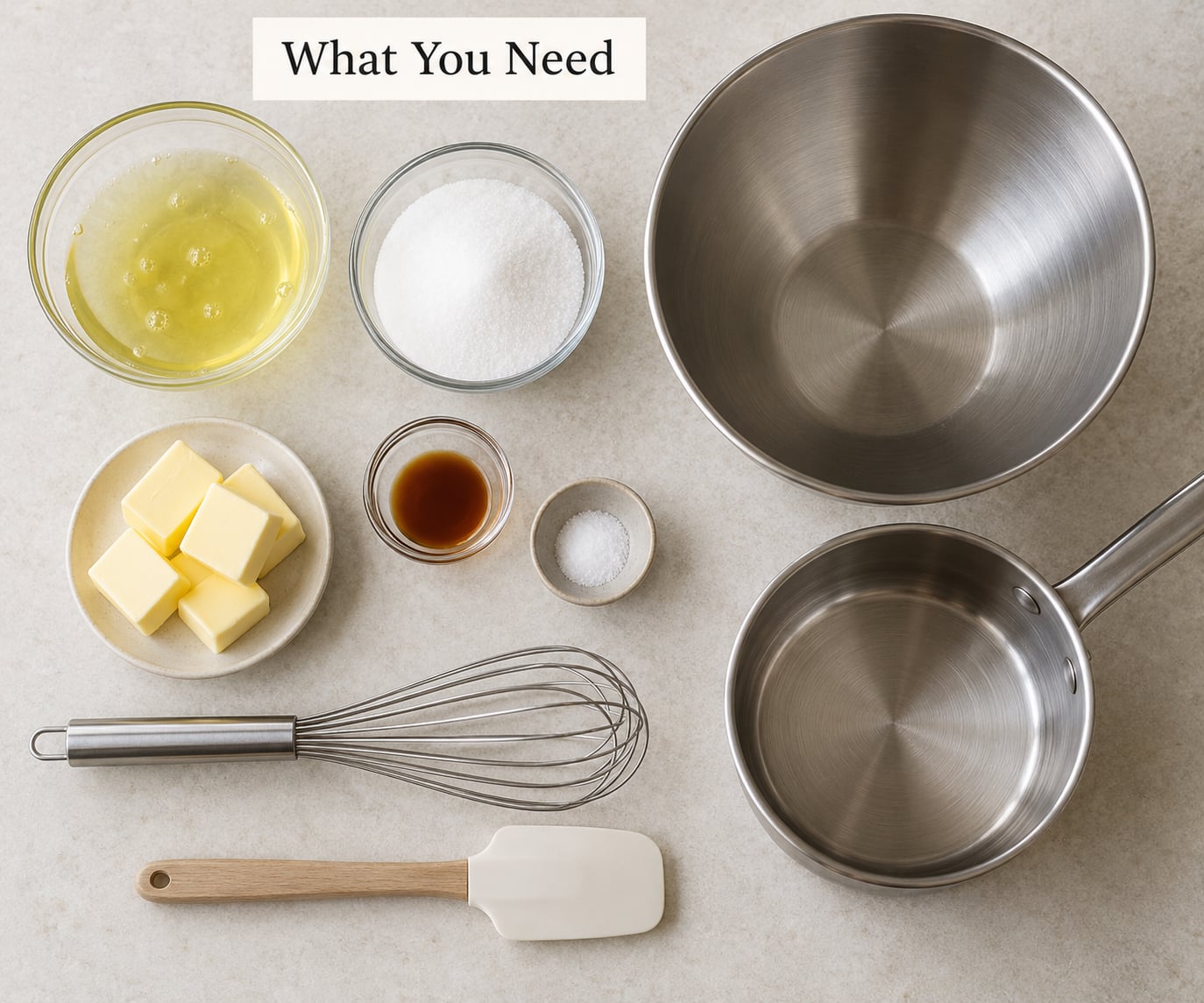
Swiss meringue buttercream uses four ingredients and a couple of pieces of equipment. Measuring by weight is not optional fussiness here, because the sugar-to-egg-white ratio is what makes the frosting stable.
- 115 g egg whites (about 4 large eggs, or 1/2 cup plus 2 tablespoons by volume)
- 175 g granulated sugar (about 3/4 cup plus 2 tablespoons)
- 340 g unsalted butter (1 1/2 cups or 12 tablespoons), cut into 12 cubes
- 1 teaspoon vanilla extract and a small pinch of fine salt
- Instant read thermometer — not a meat thermometer, which is not accurate enough for this
- Heatproof glass or metal bowl that fits your stand mixer, plus a saucepan and a heatproof spatula
The ratio to remember is 150 percent. For every 100 g of egg whites by weight, you use 150 g of sugar, and roughly three times that in butter. Get the egg whites and sugar right by weight and the frosting will hold its shape on a hot day. Get them wrong and no amount of whipping will save it.
A stand mixer with a whisk attachment and a paddle attachment is the ideal setup. You can do it with a hand mixer, but expect 15 to 20 minutes of continuous beating and a sore arm. Skip the stand mixer only if you have to.
Step-by-Step: How to Make Swiss Meringue Buttercream for Beginners
Step 1: Bring the Ingredients to Room Temperature
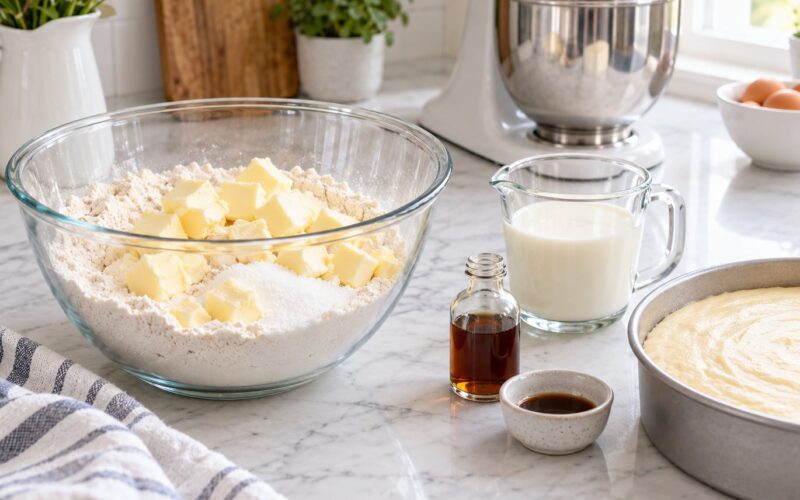
Take the butter out of the fridge 30 to 40 minutes before you start, and let the mixing bowl sit at room temperature too. Cut the butter into twelve roughly equal cubes and set them on a plate near the mixer.
This is the step beginners skip, and it is the reason so many first attempts turn to soup. Cold butter hitting warm meringue seizes into solid chunks that never emulsify. Cold butter is the single most common cause of failure, so measure the butter and put a clock on it before you heat anything.
Also wipe your bowl and whisk with a paper towel. Any trace of grease stops egg whites from whipping, and a single drop of yolk behaves like grease.
Step 2: Heat the Egg Whites and Sugar
Fill a saucepan with a couple of inches of water and bring it to a gentle simmer, with no big bubbles breaking the surface. Set your heatproof bowl over it so the bottom stays just above the water and never touches it.
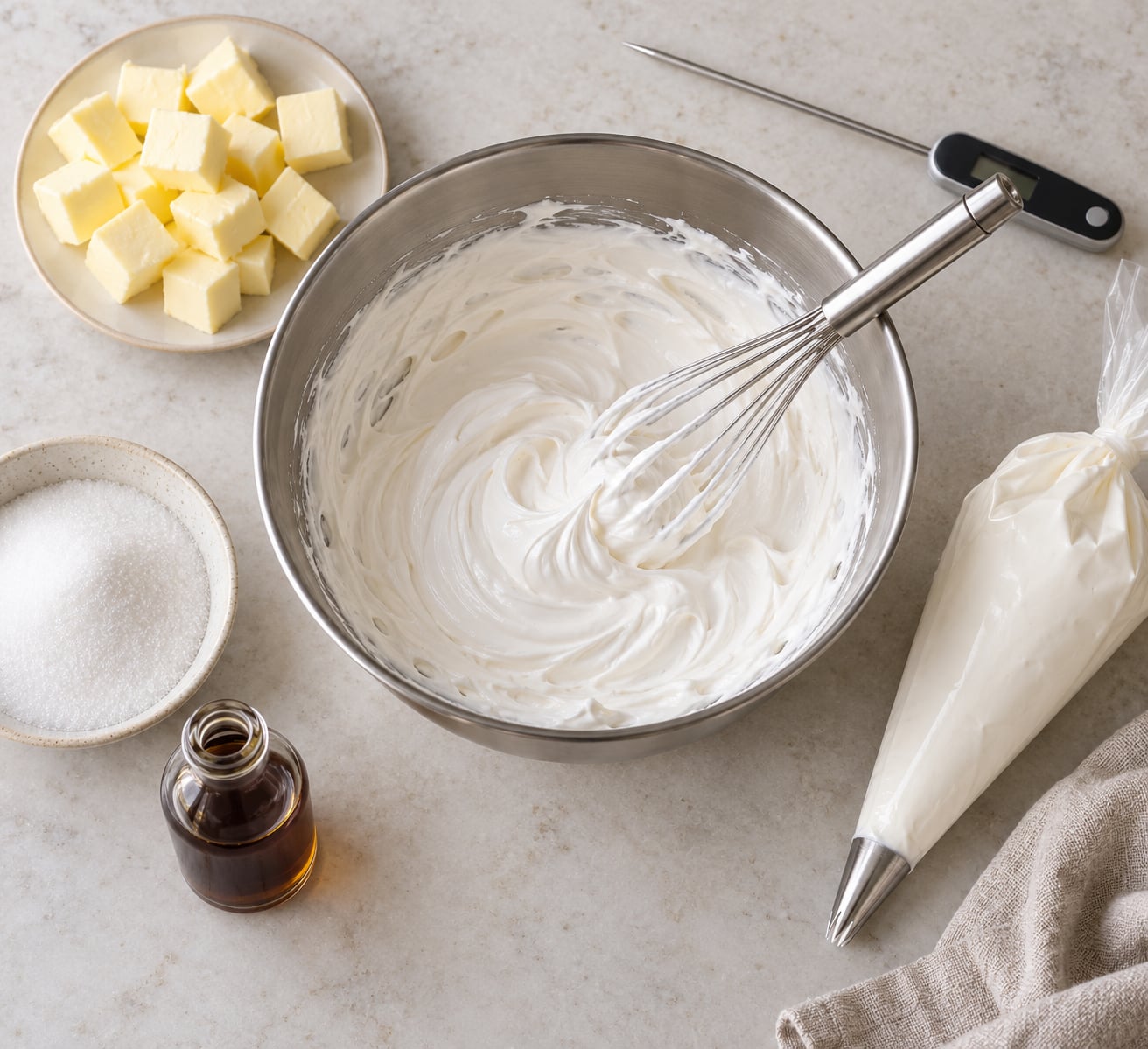
Whisk the egg whites in the bowl until foamy and pale. Gradually sprinkle in the sugar a tablespoon at a time while whisking steadily, then keep whisking until the mixture is hot to the touch and about 160°F (71°C) on the thermometer. Check it in several spots, not just the center.
You will see the mixture thicken, go glossy, and start to hold soft ridges. About 5 to 7 minutes of whisking gets you there. If it looks like loose egg white and raw sugar, keep going; you are not there yet.
About 140°F (60°C) appears in a few recipes and is fine for texture. I use 160°F because it cooks the egg whites properly, which matters if you are serving anyone who should avoid raw egg.
Step 3: Whip the Meringue Until Cool and Fluffy
Take the bowl straight off the heat — do not let the meringue cool on the counter first — and set it in the stand mixer with the whisk attachment. Start on medium speed.
This is the part most beginners get wrong in the other direction. Experienced decorators whip the meringue while it is still warm, and that heat is what dissolves the sugar into a smooth, glossy foam. Whipping cold meringue gives you a thinner, grittier result that is harder to bring together later.
Whip for 7 to 10 minutes, until the bowl is no longer hot to the touch and the meringue looks billowy, glossy and stiff. When you lift the whisk, the peaks stand up in smooth points that do not flop over. On a humid day this can stretch to 15 or 18 minutes. That is normal, so keep going rather than dumping in the butter early.
Step 4: Add the Butter Slowly
Switch to the paddle attachment and start on low speed. Add one cube of butter at a time, letting each one disappear before the next goes in. This is where most people rush, and rushing is what causes greasy, separated frosting.
Here is the part that panics every beginner. Within the first few cubes the mixture will look loose, then like curdled cottage cheese, then split with oily streaks at the bottom of the bowl. That looks broken. It is not. The butter is melting into the hot meringue and the emulsion is mid-way through forming, and it will come together if you keep the mixer running.
The mistake is to react to the ugly stage by adding extra butter. More butter means more liquid trying to emulsify into a mixture that already has enough, and the frosting stays thin. Keep beating on low for another 2 to 3 minutes and it will tighten, turn glossy, and go from yellow to pale cream.
Add butter slowly in thin, steady streams with the mixer already moving, rather than dropping pieces in from above. That keeps butter off your counter, keeps the bowl from spattering, and gives the emulsion a more even path.
Step 5: Finish and Check the Buttercream
Once the buttercream is smooth and cohesive, add the vanilla and a pinch of salt and mix on low for another 30 seconds. The salt is not optional decoration; it sharpens the sweetness and makes the frosting taste less sugary.
Taste it on a spatula. Swiss meringue buttercream should taste of butter first and sugar second, noticeably milder than American buttercream. If it tastes only of butter with no sweetness at all, you went too heavy on the vanilla or the sugar did not dissolve — see the fixes below.
Do not add gel food coloring at this stage if you can avoid it. Gel colors stain, so tint a small scoop in a separate bowl first, confirm the shade, then work back into the main batch.
How to Tell the Buttercream Is Ready
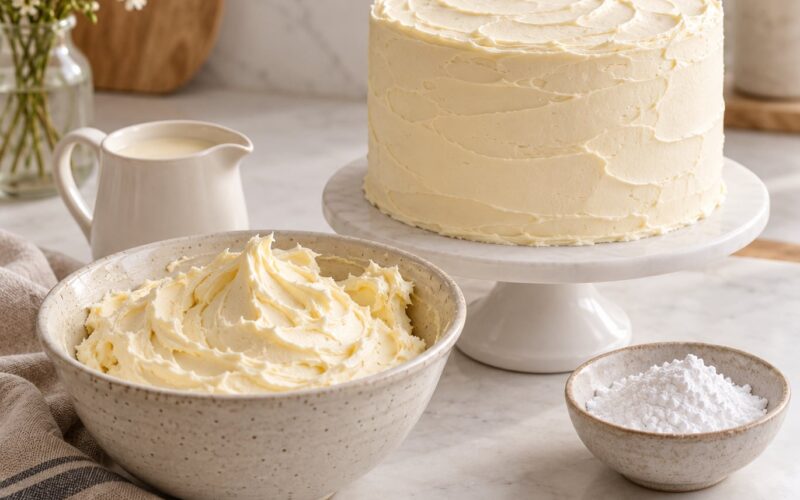
A finished batch is glossy, pale, and holds a soft curl on the spatula. Run these quick checks before you frost anything.
The ribbon test
Drizzle a ribbon across the surface. A ready buttercream falls in a slow, unbroken ribbon that sits on top before folding in slowly. A thin, watery ribbon that runs flat and disappears is too warm or has too much butter in it.
The spread test
Scoop some onto the back of a spoon and tilt it. It should slump slowly and hold a soft peak at the edge, not run off the spoon or sit in a stiff block.
The hold test
Pull a dab between two fingers. It should stretch and hold shape rather than break into crumbs or slide off slick. That tackiness is what lets a piped swirl stand up for hours.
How it differs from other buttercreams
Italian meringue buttercream is made from hot sugar syrup and egg whites and goes stiff and glossy, which makes it better suited to hot climates and modeling work. French meringue uses raw whipped whites and butter, so it needs refrigeration. American buttercream is powdered sugar and butter, which is much sweeter and crusted. Swiss sits in the middle: smooth and spreadable, stable at room temperature, mildly sweet.
A quick smoothing test
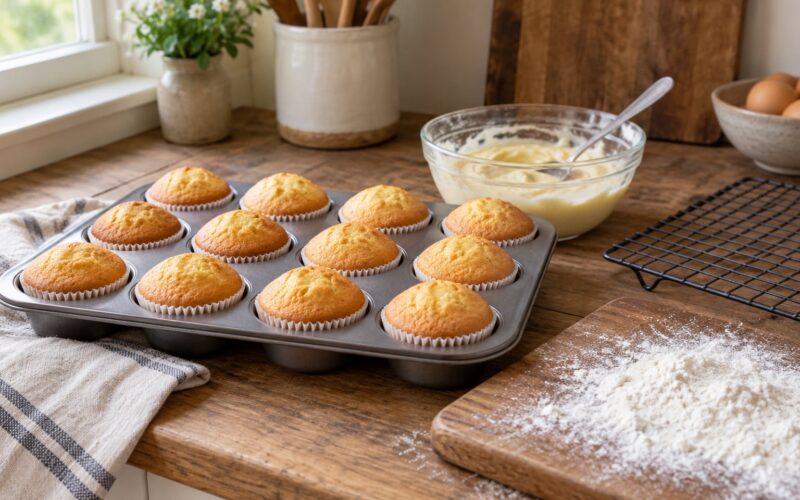
Scoop a small amount onto a chilled cupcake and smooth it with the back of a spoon. If it sits where you put it and holds the surface, it is ready for the whole cake. If it slumps into a puddle, chill the bowl for 5 minutes and beat again.
How to Use and Store Swiss Meringue Buttercream
A standard batch yields roughly 5 cups of frosting. That covers a three-layer 9-inch cake, about two dozen cupcakes, or a single 9×13 sheet cake. It also works for filling macarons, whoopie pies, and cream puffs, where the mild sweetness lets the filling flavor come through.
For a layer cake, do a thin crumb coat first, chill the cake for 15 minutes, then apply the final coat. That traps crumbs and gives you a smooth canvas for piping. The frosting holds up under fondant too, provided you let it set for 20 to 30 minutes first.
Covered airtight, it holds in the fridge for up to a week. Yes, it hardens in the cold, and that is not a failure — let it sit at room temperature for 20 to 30 minutes, then beat it again until smooth and spreadable before using it.
For freezing, press plastic wrap directly onto the surface of the buttercream to block air, then seal and freeze for up to three months. Thaw it in the fridge overnight and rewhip before spreading. Because the water content is already cooked into the frosting, freezing costs you very little texture.
Making it a day or two ahead is the smart move for a first attempt. It firms up in the fridge, is easier to spread, and leaves room to make a second batch if something goes wrong the first time. Several bakers describe that two-day head start as the thing that turned a nervous attempt into a repeat attempt.
Common Mistakes and Easy Fixes
Almost every failure below is temperature or timing, not technique. Work down the list in order.
Grainy or gritty frosting
The sugar did not dissolve. Whip the finished buttercream on high for 3 to 5 minutes, which often smooths it out. If it is still gritty, return it to your stand mixer, add 2 tablespoons of boiling water, and whip until it comes together. Adding cold water will not work.
Frosting tastes only of butter
The base was underheated and raw sugar flavor carried through. Whip in powdered sugar 1 tablespoon at a time until it tastes right. Too much vanilla can also flatten the sweetness, so start with half a teaspoon next time.
Curdled, split, or soupy buttercream
Too warm, or too much butter added at once. Chill the bowl for 10 to 15 minutes in short bursts, then beat on low until it re-emulsifies. Bakers report that chilling and rewhipping rescues nearly every split batch. If it is still thin, chill it in 5-minute bursts and check between each one rather than dumping in more butter.
Stiff frosting that will not spread
Either the butter was too cold and you ended up with too little, or the batch sat in the fridge too long. Add softened butter 1 tablespoon at a time and beat briefly. If you still need thinning, hold the bowl over a bain-marie for 30 to 60 seconds and beat until it loosens.
Meringue that never reaches stiff peaks
Almost always a yolk, a greasy bowl, or a hot bowl. Chill the bowl and whisk for a full minute, then re-whip the whites from scratch with fresh equipment. If a yolk got in, those whites will not stiffen and are best discarded rather than fought.
Undercooked, thin meringue base
If it never thickened over the heat, the water was boiling too hard and the bowl was too cool. Use a gentle simmer, keep the bowl clear of the water, and whisk constantly while checking the thermometer in a couple of spots.
Decorating tips that avoid the next problem
Chill your layers before the crumb coat. If you are frosting in heat, use fewer cups of frosting and pipe closer to the serving time. Keep the finished batch out of direct sun, and do not cover a warm bowl of buttercream — condensation is the fastest route to a watery surface.
Frequently Asked Questions
What temperature should Swiss meringue buttercream egg whites reach?
Cook the egg whites and sugar to 160°F (71°C), stirring constantly, which cooks the eggs fully and dissolves the sugar. Some recipes stop at 140°F (60°C), which produces a good texture but leaves the whites undercooked. If you are serving anyone who should avoid raw egg, use 160°F and check the thermometer in several spots rather than only the middle of the bowl.
Why is my Swiss meringue buttercream grainy, and how do I fix it?
Graininess means the sugar crystals never dissolved, usually because the base was underheated or the meringue went cold before whipping. Whip the finished buttercream on high for 3 to 5 minutes first. If it stays gritty, add 2 tablespoons of boiling water and whip again. The water re-dissolves the sugar; cold or room temperature water will not help.
How long should I whip Swiss meringue buttercream for a beginner?
Plan on 7 to 10 minutes of whisking for the cooked meringue plus 2 to 3 minutes of paddle mixing for the butter. On humid days the whisk stage can stretch to 15 or 18 minutes. Judge by texture, not the clock: the meringue should be glossy and stiff, and the finished buttercream should be smooth and pale. Keep the mixer running through the ugly curdled stage instead of stopping early.
Can I use Swiss meringue buttercream between cake layers?
Yes, it is one of the main reasons to make this frosting. It is firm enough to hold a filling layer without sliding, and its mild sweetness keeps a tall layered cake from tasting too sugary. Spread a thin even layer, chill the cake for 20 to 30 minutes, then add the top coat. It also fills macarons and whoopie pies well.
Can Swiss meringue buttercream be made ahead and frozen?
Yes, and making it two days ahead is the easiest way to make your first attempt less stressful. Covered airtight, it keeps in the fridge for up to a week. For longer storage, press plastic wrap directly onto the surface, seal it, and freeze for up to three months. Thaw overnight in the fridge and beat briefly before using.
Conclusion
Swiss meringue buttercream comes down to four things you can check: butter and bowl at room temperature, egg whites and sugar cooked to 160°F (71°C), meringue whipped until it is fully cool to the touch, and butter added one piece at a time on low speed.
Start by cutting your butter into twelve cubes and setting it out 30 minutes early. Everything after that is watching for stiff glossy peaks, resisting the urge to add more butter during the curdled stage, and trusting the texture rather than the clock.