Italian meringue buttercream is the more stable, slightly sweeter frosting, made by streaming a 118C (240F) sugar syrup into whipped egg whites. Swiss meringue buttercream is the easier, less sweet option, made by heating the whites and sugar together in a double boiler to about 160F (71C). Pick Swiss if you are new to meringue frosting or want a light, spreadable texture; pick Italian if you are stacking tiers, filling a cake or decorating in a warm room.
Both are egg-white buttercreams. The butter is what makes them stable and long-lasting, and the meringue is what makes them light, so neither one is a shortcut around the other. The only real difference is how hot the sugar gets before it meets the egg white.
Table of Contents
- Italian Meringue Buttercream vs Swiss Meringue at a Glance
- Italian Meringue Buttercream vs Swiss Meringue comparison table
- What Is Italian Meringue Buttercream?
- How the Italian method runs
- What Is Swiss Meringue?
- How the Swiss method runs
- Texture and Frosting Performance
- Sweetness, Flavor, and Ingredients
- Temperature and Stability
- Which Is Easier for Beginners?
- Italian Meringue Buttercream vs Swiss Meringue: Which Should You Choose?
- Frequently Asked Questions
- Which is better, Italian meringue buttercream or Swiss meringue?
- Is Italian meringue buttercream more stable than Swiss meringue?
- Which meringue frosting is sweeter?
- Is Swiss meringue easier for beginners to make?
- Can Italian meringue buttercream be used on cupcakes?
- How long can each meringue frosting be stored?
- Conclusion
Italian Meringue Buttercream vs Swiss Meringue at a Glance
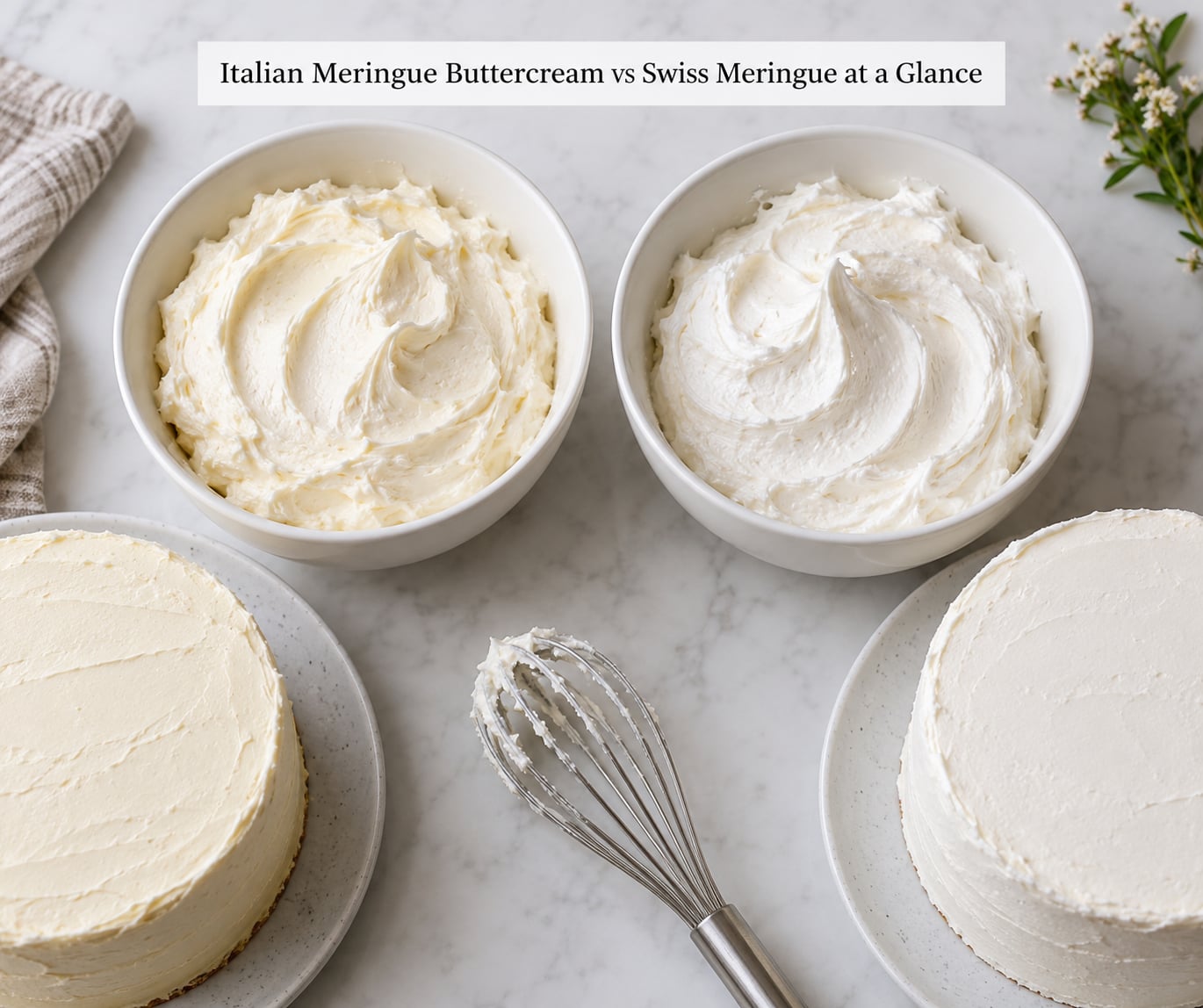
The short version: Swiss meringue buttercream wins on forgiveness and sweetness, Italian meringue buttercream wins on structure and heat tolerance. Everything else follows from those two points.
Italian Meringue Buttercream vs Swiss Meringue comparison table
| Criterion | Italian meringue buttercream | Swiss meringue buttercream |
|---|---|---|
| How the meringue is cooked | Sugar syrup boiled separately to 118C / 240F, then drizzled into whipped whites | Whites and sugar warmed together over a double boiler to 160F / 71C |
| Overall difficulty | Higher, timing and stream control matter | Lower, hard to ruin if you stir constantly |
| Sweetness | Slightly sweeter, reads less sugary once whipped | Noticeably less sweet, ideal for sharp cake |
| Texture | Smooth, dense, plush, holds fine piping detail | Light, aerated, softer, slightly cloudier |
| Melt resistance | Better in a warm room and on tiered cakes | Softens sooner, needs a cool space |
| Egg white pasteurisation | Full cook, no raw-white exposure | Cooked, but less thorough |
| Best uses | Tiered cakes, filled layers, warm events, macaron filling | Cupcakes, layer cakes, swirls, beginner projects |
| Refrigerated storage | Whips back up well after chilling | Holds body, sometimes firms after a fridge |
| Freezing | Up to 3 months, defrost in the fridge overnight | Up to 3 months, defrost in the fridge overnight |
One note on terminology: Italian meringue buttercream is also sold and labelled as mousseline buttercream. If a bakery or a recipe uses that word, it is the syrup-cooked version.
What Is Italian Meringue Buttercream?
Italian meringue buttercream is an egg-white buttercream made by boiling sugar with water to a soft-ball stage and pouring that hot syrup into stiffly whipped egg whites, then beating in cubed butter. The syrup is cooked to roughly 118C (240F) before it hits the whites.
The heat does two jobs. It dissolves more sugar into the meringue, and it thickens the foam so it holds air better than a softly set foam would. That is why Italian meringue ends up plush and dense rather than cloud-like.
How the Italian method runs
- Whip the egg whites with a little sugar to stiff peaks.
- Boil the remaining sugar with water to 118C (240F), about the soft-ball stage.
- Dribble the syrup down the side of the bowl while the mixer runs on medium, hitting the widest part of the foam.
- Keep whipping until the bowl is warm to the touch, then cool it fully.
- Beat in butter cubes a few at a time on low speed.
The drizzling is the part beginners rush. Add syrup too fast and you get loose, watery meringue. Hold it too close to the burner and you get scrambled egg, which is unrecoverable in the bowl.
What Is Swiss Meringue?
Swiss meringue buttercream is an egg-white buttercream made by heating egg whites and sugar together in a double boiler, whisking constantly, until the whites reach about 160F (71C) and stiff peaks form. The mixture is then cooled completely before butter goes in.
Because the sugar never gets hotter than that gentle simmer, more of it stays in its dissolved form without being concentrated by boiling. The result is softer in the mouth and noticeably less sweet than Italian.
How the Swiss method runs
- Whisk egg whites and sugar over barely simmering water, never boiling.
- Keep the mixture moving so no egg sets on the bottom of the bowl.
- Take it off the heat once the whites hit 160F (71C) and form stiff, glossy peaks.
- Cool the bowl to room temperature, ideally in an ice bath to speed it up.
- Beat in butter cubes on low speed until smooth.
A stand mixer with a paddle attachment makes the whole job calmer. If you lack one, this is a whisk-forward recipe by nature, so a hand mixer works but you will be working harder for the same result.
Texture and Frosting Performance
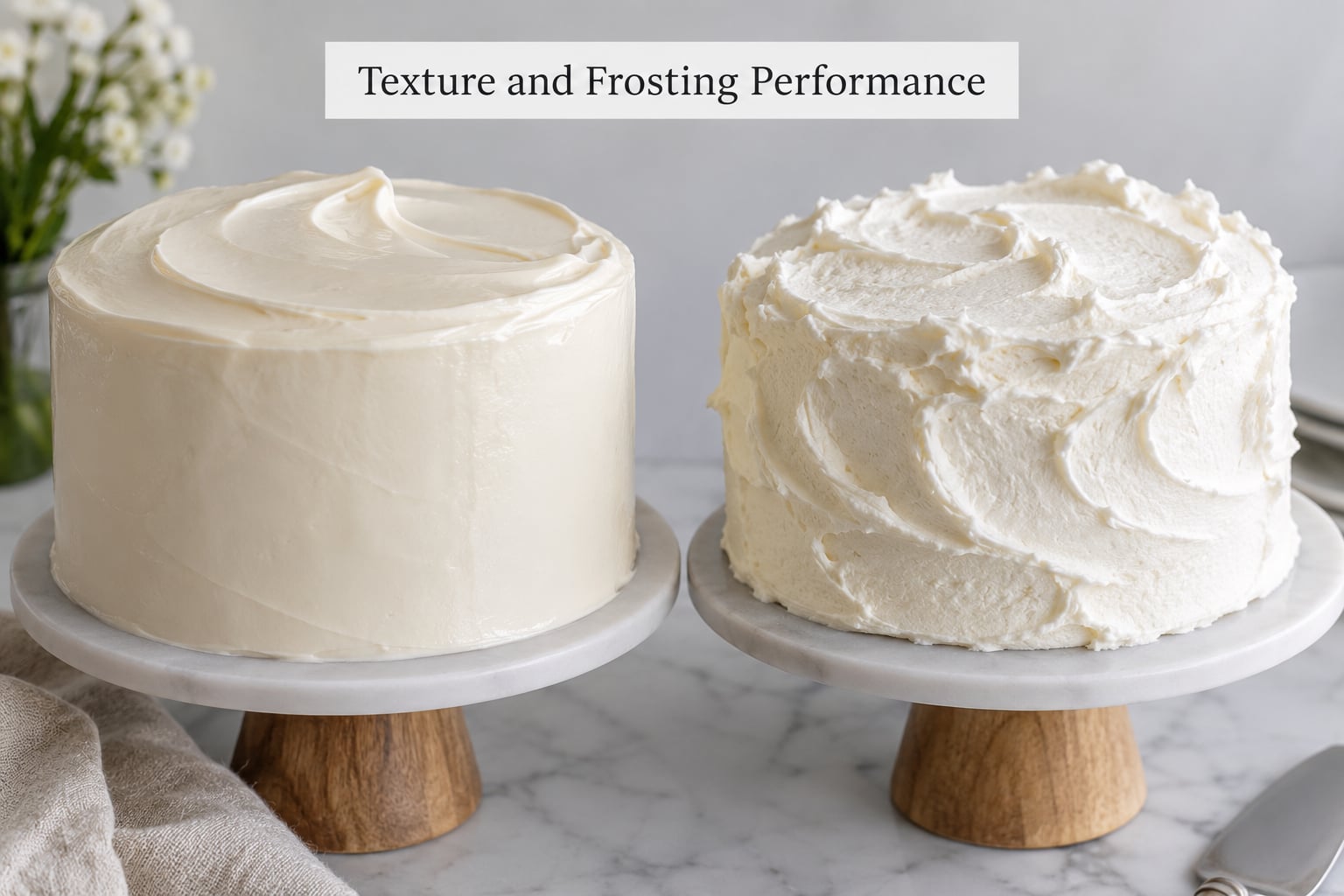
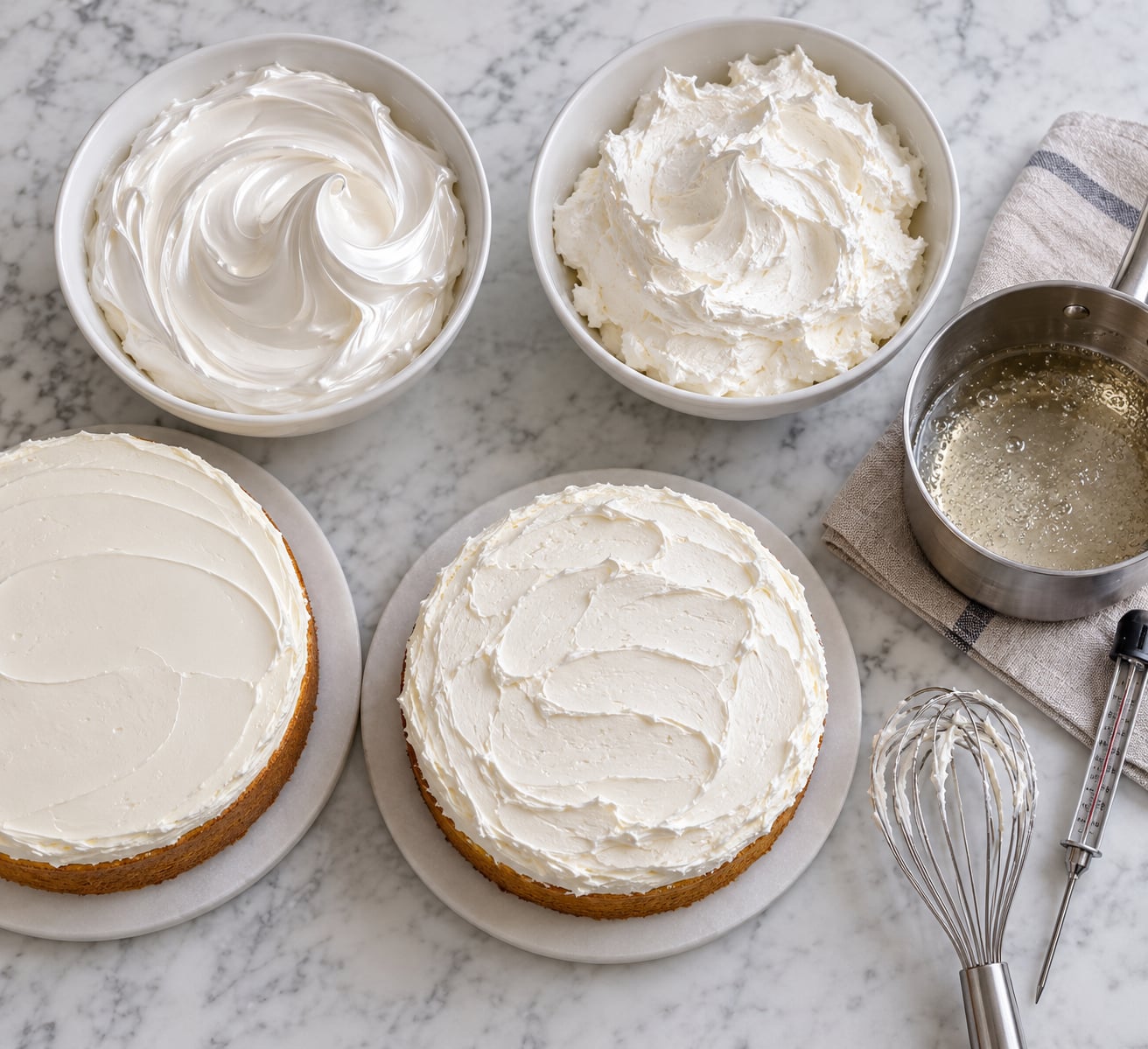
Italian meringue buttercream spreads smooth and glossy, almost like a soft ganache, and it holds sharp edges on piped borders. Swiss meringue buttercream is lighter and fluffier, with a slightly cloudier finish that spreads more readily with a palette knife.
For piped borders and roses, Italian gives cleaner definition and less slump while you work. For a swoop, a spread or a thick layer between cake tiers, Swiss moves faster and needs less pressure.
Cake filling is where Italian pulls ahead. It is dense enough not to push the layers apart and it holds a heavy stack without squeezing out. Swiss works as a filling too, just add a crumb coat and chill before you add the next tier.
Under fondant, both are usable. Many cake shops use a thin layer of Italian as a glue and a fill because it stays put while the fondant is smoothed and burnished.
Macaron shells filled with either will keep for a day or two in the fridge, though Italian is more forgiving if the filling is warm when piped.
Sweetness, Flavor, and Ingredients
Italian meringue buttercream tastes slightly sweeter than Swiss, but not by much, because whipping air into the meringue dilutes the sugar across a much larger volume. Swiss is the one most people describe as less sweet, and it lets fruit, coffee and chocolate flavours come forward instead of the sugar.
Butter behaves the same in both, so use unsalted butter for a cleaner flavour profile and salted if you want the frosting to taste a little more like cake. Very soft butter at room temperature is the target in both cases; cold butter will not emulsify and hard butter will not blend.
Vanilla, cocoa powder and liqueurs all behave similarly. One difference worth knowing: Italian takes colour more cleanly because its denser foam spreads more evenly, while Swiss can look faintly streaky if you tint it too heavily.
Some bakers add a small amount of glucose or corn syrup to either method. It slows melting in warm weather without adding obvious sweetness, which matters more for Italian on an outdoor table.
Temperature and Stability
Italian meringue buttercream holds its shape better as the room warms, which is why it is the standard choice for tiered wedding cakes, cakes that need transporting, and anything served outdoors. Swiss softens earlier and can start to sag or sweat on a filled cake in a warm space.
Neither one shrugs off heat entirely. Above roughly 80F (27C) you should expect some movement in Italian and noticeably more in Swiss, and both will need to go back into the fridge if the weather turns.
There is a useful storage difference that recipe pages rarely mention. Bakers report that Italian meringue buttercream can lose some of its body after refrigeration but whips back to a workable texture with a couple of minutes on medium speed. Swiss often comes out of the fridge firmer than expected, so soften it with a few extra minutes or a splash of warm cream if needed.
Both frostings need the meringue cooled to room temperature before the butter goes in. Warm meringue melts the butter on contact, and that greasy, split result has no fix.
Which Is Easier for Beginners?
Swiss meringue buttercream is easier for beginners. It needs one bowl, a double boiler and a thermometer, and the only skill that really matters is keeping the mixture moving so no egg sets on the base.
Italian asks for more precision. You juggle a hot pan of syrup and a running mixer at the same time, and a stream that lands on the side of the bowl instead of the foam will not thicken properly.
| Tool | Italian meringue buttercream | Swiss meringue buttercream |
|---|---|---|
| Candy thermometer | Required, you are tracking syrup temperature | Required, you are tracking the whites |
| Stand mixer | Paddle for whipping, low speed for butter | Paddle or whisk, low speed for butter |
| Saucepan | Needed for the syrup | Not needed |
| Heatproof bowl | Needed, syrup is near-boiling | Needed, bowl sits over simmering water |
| Ice bath | Useful for the final cool-down | Strongly recommended |
Beginner troubleshooting, in the order you are most likely to hit it:
- The mixture looks curdled when you add the butter. Keep beating on low. Curdling usually resolves once the butter is fully incorporated.
- It stays curdled and separates. Chill it in small portions, then whip each piece on its own until smooth before combining.
- It tastes greasy or too buttery. The meringue was still warm, or the butter was added too fast. Next time cool longer and add it a cube at a time.
- It is soupy. Syrup went in too fast on the Italian, or the Swiss whites did not reach 160F (71C). Both are temperature problems.
- You see big bubbles in the finished frosting. Rub the final product with a warm damp cloth, or keep mixing on low for another minute.
Using pasteurised eggs or meringue powder removes the raw-white question, and both methods work the same way with pasteurised whites.
Italian Meringue Buttercream vs Swiss Meringue: Which Should You Choose?
Choose Italian meringue buttercream for a tiered cake, a filled layer cake that will be assembled hours ahead, a warm-room event, or anything you need to move after frosting. Choose Swiss meringue buttercream for cupcakes, a simple layer cake, a first attempt, or any project where you want the least sweet frosting and the least technique.
- Tiered or stacked cake: Italian. It carries weight and keeps its edges.
- Outdoor or warm-weather event: Italian, plus a glucose or corn syrup addition.
- Cupcakes and smash cakes: Swiss. Faster to make and easy to spread.
- Sharp cake such as lemon or carrot: Swiss. Less sugar competes with the flavour.
- Filling between layers: Italian. Denser, so the layers stay aligned.
- Under fondant: Either, though Italian is the more common shop choice.
- Macaron filling: Either. Italian holds slightly better once the shells chill.
- First meringue buttercream ever: Swiss, every time.
If you already have a Swiss recipe and want to switch, the change is small: cook the sugar separately to 118C (240F) and stream it into whites whipped to stiff peaks, with everything else staying the same.
Frequently Asked Questions
Which is better, Italian meringue buttercream or Swiss meringue?
Italian wins on structure. Italian meringue buttercream is denser, holds piping detail and resists warm rooms better. Swiss wins on ease and sweetness. Swiss meringue buttercream is lighter, less sweet and harder to ruin. For cupcakes, layer cakes and first attempts, choose Swiss. For tiered cakes, filled layers, travel and warm events, choose Italian.
Is Italian meringue buttercream more stable than Swiss meringue?
Yes. Italian meringue buttercream is more stable because the sugar syrup is boiled to about 118C (240F), which makes the meringue foam denser and more pasteurised. That density lets it hold piped shapes and resist softening in a warm room. Swiss meringue buttercream softens sooner, so it suits cool indoor decorating and cakes eaten within a day or two.
Which meringue frosting is sweeter?
Swiss meringue buttercream is the less sweet of the two, because the sugar is never boiled and much of it stays in dissolved form without concentrating. Italian meringue buttercream tastes slightly sweeter, though whipping air into the foam spreads that sugar across a larger volume. If sweetness is your main concern, add extra butter rather than reducing sugar, which is what causes a soupy frosting.
Is Swiss meringue easier for beginners to make?
Swiss is the easier method. The egg whites and sugar heat together in a double boiler to about 160F (71C) while you whisk, so there is no hot syrup to juggle and no stream to control. A curdled batch usually comes back with more whisking. Italian asks for a second pan, a candy thermometer and steady hands on the syrup pour.
Can Italian meringue buttercream be used on cupcakes?
Yes, and it pipes beautifully on cupcakes. The denser texture holds tall swirls and rosettes without slumping, which is the main reason it is the choice for decorated cupcake towers. Italian is slightly sweeter than Swiss, so for very sweet cake flavours you may want to cut the sugar a little or use Swiss instead.
How long can each meringue frosting be stored?
Both keep in the fridge for up to 3 days in an airtight container, and both freeze for up to 3 months. Defrost in the fridge overnight rather than on the counter. Because both contain cooked egg whites and dairy, discard frosting that has sat out longer than about 2 hours at room temperature, or 1 hour if the room is above 90F (32C).
Conclusion
Start with Swiss meringue buttercream if this is your first meringue frosting or if you want the least sweet result with the most forgiving process. Switch to Italian meringue buttercream when the job needs structure: tiers, filled layers, a warm venue or a cake that has to travel.
Both use the same butter and the same egg whites. Learn one, get comfortable with it, and the second takes an afternoon.