How long can you freeze cookie dough? Most dough keeps for 2 to 3 months in the freezer at peak quality, and stays safe to bake for up to 6 to 12 months when it is wrapped airtight and your freezer holds 0°F (-18°C) or below. You do not need a special recipe for it. Chill the dough, portion it, seal out every bit of air, and bake it straight from frozen with a few extra minutes.
The part that trips people up is not the freezing. It is the thawing, and how long dough sat in the fridge before it ever reached the freezer. I have learned that lesson the slow way, twice, in a December batch that smelled like freezer odours because I left a twist tie loose.
This guide covers how long cookie dough lasts frozen, how to package it by cookie style, and how to get it back to a bakeable state. Updated for 2026, and tested across drop cookies, sugar cookie logs and pan bars.
Table of Contents
- What You Need
- Step-by-Step
- How Long Does Cookie Dough Last in the Freezer?
- Can You Freeze Cookie Dough With Baking Soda or Yeast?
- How to Thaw Cookie Dough Without Deflating or Spreading
- Common Mistakes
- Frequently Asked Questions
- How long can you freeze cookie dough?
- Can you freeze cookie dough with baking soda?
- Should I freeze cookie dough in individual portions or as a log?
- How long do frozen cookies need to thaw before baking?
- Can you freeze baked cookies instead of unbaked dough?
- Can you refreeze cookie dough after it has thawed?
- Conclusion
What You Need
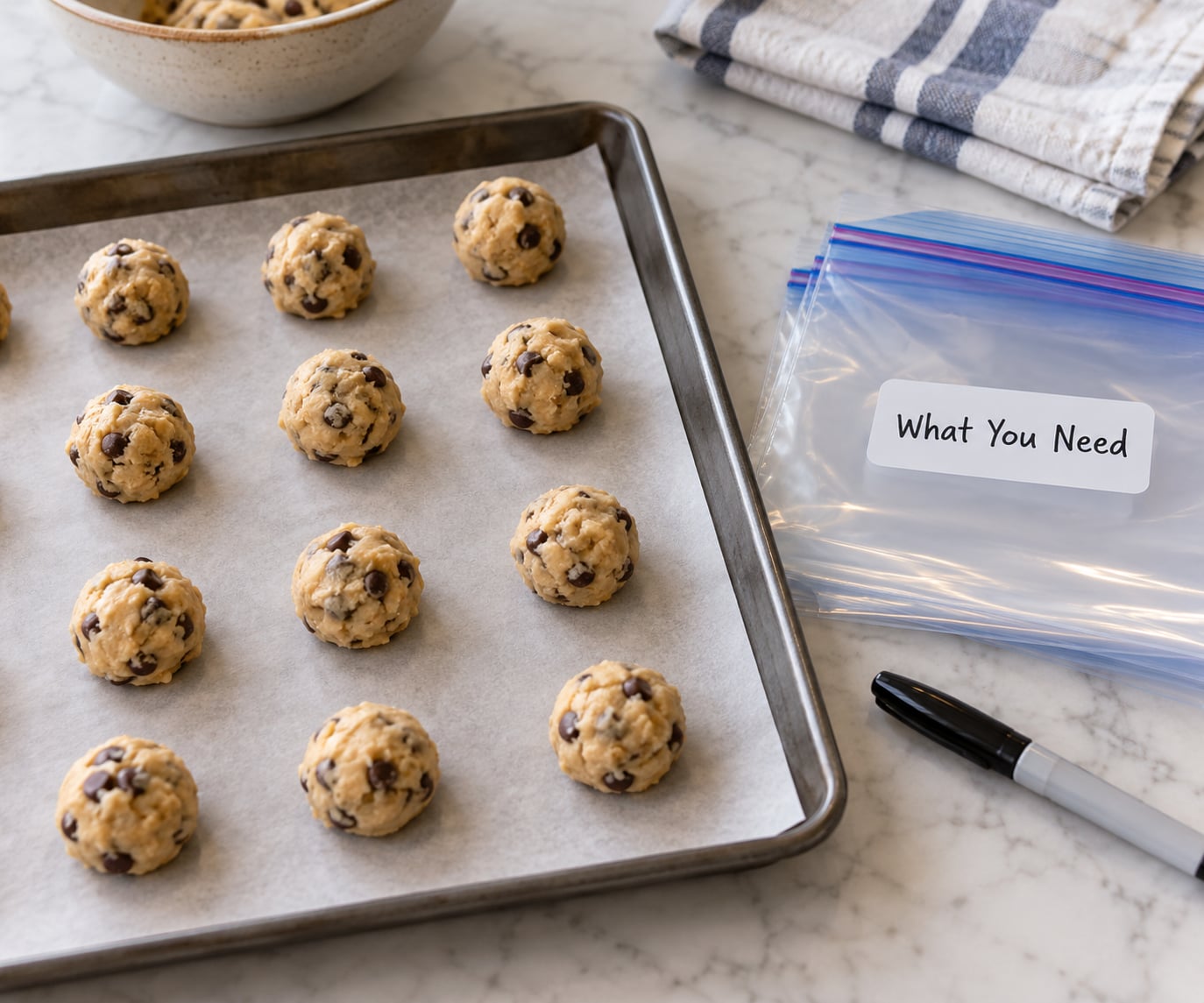
You need very little. The quality of the result comes from how well air is kept out, not from expensive gear.
- Parchment or wax paper to line your baking tray for flash freezing. Parchment survives freezer temperatures better than wax paper, which tends to crack cold.
- A baking sheet or small wire rack for freezing dough balls in a single layer without touching.
- Freezer bags or airtight containers. A vacuum sealer helps, but pressing out the air by hand works nearly as well.
- Plastic wrap or parchment discs to separate layers if you stack logs or rolled disks.
- A cookie scoop so every ball bakes the same size and cooks at the same rate.
- A permanent marker and masking tape to record the cookie type, the date frozen and the bake temperature.
- A freezer thermometer if you want proof your freezer is actually at 0°F.
Skip the fancy vacuum bags with individual compartments. They are fine, but a plain heavy-duty freezer bag with the air squeezed out performs nearly the same job.
Step-by-Step
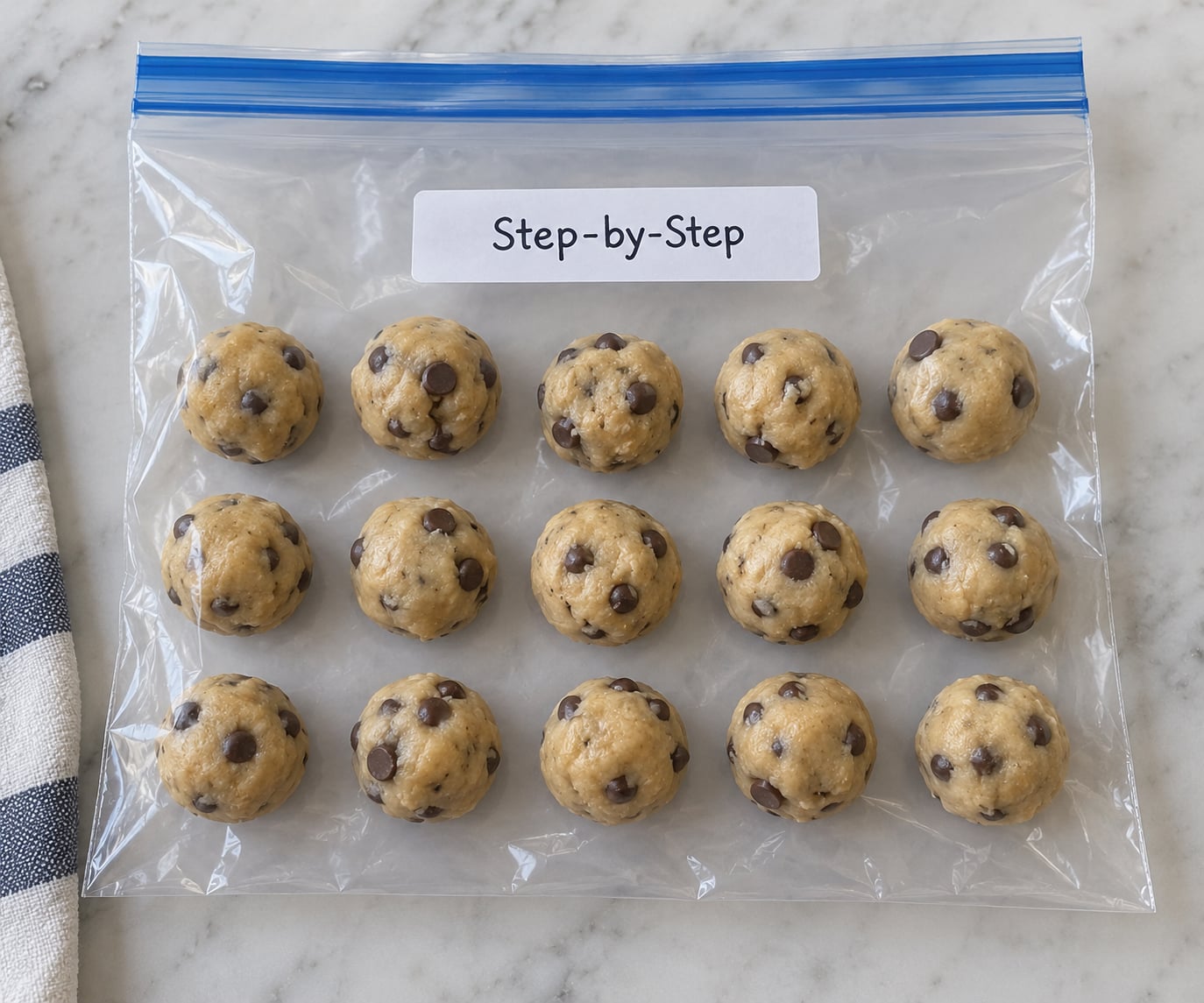
Here is the process that works for almost every drop, rolled and bar dough. Plan about 20 minutes of active time plus 1 to 2 hours of freezing.
How Long Does Cookie Dough Last in the Freezer?
For most cookie dough, plan on 2 to 3 months for the best texture and flavour, and treat 6 months as a comfortable practical ceiling for a weeknight bake. Where the 6 to 12 month range in most guides comes from is general frozen-food safety rather than a quality promise. The dough stays edible that long, but the butter flavour flattens and the texture firms up.
What you bake matters more than the calendar. Doughs high in butter and sugar freeze very well because sugar and fat both retard staling. Thin, low-fat crisps and wafers suffer most, since there is little fat left to protect them. Dough with fresh fruit or raw cream is the exception: those ingredients go downhill faster than the flour does.
Baked cookies, incidentally, hold up far longer than raw dough. Most baked cookies keep their best quality for 2 to 3 months frozen and stay perfectly safe to eat for 6 months or more.
| Dough or cookie type | Best quality frozen | Maximum safe storage |
|---|---|---|
| Drop cookies (chocolate chip, snickerdoodle) | 2-3 months | 6-12 months |
| Baked drop cookies | 2-3 months | 6-12 months |
| Sugar cookie logs and slice-and-bake dough | 3 months | 9-12 months |
| Rolled cutouts (sugar, gingerbread) | 2-3 months | 6 months |
| Brownie and cookie bar batter | 3 months | 6-12 months |
| Sandwich cookie dough (store-bought tube dough) | 3 months | 6 months |
| Gluten-free dough | 1-2 months | 3 months |
| Whipped egg white dough (macarons, meringues) | 1 month | 2 months |
| Thin pizzelles and lace cookies | Freeze baked, not raw | 3 months baked |
Can You Freeze Cookie Dough With Baking Soda or Yeast?
Yes, but the leavening behaves differently depending on which one you used. Baking soda dough freezes reliably. What you may notice is that thawed soda dough spreads a little more, so give it a longer chill before baking and expect slightly flatter cookies.
Baking powder dough also freezes well. Because baking powder loses potency slowly, a dough that has sat a few months can come out of the oven a fraction lower and denser than a fresh batch, though it will still rise.
Yeast dough is the one to think twice about. Freezing can weaken yeast activity, and the damage grows the longer the dough sits. Freeze it only if the plan is to bake within about a month, and prefer freezing unbaked shaped rolls rather than the risen mass.
How to Thaw Cookie Dough Without Deflating or Spreading
The rule of thumb: thaw in the fridge, never on the counter. Cold thawing lets the butter soften slowly, which is what keeps a dough ball round instead of letting it puddle.
- Dough balls usually need 30 to 60 minutes at room temperature if you want to bake within the hour, or 2 to 4 hours in the fridge for an even softer ball.
- Logs and rolled disks need 24 to 48 hours in the fridge. You want the log firm enough to slice cleanly without crumbling.
- Slice-and-bake dough can usually go straight to baking from frozen, sliced paper-thin.
If the dough comes out harder than you expected, give it more fridge time rather than microwaving it. A microwave leaves hot spots that melt the butter in patches and the cookie bakes uneven.
If the dough got soft and sticky while you were handling it, do not bake it as it is. Flatten it back onto a lined tray, chill it for 30 minutes until firm, and it will behave normally.
And when you do bake, add a little time. The oven still needs to bring the centre of a frozen ball to temperature, and skipping the extra minutes leaves you with a raw middle.
| Cookie type baked from frozen | Add to the bake time | Notes |
|---|---|---|
| Drop cookies | 1-2 minutes | Drop balls straight onto the hot tray, 2 inches apart |
| Rolled cutouts | 2-3 minutes | No need to thaw, just bake from the frozen sheet |
| Slice-and-bake logs | 1-3 minutes | Slice with a sharp knife while still firm |
| Cookie bars | 3-5 minutes | Cover the pan with foil for the first 10 minutes |
| Air fryer, any type | 1-2 minutes at 350°F | Do not stack, and check at the halfway point |
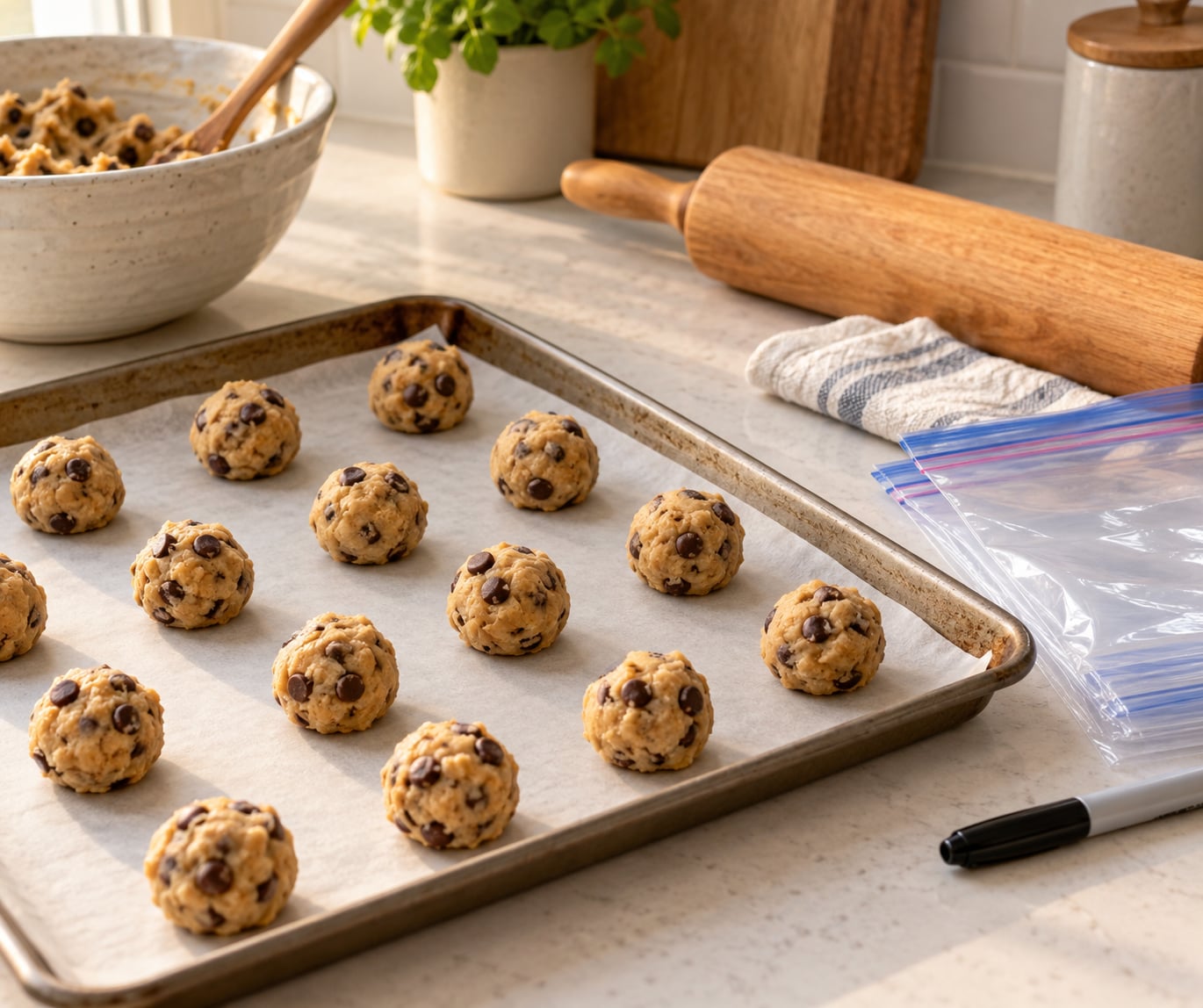
Now the freezing itself, step by step. Chill the mixed dough for at least 30 minutes so the butter firms and the dough is easier to handle. Portion it: scoop balls for drop cookies, roll logs about 2 inches wide for slice-and-bake, or roll and cut your shapes straight from the chilled slab.
Arrange the portions on a parchment-lined baking sheet, spaced so they cannot touch. This is the flash freeze step that most guides call essential, and it is the single thing that stops dough balls welding themselves into one lump. Freeze 1 to 2 hours, until solid to the touch.
Transfer the frozen portions to a freezer bag or airtight container, press out the excess air and seal it. Squeeze air out of a bag with a rolling pin if you do not own a vacuum sealer; that is the same trick.
Label it with the cookie type, the date and the temperature you baked at before freezing. Freeze flat, away from raw meat and fish, and keep the freezer at 0°F or below. Use it from the back of the freezer where the temperature stays coldest.
Common Mistakes
Freezing one big unportioned mass. You cannot break it off later without digging into it, and the exposed surface frosts over. Portion first, freeze second.
Leaving air in the bag. That trapped air is what causes freezer burn, the dry greyish surface and off odours you notice on thawed dough. Press the bag flat as you seal it.
Not labelling packages. Frozen dough all looks like a pale lump. Two unlabelled bags become a guessing game, and you end up baking the wrong one for the wrong occasion.
Thawing on the counter for hours. Room temperature is where bacteria multiply, and it is the fastest route to a spread, greasy cookie. Move the dough to the fridge as soon as you take it out.
Baking straight from the freezer without extra time. This is the reason frozen cookies sometimes come out doughy in the middle. Add the extra minutes listed above.
Forgetting the mix-ins change behaviour. Nuts go soft and chewy when frozen, dried fruit and fresh berries bleed colour into the dough, and chopped chocolate loses its snap. Freeze those doughs for under two months and expect a slightly different texture than a fresh batch.
Leaving the freezer door open while you bake. The dough refreezes in the middle of thawing and the texture suffers. Take out one bag, bake, and put the rest back.
Using the dough you thawed in the fridge for a week. Dough keeps about 2 to 3 days refrigerated, sometimes up to 4 if it is well wrapped and your fridge is cold. Beyond that, freeze it instead.
Two habits cover most of the rest. Store different doughs in separate bags rather than one crowded box, so you can pull a single portion out without thawing everything. And keep a small written list taped inside the freezer door with the date next to each item; on day one you will remember, on day ninety you will not.
Frequently Asked Questions
How long can you freeze cookie dough?
Cookie dough keeps its best flavour and texture for 2 to 3 months in the freezer, and remains safe to bake for 6 to 12 months when wrapped airtight at 0°F or below. Doughs high in butter and sugar freeze best, while thin wafer styles and doughs with fresh fruit lose quality faster. Baked cookies keep longer than raw dough, usually staying at peak quality for 2 to 3 months frozen.
Can you freeze cookie dough with baking soda?
Yes. Baking soda dough freezes reliably and thaws without turning grainy. The main change is that thawed soda dough tends to spread a little more, so chill it again before baking and expect slightly flatter cookies than you would get fresh. Dough made with baking powder also freezes well, though very old dough may rise a little less. Yeast dough is the least forgiving.
Should I freeze cookie dough in individual portions or as a log?
Portion before freezing whenever you can. Scooped balls bake in 10 to 15 minutes straight from frozen, with no slicing and no guessing. Logs are better for slice-and-bake cookies and for rolled disks, since you can cut them to thickness later. Either way, flash freeze the portions on a parchment-lined tray for 1 to 2 hours first so they do not fuse together in the bag.
How long do frozen cookies need to thaw before baking?
Most dough balls only need 30 to 60 minutes at room temperature if you are baking within the hour, or 2 to 4 hours in the fridge for a softer, more workable ball. Logs and rolled disks need 24 to 48 hours in the fridge so they slice cleanly. Slice-and-bake dough can go from freezer to oven without thawing, and drop cookies usually just need an extra 1 to 2 minutes in the oven.
Can you freeze baked cookies instead of unbaked dough?
Yes, and baked cookies are actually easier to store. They hold their best quality for 2 to 3 months frozen and remain safe to eat for 6 months or more. Cool them completely on a rack first, then pack them in layers with parchment between each one, and skip the frosting or glaze until serving. Freezing frosted cookies works too, but the icing often turns crumbly.
Can you refreeze cookie dough after it has thawed?
You can, but quality drops with each thaw and refreeze cycle, and dough that sat at room temperature for more than about two hours should not go back in the freezer. The practical limit is one refreeze. If your dough has been in the fridge for 2 to 3 days, freezing it then is still fine, as long as you wrap and label it like a fresh batch.
Conclusion
So, how long can you freeze cookie dough? Two to three months is the window where it bakes like fresh dough, and six months or more stays perfectly safe when it is sealed and kept at 0°F. Nothing else changes the outcome as much as the packaging.
Here is what to do first: chill the dough, portion it, flash freeze the pieces on a parchment-lined tray for 1 to 2 hours, then move them into a labelled airtight freezer bag. Fifteen minutes of work on a Tuesday gives you warm cookies for months.