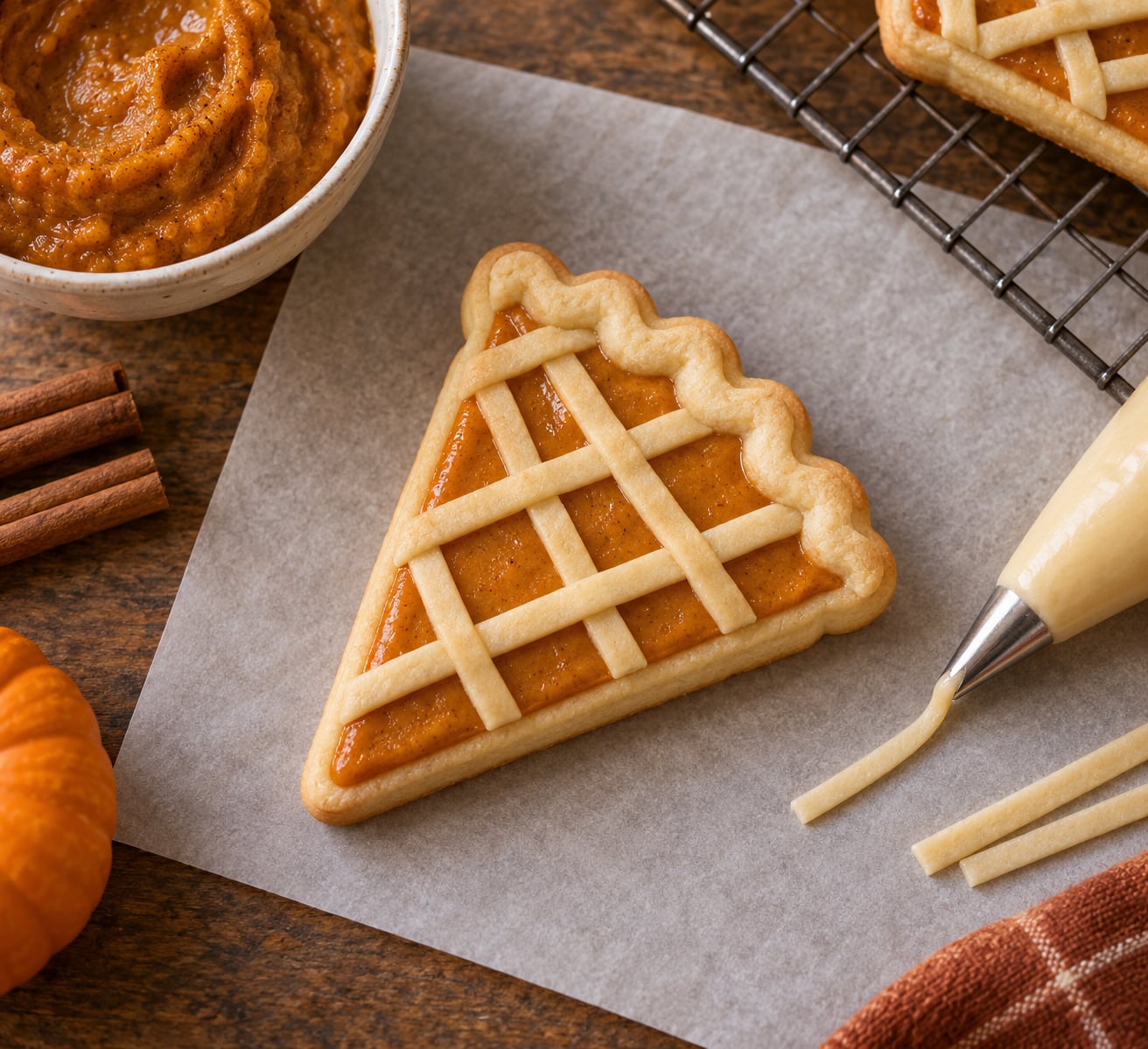
Thanksgiving pie cookies are bite-sized cookies that capture the flavor of a holiday pie, whether that is apple, pumpkin, pecan or sweet potato, without the rolling, blind-baking and 90-minute bake of a real pie. To make them, chill a rolled sugar-cookie dough, cut pumpkin-pie shapes, bake until the edges are crisp, cool the shells completely, then fill and top with a thickened pumpkin filling and a lattice of pastry strips.
The full batch takes roughly 90 minutes from counter to finished cookie, and about 40 of those minutes are hands-off. The tricky part is not baking, it is patience: dough that is too warm spreads, cookies that are filled while warm turn soggy underneath, and a filling that is not thickened runs out onto the sheet pan. Read the steps below once before you start and this is a beginner-friendly project.
Table of Contents
- What You Need
- Sugar-cookie dough
- Pumpkin pie filling
- Finishing
- Tools
- What can be made ahead
- Step-by-Step
- Chill and Roll the Cookie Dough
- Bake the Pie-Shaped Cookies
- Make the Pumpkin Pie Filling
- Assemble and Decorate the Cookies
- Make the Thanksgiving Pie Cookies Ahead
- Common Mistakes
- Tips for Perfect Thanksgiving Pie Cookies
- Frequently Asked Questions
- What are Thanksgiving pie cookies?
- How long should I bake pumpkin pie cookies?
- Can I make Thanksgiving pie cookies ahead of time?
- Can pumpkin pie cookies be frozen?
- What filling works best for pie-shaped cookies?
- Can I make pumpkin pie cookies without fresh pumpkin?
- Conclusion
What You Need
Everything comes from a standard pantry plus one canned ingredient. The recipe below makes 16 cookies, enough for a dessert table alongside a pie, or a full stand-alone treat if you double the dough.
Sugar-cookie dough
- 2 1/4 cups (280 g) all-purpose flour, plus extra for rolling
- 1/2 cup (113 g) unsalted butter, softened to room temperature
- 1/3 cup (67 g) granulated sugar
- 1 large egg, room temperature
- 1 teaspoon vanilla extract
- 1/2 teaspoon fine sea salt
Pumpkin pie filling
- 3/4 cup (185 g) canned pumpkin puree, not ready-made pie filling
- 1/3 cup (67 g) packed light brown sugar
- 1 teaspoon pumpkin pie spice
- 1/4 teaspoon fine sea salt
- 1 tablespoon cornstarch mixed with 1 tablespoon cold water to make a slurry
- 1 teaspoon vanilla extract and a squeeze of fresh lemon juice, both optional
Finishing
- 1 egg plus 1 tablespoon milk or water for an egg wash
- 2 tablespoons coarse sugar for the edges
- Confectioners sugar or a small batch of lightly whipped cream for finishing, if you like
Tools
A rolling pin, a pumpkin-pie-shaped cookie cutter around 4 inches wide, a small offset spatula or butter knife for lifting cookies, a pastry brush, a rimmed baking sheet lined with parchment paper, a wire cooling rack, a small saucepan for the filling, and either a small piping bag or a resealable zip-top bag with a corner snipped off for the lattice strips. A pumpkin pie cutter with a fluted edge gives you the lattice design built in, which saves the piping step entirely.
What can be made ahead
Nearly everything. The dough can be formed into two logs, wrapped and refrigerated for up to 3 days or frozen for up to 2 months. The cooked pumpkin filling keeps in an airtight container in the fridge for 5 days. Baked shells stack in a single layer in a sealed container and stay good for 5 days, though the edges soften after 2 days if you store them with any moisture. That is why the shells wait, unfilled, until the day before or the morning of.
If anyone at your table has a nut allergy, buy cornstarch, pumpkin puree, spice blends and coarse sugar from brands that label allergen information, and make the nut-free batch first with a clean bench and clean utensils. Cross-contact matters more than the recipe itself here, and it takes five extra minutes to do the safe version first rather than later.
Step-by-Step
Chill and Roll the Cookie Dough
Whisk the flour and salt together in a large bowl. Beat the softened butter and granulated sugar until pale and slightly fluffy, about 2 minutes, then mix in the egg and vanilla until smooth. Add the dry ingredients and stir just until no floury streaks remain.
Wrap the dough and refrigerate for at least 45 minutes. This is not optional, and it is the single change that fixes most spreading, cracking and ragged edges. A cold dough holds its shape on the sheet; a warm one slumps into a puddle the moment it hits the heat.
Lay a sheet of parchment on the counter, dust it lightly with flour, and unwrap the dough onto it. Flour the rolling pin and roll the dough to 1/4 inch thick, turning it a quarter turn every few passes so it does not stick. Correct thickness is the difference between a cookie that stays crisp and one that goes hard and pale.
Press a fluted pumpkin-pie cutter straight down, no rocking, and lift each round onto the parchment. Reroll the scraps three or four times instead of twice, then stop and bake whatever odd shapes you get. Those ragged edges are the cook’s taste.
Before the shapes go on the sheet, the dough should look matte and pale with a faint sheen from the butter, and it should spring back slowly when you press a fingertip into the edge. If it cracks sharply or leaves flour behind, it is too dry; knead in a tablespoon of butter or a splash of milk rather than adding more flour.
Bake the Pie-Shaped Cookies
Heat the oven to 350 F (175 C) and line a baking sheet with parchment. Space the pie shapes 2 inches apart, which sounds generous for such small cookies but matters: the extra room is what keeps the lattice and the fluted rim legible instead of fusing into one another.
Brush lightly with the egg wash and scatter a pinch of coarse sugar around the rim of each cookie. Do not sugar the middle. The filling goes there, and a sugared middle bakes into a hard shell that the filling then cracks.
Bake for 10 to 12 minutes, rotating the pan once at the halfway mark. The cookies are done when the edges are firm and lightly golden and the centers still look pale and slightly underdone. They will set as they cool, and a cookie that looks done in the oven will be dry and crumbly by the time the filling goes on.
If your cookies are browning fast, wrap the pan in a second sheet pan or drop the oven a notch. The single biggest reason the pie outline disappears is fat plus heat: too little butter in the dough, or too much of it, both melt before the flour sets.
Make the Pumpkin Pie Filling
Whisk the pumpkin puree, brown sugar, pumpkin pie spice, salt, vanilla and lemon juice together in a saucepan. Set it over medium-low heat and stir often as it comes up to a simmer, then stir in the cornstarch slurry and keep stirring for 1 to 2 minutes.
The filling is ready when a finger drawn across the bottom of the pan leaves a clean trail that stays open for a few seconds. That is the cornstarch doing its job. Skipping the slurry gives you a filling that bakes thin and then runs out of the cookie the moment it cools, which is the most common complaint about pie cookies.
Pour it into a shallow dish and cool to room temperature, or set it over an ice bath if you are in a hurry. Cool filling sets to a soft, spoonable paste. Warm filling melts the shell underneath it and gives you a soggy bottom.
Canned pumpkin is what you want here. Fresh pumpkin or roasted squash has too much water to thicken reliably, and if you insist on using it, roast the flesh first, let it drain, and reduce it on the stove until it is the consistency of thick yogurt before it goes into the pan.
Assemble and Decorate the Cookies
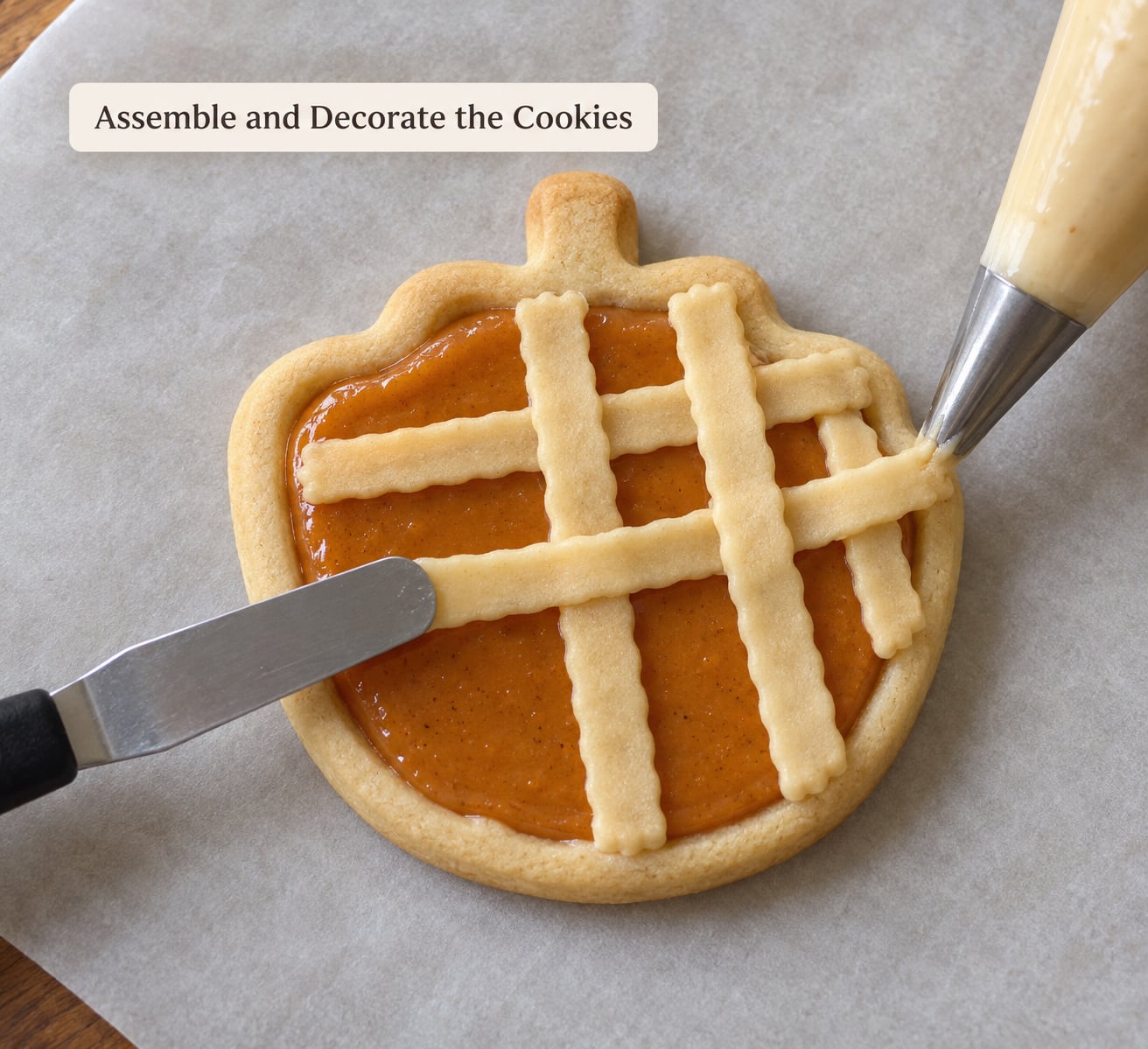
Cool the shells on a wire rack until they are completely at room temperature, which usually takes 25 to 30 minutes. A warm shell has residual heat that will soften the filling and melt the butter in the lattice strips.
Flip each cookie so the flat baked side faces up. Flipping is what separates a tidy tray from a lopsided one: the base becomes your filling surface, and the rim you cut stays as a raised border around the pie.
Fill the center of each cookie with about 1 tablespoon of filling, staying inside the crust rim. A small offset spatula or the back of a teaspoon works well, and a zip-top bag with a clipped corner gives you the most control. Less filling is nearly always better than more; a little that shows above the rim looks generous, a lot looks like it is escaping.
Crisp pie cookies are a serving suggestion rather than a food safety rule, so room temperature is fine for a few hours. If a dish is going to sit out on a warm counter all afternoon, refrigerate it and bring it out 20 minutes before serving. Any filling made with cream cheese, or any plate that has been in a warm car, should not go back in the fridge or go to anyone else; throw it out instead.
Make the Thanksgiving Pie Cookies Ahead
Thanksgiving is the easiest baking holiday to get ahead on because the cookies break into separate parts. Nothing needs to be assembled until the last hour.
Three days out, form the dough into two logs, wrap them and refrigerate. Two days out, cook the filling, cool it, cover and refrigerate. One day out, bake the shells, cool them completely, and store them in a single layer in a sealed container, not stacked, so the rims do not get crushed. The morning of, fill and pipe, then let them set on the tray for 20 minutes before moving them.
| When | What to do | Where it goes |
|---|---|---|
| 3 days out | Make and shape the dough into two logs | Refrigerator, wrapped |
| 2 days out | Cook the pumpkin filling and cool it | Refrigerator, airtight |
| 1 day out | Bake the shells, cool fully, store in a single layer | Airtight container at room temperature |
| Day of | Fill, pipe the lattice, finish with sugar or cream | Set on the tray 20 minutes before serving |
Frozen shells freeze well, up to 2 months, in a single layer. Thaw them at room temperature, uncovered, on a rack, then fill and bake as if they were fresh.
Common Mistakes
The dough spreads into ovals. It was too warm, or it rested too long after rolling. Chill the logs for 30 minutes before cutting, cut fast, and get the shapes onto the sheet within 10 minutes. If your kitchen is warm, work in batches rather than rolling the whole dough at once.
The cookies look right but the pie outline disappears. Usually fat content. Very high-fat dough melts before it sets, and a very lean dough spreads from the opposite direction. Stick to the ratio in this recipe, and press the cutter straight down instead of rocking it, which thins the edge.
The dough cracks around the filling well or during rolling. The crust is too dry. Add a tablespoon of butter or a splash of milk and knead it back in. A well pressed into a dough ball taken straight from the fridge splits the top, so let chilled dough sit at room temperature for about 30 minutes before you indent it.
The filling runs out of the cookie. Almost always a thin filling. Cornstarch slurry is not optional, and the filling must cool to room temperature before it goes on. If you used sweetened canned pie filling instead, use two-thirds as much and let it thicken on the stove first.
The bottoms go soggy. You filled a warm shell, or you stored the finished cookies in a sealed container while they were still warm. Cool everything first, and keep frosted cookies out of an airtight box until the frosting has set.
The lattice strips slide off or slump. Overpiped or piped on a warm cookie. Pipe a thinner line than feels right, use cooled cookies, and press each strip lightly into the filling at both ends so it has something to grip. A fluted cutter does the same job with no piping at all.
Tips for Perfect Thanksgiving Pie Cookies
Control the spice, because two blends are very different. Pumpkin pie spice is already a mix of cinnamon, ginger, nutmeg, cloves and allspice. Adding cinnamon and nutmeg on top of it is the reason many cookies taste dusty, so use the blend at the stated amount and taste the raw filling before baking.
Roll the dough to a steady 1/4 inch. A ruler or a ruler plus two dowels on either side of the dough keeps every cookie the same thickness, which matters more than it sounds because thin cookies crisp and thick ones stay pale.
Do a nut-free batch first and dedicate the tools. Wipe the bench, use a clean rolling pin, and keep the flour and sugar in tubs you use only for this. A nut-free cookie is not nut-free if the same scoop touched almonds last week.
Pick the method for the room. Pie-shaped sugar cookies with a lattice top look like a pie and suit adults and a formal table. Pumpkin thumbprints, where you press a well into a spiced dough ball and fill it, take about half the time and are more forgiving for a group bake with kids. Pumpkin cookies also travel better in a Tupperware than latticed ones, which are fragile when stacked.
Scale for a big table. Four times the dough in one bowl is fine; four batches at once in one oven is not. Stagger the sheets so you can rotate and remove them without rushing.
Finish simply. A dusting of confectioners sugar the morning of, or piped whipped cream added at serving, is enough. Save candy corn and sprinkles for the kids’ table, where they earn their place.
Frequently Asked Questions
What are Thanksgiving pie cookies?
Thanksgiving pie cookies are bite-sized cookies that capture the flavor of a holiday pie without making a whole pie. Most versions use rolled sugar-cookie dough cut into pumpkin-pie shapes, baked until crisp, then filled with spiced apple or pumpkin and finished with a lattice top. Other popular forms are pumpkin thumbprints, chewy cookies made with pieces of pie crust folded into the dough, and swirled spiced dough.
How long should I bake pumpkin pie cookies?
Pie-shaped sugar cookies bake at 350 F (175 C) for 10 to 12 minutes, until the edges are firm and lightly golden and the center still looks pale. They finish setting on the cooling rack, so pulling them at the first sign of color is right. Pumpkin thumbprint cookies take 12 to 15 minutes at the same temperature. Anything longer usually means the oven is running hot.
Can I make Thanksgiving pie cookies ahead of time?
Yes, and it is the easiest part of this recipe. Make the dough up to 3 days ahead and keep it wrapped in the fridge, cook the filling 2 days ahead and refrigerate it airtight, and bake the shells a day ahead stored in a single layer. Fill and decorate the cookies the morning you plan to serve them, and the shells will still be crisp.
Can pumpkin pie cookies be frozen?
Baked shells and unfilled cookies freeze well for up to 2 months in a single layer on a sheet pan, then moved to a container. Thaw them uncovered on a wire rack at room temperature rather than in the fridge, because thawing slowly adds moisture to the bottom. Do not freeze a filled or frosted cookie; the filling goes on after thawing.
What filling works best for pie-shaped cookies?
A cooked, thickened filling is what keeps pie cookies from falling apart. The best flavor comes from a simple stovetop filling of canned pumpkin, brown sugar, pumpkin pie spice and a cornstarch slurry, cooked for 1 to 2 minutes. Ready-made canned pie filling works too, but use two-thirds as much and simmer it first, because it is thinner and much sweeter.
Can I make pumpkin pie cookies without fresh pumpkin?
Canned pumpkin puree is the better choice, and it is what this recipe assumes. Fresh pumpkin or roasted squash holds too much water to thicken properly, which gives you a cookie with a soggy bottom. If fresh is all you have, roast it, drain it, then simmer it until it is as thick as yogurt before mixing it into the filling.
Conclusion
Start by chilling the dough, not by preheating the oven, and give the shells a full 30 minutes on a rack before they get filled. Cook the pumpkin filling with a cornstarch slurry and let it cool to room temperature; those two steps are what separate a crisp pie cookie from a soggy one. From there the schedule is forgiving: dough three days out, filling two days out, shells the day before, and filling and lattice work on the morning of Thanksgiving.