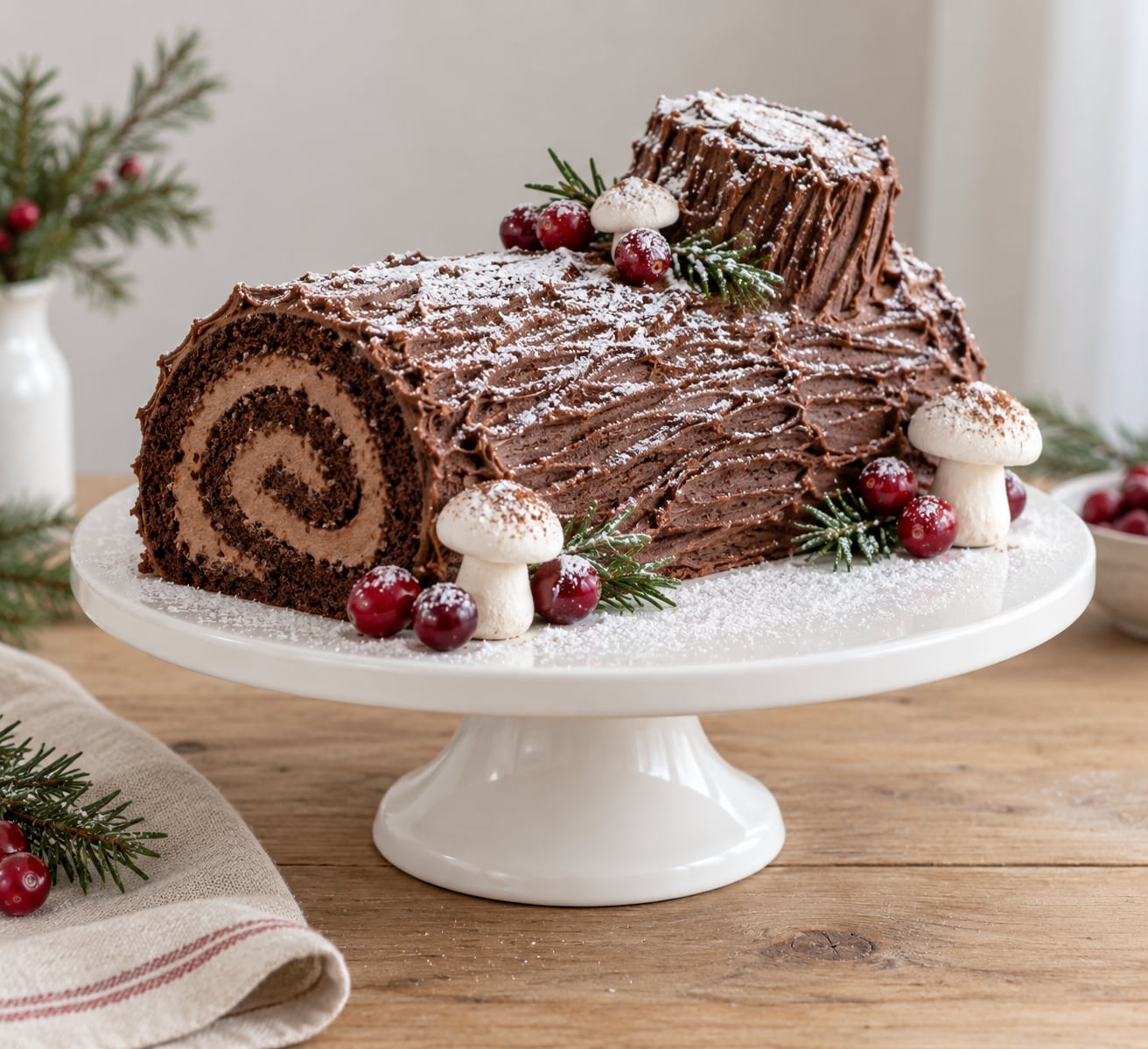
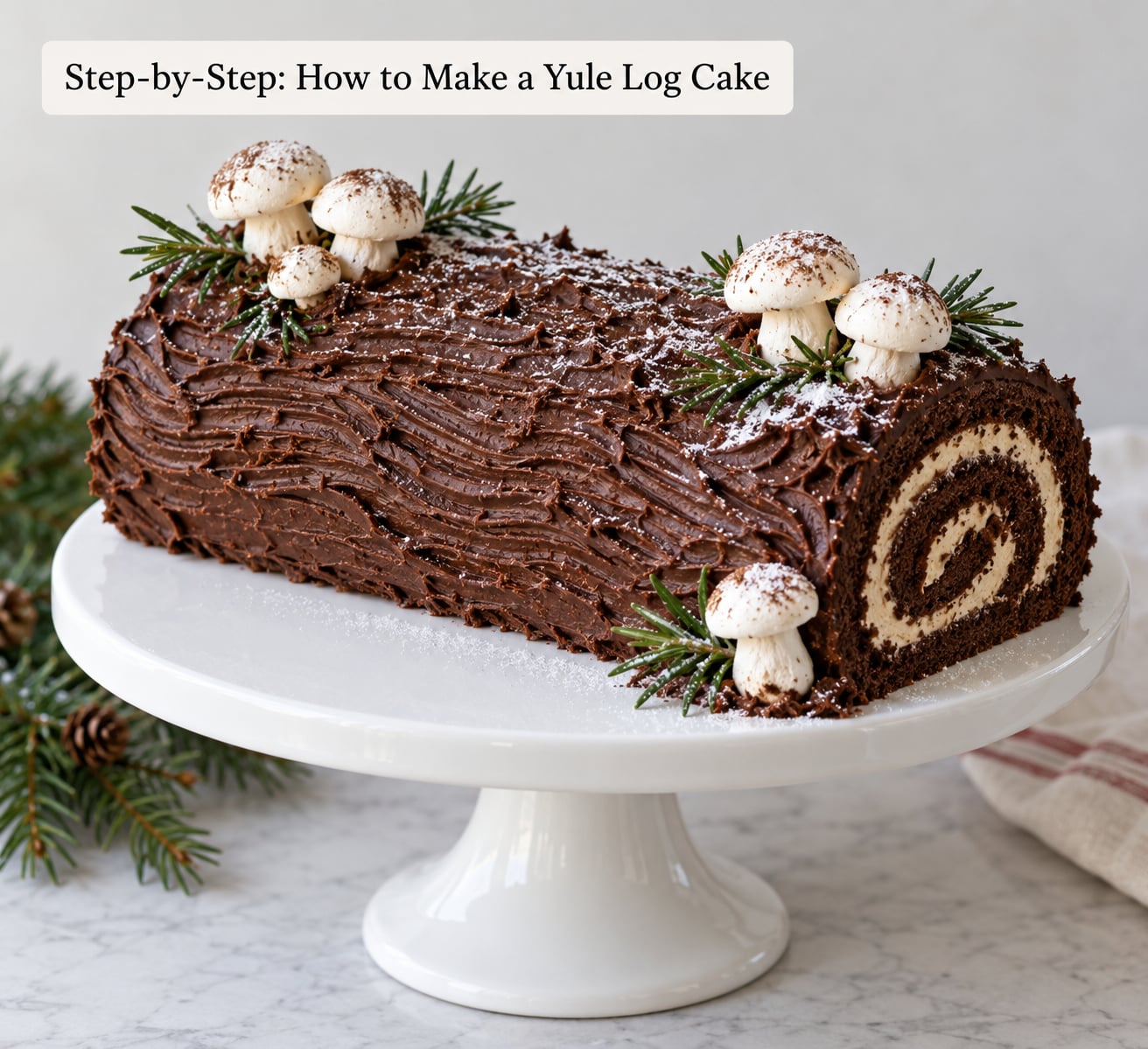
Learning how to make a yule log cake, called a bûche de Noël in French, means rolling a thin chocolate sponge into a cylinder, filling it with whipped cream, coating it in chocolate ganache, and texturing that with a fork so it looks like a rustic woodland log. It has four parts: sponge, filling, ganache, decorations. Plan on roughly three hours, most of which is waiting.
Is a yule log hard to make? Not really. The one genuinely tricky moment is rolling the sponge, and it becomes predictable once you learn to roll it while it is still warm and let it cool fully in the roll rather than flat.
Table of Contents
- How to Make a Yule Log Cake in Six Steps
- What You Need to Make a Yule Log Cake
- Equipment
- Chocolate Sponge
- Whipped Filling
- Ganache and Decorations
- Swaps and Shortcuts
- Step-by-Step: How to Make a Yule Log Cake
- Prepare the Cake Pan and Oven
- How to Make the Chocolate Sponge
- Add the Filling and Roll the Cake
- Bake or Chill the Log
- Make the Chocolate Ganache and Coat the Log
- Add the Bark Texture and Festive Details
- Chill, Slice, and Serve
- Common Mistakes and Fixes
- Frequently Asked Questions
- Do I need to bake the Yule log cake after rolling it?
- What filling works best for a Yule log cake?
- How do I keep the chocolate sponge from cracking when rolling?
- Can I make a Yule log cake ahead of time?
- How should I store a Yule log cake, and can it be frozen?
- How do I make the cake nut-free or safe for a child with allergies?
- Where to Start With Your First Yule Log
How to Make a Yule Log Cake in Six Steps
- Bake a thin chocolate sponge in a lined jelly-roll pan at 350°F (175°C) for 12 to 15 minutes.
- Lift the sponge on its parchment and roll it up while it is still warm.
- Let the rolled sponge cool completely in its towel, then unroll and spread it with whipped filling.
- Re-roll tightly, wrap, and chill for at least two hours.
- Pour hot cream over chopped chocolate, chill until spreadable, then coat the log and scrape it into bark texture.
- Chill, slice one angled piece for the branch, and finish with powdered sugar, berries, and rosemary.
What You Need to Make a Yule Log Cake
Everything comes down to a pan, a few hand tools, and four ingredient groups. Grab the pan first, because the wrong size is the most common reason a log comes out too short to cut a branch from.
Equipment
- A 17 by 12 inch (43 by 30 cm) jelly-roll pan. An 18 by 13 inch (45 by 33 cm) half sheet works too and leaves more length for the branch.
- Parchment paper, cut to fit the pan, plus a second sheet for rolling.
- A clean, thin cotton tea towel for guiding the roll.
- An offset spatula, a fine mesh sieve, a fork, and a sharp serrated knife.
- A wire rack, and a cake board or platter for serving.
Chocolate Sponge
- 4 large eggs, room temperature
- 3/4 cup (150 g) granulated sugar
- 1/2 cup (120 ml) neutral oil, like canola or grapeseed
- 3/4 cup (180 ml) hot water
- 1 cup (125 g) all-purpose flour
- 1/2 cup (43 g) Dutch-process cocoa powder
- 1 teaspoon baking powder, 1/2 teaspoon fine salt
- 1 teaspoon vanilla extract and 1 teaspoon instant espresso powder
Whipped Filling
- 8 oz (225 g) mascarpone cheese
- 1 cup (240 ml) heavy whipping cream
- 1/4 cup (30 g) powdered sugar and 1 teaspoon vanilla
- A pinch of flaky salt, which is what keeps the sweetness in check
Ganache and Decorations
- 6 oz (170 g) bittersweet or semisweet chocolate, chopped
- 1 cup (240 ml) heavy whipping cream for the ganache
- Powdered sugar, fresh cranberries, and rosemary sprigs
- Optional: meringue mushrooms, piped with a small round tip
Swaps and Shortcuts
For a nut-free version, skip any hazelnut or praline and use plain mascarpone or a cream-cheese filling. If you like a boozy note, a tablespoon of coffee liqueur stirred into the filling works, but leave it out for an alcohol-free bake and add a splash of cold strong coffee or an extra teaspoon of vanilla instead. A boxed chocolate cake mix works: use one 15.25 oz box, prepare it with 3 eggs, 1/2 cup water, and 1/3 cup oil, spread it thin on the pan, and bake 11 to 13 minutes.
A vanilla version replaces the cocoa with an equal weight of flour and uses white chocolate ganache with a vanilla bean filling. For mini logs, bake the same sponge in a 13 by 9 inch (33 by 23 cm) pan and slice it into two short rolls.
Step-by-Step: How to Make a Yule Log Cake
Prepare the Cake Pan and Oven
Heat the oven to 350°F (175°C) and set the rack in the middle third of the oven. Lining the pan while it is cold keeps the parchment flat and stops the sponge from gripping the metal edge.
Lay a sheet of parchment in the pan and press it firmly into the corners so it lies flat with no wrinkles. Rub a little oil over the surface and dust it lightly with cocoa powder or the sugar measure. A wrinkle in the parchment prints a stripe straight down the outside of your log.
Give the oven ten full minutes to preheat. An oven that is still climbing in temperature bakes the edges of the sponge hard before the middle sets, and hard edges are exactly what crack when you roll.
How to Make the Chocolate Sponge
Whisk the eggs, sugar, oil, vanilla, and espresso powder together for two full minutes until the mixture is pale, thick, and falls off the whisk in a ribbon. Hand mixers work; a stand mixer saves your arm.
Sift the flour, cocoa, baking powder, and salt in twice. Fold the dry ingredients into the wet in two additions, and stop mixing the moment the last streak of flour disappears. Overmixing develops gluten and gives you a rubbery sheet that cracks instead of rolling.
Pour the batter into the lined pan and spread it into the corners with an offset spatula. Tilt the pan and tap it once on the counter to push out the big air pockets. Bake for 12 to 15 minutes, until the surface springs back when you press a fingertip near the edge and a tester inserted in the middle comes out with only a few moist crumbs.
Take it out while the centre still looks a shade underdone. Sponge that bakes to a deep brown crust loses the elasticity you need for the roll.
Add the Filling and Roll the Cake
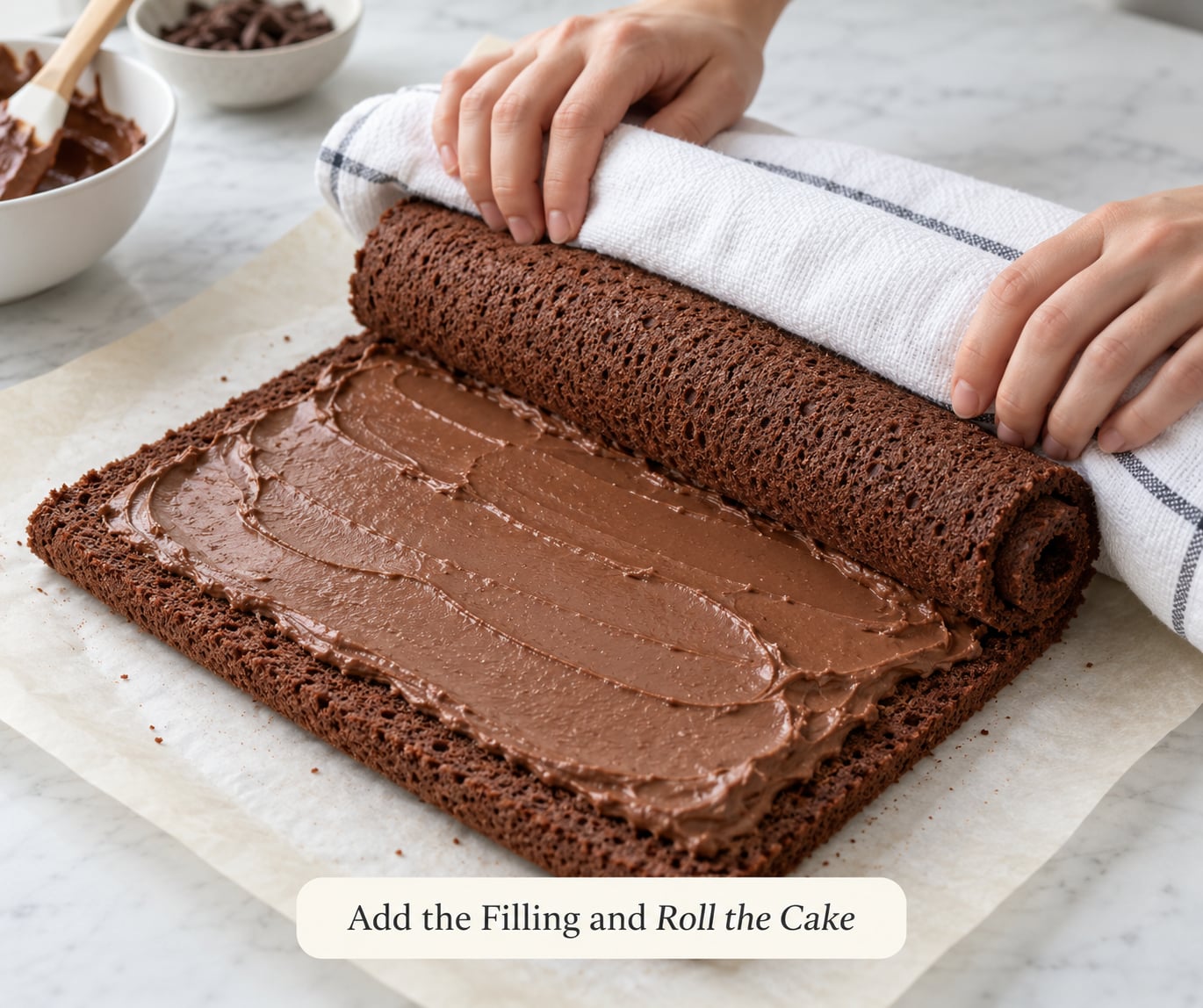
Lift the sponge out of the pan by the parchment and lay it on your work surface. Drag a clean, thin tea towel across the top and roll the sponge up inside the towel, starting at one short end, using even pressure.
Roll slowly. Push from the outside edge rather than pulling the far end, which is what makes the roll tighten into a cone. Once it is a cylinder, leave it seam-side down in the towel and let it cool completely, about 45 minutes.
Cooling it rolled is not optional. The sponge finishes setting in its spiral shape, and a log that cooled flat will spring open and split along the seam when you fill it.
Meanwhile whip the filling. Beat the mascarpone just until smooth, add the heavy cream, powdered sugar, vanilla, and salt, and whip on medium-high until it holds a soft peak that just flops over. Spread it in a generous layer, but leave a 1 inch (2.5 cm) border at the far edge, since that strip is what seals the seam.
Unroll the cooled sponge carefully, fill it, and re-roll using the towel again. Press the seam-side down and wrap the whole log in plastic wrap.
Bake or Chill the Log
Chill the filled log seam-side down for at least two hours, or overnight. If you prefer a firmer log that slices into cleaner spirals, freeze it for 30 minutes before the final coating.
A short bake after rolling is the old French pastry-school step: 350°F (175°C) for 8 to 10 minutes sets the filling and gives the sponge extra grip so it will not slide apart. Chilling achieves nearly the same result without drying the sponge out, which is why most home bakers I know skip the second bake.
Make the Chocolate Ganache and Coat the Log
Pour the 1 cup of heavy cream in a saucepan and bring it just to a simmer, with the first bubbles breaking the surface. Chop the chocolate finely while it heats, then pour the cream over it and let it sit for one full minute without stirring.
Stir from the centre outward until the chocolate disappears and the ganache is glossy. Chill it until it thickens to a soft, spreadable consistency, about 20 to 30 minutes, stirring once halfway through. The test is simple: a finger dragged across the surface should leave a clean line that holds its edge.
If it runs off the log and pools on the plate, it needs more chilling, not more chocolate. A splash of cold cream and ten more minutes is the usual rescue.
Set the chilled log on a rack over a baking sheet and pour the ganache over the top. Turn it as you go so the ends and underside are coated, then use an offset spatula to sweep the surface smooth.
Add the Bark Texture and Festive Details
Drag the tines of a fork lightly along the log in uneven, vertical strokes to pull the ganache into bark lines. A pastry wheel gives chunkier ridges, and a small knife makes the deep slashes used for the cut-off branch end.
Cut a 3 to 4 inch (7.5 to 10 cm) piece from one end of the log and angle the cut. Set it against the log so the exposed spiral faces out, ganache that joint, and run a few lines through the cut face to suggest the rings of a cut branch.
Dust powdered sugar through a fine sieve for snow. Sugared cranberries and a rosemary sprig or two are the classic garnish, and small meringue mushrooms, piped and dried on the tray overnight, turn a rustic log into the showpiece everyone photographs.
Chill, Slice, and Serve
Chill the decorated log for at least 30 minutes so the ganache firms. Wipe the knife with a hot damp cloth between every slice, because a warm blade melts the ganache and drags it across the spiral.
Cut with a long serrated sawing motion from one end to the other rather than pressing straight down. Serve at room temperature, and take it out of the fridge about 20 minutes before eating so the ganache softens and the sponge tastes of something more than cold cream.
Common Mistakes and Fixes
Almost every failed yule log comes down to one of five things: heat, timing, seal, ganache thickness, or humidity. Find the symptom below and fix that line first.
| What went wrong | Why it happened | How to fix it next time |
|---|---|---|
| Sponge cracked or shattered while rolling | It was overbaked, or fully cooled before rolling | Bake 2 minutes less, check at 12 minutes, and roll while warm. Unroll and re-roll every 5 minutes as it cools. |
| Cake stuck to the parchment | Parchment was too tight or the sponge sat too long | Cool 5 minutes only, then peel the parchment back slowly at a low angle while you start the roll. |
| Log is loose and springs open | Cooled flat, or rolled too loosely | Always cool the sponge inside its first roll. Re-roll with firm, even pressure. |
| Filling oozes out of the seam | Filling spread to the very edge, or the log was sliced cold and fast | Leave a 1 inch border unfilled, and chill the finished log fully before cutting. |
| Ganache slides off and pools | Ganache was too warm or too loose | Chill until a finger-drawn line holds its edge, then spread in thin layers and chill between coats. |
| Meringue mushrooms weep or shrink | Humidity in the room | Add a tablespoon of powdered sugar to the egg whites, dry fully, and bake on low until crisp. |
Make-ahead is straightforward. Bake and roll the sponge up to two days ahead, fill and wrap it, and refrigerate. Make the ganache a day ahead too, and rewarm it gently before use. A decorated log keeps in the refrigerator for up to 4 days and freezes undecorated for up to 3 months; defrost it in the fridge overnight, then add the ganache and snow on the day you serve.
Frequently Asked Questions
Do I need to bake the Yule log cake after rolling it?
No. Most home bakers chill the filled log for two hours instead, which sets the filling and firms the spiral without drying the sponge out. A short second bake at 350F for 8 to 10 minutes is traditional, but it is optional. Chilling gives cleaner slices and a cake that stays tender for days.
What filling works best for a Yule log cake?
Whipped mascarpone is the most reliable: it is rich, holds a soft peak, and does not weep when you cut the log. Plain whipped cream works but needs a spoonful of powdered sugar to stay stable. Cream cheese beaten with sugar and a little cocoa is a good nut-free choice, and it survives a weekend in the fridge better than cream does.
How do I keep the chocolate sponge from cracking when rolling?
Roll while warm, not hot and not cool. As soon as it leaves the pan, lift it by the parchment and use a clean tea towel to guide the roll with even pressure. If it does crack, unroll it and wait five minutes before trying again. That single wait restores enough elasticity for most bakers on the second attempt.
Can I make a Yule log cake ahead of time?
Yes, and most people do. Roll and cool the sponge, fill and wrap the log, then refrigerate for up to two days. Keep the ganache separate and apply it the day you serve, so the log stays crisp instead of going soggy under the frosting. Add powdered sugar, berries, and meringue mushrooms only at the last moment.
How should I store a Yule log cake, and can it be frozen?
A decorated log keeps in the refrigerator for up to 4 days, loosely covered so the ganache does not pick up fridge smells. For longer storage, freeze the filled and rolled log before coating, wrapped in plastic and foil, for up to 3 months. Thaw it overnight in the fridge, then cover with fresh ganache.
How do I make the cake nut-free or safe for a child with allergies?
Skip hazelnut and praline spreads entirely and use plain mascarpone whipped cream or a cream cheese filling. Check that your chocolate is labelled nut-free, since some dark chocolate carries nut trace warnings from shared equipment. Serve alcohol-free by leaving out any liqueur, and always tell your guests which filling is in the log before they eat.
Where to Start With Your First Yule Log
Start tonight with the sponge. Get the pan lined, bake it two minutes under the time, and roll it while it is warm. Everything after that is forgiving, and once you see the spiral hold together, the frosting and bark are the fun part.