If your cake sinks in the middle, the center was still raw or too weakly supported when it came out of the oven. Heat reaches the edges first, so they set into a firm shell while the moist middle is still liquid, and that middle cannot hold up the risen top. It collapses inward as the cake cools and trapped steam escapes. The fix is to stabilize the batter and verify your oven temperature before the next bake.
It is the single most common home baking failure, and the cruel part is that the outside looks completely fine. Golden edges, clean release from the pan, a tester that comes away clean near the rim. Then you cut it open and find a raw crater in the center.
This guide walks through the seven reasons cakes sink, how to diagnose which one you hit, and what to change on the next bake. Last updated October 2026.
Table of Contents
- Why Does My Cake Sink in the Middle?
- Key takeaways
- What Does a Sunken Cake Look Like?
- What Causes a Cake to Sink in the Middle?
- How Oven Temperature Affects the Batter
- How the Pan Shape Affects the Center
- How to Tell Whether the Cake Was Underbaked in the Middle
- How to Prevent Your Next Cake from Sinking
- Can You Fix a Cake That Has Already Sank?
- Which Cake Pans Are Least Likely to Cause Sinking?
- When a Layer Cake Is the Problem
- Frequently Asked Questions
- Why does my cake sink in the middle even when the outside looks done?
- Can I still eat a cake that sank in the middle?
- How do I stop my cake from sinking while it cools?
- Why is the center of my cake raw and sinking?
- Should I change the baking temperature if my cakes always sink?
- Start With the Batter and Pan
Why Does My Cake Sink in the Middle?
A cake sinks in the middle because the edges set long before the center does. The outside of the batter touches the hot pan and oven walls, so it firms up early into a shell. The center is insulated by that shell and by its own moisture, so it is still soft and steam-filled when the timer goes off. Remove the cake then, and the top has nothing underneath it, so it falls inward.
That collapse often happens partly in the oven and finishes on the cooling rack, which is why a cake can look like a slow rise until the moment you pull it out.
Key takeaways
The most common causes of a sunken cake:
- The center was still underbaked when the cake left the oven, so it had no set structure to hold the top up.
- The oven runs cool, giving the outside a head start while the middle lags far behind.
- Too much baking powder or baking soda inflates fast, sets early, and then collapses under its own weight.
- Opening the door in the first 15 to 20 minutes drops the temperature and pauses the rise.
- The pan is too small or filled too full, so the center gets a deeper column of wet batter than it can hold.
- Overmixing after the flour goes in develops gluten and turns the batter tough and dense.
- Unmolding too early or stacking a warm cake lets steam and weight pull the center down.
How to fix a sunken cake next time:
- Test doneness in the very center, not near the edge, and accept moist crumbs over wet batter.
- Check your oven with a thermometer and write the real offset on the dial.
- Leave the door shut for the first 15 to 20 minutes of the bake.
- Fill pans no more than two-thirds full and use the pan size the recipe was tested in.
- Cool fully in the pan, then on a rack, before frosting or stacking.
What Does a Sunken Cake Look Like?
A sunken cake has a crater in the center with the edges standing higher than the middle, sometimes by an inch or more. The dome that rose during baking folds inward, often with cracks radiating from the dip, and the top surface ends up uneven or cracked like a dry lake bed.
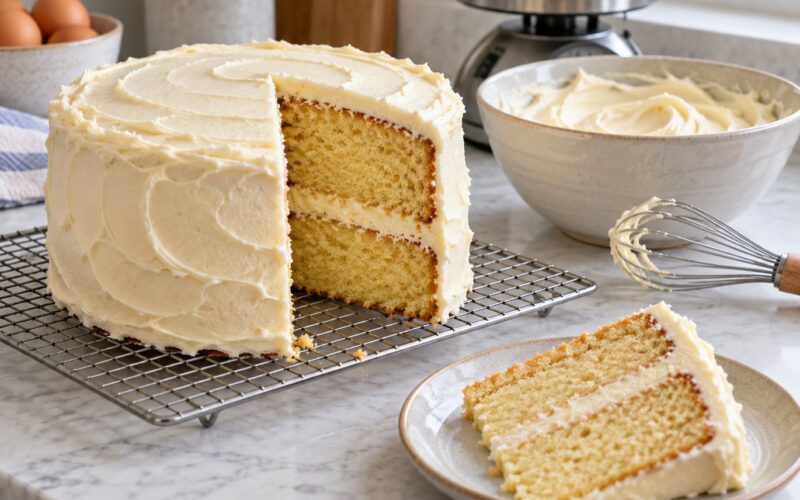
Cut it and the center tells the real story. A cake that was underbaked shows gummy, damp crumbs, a band of wet batter, or even raw batter that smears under the knife. The bakes that just lost their rise during cooling taste fine all the way through, and the crumb is even but soft.
There is one normal outcome that gets mistaken for sinking. Many cakes rise in a dome during baking and settle by an inch or so as they cool, because the crumb contracts and the structure firms up. That gentle settling leaves a slightly rounded top and even slices. A real sink is a sharp dip with a raw or gummy center, and a knife will find a weak or collapsed core in the middle of the crumb.
Worth separating too: a cake that barely rises at all and sits flat and dense is a different problem. That is usually too little leavening, not too much, and none of the temperature fixes below will help it.
What Causes a Cake to Sink in the Middle?
Here are the causes in the order they are worth checking.
- Underbaking in the center. The batter never reached doneness in the middle, so the crust carried a weight it was never strong enough to hold.
- An oven that runs cool. The outside browns and sets at a normal pace while the center lags, and the cake is pulled out on time rather than on doneness.
- An oven that runs hot. The edges and top set and dry out fast, and the center, still expanding, cracks the shell and drops through it.
- Too much leavening. Extra baking powder or soda produces a fast, tall rise that cannot be supported by the flour and egg structure, so it falls once the oven is off.
- Opening the oven door too early. A rush of cool air in the first 15 to 20 minutes drops the temperature and interrupts the rise while the batter is still fluid.
- Wrong pan size or too full a pan. A deep layer of batter in a small pan heats slowly in the middle, and a pan filled past two-thirds has nowhere for the batter to go but up and over.
- Improper mixing or cold ingredients. Overmixing after the flour is added builds gluten, and cold eggs and butter fail to emulsify into the batter properly, so the structure never develops.
How Oven Temperature Affects the Batter
Oven temperature is the cause most people never test, and the most likely to be wrong. Residential ovens regularly run 20 to 25 degrees off the dial in either direction, and the error swings with how the oven is used. A fan setting, a bake that starts right after a previous bake, or a door that seals loosely all push it further off.
A cool oven is the sneaky one. The edges set and the middle takes forever, so the cake is technically underbaked when the timer rings. A hot oven produces a different signature: crisp, dark edges, a domed top that cracks, and a center that drops sharply in the last few minutes. Bakers assume they are running hot, so the gap between the guess and the real number keeps going unnoticed.
Put a leave-a-gap oven thermometer on the middle rack and read it after a full preheat. If it shows 25 degrees under the dial, set the dial 25 degrees higher from now on, and write it on a strip of tape inside the door. Do the same check for a hot oven, in the other direction. Once you have the offset, baking gets predictable, and the same recipe stops producing a different result every run.
Hot spots are a separate issue from a wrong temperature. If one side of the cake browns faster, turn the pan halfway through the bake, not at the start, because opening early costs you more than the rotation gains. Nobody mentioned hot spots in my own troubleshooting notes for years, and it was the reason two pans on the same rack baked differently for me.
How the Pan Shape Affects the Center
Shape decides how fast the middle cooks, and that is often the whole story. A small diameter with the same batter volume gives you a deeper column of wet cake in the center, and depth means the heat has further to travel. This is why a recipe that works in a 9 inch pan sinks every time in the 8 inch one you had on hand, and why a loaf of banana bread caves in so reliably.
Material and color matter too. Dark metal and glass absorb heat at the surface and drive the outside of the cake forward, so the ring around the edge sets and browns long before the middle finishes. Light-colored aluminum spreads heat more evenly across the base, which gives the center a better chance of setting at the same time as the edge.
Weight is a proxy for evenness. A thin, warpy pan flexes in the oven and cooks the batter unevenly across its surface, and a worn pan with a dark, scratched base behaves more like dark metal than the light pan it replaced. If your pans have warps, dark patches, or a base that feels thin, they are worth replacing for this reason alone.
Fill level is the other half. Two-thirds full is the working rule for most layer cakes, and going past it removes the headroom the rising batter needs. If your batter is deep enough that the pan looks nearly full before it goes in the oven, that alone can produce a central dip.
How to Tell Whether the Cake Was Underbaked in the Middle
Three tests tell you more than the timer ever will, and the first one is the one people get wrong.
First, test the very center. A toothpick or skewer inserted near the edge meets crumb that set 20 minutes ago, so it always looks done. Push it into the middle of the cake, all the way down into the deepest point of the dome, and that is where the answer lives.
Second, read what comes out. Wet, glossy batter on the toothpick means the center is still liquid and the cake will sink. Moist crumbs that hold their shape, with a few damp specks, mean done. A completely clean toothpick usually means a little overbaked, and it is a fine result in most recipes.
Third, press the top gently. A properly baked cake springs back and leaves only a small indent. If your finger leaves a lasting dent that feels soft and yielding, the structure has not set and the cake needs more time.
Recipe times assume a specific pan, a specific oven, and a full preheat. They are a starting point for the outside of the cake. Trust the center tests over the clock, and give the cake extra minutes rather than trusting a timer that was written for somebody else’s kitchen.
How to Prevent Your Next Cake from Sinking
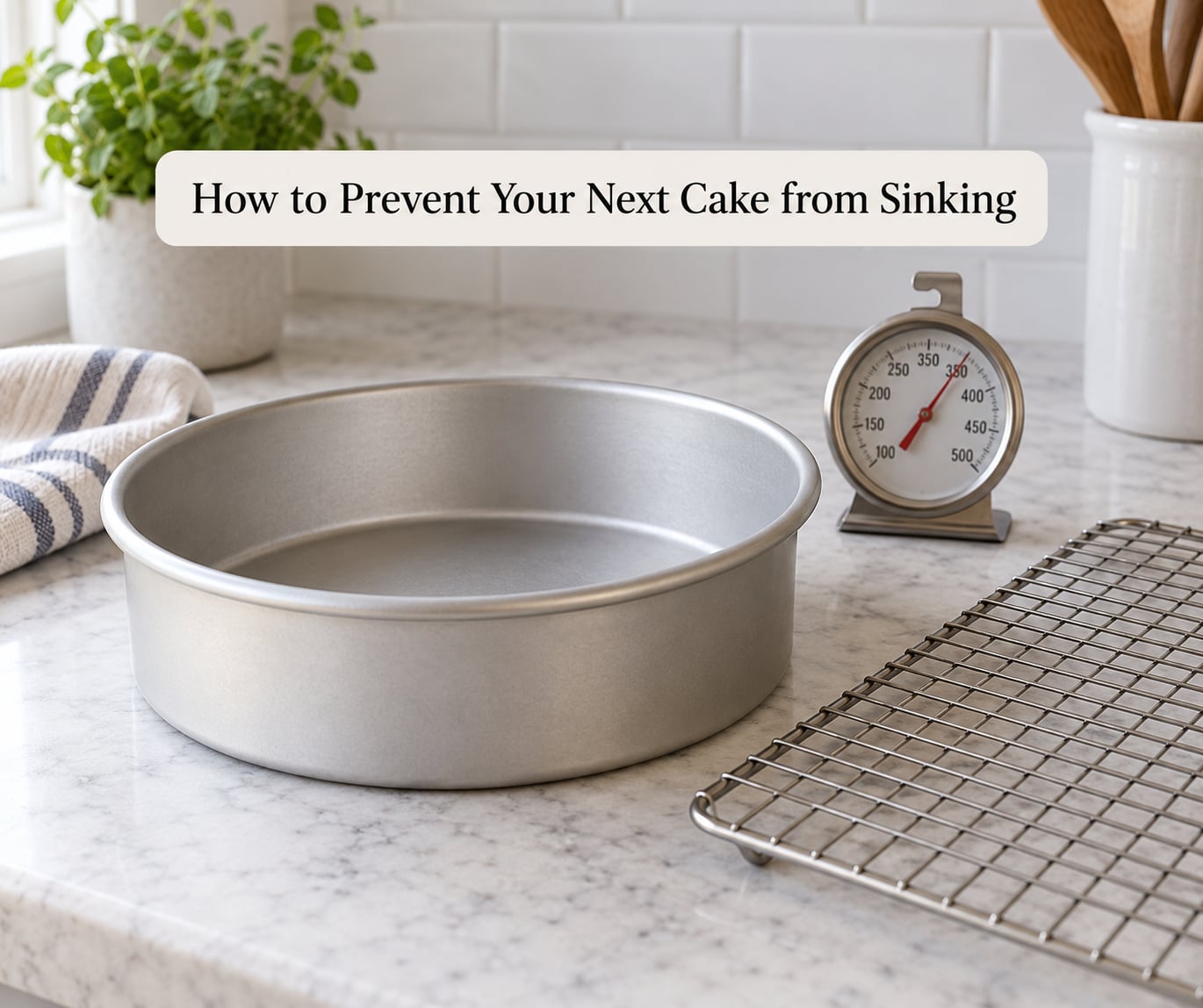
Work through this in order when a cake sinks twice. The first three checks catch most cases.
- Check the oven first. Read a leave-a-gap thermometer on the middle rack after a full preheat, note the offset, and adjust the dial every bake from then on.
- Test the center, not the edge. Use a toothpick or cake tester in the deepest point of the top, and keep baking while the tester brings up moist crumbs rather than wet batter.
- Hold the door shut for 15 to 20 minutes. Bakers open the oven to look, and that peek costs more rise than most people expect. Set a timer for the whole bake instead.
- Weigh the leavening. Spoon measures pack baking powder loosely, so level with a knife and then weigh. A quick sanity check is 1 to 1.25 teaspoons of baking powder per cup of flour, adjusted for the recipe.
- Test the leavening is still active. Baking powder fizzes when you stir a spoonful into hot water, and baking soda bubbles in vinegar. No reaction means it has lost its power and needs replacing.
- Stop mixing the moment the flour disappears. Fold the last of the dry ingredients in with a spatula, and scrape the bowl once. A few lumps are fine; a smooth, heavy batter is overmixed.
- Bring ingredients to room temperature. Eggs, butter, and milk straight from the fridge do not emulsify into the fat, and cold butter stays in lumps that leave weak spots in the crumb.
- Use the pan the recipe was tested in. Match diameter, depth, and material. If you have to substitute, adjust the bake time and expect a different result.
- Fill to two-thirds and cool properly. Leave the cake in the pan on a wire rack for about 10 minutes, turn it out, cool completely, and only then frost or stack.
Two forum-reported triggers are easy to overlook. The first cake of the day often sinks while the second comes out fine, because the pan was not fully preheated and the oven was still recovering from the last bake; give the oven 15 minutes of preheat with the pan inside. And a warm cake carried from a hot kitchen into a cooler room can sink as it cools, because the rapid temperature change collapses the crumb faster than it can set.
Cheap checks worth doing once. Flour that has gone damp or clumpy will not form structure properly, and if the flour has been open a long time or smells musty, replace it. A kitchen scale that reads a little off compounds every recipe you make with it, so check the weight of a known measure of water once a year. Neither of these shows up in the usual advice, and both quietly ruin bakes.
Can You Fix a Cake That Has Already Sank?
No, the original dome is gone. What you can do is stop wasting the bake and decide whether the cake still earns a place on the table.
If the center is raw or gummy, put the cake back in the oven. Loosely tent it with foil, set it back at the recipe temperature, and give it 10 to 15 minutes, testing at the center again. This works when the raw patch is small and localized, which is most sunken cakes. It will not rescue a cake that sank badly all the way through, so slice a thin piece from the deepest part and taste it before you commit to the whole thing.
If the cake is fully baked and just dipped, the honest repair is to cut it level. Run a long serrated knife across the top to remove the dip, then flip the cake or just accept the flat surface. A layer cake with buttercream hides the repair completely, and a single layer often looks fine once frosted on top.
Other uses for a cake that still tastes good. Cube it for a trifle, where the soaked sponge is the point rather than a flaw. Turn it into cake pops if the crumb is tight enough to hold on a stick. A damp carrot or banana cake can be cut into slabs and turned into a sticky toffee or caramel pudding, which is exactly what one baker on a baking forum did with an undercooked honey cake rather than bin it.
Is a sunken cake safe to eat? Yes, as long as it was fully baked. A raw or gummy center is an underbaking problem, not a food safety one, since the ingredients are not hazardous. Discard it if it smells off, shows mold, or sat out at room temperature for more than about two hours. Otherwise, bake it through or repurpose it.
Which Cake Pans Are Least Likely to Cause Sinking?
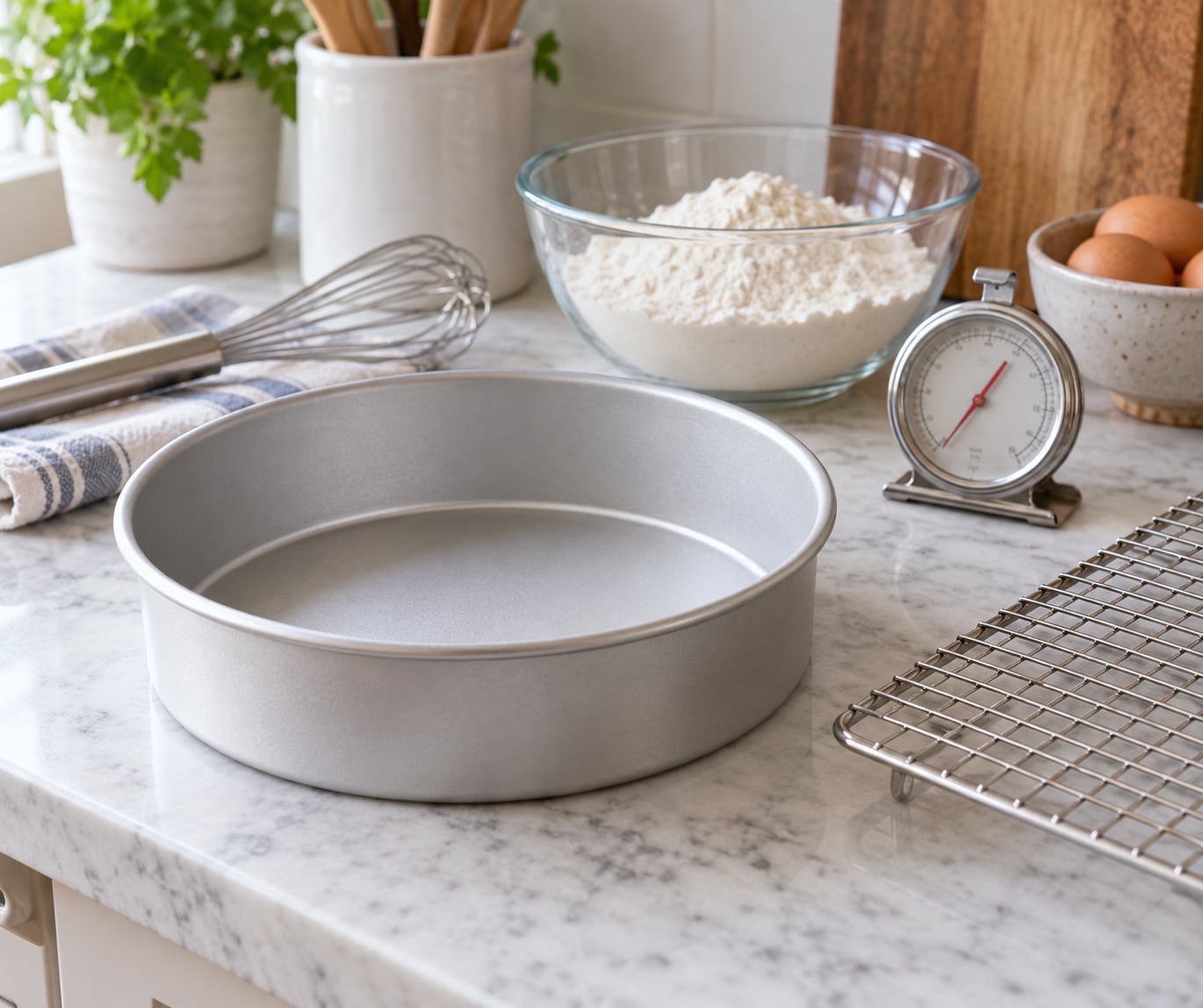
Light-colored aluminum is the safest choice for even baking, because it reflects heat into the batter rather than absorbing it, and it spreads heat across the base so the center sets at close to the same time as the edges. A heavy pan in a light color gives you the same benefit and stays flat in a hot oven. Avoid dark metal, glass, and thin warpy pans for cakes that have to rise tall, since all three drive the outside forward.
Size is the piece most recipes get wrong. Match the diameter and depth the recipe was developed for, and if you only own a different size, adapt rather than guess. A smaller pan means a deeper batter column and a longer bake, and a larger one means a thin cake that dries out before the center can set properly.
Prepare the pan the way the recipe asks, whether that is greasing and flouring or a parchment liner. Preparation does not stop sinkage on its own, but it makes sure a good bake comes out in one piece instead of tearing in half while you try to save a set cake.
Brand matters far less than weight and color. A well-made light-colored aluminum pan from any manufacturer will out-bake a bargain dark pan every time, and you do not need a specialty product to get an even cake.
When a Layer Cake Is the Problem
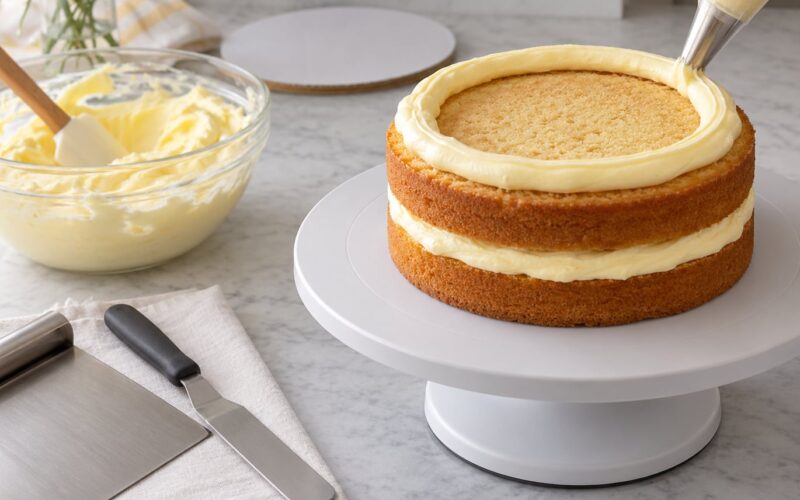
Sometimes the batter is perfect and the cake sinks anyway, because the weight above it is too much for the structure underneath. This is the version that shows up in tall stacked birthday cakes and in layer cakes that were frosted while still warm.
Frosting applied to a warm layer melts into the crumb and adds weight before the cake has finished setting. It also slides down and pulls the top with it. Wait until the layers are completely cool to the touch, including the bottom, which holds heat longest.
Use firm fillings. Whipped cream, soft mousse, and loose curd fillings are heavy and unstable, and they push down into a crumb that is only partly set. Buttercream, ganache, and a thin layer of jam are lighter and hold their shape.
For tall stacks, insert dowels or cake supports. They carry the load of the upper layers so the cake below is not compressed, and that compression is what turns a tall cake into a sagging one. Level each layer with a serrated knife before the first fill, because frosting a tilted layer builds that tilt into the whole stack.
Frequently Asked Questions
Why does my cake sink in the middle even when the outside looks done?
The edges touch the hot pan and oven walls, so they set first into a firm shell that browns on schedule. The insulated center heats slowly and can still be wet when the outside looks finished. Test with a toothpick in the deepest point of the dome, not near the edge, and keep baking while it brings up moist crumbs instead of wet batter.
Can I still eat a cake that sank in the middle?
Yes, if it is fully baked. A sunken center is a structure problem, not a food safety one, so a gummy middle just means the cake needs more time in the oven. Put it back under loose foil for 10 to 15 minutes and retest the center. Discard it only if it smells off, shows mold, or sat out for hours.
How do I stop my cake from sinking while it cools?
Let the cake rest in the pan on a wire rack for about 10 minutes, turn it out, and cool it completely on the rack before frosting or stacking. Keep it out of drafts and out of a cooler room, since a sudden temperature change collapses the crumb faster than it can set. Never frost a warm layer, and use dowels on tall stacks.
Why is the center of my cake raw and sinking?
A deep center in a small pan, an oven running cool, or a pan filled past two-thirds all leave the middle as a thick column of wet batter that heat cannot reach in time. Match the recipe’s pan size, fill to two-thirds, and verify your oven with a leave-a-gap thermometer on the middle rack. If your oven runs low, write the offset on the dial.
Should I change the baking temperature if my cakes always sink?
Only if your thermometer tells you to. Most home ovens run 20 to 25 degrees off the dial, and a cool oven is the usual reason cakes sink. Check the real temperature, then adjust the dial permanently in that direction rather than changing the recipe. If the oven runs hot instead, lower it and shorten nothing, since the center needs the longer time.
Start With the Batter and Pan
If you only do three things before the next bake, make them these. Put a thermometer on the middle rack and find out whether your oven is actually at the temperature on the dial, then adjust the dial and leave a note for next time. Leave the door shut for the first 15 to 20 minutes. And test doneness in the very center of the cake instead of trusting the timer or the color at the edges.
After that, work through the batter and the pan: weigh the leavening, check that it still fizzes, stop mixing when the flour disappears, and use the pan size the recipe was tested in. Once you have your oven offset written down and your center test habit in place, the same recipe stops producing a different result every time you make it, which is the only real fix for repeated sinkage.