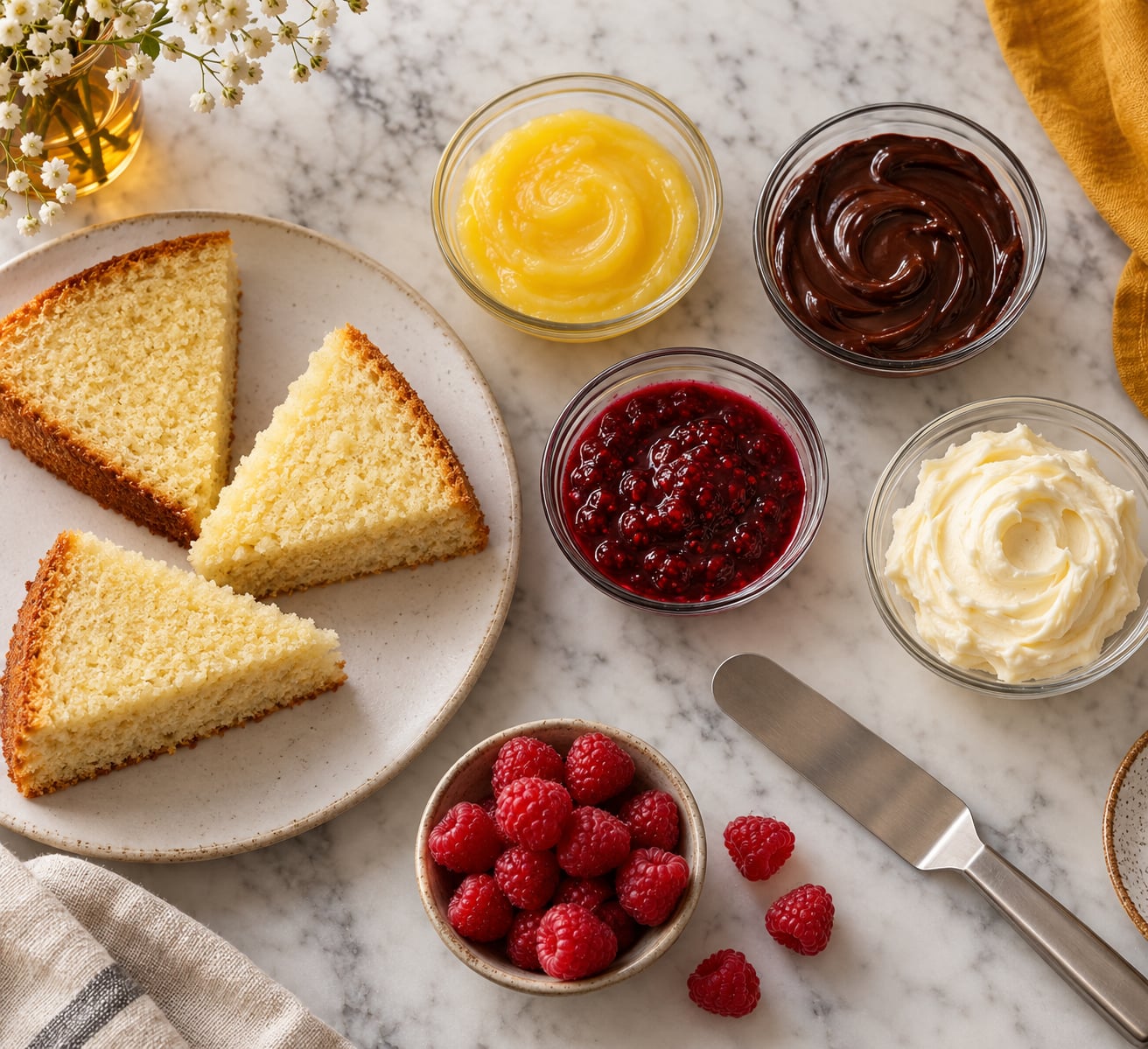
To pick cake flavor and filling combinations that actually taste good, choose the cake for the occasion, rank both flavors by intensity, and give the filling one job: cut sweetness, add acid, or add texture. Never let the cake, the filling, and the frosting all land on sweet at the same time.
That sounds simple, but it is the part most cake decisions skip. A bakery menu with 10 cake flavors and 42 fillings is easy to freeze in front of, and the wrong pairing is very hard to undo once the layers are stacked. So the method matters more than the list.
What follows is the way I think through a pairing: four decisions up front, the balancing rules that make any combination work, pairing lists organised by filling type, the structural rules that keep a cake from turning to mush, and a small tasting routine you can run in an afternoon.
Table of Contents
- How to Pick Cake Flavor and Filling Combinations
- What Makes a Cake and Filling Combination Taste Balanced?
- Which Cake Flavors Work Best With Each Filling?
- How to Choose Fillings by Texture and Moisture
- How to Match Flavors to the Occasion and Your Guests
- A Simple Method for Testing Your Combination
- How to Pick Cake Flavor and Filling Combinations for Nut-Free Service
- Frequently Asked Questions
- Should the cake and filling flavors be the same?
- What is the most balanced cake and filling combination for beginners?
- Which fillings make a cake too wet or likely to slide?
- Are fruit curd and custard fillings safe for a layered cake?
- What cake flavor works best for a nut-free birthday cake?
- Can I change the filling without changing the cake flavor?
How to Pick Cake Flavor and Filling Combinations
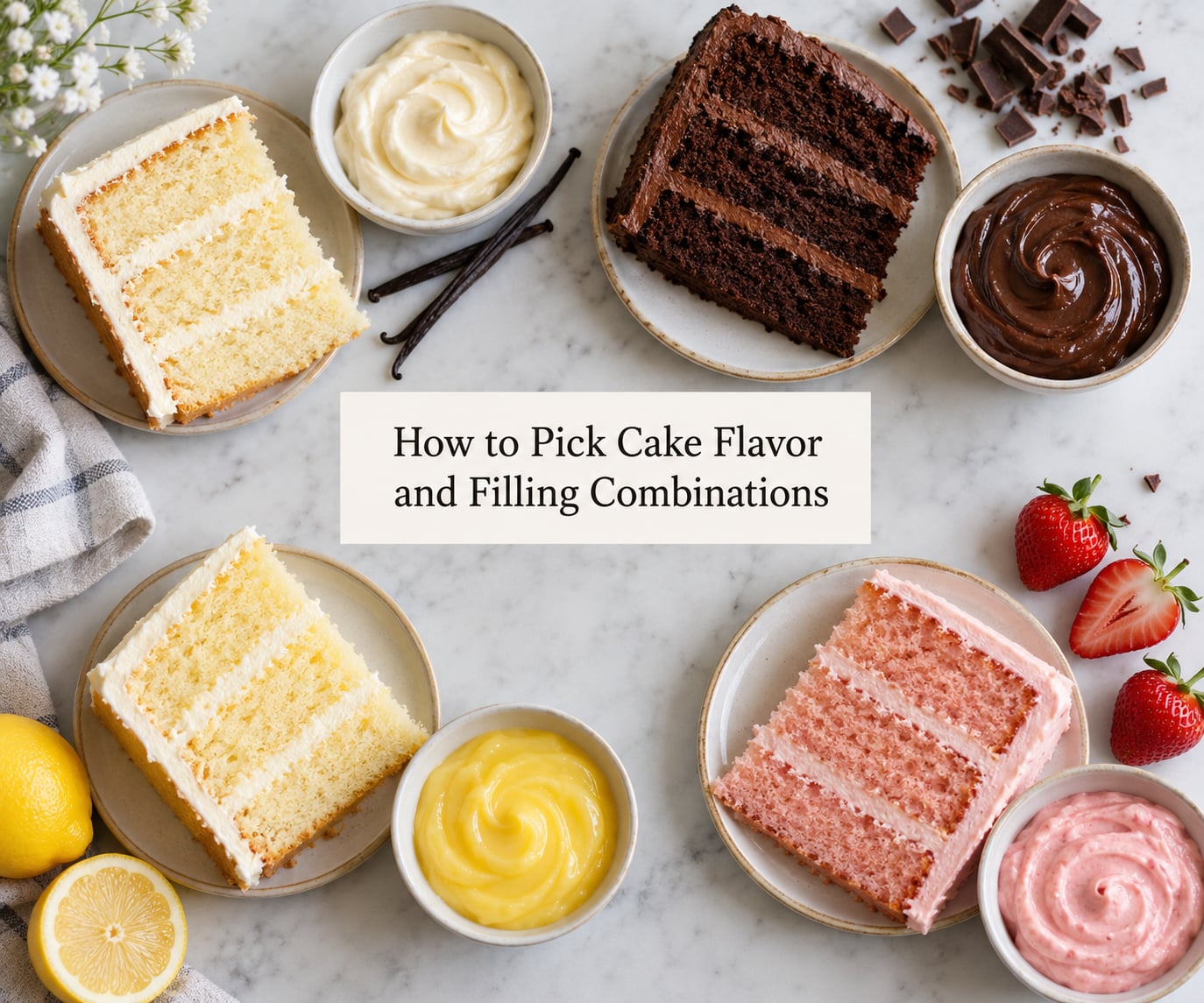
Four decisions come before any flavor name: the cake style, the flavor intensity of both components, the job the filling has to do, and who is eating it. Answer those and the pairing almost picks itself.
Start with the cake style, not the flavor name
A light, open sponge, a dense butter cake, and a chewy one-batter cake do different jobs with a filling. A very soft crumb swallows moisture, so anything loose inside it turns to pudding. A dense crumb can hold a wetter filling without losing its shape.
Pick the structure you want to eat first, then choose the flavor that suits that structure. Lemon works on a light sponge because the crumb stays tender. It works less well on a dense lemon pound cake, where you already have enough lemon to deal with.
Rank the flavor intensity out loud
Rate both the cake and the filling from one to five, five being loud. Pairings feel safe when the numbers are close or when the loud one is the cake and the filling is quiet. They feel wrong when a bold filling meets a bold cake, because nothing gets to be the star.
The exception is a deliberately contrasting pair, where a strong filling in a mild cake creates the interest. Lemon cake with raspberry curd works because the raspberry is loud and the lemon is clean.
Give the filling one job
A filling can do exactly one of four things well. It can cut sweetness with acid, add richness, add moisture, or add a texture contrast. Fillings that try to do two jobs at once, usually sweetness plus richness, are what make a cake feel heavy by the third slice.
Write the job down before you choose the filling. If the job is cut sweetness, you are shopping for curd, passion fruit, or a tart berry preserve. If the job is texture, you are shopping for mousse, ganache, or a crunchy element.
Count the guests and the constraints first
Decide who is eating before you decide what they are eating. A sheet cake for a school birthday and a three-tier wedding cake for eighty adults are different problems, and so is a table that includes a nut allergy, a dairy-free guest, and a child who will only eat vanilla.
One person in the group who cannot eat the cake is a real constraint. So is a cake that has to sit unrefrigerated on a buffet for three hours, which rules out anything that needs cold storage.
A five-step decision framework
Here is the sequence I use. It takes about five minutes on paper and saves an afternoon of baking the wrong thing.
- Pick the cake. Choose the base flavor and crumb style that suits the occasion and the guests.
- Score the sweetness of the whole dessert. Remember the frosting counts as part of that number, not as a separate decision made later.
- Name the filling’s job. Acid, richness, moisture, or texture. One job.
- Choose a filling that contrasts on at least one axis. Sweet against tart, soft against firm, delicate against bold. Matching on every axis is what makes a pairing flat rather than bad.
- Test a small sample before you commit. Cake alone, filling alone, then a thin layer of both, tasted after an hour and again after chilling.
Which combination suits which occasion
| Occasion | Reliable pairing | Filling type | Why it works |
|---|---|---|---|
| Kids’ birthday | Vanilla cake with strawberry compote | Compote | Familiar flavors, and the fruit cuts the sweetness of the buttercream |
| Adult birthday | Chocolate cake with salted caramel | Caramel | Rich and layered, and the salt stops the caramel from being cloying |
| Wedding | Vanilla cake with lemon curd | Curd | Light, elegant, and it does not fight a white or florals finish |
| Baby shower | Vanilla cake with raspberry curd | Curd | Pale cake, pink filling, and a bright flavour that still reads fresh after a long event |
| Holiday gathering | Ginger cake with cream cheese filling | Cheese filling | Warm spice against cool tang, and it holds up across a long afternoon |
| Layered celebration cake | Carrot cake with cream cheese filling | Cheese filling | A dense crumb that tolerates a soft filling, with spice and tang in balance |
| Sheet cake | Chocolate cake with chocolate ganache | Ganache | Forgiving, spreadable, and it travels and holds slices well |
What Makes a Cake and Filling Combination Taste Balanced?
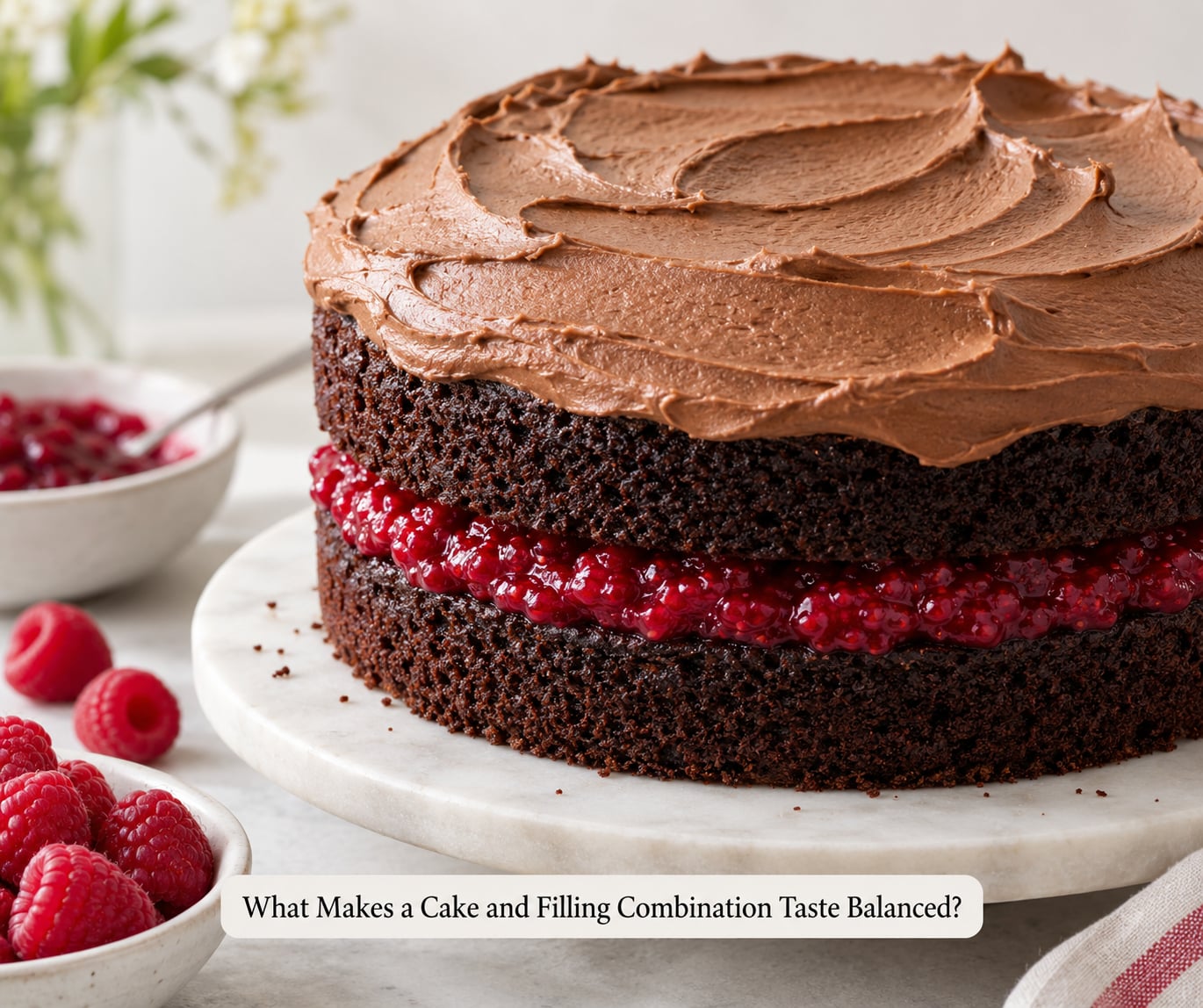
Balance comes from contrast, not similarity. A balanced pairing does not need the filling to taste like the cake; in most cases the two should differ, and that difference is what makes both taste more distinct.
Once you understand which axis does the work, you can pair flavors that are not on any list.
Total sweetness is a three-part number
Guests experience cake, filling, and frosting as one dessert. If all three are sweet in the same register, the third slice feels like syrup no matter how good the recipe is.
Count them: sweet cake plus sweet filling plus sweet frosting. If all three are landing high, take one of them down, and the easiest one to take down is usually the filling, because you can add acid without changing the recipe.
Acidity is the fastest lever
A little acid makes everything else taste more like itself. That is why lemon curd in a vanilla cake tastes like a clearer vanilla cake, and why a squeeze of lemon in coffee icing makes the butter taste more buttery.
Citrus, berry, passion fruit, and tangy cheese all work on this principle. Use acid as a corrective: if a cake tastes flat, it usually needs more acid, not more sugar.
Texture contrast is what guests actually notice
Most people cannot tell you why a cake was memorable, but they can tell you it had something interesting in it. A thin layer of firm curd against a soft crumb, or a mousse against a dense cake, gives the mouth something to do.
The same principle rules out the boring pairings. Two soft textures in the same slice register as one texture, which is a missed opportunity rather than a flaw.
Aroma intensity decides who tastes the filling
Strong aromas such as coffee, black chocolate, cinnamon, and almond fill the whole room and drown out anything subtle next to them. Delicate aromas such as vanilla, rose, and fresh fruit disappear next to them.
So match intensities, not just categories. A faint rose filling in a strong espresso cake will be invisible. A light vanilla sponge is where rose has room to be noticed.
Then look at the four practical levers together: total sweetness, acidity, texture, and aroma. Two of the four matching and two contrasting is the sweet spot, and it is the reason a lemon cake with raspberry curd is such a dependable pick.
Which Cake Flavors Work Best With Each Filling?
Organised by filling type rather than by cake, this is the fastest way to browse. For each group I have noted the cakes that complement the filling, the cakes that contrast with it, and the ones that turn heavy.
Curd
Complements: lemon cake, vanilla cake, almond cake, and plain chiffon.
Contrasts: chocolate cake, coffee cake, and dark chocolate cake, where the sharp fruit cuts through the cocoa.
Avoid: lemon cake with lemon curd, and any citrus cake with citrus curd. That is one flavor repeated, not a pairing.
Curds are firm, sharp, and hold their shape, which makes them the safest filling for a tall layered cake or a cake that has to sit for a few hours. Examples worth trying: lemon cake with raspberry curd, chocolate cake with passion fruit curd, and vanilla cake with lime curd.
Jam and compote
Complements: vanilla, almond, coconut, and mild coffee cakes.
Contrasts: lemon cake with berry preserves, and ginger or carrot cake with apricot.
Avoid: very soft sponge with a loose fresh-fruit compote. The compote adds water to a crumb that cannot take it.
Preserves are the home baker’s friend because they keep their shape and spread easily. A thick, good-quality preserve spread in a thin layer tastes like a fruit filling without any cooking.
Custard and bavarian cream
Complements: spice cakes, carrot cake, and chocolate cake.
Contrasts: a firm yellow cake, where the set custard gives a clean, cold contrast to the warm crumb.
Avoid: light sponge, and anything that has to travel warm.
This is the filling most often blamed for a mushy cake. Bavarian cream with fresh strawberries was described in one wedding planning discussion as turning a cake a bit mushy and tasting like strawberry shortcake, and the same combination earned praise from another taster. The difference was in how the layers were handled, not in the recipe.
Mousse
Complements: marble cake, almond cake, white sponge, and chocolate cake.
Contrasts: delicate fruit and floral cakes, where the airy filling does not weigh them down.
Avoid: anything served warm, and any cake that will sit unrefrigerated for more than about two hours.
Mousse is the most-recommended filling texture in the wedding forums, and it earns that. Chocolate mousse in a marble cake with raspberry was called awesome and absolutely delicious by more than one person, and a white sponge with white chocolate mousse and fresh raspberries came up repeatedly in the same discussions.
The limitation is structure. Mousse is soft, so it needs a firm cake to hold it and cold storage to stay safe.
Ganache
Complements: chocolate cake, brown butter cake, and espresso cake.
Contrasts: fruit or citrus cake, where dark chocolate reads as a background note rather than the whole dessert.
Avoid: a very sweet cake under a sweet ganache with sweet frosting on top.
Ganache is the most forgiving filling for a first layer because it firms up as it cools and spreads without effort. A thin layer of dark ganache between chocolate layers, with frosting on the outside, gives you a rich cake that still tastes balanced after several slices.
Buttercream and cream cheese filling
Complements: carrot cake, red velvet, chocolate cake, and spice or pumpkin cakes.
Contrasts: lemon cake and almond cake, where a tangy filling keeps the butter from sitting heavy.
Avoid: a sweet vanilla sponge with a sweetened cream cheese filling and a cream cheese frosting, which is a lot of sugar in one place.
Unsweetened or lightly sweetened cream cheese filling on carrot cake is the most dependable combination on most people’s lists, and it is the one I would hand to a first-time cake maker.
Nut pastes and nut-free spreads
Complements: chocolate cake, chocolate sponge, and graham-style crumb cakes.
Contrasts: banana cake and coffee cake, where the salt in the spread balances the coffee.
Avoid: serving to any table where a nut allergy is present, including seed and nut-butter cross-contact risk.
Peanut butter cup filling on chocolate cake was described in a Disney wedding forum thread as the real hit that everyone was still talking about, while another taster in the same conversation disliked a jiffy-style peanut butter filling for tasting artificial. The flavor was not the problem; the ingredient quality was.
Filling type reference table
| Filling | Sweetness | Best cake base | Holds its shape | Needs refrigeration |
|---|---|---|---|---|
| Lemon or citrus curd | Tart | Vanilla, almond, chocolate sponge | Yes, when cooled | Yes |
| Berry curd | Tart to medium | Vanilla, lemon, chocolate | Yes, when cooled | Yes |
| Thick jam or preserves | Medium to sweet | Vanilla, almond, coconut | Yes | Optional |
| Fruit compote | Medium | Firm butter cake, not light sponge | Partly | Yes |
| Custard or bavarian cream | Medium | Carrot, chocolate, spice | Yes, when set | Yes |
| Mousse | Light to medium | Marble, almond, white sponge | No | Yes |
| Ganache | Rich | Chocolate, brown butter, coffee | Yes | Yes |
| Buttercream filling | Sweet | Any, but pair with a tart element elsewhere | Yes | In warm conditions |
| Cream cheese filling | Medium to sweet, with acid | Carrot, red velvet, spice | Yes, when firm | Yes |
| Caramel or dulce de leche | Sweet | Chocolate, coffee, vanilla | Yes | Yes |
How to Choose Fillings by Texture and Moisture
Most cake disasters are structural, not flavor problems. The pairing tastes fine and the slice falls apart, or the middle turns damp by the second hour. Both come down to how much water you are putting into a crumb that can only take so much.
Soft open cakes
Sponge and chiffon have large, open crumbs that drink liquid. They take a thin layer of a firm filling, such as curd, ganache, or a thick preserve, and nothing wetter. A mousse works in a light sponge only if it is stabilized and the cake stays cold.
Dense cakes
Oil-based and one-batter cakes such as carrot, banana, and pound cake have a tight crumb that tolerates a softer filling. Cream cheese filling and custard sit happily in a dense cake, which is exactly why those are the classic combinations.
Warm cake and set fillings
Fill a warm cake and you lose your filling. A thin layer of curd or ganache will slide into the crumb, and the layer above will not sit flat. Let the layers cool completely, even if that costs you time, and chill firm fillings briefly so they spread rather than smear.
Chilled cake, travel, and thickness
For a cake that travels, sits on a warm table, or has to survive a car boot, choose firm over soft. Curd and ganache hold their shape, and so does a well-set buttercream. Mousse and whipped cream do not.
On thickness, a layer of filling that is too thick pushes the crumb sideways and the top tier tilts; one that is too thin disappears. Aim for a thin, even layer, spread with the back of a palette knife, and level the top of each layer before you add the next.
Fresh fruit is the other structural risk. Cut fruit releases water as the cake sits, which is the real reason fresh-fruit fillings give people a mushy layer. Thickening the fruit, cooking it into a compote, or using it only in the frosting rather than between the layers all solve it.
Soaking is a separate decision from filling
A syrup soak adds moisture and flavor, and a filling adds structure and flavor. Decide them separately, because a soaked soft sponge plus a soft filling plus a frosting is three sources of moisture in one slice.
Keep the soak light, in a light sponge, and skip it entirely if you are filling with custard or mousse.
How to Match Flavors to the Occasion and Your Guests
The same pairing that works at a wedding can fall flat at a five-year-old’s party, and the reverse is just as true. Occasion sets the tone, and the guest list sets the risk.
Birthdays and kids’ parties
Vanilla sponge with strawberry compote, or a chocolate cake with a chocolate filling, are the reliable choices. Kids tend to like chocolate and vanilla, they like fruit when it is recognizably fruit, and they notice texture. A mousse is fine here, but only if the cake stays refrigerated until serving.
Weddings
Vanilla, chocolate, and red velvet cover almost every guest, and at least one of the three will land. For the flavor itself, choose a filling that contrasts rather than repeats: lemon curd in vanilla, raspberry in red velvet, passion fruit mousse in chocolate.
One person on a wedding planning forum reported tasting a passion fruit mousse that beat a dark chocolate mousse even as a self-described chocoholic, and another noted that a tropical mousse was enjoyed but dismissed as not a wedding cake flavor. Context genuinely changes what works.
Baby showers
Vanilla sponge with raspberry or strawberry curd is the reliable pick. A pale cake, a bright filling, and a light finish photograph well and suit a daytime event where the cake may sit out for a few hours, which is another reason to pick a firm curd over a mousse.
Holiday gatherings
Ginger, spice, pumpkin, and carrot cakes take a tangy filling well, and they hold their flavor after a long afternoon better than a delicate cake does. Peppermint belongs on a chocolate cake, and it is strong, so keep the rest of the dessert simple.
Adult and evening celebrations
This is where coffee, espresso, olive oil, browned butter, and salted caramel earn their place. Tiramisu-style combinations and anything with citrus work well here too. Strong spirits such as amaretto and Baileys are divisive, and one tasting described both as too strong against a mousse.
Seasonality and availability
Out-of-season fruit is the quiet reason a great pairing gets abandoned. A baker who cannot source good berries will either skip the filling or substitute something that does not work, and fruit quality decides whether a curd tastes bright or dull.
Build the pairing around what is genuinely good right now, and treat the off-season version as a different recipe rather than the same one made worse.
A Simple Method for Testing Your Combination
You do not need a full cake to test a pairing. One layer and a small jar of filling will tell you in an afternoon whether the idea works, and it removes the worst part of baking, which is discovering the answer after the whole thing is assembled.
Six-step trial method
- Make the filling first and taste it alone. Is it too sweet on its own? A filling should be a little more intense than it will seem between layers.
- Taste a plain bite of cake on its own. Note whether it is sweet, dense, or light. This is your baseline for everything that follows.
- Spread a thin layer on one cake layer and taste it in a single bite. Judge flavor dominance first: which of the two is louder?
- Check the weight of the bite. If it feels heavy, the filling is too rich or too sweet, or the layer is too thick.
- Test the texture contrast. If everything in the bite is soft and creamy, the pairing needs a firm element such as curd, a crunch, or a fruit preserve.
- Wait an hour, then refrigerate a slice and taste it cold. Sweetness reads stronger when the cake is cold, and a filling that seemed balanced at room temperature can turn cloying after two hours in a fridge.
Checklist before you commit
- Can you name the filling’s job in a few words?
- Do cake, filling, and frosting leave at least one of the three not-sweet?
- Is there a texture difference inside a single bite?
- Does the filling hold its shape, and does the cake stay upright?
- Does the pairing still taste balanced after refrigeration?
- Can everyone at the table eat every component?
If a pairing fails on sweetness, add acid before you add anything else. If it fails on texture, add a firm element rather than a wetter filling. If it fails on aroma, pick the quieter of the two and let it lead.
How to Pick Cake Flavor and Filling Combinations for Nut-Free Service
When a nut allergy is in the room, pick a combination that avoids the risk rather than one that depends on careful handling. The simplest way to do that is to choose flavors with no nut component in the first place, so nothing needs to be managed at the table.
Verify every ingredient, every batch
Check the labels on the cake mix, flour, and any spreads you use, and check the filling separately. Recipes change, so a product that was nut-free last season may not be this season. If a bakery is baking for you, ask which products they use and whether they can tell you in writing.
Common hiding places include almond extract, marzipan, praline, frangipane, and some nut-flavored coffee and chocolate products. Coconut and sunflower and seed spreads are not nuts, but they can be handled in the same facilities, so ask about that too.
Ask about shared equipment and procedures
Ask what the bakery does about shared ovens, mixers, and work surfaces, and whether they can make the cake at a time when nut products are not in the kitchen. Then tell your guests what the cake does and does not contain, rather than leaving it to be assumed.
For a specific allergy plan for an individual, ask their doctor or dietitian what they are actually allergic to and what cross-contact means for them. This guide covers flavor pairing, not medical risk, and a bakery is the right place to confirm its own procedures.
Naturally nut-free combinations that work well
- Lemon cake with raspberry curd
- Vanilla cake with passion fruit curd
- Carrot cake with cream cheese filling
- Chocolate cake with salted caramel
- Red velvet with cream cheese filling
- Vanilla sponge with strawberry compote
All of these work because of the balancing rules in this guide rather than in spite of them, which means a nut-free cake does not have to be the compromise on the table.
Frequently Asked Questions
Should the cake and filling flavors be the same?
No. Matching flavors makes a pairing flat rather than bad, because one element has nothing to add to the other. Most reliable combinations contrast on at least one axis instead. Lemon cake with raspberry curd, chocolate cake with passion fruit curd, and vanilla cake with strawberry compote all work because the filling is doing a specific job the cake cannot do, usually cutting sweetness with acid or adding a texture the crumb does not have.
What is the most balanced cake and filling combination for beginners?
Vanilla cake with lemon curd, or carrot cake with cream cheese filling, are the two safest starting points. Both use familiar flavors, both fillings hold their shape well between layers, and both have enough acidity to keep a sweet cake from feeling heavy. Use a thin, even layer and keep the frosting simple, so you can taste the filling clearly and learn from how the combination works.
Which fillings make a cake too wet or likely to slide?
The usual culprits are fresh cut fruit, loose compote, and thin custards, especially in a light sponge whose open crumb drinks liquid. Fillings that slide are usually soft mousses, whipped cream, or runny ganache in a warm cake or on a warm table. Use cooked and thickened fruit, set your custard fully, chill firm fillings briefly, and keep the filling layer thin and even.
Are fruit curd and custard fillings safe for a layered cake?
Yes, as long as both are fully set and the assembled cake stays cold. Curd and custard are high in dairy and eggs, so they need refrigeration rather than sitting on a table for hours. Cool the layers completely before filling, spread a thin even layer, and keep the cake refrigerated until shortly before serving. Fruit curd is more forgiving than custard because its acidity helps it stay firm.
What cake flavor works best for a nut-free birthday cake?
Vanilla sponge with strawberry compote is the easiest nut-free combination to serve at a party, because almost everyone eats it and nothing needs special handling. Red velvet with cream cheese filling and chocolate cake with salted caramel are also naturally nut-free and more distinctive. If a guest has a diagnosed nut allergy, confirm labels and your bakery’s cross-contact procedures with them directly.
Can I change the filling without changing the cake flavor?
Yes, and it is often the easier change. Swapping the filling lets you correct sweetness or texture without rebaking anything. If the new filling is more acidic, you may want less-sweet frosting to balance the whole dessert. If it is richer, choose a firmer filling, since a soft cake carrying a heavy filling tends to sag. Taste one assembled slice before you build the full cake.
Start with the four decisions, not the flavor list. Pick the cake, name the filling’s job, and check the four balancing axes of sweetness, acidity, texture, and aroma. Then make one small sample and taste it cold before you commit to a full cake.