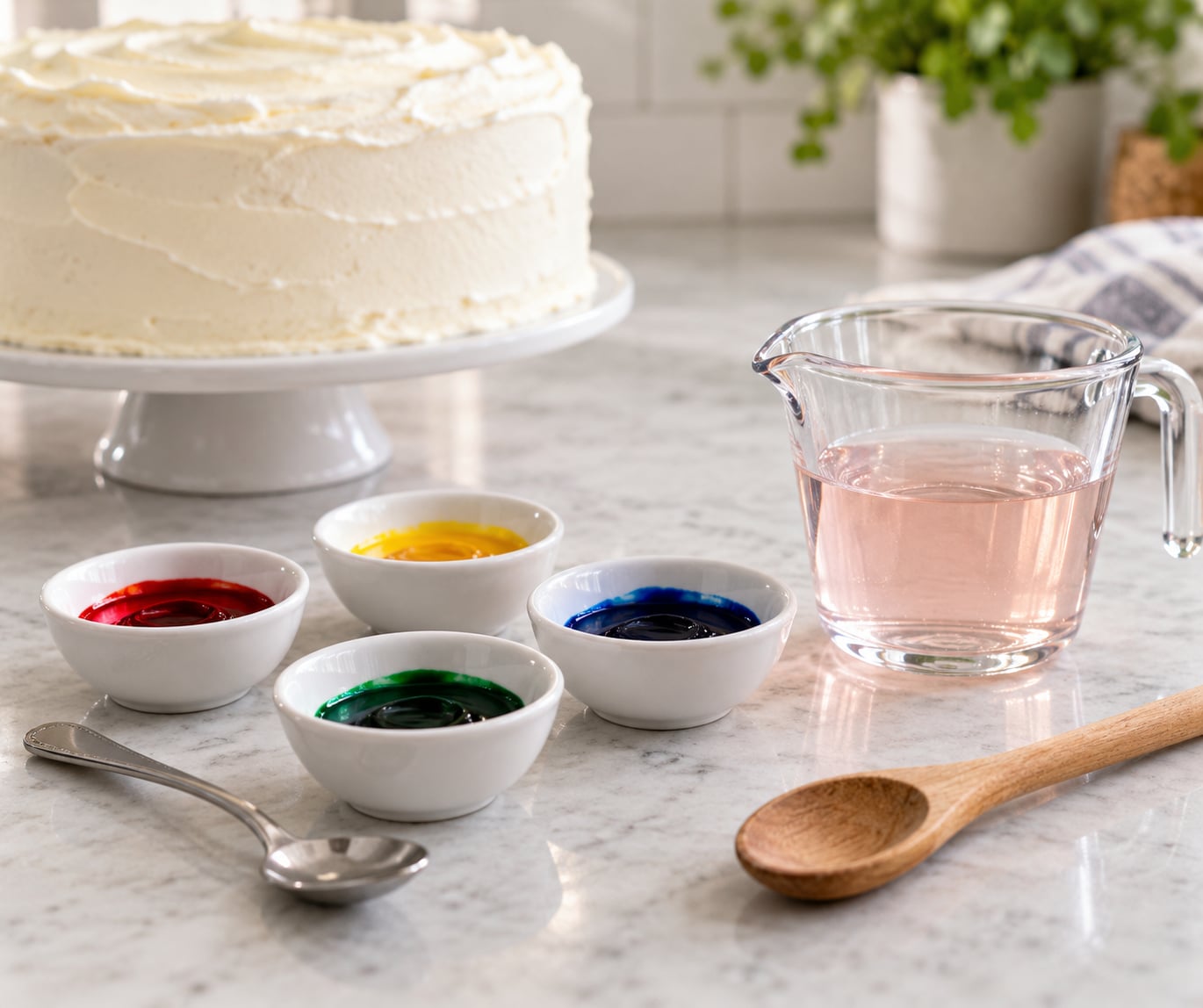
Gel food coloring is a thick, glycerin- or corn-syrup-based dye so concentrated that two or three drops will color an entire batch of frosting. Liquid food coloring is a thin, water-based dye that needs a spoonful to reach the same shade, and every drop of it adds real water to your recipe.
That single difference decides nearly everything else. Gel gives you saturated color without thinning buttercream, so it wins for decorating, fondant and strong reds and blacks. Liquid is gentler, cheaper per bottle and easier to dose, which makes it the better pick for pale tints, drinkable glazes and forgiving batch work.
Table of Contents
- Gel Food Coloring vs Liquid Food Coloring for Baking at a Glance
- Which Type of Food Coloring Is More Concentrated?
- How Do Gel and Liquid Colors Mix Differently?
- Which Is Easier and Safer to Use?
- Gel vs Liquid Food Coloring: Cost and Storage
- Which Should You Choose?
- Frequently Asked Questions
- Can you use gel food coloring in cake batter?
- What type of food coloring is best for coloring royal icing?
- What is the difference between food coloring dye and gel?
- How much gel food coloring equals liquid food coloring?
- Can I put gel food coloring in liquid?
- Does gel food coloring stain hands and counters?
- Final Verdict: Pick the Coloring That Matches Your Bake
Gel Food Coloring vs Liquid Food Coloring for Baking at a Glance
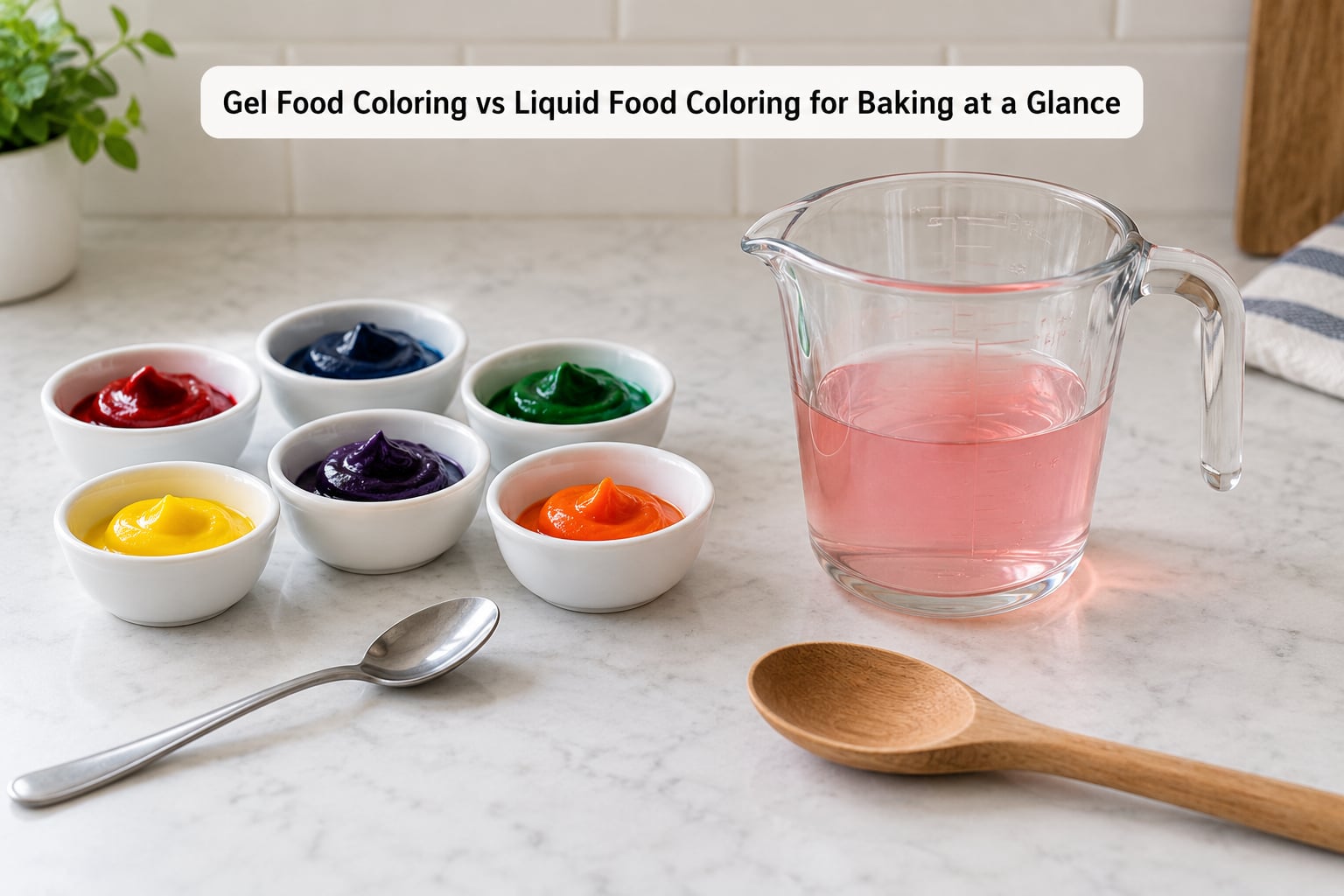
The fastest way to understand this comparison is to look at what each type adds to a recipe. Gel adds almost no free water. Liquid adds a measurable amount every time you use it.
| Criterion | Gel food coloring | Liquid food coloring |
|---|---|---|
| Color intensity | Very concentrated; a few drops color a full batch | Diluted; tablespoons are often needed for a strong shade |
| Moisture added | Negligible, even at full tint strength | Real water, and it adds up quickly |
| Effect on consistency | Leaves buttercream, royal icing and dough essentially unchanged | Thins frosting, softens dough and can make icing runny |
| Dosing control | Toothpick-dosing; easy to go slowly | Counted in drops or spoonfuls; hard to go slowly |
| Best applications | Buttercream, fondant, royal icing, batter, cookie dough | Pale tints, glazes, syrups, beverages, Easter egg dye |
| Color that stays put | Deep, saturated shades including true red and near-black | Pastel-leaning; true red and black are hard to reach |
| Melted chocolate and candy melts | No, water-based gel will seize the chocolate | No, same problem, and more of it |
| Staining | Frequent and stubborn, especially reds, blues and blacks | Present but usually lighter and easier to wash out |
| Storage and shelf life | Long jar life but can dry out and crust over | Long bottle life; separates over time but shakes back together |
| Cost per finished batch | Higher per bottle, lower per project | Lower per bottle, higher per project |
Read that table with one sentence in mind: gel trades volume for strength. Everything that makes it powerful, and everything that makes it slightly harder to work with, comes from that trade.
Which Type of Food Coloring Is More Concentrated?
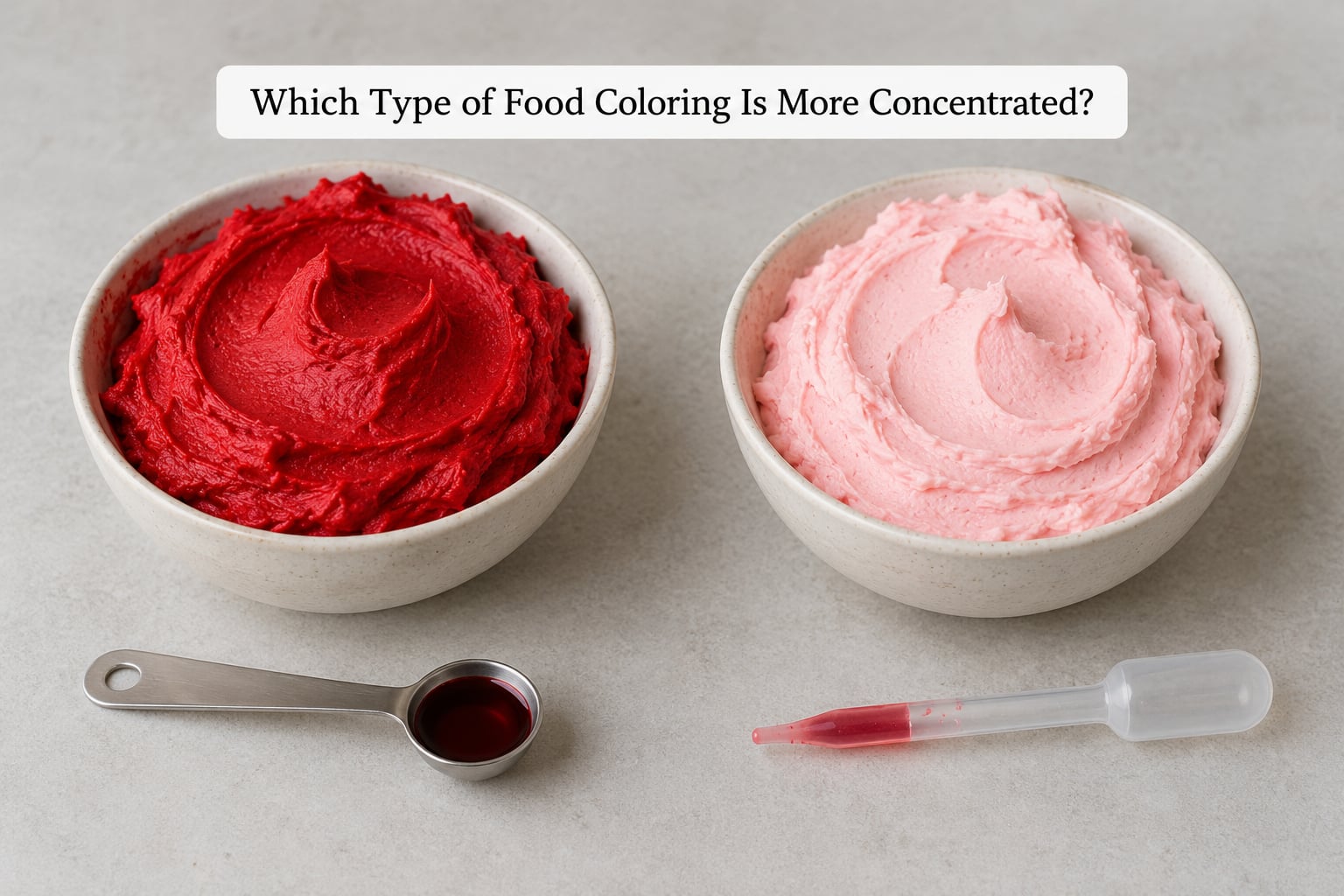
Gel is more concentrated, and by a lot. Both types work the same way at the core: dye is suspended in a carrier liquid. Gel’s carrier is glycerin or corn syrup, which is viscous and barely registers as free moisture in a frosting. Liquid’s carrier is water, and water is exactly what you are trying to avoid adding.
Because gel holds so much pigment per drop, a bright red in white buttercream usually takes around nine drops. A true deep red, the kind that does not go orange in daylight, needs closer to 10 to 12. Near-black takes 16 to 20 drops of gel, which sounds like a lot until you try to build black out of liquid coloring and watch it stay stubbornly grey.
Two colors behave differently no matter which type you use. Red and dark blue are hard to shift away from their natural tone; red keeps pulling toward pink or orange, and blue toward teal, unless you start with a concentrated base. Red and black also eat more dye than any beginner expects, which is where over-coloring and that familiar bitter edge in the finished bake usually comes from.
Color keeps developing after you mix. Give a batch 15 minutes at room temperature and you are seeing most of the shift, but reds and blacks can keep darkening for several hours and overnight. Frosting that looks right at midnight can read as over-tinted by morning. Mix a test dab, wait, then decide.
Both types are water-based dyes with the same dye certification requirements, so the color difference is about pigment load and carrier, not about safety.
How Do Gel and Liquid Colors Mix Differently?
Mixing behavior is where the practical difference shows up fastest, and it changes completely depending on what is in the bowl.
Buttercream and royal icing
These are the two recipes where liquid coloring fails you. American buttercream is already a stiff, butter-heavy frosting, and every spoonful of thin liquid you add softens it. Royal icing goes from pipeable to soupy with alarming speed, and icing that will not hold a tip cannot be fixed once it has happened. Gel tints both without moving the texture, which is why decorators working with buttercream almost never use liquid color.
Fondant and modelling paste
Rolled fondant is mostly sugar, glycerin and water, so extra water makes it sticky and prone to tearing at the edges. Small amounts of liquid are workable here and give you soft, blended shades, which is genuinely useful for skin tones and soft gradients. For anything crisp, like a tie, a flower edge or lettering, gel holds its shape and keeps the surface firm enough to work with.
Cake batter and cookie dough
Liquid color in batter is a small risk. In cookie dough it is a bigger one, because the dough goes soft and sticky and spreads more in the oven. Gel is the safer choice in both, though note that intense gel color in a baked good can taste bitter, so keep batter tints on the moderate side and use gel mainly where you need depth.
Mergingue, macarons and pulled sugar
These are moisture-sensitive in their own way. Egg white takes color readily, and a little liquid will not hurt a meringue, but macaron shells and Italian meringue for buttercream can seize or deflate if the whites are overloaded with thin liquid. A drop or two of gel gives you a controlled tint on a damp surface without the extra water.
Chocolate and candy melts: neither one works
This is the rule that catches out almost everybody at least once. Both gel and liquid coloring are water-based, and any water at all makes melted chocolate seize. The chocolate goes from glossy to dull, then to thick, grainy rubble you cannot stir smooth. For melted chocolate or candy melts, use an oil-based liquid color, or powder coloring, or do the marble technique: pipe a little gel into one corner of the slab, let the temper run through it, and marble it with a heatproof spatula.
Wilton icing color and other fat-based icing colors belong in the same category as oil-based color, not with gel or liquid. They work in chocolate because they carry fat rather than water.
Glazes, syrups and drinks
Liquid wins outright here, and gel will not even dissolve cleanly. In a drink or thin syrup, a spoonful of liquid color disperses instantly, while gel sits in sticky ribbons at the bottom of the glass unless you whisk it hard and dilute it with water first. Gel mixed with water does work as edible paint for cookie plaques, and it dries, but it takes more mixing than liquid does.
Which Is Easier and Safer to Use?
Gel gives you more control, and liquid gives you fewer ways to make a mess. Gel dosing is easy to slow down: dip a clean toothpick and flick off the excess so you are working one tiny drop at a time. Liquid color runs faster than you can stop it, which is exactly how a teaspoon becomes three.
The flip side is staining. Gel is sticky, concentrated and it does not wash off skin easily, and the darker reds, blues and blacks are the worst offenders. Liquid color also stains, but far more lightly, and it rinses out of most surfaces. Either way, the habits that prevent damage are simple and worth forming before you open the jar.
- Wear disposable gloves for anything dark, and roll the cuffs up.
- Work over a sheet that you can fold and bin, or a silicone mat you can scrub.
- Set out a damp cloth and a bowl of warm water before you start tinting.
- Do not use a pastry brush you care about. Dye goes into the bristles permanently.
- For benchtop marks, wipe with a paste of baking soda and a little oil, then wash normally.
On safety, read the label rather than the color. Some people avoid certain hues, most often red, blue and yellow, out of concern about synthetic dyes and how they behave for their own family. That is a personal call, but two practical notes hold up: check that the product is certified for food use in your country, and follow the manufacturer’s stated limits, which are on the packaging in most cases.
Natural and plant-based colorings have the same water-versus-glycerin choice, but a different result. Beet, hibiscus, turmeric and chlorophyll shades land in muted or brownish territory rather than the bright synthetic hues, and they shift in hue as they bake. Do not swap one type for another in a project mid-way if color match matters.
Gel vs Liquid Food Coloring: Cost and Storage
Cost comparison depends entirely on how you count. A bottle of liquid color is cheaper than a jar of gel, and it runs out faster because you use so much more of it. A jar of gel typically outlasts many bottles, which flips the answer once you count batches rather than containers.
The math is simple if you track it. If a bright red buttercream takes roughly nine drops of gel or a couple of teaspoons of liquid, then one jar covers dozens of medium batches while a bottle is usually gone in a handful. Gel wins on cost per finished project. Liquid wins if you only tint occasionally, because the bottle sitting in the cupboard is not money wasted yet.
Storage behaves differently too. Liquid color separates in the bottle, which looks alarming and means nothing. Close the cap, shake it, and it comes back. Gel does not separate, but it does dry. The surface skins over and the exposed edge hardens, which is why you should wipe the inside of the lid with a damp finger every time you close the jar, and store it upright and closed.
To revive a dried-out jar, add a single drop of warm water to the center and press the solid gel back together with a clean spoon. It does not come back to pourable gel, but a reconstituted paste colors frosting perfectly well.
Which Should You Choose?
Match the type to the job rather than to habit.
- Layered cakes with buttercream: gel, without question. The frosting has to stay firm enough to smooth and stack.
- Fondant and modelling paste: gel for anything with edges, lettering or detail; liquid for soft blended tints and skin tones.
- Intricate decorating, piping and color combinations: gel. Drop-by-drop control is what makes marbling, ombre and two-tone piping predictable.
- Cupcakes and quick party batches: either works. Gel if you want color that reads from across the room, liquid if the frosting is meant to stay soft and fluffy.
- Cookie dough: gel. Liquid softens the dough and the cookies spread.
- Pale flavors like lemon, coconut or vanilla: liquid, or use gel very sparingly. Heavy color competes with delicate flavors and can taste bitter.
- Large batches and big bakes: gel scales without thinning anything, which makes it easier to keep every tier of a tall cake the same shade.
- Beginners who want forgiving results: liquid, because a small mistake is easy to correct. Once you are decorating buttercream regularly, switch to gel.
- Drinks, syrups, glazes and Easter egg dye: liquid, by default.
- Melted chocolate or candy melts: neither. Use oil-based liquid color or powder.
If you only buy one thing to start, a small set of gel colors plus one bottle of liquid covers everything a home baker does for years.
Frequently Asked Questions
Can you use gel food coloring in cake batter?
Yes, and it is the safer choice because it adds almost no water. The thing to watch is taste: gel is concentrated enough that heavy tints in a baked cake can read bitter, since the dye does not cook off. For a bright layer cake, a moderate tint is usually enough to look vivid once the cake is sliced.
What type of food coloring is best for coloring royal icing?
Royal icing needs coloring that adds no water, so gel is the standard choice. Thin liquid icing color is the fastest way to turn royal icing from pipeable to runny, and that change cannot be reversed. For the smoothest working, mix your gel into a small portion of icing first, then blend it back into the batch.
What is the difference between food coloring dye and gel?
Both are dye suspended in a liquid carrier. The difference is the carrier and the concentration: gel uses glycerin or corn syrup with a heavy pigment load, so a few drops deliver saturated color. Liquid uses water and a much lower pigment load, so you need far more of it and every drop adds moisture to your recipe.
How much gel food coloring equals liquid food coloring?
Think roughly a one to ten ratio. Around nine drops of gel gives a bright red in white frosting where liquid would need about two teaspoons. Near-black takes 16 to 20 drops of gel and is barely reachable with liquid. Treat these as starting points, since pigment strength varies by brand and by how white your frosting is to begin with.
Can I put gel food coloring in liquid?
You can, but it will not dissolve on its own. Whisk a small amount of gel into a little warm water first, then stir that solution into your drink, syrup or glaze. Straight gel dropped into liquid tends to sit in sticky ribbons at the bottom. If you are coloring a drink rather than a glaze, plain liquid color is faster and disperses properly.
Does gel food coloring stain hands and counters?
Yes, and gel stains harder than liquid color because it is thicker and more concentrated. Reds, blues and blacks are the worst. Wear disposable gloves for dark shades, work over a silicone mat or sheet you can throw away, and keep a damp cloth and a bowl of warm water next to you while you mix. A paste of baking soda and oil lifts most residue from a worktop.
Final Verdict: Pick the Coloring That Matches Your Bake
Gel food coloring vs liquid food coloring for baking comes down to whether the recipe can afford extra water. If it cannot, use gel: buttercream, royal icing, fondant, cookie dough, deep reds and blacks. If it can, use liquid: pale tints, glazes, drinks and quick batches you would rather not fuss over. And skip both for melted chocolate.
What to do first: mix one small test dab of each type in the frosting you actually use, wait fifteen minutes, and compare. The answer becomes obvious in about two minutes, and it saves a ruined batch.