The trick to shipping cookies without them breaking is removing all movement: let the cookies cool completely, pair two at a time back-to-back so their flat sides support each other, wrap each pair tightly, set them snugly in a rigid container with no room to slide, then cushion that container inside a sturdy outer box. Cookies break because they shift, and shifting is something you can engineer out of the box.
This matters whether you are mailing a tin of holiday cookies to your sister in Georgia or shipping a small batch to a customer. The packing takes about twenty minutes. The baking already took an afternoon.
Table of Contents
- What You Need
- Step-by-Step: How to Ship Cookies Without Them Breaking
- 1. Choose Cookies That Can Handle Shipping
- 2. Cool and Fully Set the Cookies
- 3. Separate Every Layer With Parchment
- 4. Protect Decorated Cookies in Pairs or Small Groups
- 5. Choose a Rigid Box With Little Empty Space
- 6. Cushion and Seal the Package
- 7. Choose the Right Shipping Speed and Route
- 8. Test the Box Before Mailing
- Common Mistakes
- Packing cookies while they are still warm
- Leaving headroom in the container
- Stacking decorated cookies face to face with parchment only
- Using a padded envelope
- Wrapping one container without cushioning the empty space
- Shipping over a weekend or in a heat wave
- Mixing flavors or allergens in one box
- Frequently Asked Questions
- What is the best way to ship cookies without breaking them?
- Should I refrigerate cookies before shipping them?
- How long do cookies stay fresh when shipped?
- What type of box is best for shipping decorated cookies?
- Can I ship cookies in a padded envelope?
- How do I keep chocolate and icing from melting during shipping?
- Conclusion
What You Need
Gather everything before you start wrapping, because the packing goes fast and it is much easier when you are not hunting for parchment at the last minute.
- Cookies that are completely cool and firm
- A rigid container that fits them closely: a cookie tin, a sturdy plastic tub with a snapping lid, or a disposable aluminum pan with a tight foil seal
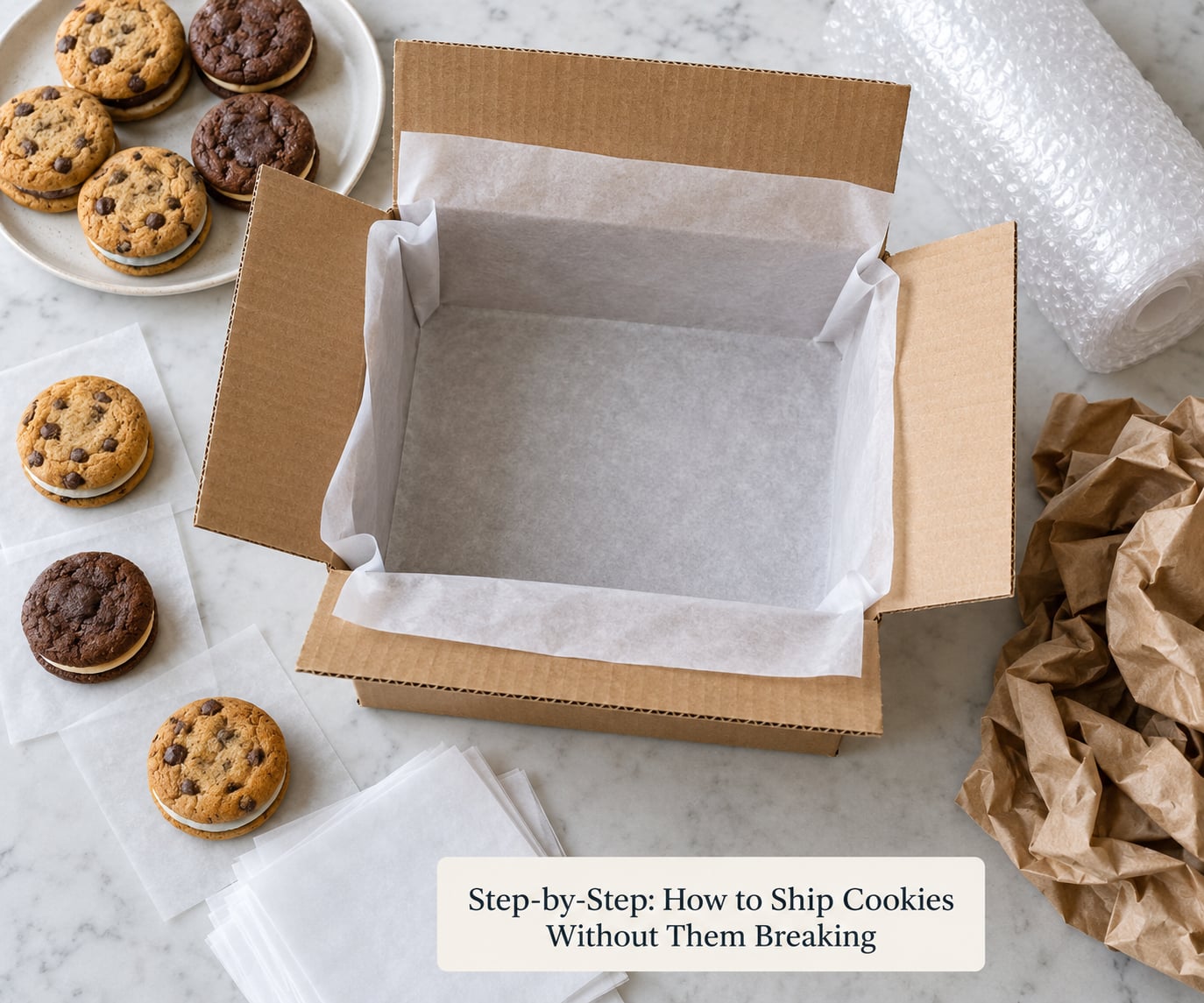
- Parchment or wax paper cut into squares, one for every layer
- Plastic wrap, or small resealable bags, or a heat sealer if you ship often
- Cushioning: bubble wrap, crinkle paper, packing peanuts, or crumpled kraft paper
- A corrugated shipping box with about two inches of padding on every side
- A moisture barrier if you are mailing crisp cookies: a sealed bag or plastic wrap layer
- A sheet pan and cooling rack
- Optional: insulated liner or cold pack for warm weather routes
Skip glass and mason jars. Bakers on baking forums talk about this constantly, and the consensus is consistent: glass adds weight, shifts in a box, and arrives as shards. If you love the look of a jar, ship the cookies inside and gift the jar empty.
Step-by-Step: How to Ship Cookies Without Them Breaking
1. Choose Cookies That Can Handle Shipping
Pick cookies by density and thickness, not by flavor. The best travelers are drop cookies that are thick and slightly soft: chocolate chip, snickerdoodle, oatmeal raisin, peanut butter blossom, gingerbread, and anything with chocolate chunks for structure. Biscotti and other twice-baked cookies are close to indestructible. Shortbread holds up well if it is thick-cut.
Bars are even easier than cookies. Blondies, brownies, and rice krispie treats ship as a single slab, and a lot of mail-order bakers just send the whole pan. Cut them only if you want individual portions.
Avoid anything thin, glassy, or decorated with anything that snaps. Lace cookies, madeleines, tuile, meringues, thin wafer cookies, macarons, and jam or curd filled cookies all crack under pressure. A frosted treat with buttercream is a soft target for a box corner.
2. Cool and Fully Set the Cookies
Let cookies sit on a wire rack until they are at room temperature all the way through, usually one to two hours. Packing warm cookies traps steam, and that steam condenses inside the wrap and turns crisp cookies soft and sticky in transit.
Give decorated cookies longer. Royal icing needs to dry completely, which takes several hours on a counter, before it can be handled at all. If you can press a fingertip to the icing and leave no mark, it is ready. Any dent means wait.
3. Separate Every Layer With Parchment
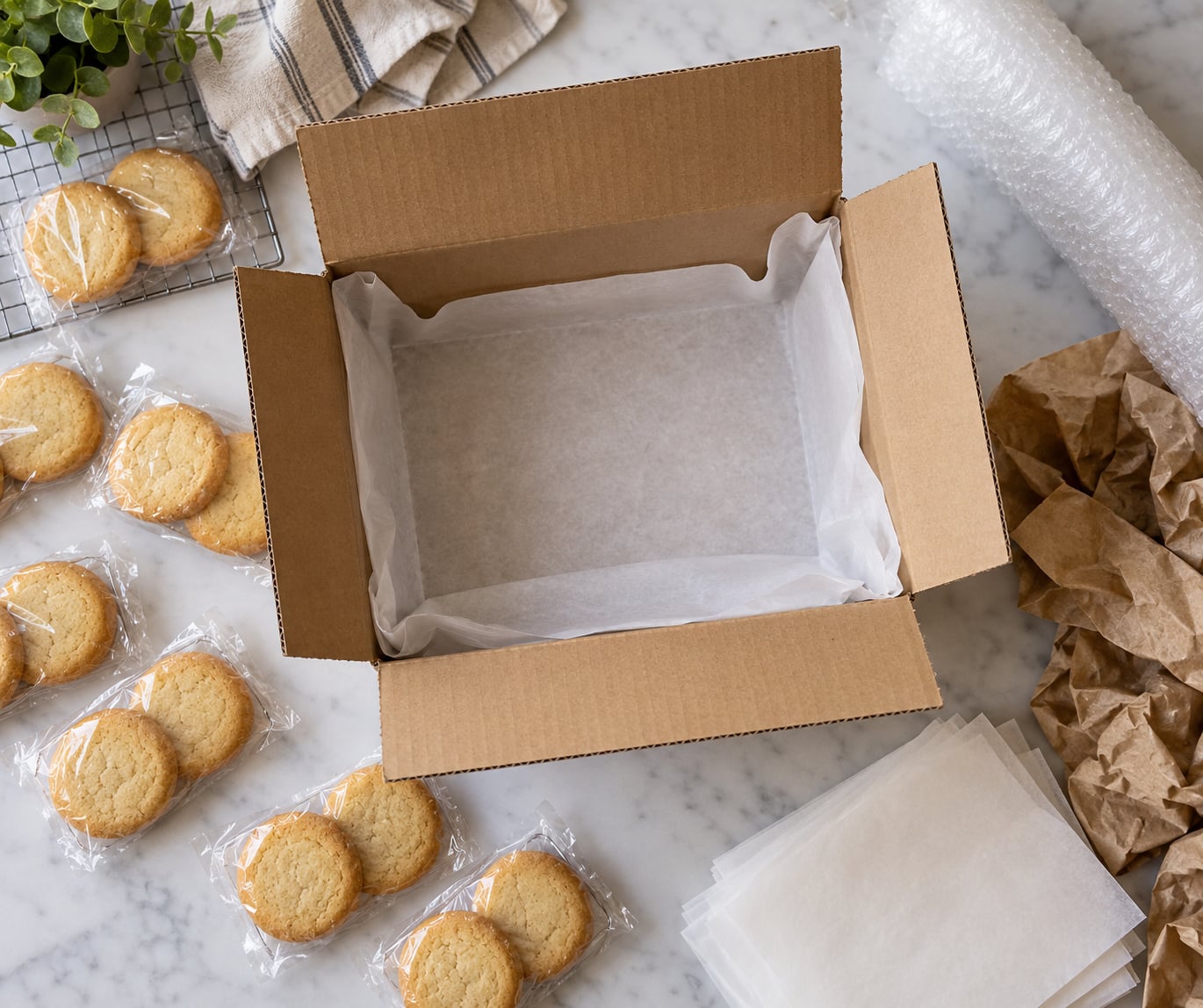
Lay cookies flat in a single layer with a square of parchment or wax paper between every layer and on top of the last one. This stops icing, chocolate, or confectioners’ sugar from transferring to the cookie underneath, and it stops two cookies from welding themselves together.
You can tell it worked when you lift the top sheet and the surface underneath is clean. If you see a print of one cookie on the back of another, wrap those two individually instead.
4. Protect Decorated Cookies in Pairs or Small Groups
Pair two cookies back to back, decorated side against decorated side, and wrap the sandwich tightly in plastic wrap. The flat faces support each other, which is what keeps a piped design from cracking when the box is bumped. Twist the ends of the wrap like a candy wrapper so the pair stays together.
Small resealable bags work well for single cookies, and a heat sealer gives you a tighter seal than twist tie ever will. If you ship often, that sealer pays for itself.
5. Choose a Rigid Box With Little Empty Space
Empty space is the enemy here. A cookie rattling around in a big tin has room to accelerate and slam into a wall, and that wall is what cracks it. Choose a container where the cookies fill most of the floor with maybe a finger’s width to spare.
Wrap the whole inner container in bubble wrap if the outer box leaves any gap, and cushion the bottom of the outer box first so the inner container cannot ride up on impact.
6. Cushion and Seal the Package
Fill the space around the inner container so nothing moves when you slide the box across a table. Packing peanuts and crinkle paper work well. If you have no bubble wrap, crumpled kraft paper, newspaper, or even slices of stale bread do the job.
Keep cushioning off the tops of decorated cookies so nothing presses on the icing. Tape the seams with packing tape in an H pattern across the bottom flaps, mark the box Perishable and This Way Up, and then press firmly on the center of the box. If it flexes or the lid bows, add more cushioning.
7. Choose the Right Shipping Speed and Route
Ship early in the week, and never let a parcel sit over a weekend. A parcel that moves fast spends less time in a hot truck and less time getting tossed, and ground service on a two-day route is usually plenty for sturdy cookies.
USPS, UPS, and FedEx all handle baked goods fine. USPS ground and Priority Mail are usually the least expensive, and Priority Mail flat rate boxes are free at the post office when you bring your own package. For small mail-order bakers, a rate tool like Pirate Ship or Shippo can knock a surprising amount off UPS and USPS labels. You do not need overnight service for most cookie shipments, but do pay for faster service if the route crosses hot country in July or your cookies are iced with a perishable frosting.
8. Test the Box Before Mailing
Do all three checks before you print a label. Lift the box and shake it gently; nothing should move or rattle. Press down on the lid with both hands; the box should not bend and the top should not dome. Open it and look at the cookies; none should be leaning, cracked, or dented on the surface.
Then close it for good. Reopening a packed box is how the one broken cookie happens.
Common Mistakes
Packing cookies while they are still warm
This is the number one cause of soft, soggy arrivals. Condensation forms inside the wrap and softens everything it touches. Fix: cool to room temperature, and if in doubt, wait an extra hour.
Leaving headroom in the container
A pretty tin with lots of empty space is a rattle box. Fix: pack the cookies in smaller groups and use two snug containers instead of one loose one.
Stacking decorated cookies face to face with parchment only
Parchment protects the surface but adds nothing structural. Fix: pair decorated cookies back to back so the icing is never the layer taking the impact.
Using a padded envelope
A padded envelope has no rigidity. Crushed cardboard inside a soft mailer is not a box, and crushes travel straight through. Fix: use a corrugated box, even a small one.
Wrapping one container without cushioning the empty space
A wrapped tin still rattles in a larger box. Fix: fill every gap so the inner container cannot shift in any direction.
Shipping over a weekend or in a heat wave
A parcel sitting in a depot all Saturday can hit temperatures that soften chocolate or melt a buttercream top. Fix: ship Monday to Wednesday, use insulated liner or a cold pack, and choose the fastest affordable service in warm months.
Mixing flavors or allergens in one box
Unwrapped cookies trade smells, and a peanut butter cookie next to a nut-free one can ruin a safe batch for someone with a serious allergy. Fix: wrap every cookie individually, pack nut-free batches separately, and label the box if allergens are involved.
Frequently Asked Questions
What is the best way to ship cookies without breaking them?
Pair two cooled cookies back-to-back, wrap each pair tightly in plastic wrap or a small resealable bag, set them snugly in a rigid airtight tin or container, then cushion that container inside a sturdy outer box with no empty space. Fill every gap so nothing shifts, tape the seams, and ship early in the week so the parcel never sits over a weekend.
Should I refrigerate cookies before shipping them?
Refrigeration softens cookies and can make them smell like the fridge by arrival. Freeze instead, and only if you want to extend freshness. Let baked cookies cool on a rack, then freeze them unwrapped on a sheet until solid, pack them into the container, and let them thaw sealed at room time, usually a couple of hours, before opening the box.
How long do cookies stay fresh when shipped?
Most sturdy cookies hold their quality for several days in transit, and airtight wrapping slows staling. Crisp varieties such as shortbread and biscotti keep longest, while soft frosted cookies are best eaten within a few days. Sealing cookies away from air and moisture is what matters most, since exposed cookies go stale within a day or two. Shipping Monday to Wednesday keeps parcels moving instead of sitting.
What type of box is best for shipping decorated cookies?
A rigid corrugated box that fits snugly around a tight inner container works best. Cookie tins, sturdy plastic tubs, and disposable foil-sealed pans all hold their shape in transit, while glass jars do not. Wrap the inner container in bubble wrap, cushion the bottom and sides of the outer box, and leave only a finger’s width of headroom so the cookies cannot slide into a corner.
Can I ship cookies in a padded envelope?
You can, but breakage is likely. A padded envelope has no rigid structure, so cookies get crushed whenever the mail is stacked. A small corrugated box costs very little more and protects far better. If you must use a soft mailer, fill it with a rigid insert or corrugated cardboard and pack cookies in single, individually wrapped layers.
How do I keep chocolate and icing from melting during shipping?
Ship early in the week, avoid any route that sits in a depot over a weekend, and choose insulated shipping liner or a foil blanket for warm months. A cold pack wrapped in a towel helps on hot routes. Wrapping cookies individually in plastic wrap before packing creates a moisture barrier that limits smudging, and letting royal icing dry completely before packing keeps it from denting.
Conclusion
Start with a firm, thick cookie and a container it nearly fills. Pair the cookies back-to-back, separate every layer with parchment, wrap each pair, cushion all the empty space in a snug outer box, and give the sealed box a shake before you label it. Get those five things right and the cookies have very little room left to break.