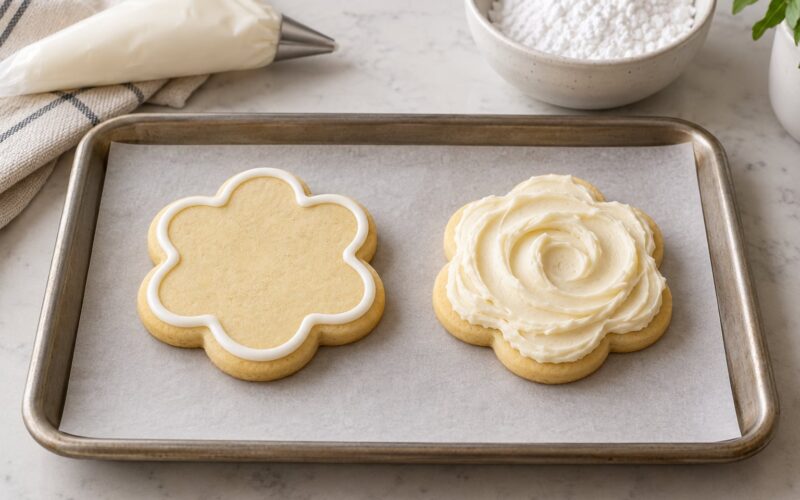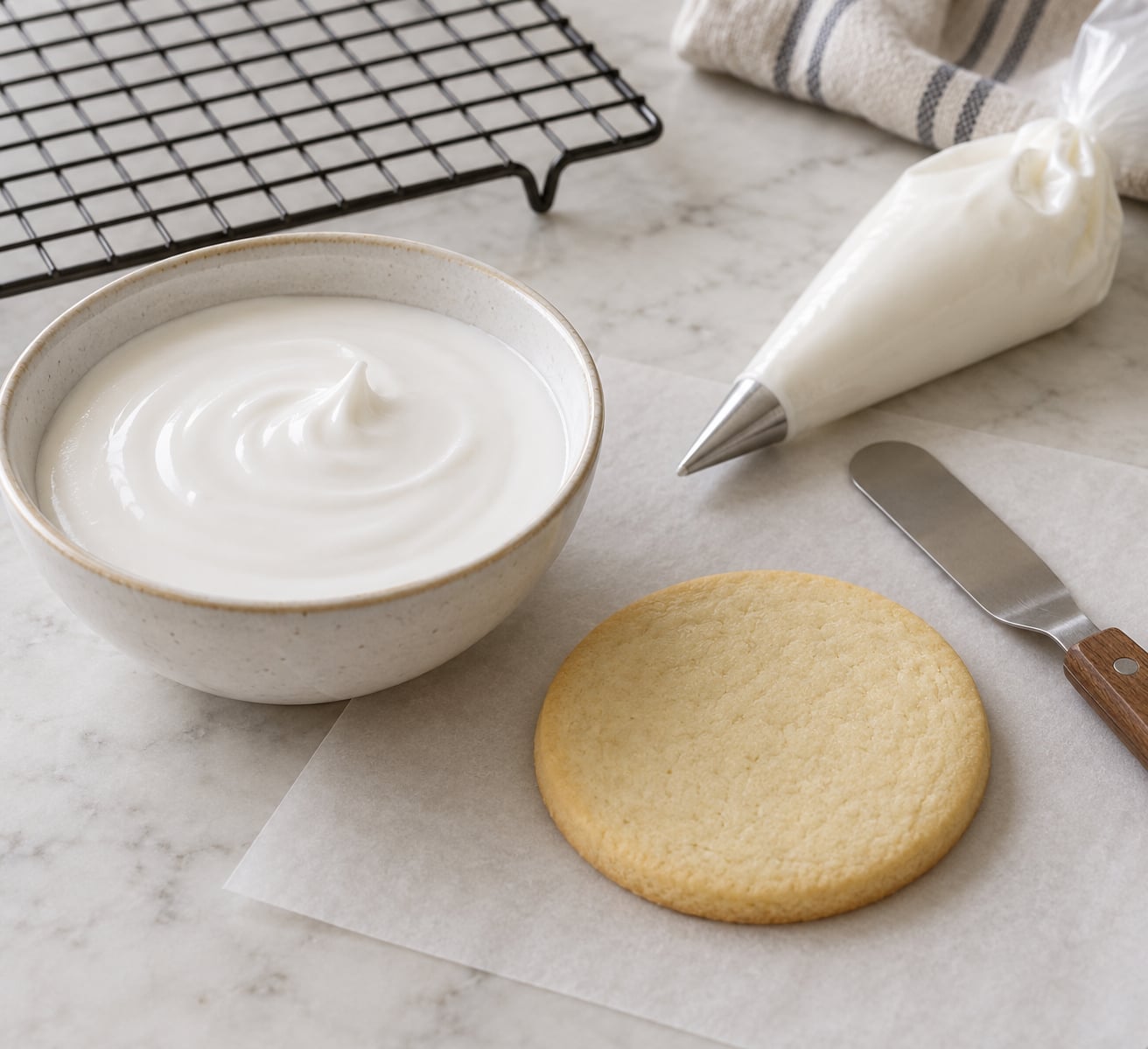
Icing dries hard when it is mostly sugar, holds almost no loose water, and goes on in a thin layer with air moving across it. The workhorse recipe is four ingredients: 3 cups (375 g) sifted powdered sugar, 2 tbsp light corn syrup, 3 to 4 tbsp milk and 1/2 tsp vanilla. Royal icing with meringue powder sets even harder. Give either one 4 to 8 hours, or overnight, and you get a firm surface that stacks, boxes and ships.
This guide covers how to make icing that dries hard for cookies, from choosing the right base to fixing a batch that refuses to set. It takes about 10 minutes of mixing and a few hours of drying, and the difficulty is low if you know the two mistakes that ruin most icing: too much liquid and overmixing.
First, a quick answer to the question underneath every other one. Sugar dissolves into the small amount of liquid you add, then that liquid evaporates and leaves a solid sugar film behind. Every extra teaspoon of milk or water has to evaporate first, which is why a thin flood sets in hours and a thick piped blob stays tacky for days.
Table of Contents
- What You Need
- The four-ingredient base icing
- The hard-set upgrade: royal icing
- Optional equipment
- For storing and testing
- Which Icing Dries the Hardest?
- Step-by-Step
- Step 1: Choose an Icing That Sets Firm
- Step 2: Mix It Smooth and Slightly Thick
- Step 3: Apply a Thin, Even Layer
- Step 4: Let the Icing Dry Completely
- Step 5: Check the Finish Before You Stack
- Common Mistakes
- How to harden store-bought icing
- Egg-free and vegan options
- Chocolate icing is a separate case
- Frequently Asked Questions
- What is the best icing for hard-drying cookies?
- How long does cookie icing need to dry before stacking?
- Can I make royal icing dry harder by adding more powdered sugar?
- Why is my cookie icing still soft after several hours?
- Can I dry cookie icing in the oven?
- How do I keep hard-drying icing from cracking?
- Start Here
What You Need
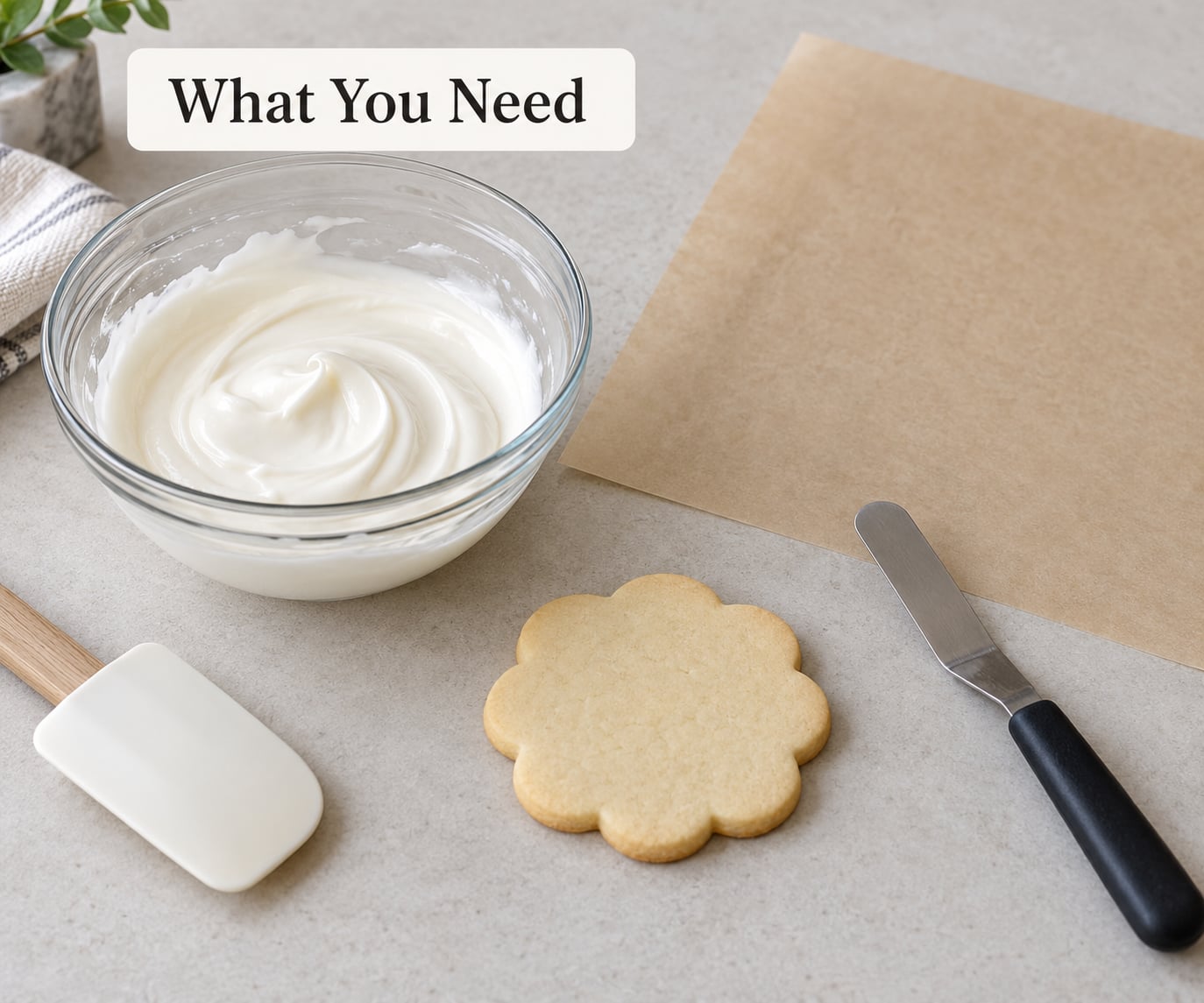
The four-ingredient base icing
- 3 cups (375 g) powdered sugar, confectioners sugar, sifted
- 2 tbsp light corn syrup, also sold as glucose syrup
- 3 to 4 tbsp milk, plus more if needed
- 1/2 tsp vanilla extract
That is the whole recipe. It firms up enough to stack cookies, and it tastes far better than plain royal icing, which is the main complaint people have about the classic recipe.
The hard-set upgrade: royal icing
If you want the rock-hard, detailed-piping version, swap in meringue powder. Combine 16 oz (450 g) powdered sugar, 3 tbsp meringue powder, 1 tsp light corn syrup and 5 to 6 tbsp warm water for outlining. Add a tablespoon or two more water for flooding.
Optional equipment
- A piping bag with a small round or star tip, plus a Wilton 4 or 5 for finer lines
- A small offset spatula or the back of a butter knife for flooding
- A toothpick or scribe tool for dragging colour through wet icing
- Gel food colouring, which is far stronger than liquid drops
- A wire cooling rack so air reaches the underside of the cookie
- A dehydrator, a fan, or a room with air conditioning
For storing and testing
Keep an airtight container, plastic wrap that touches the surface of leftover icing, and a sheet of parchment or a baking sheet with raised sides. A cooling rack is the test surface: a cookie that feels room temperature and completely dry to the touch after two hours is on track.
Which Icing Dries the Hardest?
Royal icing is the icing that dries the hardest, and it is the only one that dries to a genuinely rock-solid shell. Everything else is a softer set. Here is how the main options compare.
| Icing type | Final hardness | Shatter risk | Egg needed | Best use |
|---|---|---|---|---|
| Royal icing with meringue powder | Rock hard | High, shatters when bitten unless corn syrup is added | No, meringue powder is egg free | Piped details, stacking, shipping |
| Royal icing with fresh egg white | Rock hard | High, and it carries raw egg risk | Yes | Piped details where you accept raw egg |
| Four-ingredient corn syrup icing | Firm, slightly flexible | Low, bends instead of cracking | No | Flooding, everyday decorating, gifting |
| Two-ingredient powdered sugar and milk glaze | Soft set, sliceable but not stackable | None | No | Quick cookies you will eat same day |
| Crusting buttercream | Thin crust over soft frosting | None, but it dents on stacking | No | Decorated cupcakes and cookies you serve in place |
One fix that decorators on Cake Central have used for years: add 1 to 2 tbsp light corn syrup per pound (450 g) of sugar. The icing still dries hard but bends when someone bites it, instead of cracking their teeth.
Step-by-Step
Step 1: Choose an Icing That Sets Firm
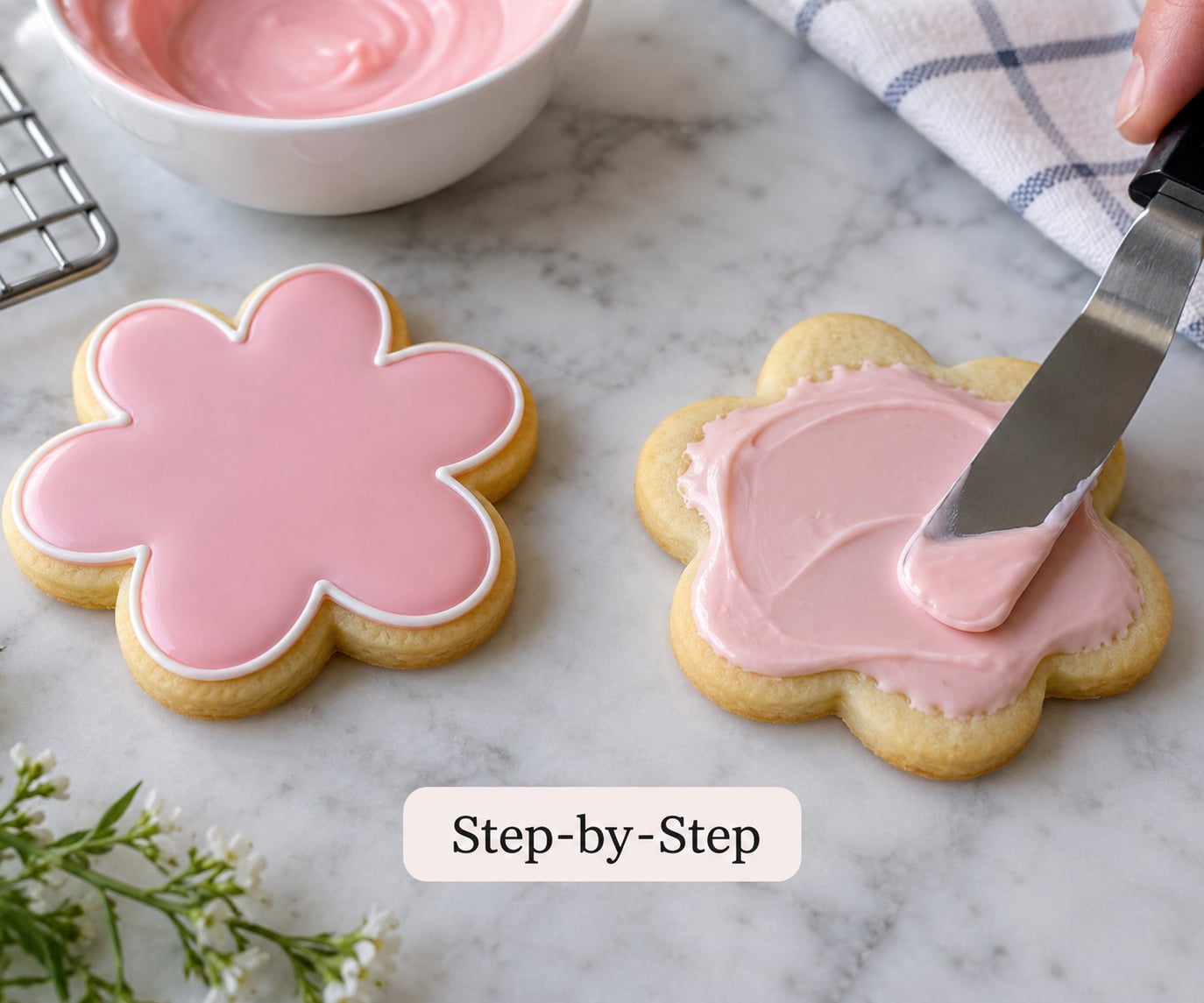
Start with powdered sugar, corn syrup and milk for a forgiving set that still stacks. Move to royal icing when you need detail work that holds a sharp line or a cookie that will survive shipping.
Buttercream is the one to avoid for this goal. It crusts over on the surface while staying soft underneath, which is fine for cupcakes and wrong for anything you plan to stack, box or mail.
Step 2: Mix It Smooth and Slightly Thick
Sift the powdered sugar first. Unsifted sugar is the single most common reason icing turns lumpy, and no amount of extra beating fixes it.
Stir in the corn syrup and vanilla, then add the milk a spoonful at a time. Beat on low for 30 to 60 seconds until the lumps are gone.
Test the consistency by dragging a spoon across the bowl and letting the icing fall back in. A ribbon should hold its shape on the surface for a few seconds before melting back in. If it disappears instantly, add a little more sugar; if it sits like a stiff mound, add milk a teaspoon at a time.
For royal icing, mix everything except the water into a bowl, add the water, then beat on low with a flat paddle for 10 to 15 minutes. On low, not high. Overmixing breaks down the proteins that set the icing, and r/cookiedecorating members repeatedly name overbeating as the reason a batch, vegan or not, refused to dry.
Split royal icing into two bowls before decorating. Keep one stiff enough to hold a line in 2 to 3 seconds for outlines and borders. Thin the other with water until it flows slowly off the spatula for floods, about 7 to 8 tbsp of water total for a 16 oz batch.
Step 3: Apply a Thin, Even Layer
Use a small offset spatula, the back of a butter knife, or a squeeze bottle with a tiny hole. Spread from the edge inward and let it self-level; do not pile icing on top of a bare cookie.
Thickness matters more than anything else. A thin flood sets in a few hours. A heavy layer keeps a wet core in the middle long after the surface feels dry, and that is the “modelled icing” problem where icing dries cracked and bumpy.
Keep your nozzle small. A wide tip lays down too much icing in one pass, and the layer underneath never has a chance to dry through.
Step 4: Let the Icing Dry Completely
Move the cookies to a wire rack with space between them and let air move across the surface. Turn cookies after a couple of hours if the underside is sitting in moisture.
| Icing type | Touch-dry | Firm enough to handle | Safe to stack |
|---|---|---|---|
| Four-ingredient corn syrup icing, thin flood | 15 to 30 minutes | 2 to 3 hours | 4 to 6 hours |
| Royal icing, thin flood | 15 to 30 minutes | 2 to 3 hours | 6 hours |
| Royal icing, piped details | 30 to 60 minutes | 4 hours | 6 to 8 hours |
| Thick piped icing, 3 mm or more | 1 to 2 hours | Overnight | Overnight to 24 hours |
Cool, dry air and moving air both matter. A fan on low works well, and decorators on r/cookiedecorating report it kept puffy details from slumping. A dehydrator at about 95°F (35°C) is the reliable option when the weather is against you.
Humidity is the reason a batch that set fine last October stays tacky in July. A decorator in Washington state reported that even a dehydrator for 30-plus minutes was not enough on the worst days. If you cannot change the weather, add an extra tablespoon of powdered sugar to soak up the extra moisture, decorate in the driest part of the house, and run the air conditioning.
Cover bowls while you work with damp paper towel or plastic wrap pressed directly against the icing. A skin on the surface of the bowl ruins the next batch.
Step 5: Check the Finish Before You Stack
Touch the icing with the back of your fingernail. If it feels cool, slightly tacky or leaves a mark, it is not ready. Dry icing feels room temperature, matte or glossy, and completely firm with no give.
Try lifting one cookie and setting it back down. If it leaves a dent or the icing marks the sheet, give it more time rather than stacking it and hoping.
For gifting and teacher gifts, let cookies dry overnight for the safest handle. For shipping, wait a full 24 hours and pack parchment between the layers, not wax paper, which can stick to a glossy set.
Leftover icing stores airtight at room temperature for up to a week with a layer of plastic wrap touching the surface. Royal icing freezes poorly once mixed, and colour can separate, so freeze it before tinting if you must.
Common Mistakes
The icing is still soft hours later. Almost always one of four things: too much liquid, overmixing, a thick application, or humid air. Add powdered sugar if it spreads, thin the next layer, and add airflow.
The icing looks set but is tacky the next morning. The surface skinned over while the layer stayed thick underneath, or the room was humid overnight. Thin your icing on the next batch and dry it longer before boxing.
Colours bleed into each other. You piped into icing that was still wet, or you used liquid food colouring, which adds water. Use gel colour and wait until each layer is touch-dry before the next goes on. Dark pigmented colours are the worst offenders, so flood those last.
The icing dries cracked and bumpy. The layer was too thick or you piped with a wide tip, so the outside hardened while moisture escaped from the middle. Scrape it back with a knife and re-flood a thin layer, or peel off the cracked shell and start again.
It is rock hard and cracks teeth. That is corn syrup’s job. Mix 1 to 2 tbsp light corn syrup into every pound of sugar, and store finished cookies airtight so they do not re-dry further. Dry cookies are also what makes them shatter, so wrap them well.
There are lumps in the bowl. Unsifted sugar or undermixing. Sift next time and press the icing against the side of the bowl while beating. Squeezing lemon juice into a lump of powdered sugar also breaks it apart.
You used honey instead of corn syrup. It will not set the same way and the icing can stay soft. Leave the honey out rather than swapping it in.
Edible markers and dark colours never dry. Some food pens stay slightly tacky by design. Draw those details last, on the day of gifting, and let them sit in a dry room rather than a fridge.
How to harden store-bought icing
Yes, you can, with two changes. Beat the icing smooth, then thin it with a small amount of warm water or milk, about a teaspoon at a time, until it flows off the spatula. Work in corn syrup if the tub frosting is pure fat-based, roughly 1 to 2 tbsp per cup, then spread a thin layer and dry it with airflow. Tub buttercream that is mostly shortening will never fully harden, so this buys you a firmer skin, not a true hard set.
Egg-free and vegan options
Meringue powder is the easiest egg-free route and sets reliably. Powdered egg whites work the same way. Aquafaba, the liquid left from a tin of chickpeas, also sets, but treat it like egg white and stop beating as soon as the meringue is glossy and firm, because it collapses and refuses to dry when overworked. No-bake cookies need the same icing as everything else, and give them the same drying time, since the icing, not the cookie, is what needs to set.
Chocolate icing is a separate case
Chocolate icing hardens for a different reason. Cocoa butter sets from temperature, not from sugar drying, so it firms in a cool room regardless of humidity. Cool, thin it with warm water or milk if it is too thick, and do not expect a sugar-style hard shell. Ganache stays soft by design, so it is the wrong choice for stacking.
Frequently Asked Questions
What is the best icing for hard-drying cookies?
Royal icing with meringue powder dries the hardest and gives the firmest shell. For most home bakers, a four-ingredient icing of powdered sugar, light corn syrup, milk and vanilla sets firm enough to stack cookies without the shattering feel of straight royal icing. Add 1 to 2 tbsp corn syrup per pound of sugar if you want hard but not brittle.
How long does cookie icing need to dry before stacking?
A thin flood of four-ingredient icing is safe to stack after 4 to 6 hours. Royal icing needs closer to 6 hours, and thick piped details can take 6 to 8 hours or overnight. In humid weather, wait longer. The test is simple: the icing should feel room temperature and firm, with no give when you press it with a fingernail.
Can I make royal icing dry harder by adding more powdered sugar?
Yes, and it is the standard fix when humidity is slowing the set. Sift in more powdered sugar a tablespoon at a time and re-test the ribbon consistency, because extra sugar also stiffens the icing. Be careful not to overcorrect until it will not pipe. In a dry climate the original ratio usually hardens plenty on its own.
Why is my cookie icing still soft after several hours?
Four causes cover almost every case. Too much liquid means the icing spreads and takes longer to evaporate. Overmixing breaks down the proteins in meringue powder, egg white or aquafaba so the icing never sets. A thick application keeps a wet core in the middle. And humid air slows evaporation. Fix the ratio, beat on low, flood thin and add moving air.
Can I dry cookie icing in the oven?
You can, but it is a last resort. A dehydrator at about 95°F (35°C) is gentler and gives even drying, and a fan on low is the simplest option. If you use the oven, use the lowest setting with the door cracked, stay in the room the whole time, and pull the cookies out the moment the icing is firm, because heat dries the surface before the layer underneath and leads to cracking.
How do I keep hard-drying icing from cracking?
Keep the layer thin. Most cracking comes from a thick application where the outside sets while moisture escapes from the middle. Add 1 to 2 tbsp light corn syrup per pound of sugar so the finished film flexes instead of snapping, and give the cookies the full drying time. Store them airtight once set, since dry cookies are what crack when bitten.
Start Here
Sift 3 cups of powdered sugar, stir in 2 tbsp light corn syrup and 1/2 tsp vanilla, then add milk until the ribbon holds its shape for a few seconds. Flood the cookies thin, give them a fan and wait 4 to 6 hours before you stack. That single batch answers most of what people search for when they look up how to make icing that dries hard for cookies, and it works again every season.