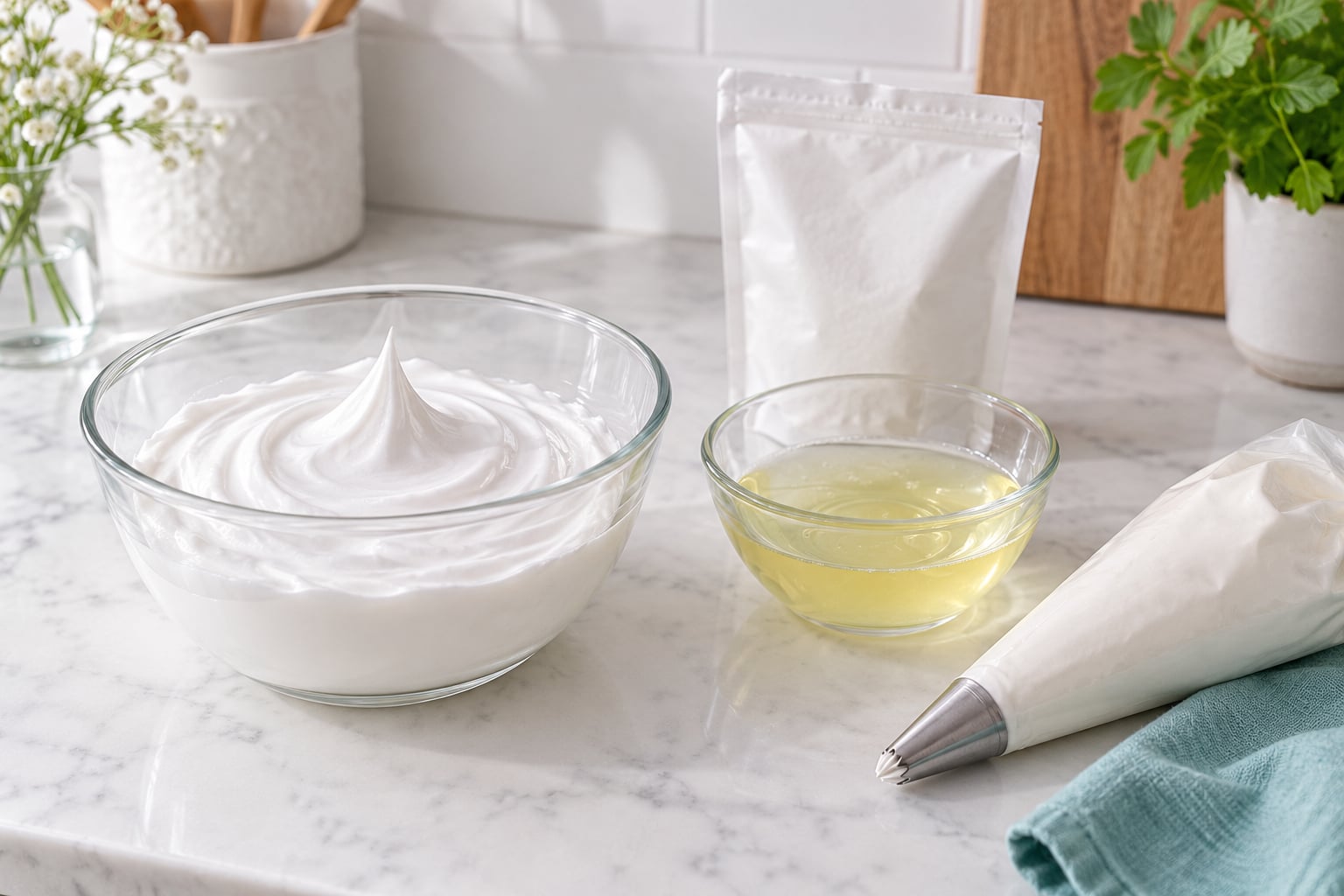
Meringue powder vs egg whites for royal icing is mostly a safety and consistency decision. Meringue powder gives you repeatable icing that pipes smoothly and stays firm, while fresh egg whites give you the classic glossy finish and a slightly lighter body. Use meringue powder for anything that gets eaten or made in bulk, and egg whites when the shine is the whole point.
Both work by rebuilding egg-white protein around powdered sugar, so both dry rock hard and hold piped detail. The difference is how you get there and what you trade away. Which one wins for your project comes down to three questions: what is the decoration for, how shiny do you need it, and who is going to eat it?
Table of Contents
- Meringue Powder vs Egg Whites for Royal Icing at a Glance
- What Is Royal Icing Made Of?
- Meringue Powder for Royal Icing: Smoothness and Simplicity
- Egg Whites for Royal Icing: Traditional Flavor and Strong Structure
- Meringue Powder vs Egg Whites: Flavor and Texture
- Meringue Powder vs Egg Whites: Stability and Drying Time
- Meringue Powder vs Egg Whites for Allergy-Aware Baking
- Cost, Shelf Life, and Ease of Use
- Which Should You Choose?
- Meringue Powder vs Egg Whites for Royal Icing: What Actually Changes
- Frequently Asked Questions
- Is meringue powder better than egg whites for royal icing?
- Can I use royal icing if I have an egg allergy?
- Does meringue powder make royal icing taste different?
- How do I keep royal icing from getting grainy or runny?
- Can I use liquid egg whites instead of fresh egg whites?
- How long does royal icing made with meringue powder or egg whites keep?
- A Practical Verdict for Your Next Cake
Meringue Powder vs Egg Whites for Royal Icing at a Glance
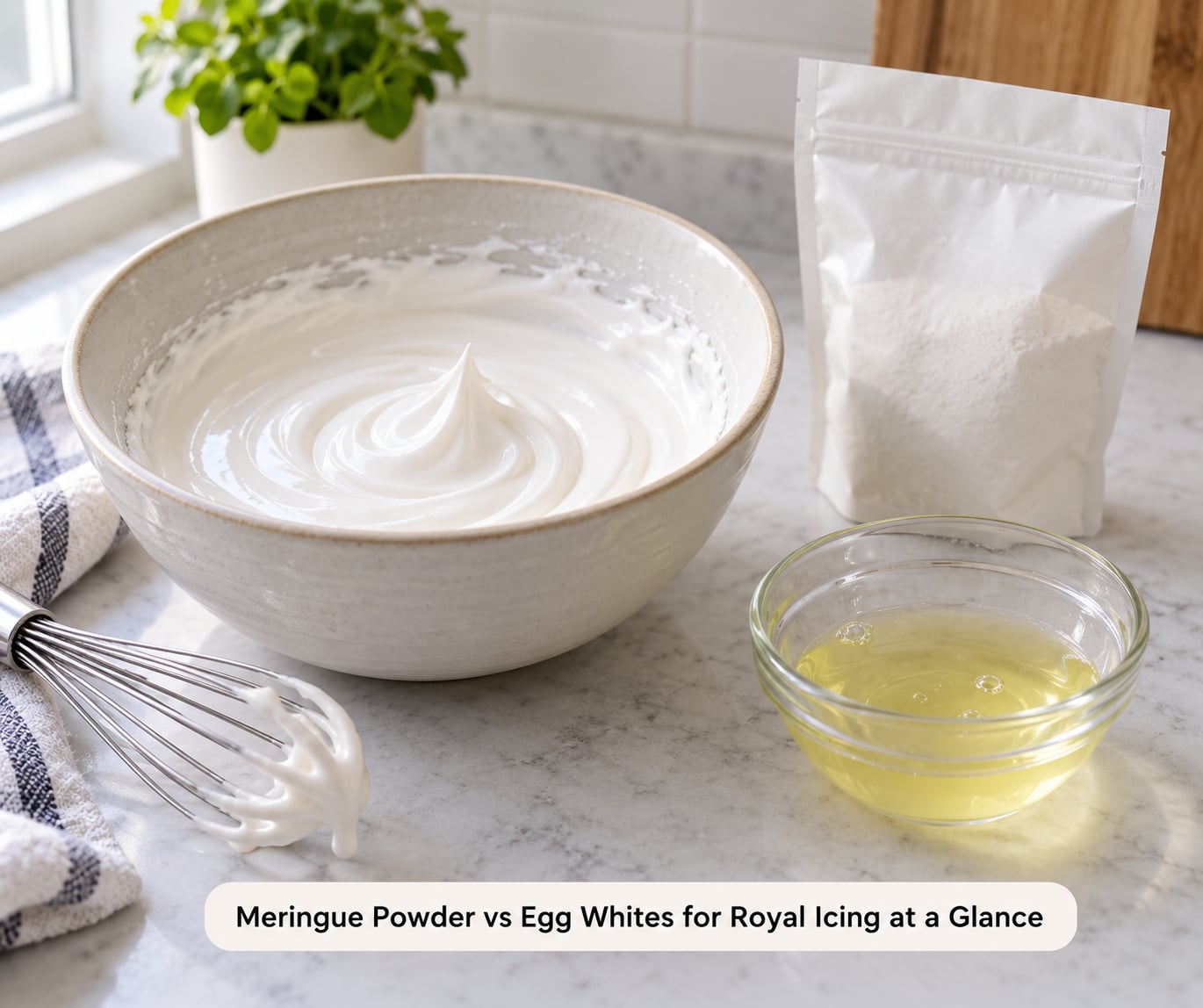
| Criterion | Meringue Powder | Egg Whites |
|---|---|---|
| Best for | Edible decorations, kids’ cookies, large batches, display work you want to be safe | Glossy showpieces, piped flowers, traditional wedding and teacup cookies |
| Flavor | Neutral, sometimes a faint sweetness from added sugar or a slight aftertaste depending on brand | Clean and neutral, no added sugar |
| Finish | Matte to satin | Bright gloss |
| Texture | Smoother, firmer, less foamy; a few decorators notice a slightly grainier bite | Creamier and slightly aerated from whipping |
| Consistency | Very repeatable batch to batch | Varies with egg size and how old the whites are |
| Drying | Hard, reliable crust in about 24 hours | Hard, reliable crust in about 24 hours |
| Preparation | Mix powder and water, rest, add sugar | Separate eggs, whip whites, add sugar |
| Shelf life of the protein | About two years dry, sealed | Use whites fresh; a carton keeps for weeks unopened |
| Allergy profile | Usually pasteurized and salmonella-free; still contains egg protein | Raw whites carry salmonella risk; pasteurized cartons do not |
| Conversion | About 1.5 tsp per cup of confectioners’ sugar, or 2 tsp plus 2 tbsp water per egg white | One large egg white per roughly one cup of confectioners’ sugar |
What Is Royal Icing Made Of?
Royal icing is confectioners’ sugar, a small amount of liquid, and something that makes the sugar stand up instead of slumping. That something is usually egg protein. Whisked whites trap air, and the protein dries into a hard shell that holds ridges, borders and 3D shapes.
The typical formula is roughly 3 cups of sugar to one egg white plus a teaspoon of cream of tartar, or 3 cups of sugar to about a tablespoon and a half of meringue powder reconstituted with water. Swap the protein source and the rest of the recipe barely changes.
Without any protein at all, you can still make edible icing with powdered sugar, water and a little corn syrup for shine. It works, but it stays softer and more fragile, which is why most decorators reach for one of the two options here.
Meringue Powder for Royal Icing: Smoothness and Simplicity
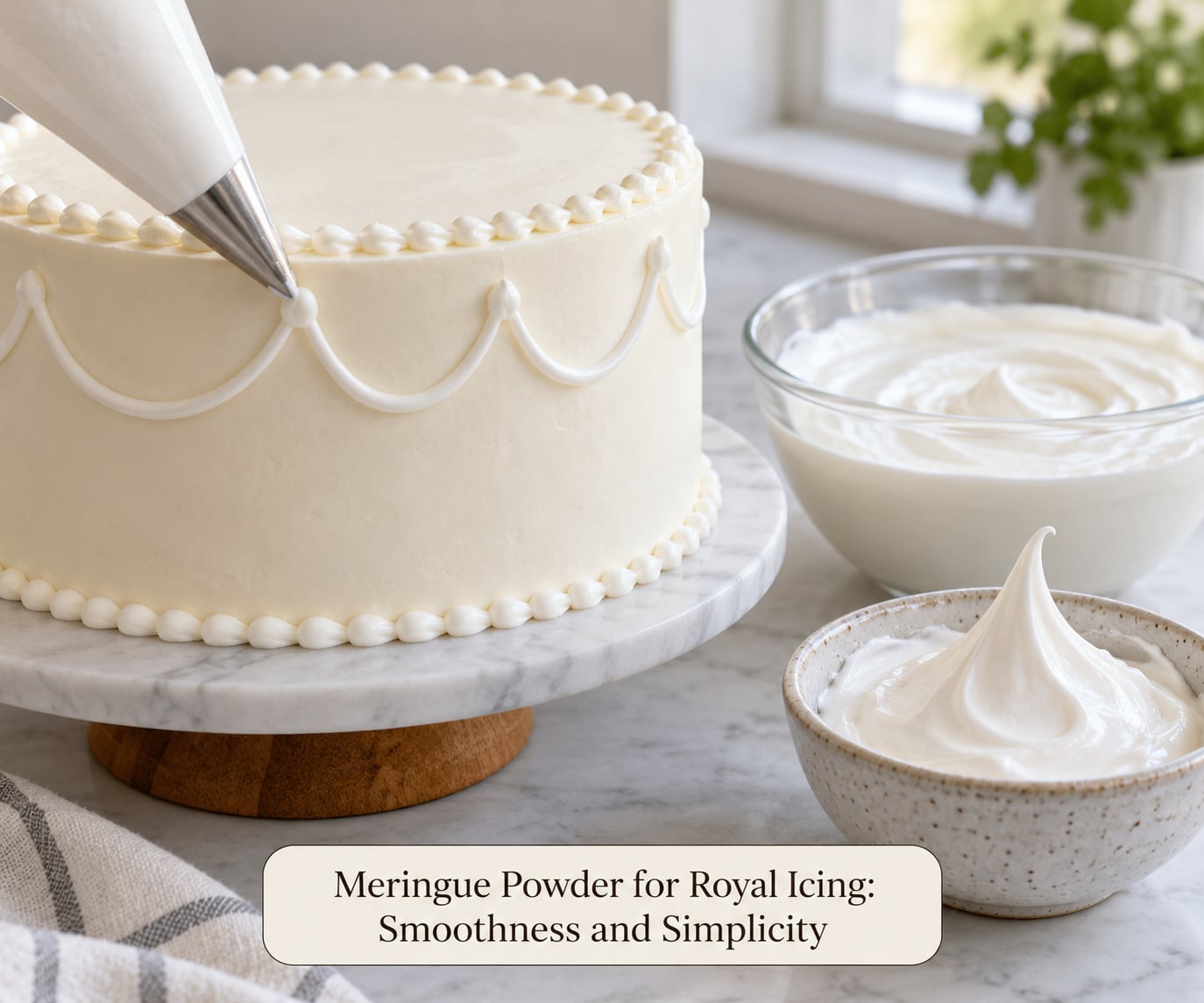
Meringue powder is pasteurized dehydrated egg white blended with sugar and a small stabilizer, usually cornstarch, cream of tartar or citric acid. You mix it with warm water first, let it sit so the protein rehydrates, then beat in the powdered sugar.
The result is an icing that holds a piping stiffness with very little correction. Because the powder is weighed and dried rather than measured by egg size, batch four tastes and pipes like batch one. That predictability is why so many holiday decorators settle on a single brand and never go back.
What to check on the label matters more than the front of the bag. Look for added sugar, since it makes the icing sweeter than an equal amount of egg-white icing, and look for gums or cornstarch, which can make the finish more matte and slightly grainier. A plain powder listing only egg whites, sugar and acid blends in more smoothly.
Mixing it correctly takes two minutes. Whisk the powder into warm water until no dry streaks remain, rest it 15 to 30 minutes to release air bubbles, then add sugar a cup at a time. Overbeating is the main way to ruin this method, and a rested paste is the cure.
Egg Whites for Royal Icing: Traditional Flavor and Strong Structure
Fresh egg whites whip to soft peaks in about a minute, and the sugar you add locks that foam into a firm, glossy shell. This is the method most competition cake decorators and cookie shops still use, and it is the one that produces the shine you see in photos of porcelain teacups and announcement cookies.
The catch is variation. A jumbo egg white and a small one change the sugar ratio, and older whites whip differently than fresh ones. Some decorators like to age their whites in the fridge for a week first for better foam, which is not a technique most beginners want.
There is a middle ground worth knowing: pasteurized carton egg whites. They pour straight from the carton and carry no raw egg, and plenty of experienced decorators rate them above meringue powder, saying carton whites look closer to the fresh version, taste cleaner and pipe with a little more precision.
Whichever white you use, keep water away from the bowl. Even a drop of yolk or a wet spatula tip will fight the foam, and a yolk that sneaks in is the number one reason icing refuses to stiffen.
Meringue Powder vs Egg Whites: Flavor and Texture
Taste is where meringue powder loses points. The added sugar in the powder makes the icing noticeably sweeter, and some brands leave a faint aftertaste that people notice. Decorators who switched to egg whites for that reason usually describe the egg white version as creamier on the palate.
Texture splits along the same line. Egg whites whip air in, so the icing is marginally lighter and foamier. Meringue powder mixes in with less air, so it is denser and holds a sharper edge. The complaint you hear most from switchers is that powder icing is less foamy and a little grainier.
Finishing is the visible difference. Egg white icing levels out to a bright gloss once it dries smooth. Meringue powder icing sits at a matte or satin finish unless you add gloss medium or a little corn syrup, because shine comes from a smooth fat-free sugar film rather than from egg protein itself.
Both pipe well once they are at the right stiffness. Egg whites tolerate slightly softer icing because the foam gives them body, while meringue powder icing that is even a little thin will run, so powder batches benefit from checking consistency more often.
Meringue Powder vs Egg Whites: Stability and Drying Time
Once dry, both methods harden to the same rock-solid finish in roughly a day, and neither needs refrigeration to set. Dry icing on a cookie or cake topper is stable for weeks at room temperature as long as humidity is not extreme.
Before drying, meringue powder icing holds its piped shape longer and resists slumping on vertical surfaces, which makes it the easier choice for stacked tiered cakes and gingerbread houses. Egg white icing slumps a touch more readily while wet but dries to a shell that resists cracking well on curved cake surfaces.
Humidity is the real enemy of both, and it is worse for the egg white version. Extra moisture in the air slows the set and keeps the surface tacky for longer. If you decorate in a humid climate or during a wet season, add powdered sugar in small increments and give each piece a full 24 hours before moving it.
For transport, both are fine once fully dry. Wrap loosely rather than airtight so condensation does not soften the surface, and let the pieces sit in a single layer until the shell is firm all the way through.
Meringue Powder vs Egg Whites for Allergy-Aware Baking
Here is the part that gets misread most often: meringue powder is pasteurized, not egg-free. It is dried egg white, so it can still trigger an egg allergy in someone who reacts to the protein.
That said, it removes the salmonella risk that comes with raw egg, which is a separate and much more common concern. If you are decorating for a child, a pregnant guest, an older relative or anyone immunocompromised, pasteurized powder, carton whites or a corn syrup icing are the sensible choices.
For a true egg allergy, check two things on the label: whether egg is listed as an ingredient at all, and whether the powder is made in a facility that also handles egg and nuts. Bakers working in allergen-aware kitchens should treat the shared-facility statement as the deciding line, not the ingredient list.
Neither option makes royal icing gluten-free on its own. You need certified gluten-free confectioners’ sugar, since most supermarket powdered sugar is made in a facility that also mills wheat.
Cost, Shelf Life, and Ease of Use
Per batch, a carton of egg whites and a tub of meringue powder land in the same general range once you count the eggs you separate and discard. What tips the balance is waste and time. Every egg you crack is a yolk you need to use up or store, and that is the real hidden cost of the traditional method.
Shelf life favors the powder clearly. A sealed bag keeps for about two years in a cool cupboard, so you buy it once and it is there when the mood strikes. Dry egg whites sold in the baking aisle are essentially the same product and keep similarly well.
Cleanup follows the same split. Meringue powder washes out of bowls and beaters with warm water. Raw whites mean washing beaters that held raw egg, and that is the step people skip, which is exactly the step that matters.
Both icings can be covered and kept at room temperature for about a week, refrigerated for a month, or frozen. Thawed icing needs a short re-whip and a little water before it pipes again.
Which Should You Choose?
Meringue Powder vs Egg Whites for Royal Icing: What Actually Changes
If the decoration will be eaten, choose meringue powder or pasteurized carton whites. There is no raw egg on the table, the texture is predictable, and a parent serving a first birthday cake should not have to worry about what went into it.
Pick egg whites when gloss is the finish you are after and you have fresh whites ready. That covers competition cake work, high-end wedding cookies and anything photographed in close-up under a light.
- Beginners: meringue powder, because a repeatable recipe matters more than tradition when you are still learning the 10 second rule.
- Smooth borders and fine piping: egg whites, because the gloss and finer piping tip response make delicate line work easier.
- Flowers and decorations that get eaten: meringue powder or carton whites, for the safety argument alone.
- Tiered or stacked cakes and gingerbread houses: meringue powder, which holds a vertical shape better while wet.
- Large holiday batches: meringue powder, since the same recipe scales up without drifting.
- Display-only decorations nobody will eat: either method works; choose whichever is already in your kitchen.
Frequently Asked Questions
Is meringue powder better than egg whites for royal icing?
Meringue powder is better for consistency, food safety and decorations that will be eaten, because it is pasteurized, dries reliably and pipes the same way every time. Egg whites are better when you want a bright glossy finish and the finest piping control. Many decorators land in the middle with pasteurized carton egg whites.
Can I use royal icing if I have an egg allergy?
Only if the icing is made without egg protein. Meringue powder is pasteurized but still contains dried egg white, so it can trigger an egg allergy. For a genuine egg allergy, use a corn syrup and powdered sugar icing instead, and check labels for shared-facility warnings if you are buying a packaged mix.
Does meringue powder make royal icing taste different?
Slightly, yes. Meringue powder contains added sugar on top of the egg white, so the icing tastes sweeter than an egg white version made with the same amount of confectioners’ sugar. Some brands also leave a faint aftertaste. Clear vanilla or almond extract keeps the flavor bright without dulling the white.
How do I keep royal icing from getting grainy or runny?
Runny icing needs powdered sugar in small increments until it passes the 10 second rule, where a line drawn on the icing stays visible for about ten seconds. Grainy icing usually means overmixing, so let the mixture rest 15 to 30 minutes to release air bubbles, and always sift confectioners’ sugar rather than scooping it.
Can I use liquid egg whites instead of fresh egg whites?
Yes. Pasteurized carton egg whites work well and carry no raw egg risk. Pour them into a clean, dry bowl and treat them exactly like fresh whites, keeping every drop of yolk and water out of the bowl. They whip slightly less than fresh whites, so expect to add sugar a little more gradually.
How long does royal icing made with meringue powder or egg whites keep?
Mixed royal icing keeps at room temperature for about a week covered with a damp paper towel, or about a month refrigerated. Unused dry meringue powder keeps roughly two years in a sealed bag in a cool cupboard. Covered in the fridge, either method’s icing can be frozen and re-whipped before use.
A Practical Verdict for Your Next Cake
Meringue powder wins the practical columns: safety, consistency, shelf life and the fact that the same recipe works on the tenth batch as on the first. Egg whites win the finish column, and if gloss is what you are decorating for, that is worth the extra bowl to wash.
Do one thing before you mix. If you are using powder, read the ingredient list for added sugar and cornstarch, then weigh out your ratio instead of trusting volume. If you are using egg whites, separate them cold with a spotless bowl and whip to soft peaks before any sugar goes near them.