Buttercream softens at about 75°F (24°C), piped details droop above 82°F (28°C), and the frosting melts outright near 90°F (32°C). So learning how to keep buttercream from melting in hot weather comes down to two levers: the fat you build the frosting with, and how cold you keep the finished cake.
Swap half or all of the butter for high-ratio shortening, frost only a cake that has been properly chilled, and keep the finished dessert in the fridge right up until shortly before serving. Those three moves handle most summer cakes, including outdoor ones.
The part nobody can control is the room itself. Bakers on r/AskCulinary and CakeCentral keep describing the same problem: the cake is flawless in the kitchen and only starts to slide at the venue, because a tent or a dessert table with no air conditioning is warmer than the forecast suggested.
Table of Contents
- What You Need
- Step-by-Step
- Step 1: Choose a Heat-Resistant Buttercream
- Step 2: Chill the Cake Before Frosting
- Step 3: Apply a Thin Crumb and Firm Frosting Layer
- Step 4: Decorate Quickly in a Cool Room
- Step 5: Chill the Finished Cake Until Serving
- Step 6: Transport and Serve Without Melting
- Common Mistakes
- How to fix buttercream that has already started to melt
- Frequently Asked Questions
- How to stabilize buttercream for hot weather?
- What type of buttercream holds up best in heat?
- Does meringue powder stabilize buttercream?
- How far in advance can I put buttercream on a cake?
- Is Swiss meringue buttercream more stable than American buttercream?
- How do I fix buttercream that has already melted?
- Conclusion
What You Need
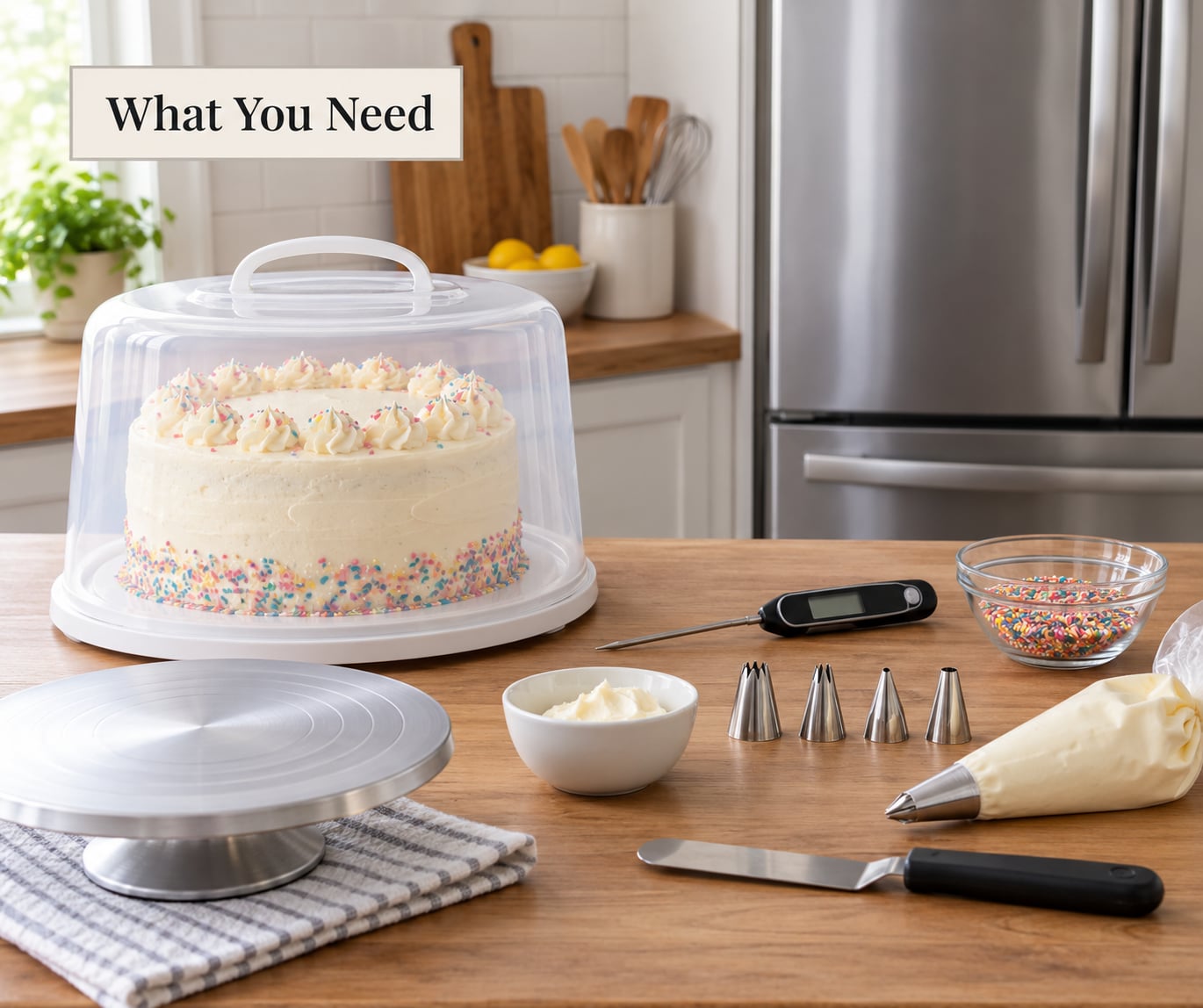
You do not need a professional setup. You do need somewhere cold with enough room, and the right fat in the bowl before you start.
- A cake carrier or sturdy box that fits on a flat car boot floor. A flat surface matters more than a level one.
- Refrigerator space, measured in advance. Most home fridges take a single 8-inch layer. Check before you bake the layers, not after.
- An instant-read thermometer for checking cake layers and the display room if you are able to.
- High-ratio vegetable shortening such as an icing fat, for the heat-stable frosting. All-purpose shortening works but less well.
- Meringue powder as a stabiliser. One tablespoon per batch is the usual amount.
- Cooling racks, spatulas and a piping bag you can chill.
- Ice packs or frozen gel packs plus an insulated bag for transport.
- Gel food colour, not liquid. Liquid colour adds water and thins the frosting.
Step-by-Step
Step 1: Choose a Heat-Resistant Buttercream
The fat does the structural work in frosting, and every fat gives out at a different temperature. This is the table worth memorising.
| Fat | Melting point | What that means |
|---|---|---|
| Coconut oil | 76°F (24°C) | Melts in a warm room. Avoid for display cakes. |
| Butter | 90–95°F (32–35°C) | The usual reason buttercream fails outdoors. |
| Margarine | 90–100°F+ (32–38°C) | Spread varies by brand. Not a reliable upgrade. |
| Vegetable shortening | up to 115°F (46°C) | Best choice. High-ratio icing fat holds longer still. |
| Cocoa butter | around 90°F (32°C) | Why chocolate ganache softens in a hot car. |
Now match the frosting type to the room. Ranked by how well they hold in heat:
- American buttercream made entirely with shortening — the most heat-resistant option. Less sweet and less good-tasting, which is the trade-off.
- American buttercream, half butter and half shortening — the best balance for most people, and what a reader on Sugar & Sparrow used for a July wedding reception in the South US, where it held.
- German or ermine buttercream — cooked starch and egg thicken it. King Arthur found it outlasted Swiss and Italian in their heat testing.
- Italian meringue — beating boiling syrup into egg whites cooks the proteins into the foam, which is why it beats Swiss in heat.
- Swiss meringue — stable, but no cooked sugar to set the proteins.
- Cream cheese frosting — surprisingly strong. The protein firms slightly under heat, so it held up better than expected in King Arthur’s hairdryer test. It still has to be refrigerated.
Ganache is a mixed bag. A semisweet ganache with a high cacao solid count beats a white chocolate one, since cocoa butter melts in the same range as butter.
Vegan butter behaves like dairy butter at best, and usually softer. If the cake is dairy-free, go all-shortening American or a cream cheese style frosting rather than a plant-butter American.
Two changes do most of the stabilising work. Replace 50–100% of the butter with high-ratio shortening, and add a tablespoon of meringue powder. Do not reduce the sugar: powdered sugar is hygroscopic, and the sugar layer is part of what protects the surface.
Step 2: Chill the Cake Before Frosting
Frosting a warm layer is the single most common reason a cake fails before it ever sees the sun. Warm cake melts the frosting on contact, and the crumbs underneath soak it up.
Cool the layers fully on a rack, then refrigerate them for at least an hour. Cold layers give you a firm surface to work against and reduce crumbs in the finish.
Fillings matter too. Jam, ganache and curd are fine. Whipped cream, custard and mousse are not, unless the cake stays refrigerated and is served within a couple of hours. If the filling needs cold storage, the whole cake needs it.
Step 3: Apply a Thin Crumb and Firm Frosting Layer
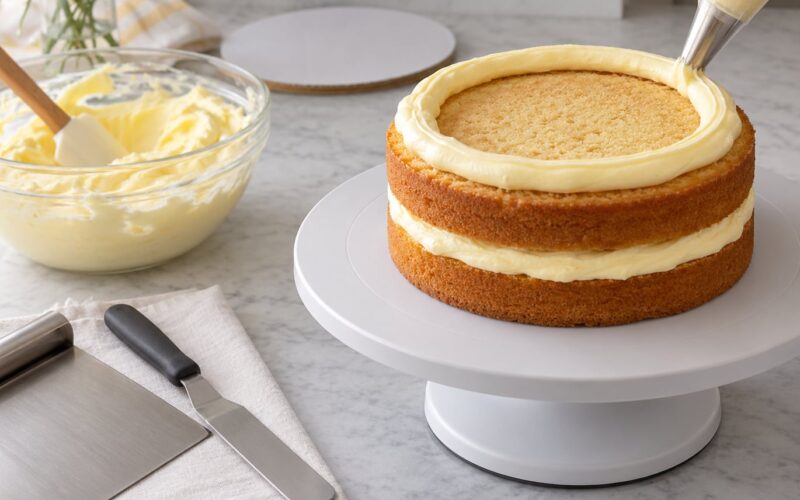
Put on a thin crumb coat first, then chill the cake again for 20–30 minutes before the final layer. The crumb coat seals exposed cake so fewer crumbs push through and no bare patch is left to weep.
The second coat should be generous. A thick layer of frosting holds its body longer than a thin skim, because the outside does not heat through as fast and American buttercream can form its thin dried crust. Push that crust down firmly with a palette knife and smooth it with a scraper.
If you have ever wondered whether reducing sugar would help, skip it. Less sugar means a softer frosting with no protective crust.
Step 4: Decorate Quickly in a Cool Room
Heat accumulates in a kitchen long before the outdoor temperature gets ridiculous. Start decorating early in the morning, turn off the oven once the layers are out, and open a window or run a fan.
Chill the bowl and the palette knife in the freezer for 10 minutes beforehand. Wrap the piping bag in a damp tea towel, or run it under cold water and dry the outside, between colours. Warm hands warm the bag, and the bag warms the frosting.
Work in stages and put each stage back in the fridge. Frost, chill, add the border, chill, then the flowers. One reader on Sugar & Sparrow’s post reported that a very stable frosting also sets fast, so sprinkles and toppers have to go on immediately.
Step 5: Chill the Finished Cake Until Serving
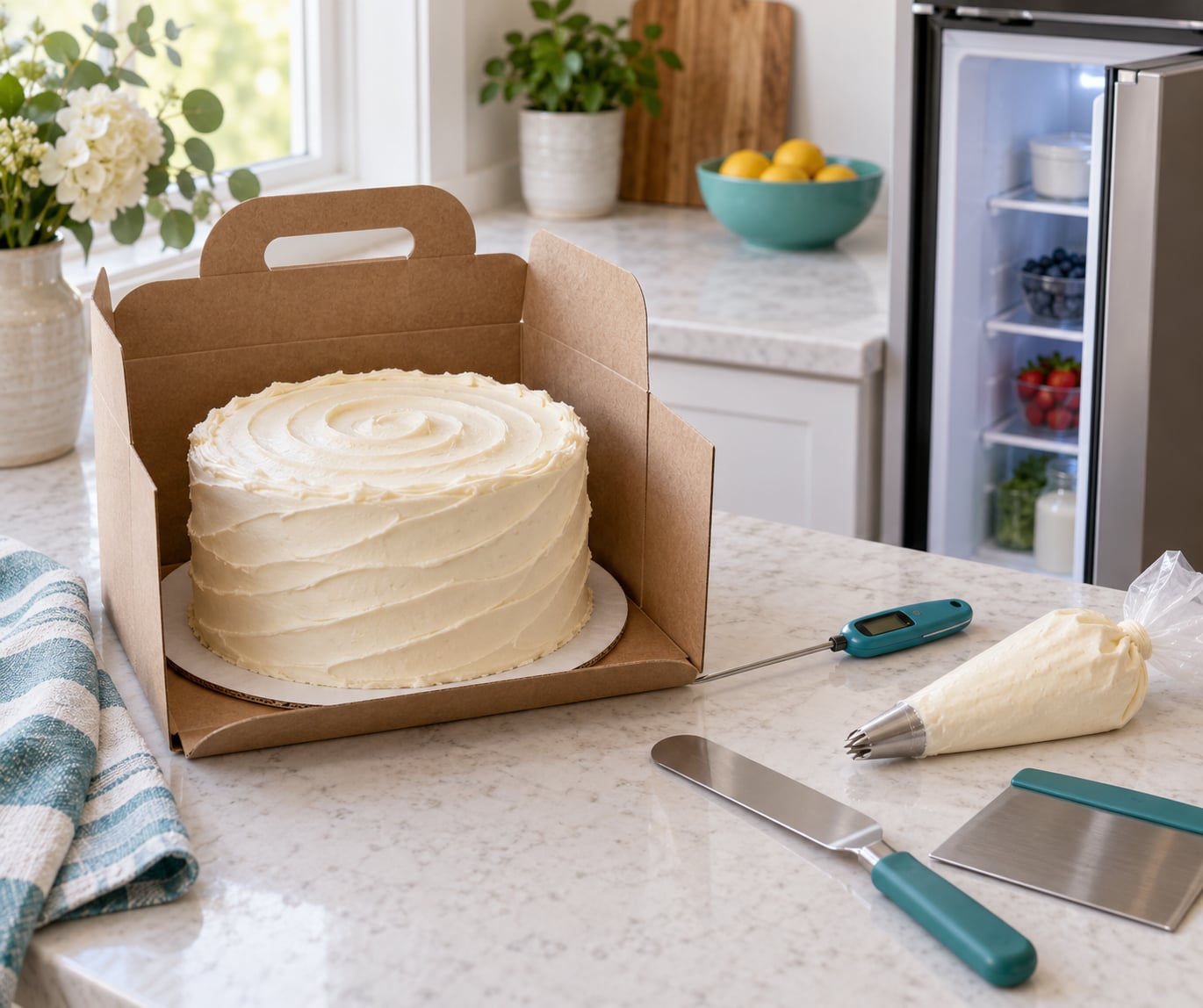
A frosted cake goes back in the fridge as soon as the decorating is done, in its box or under a cake dome so it does not pick up fridge smells. Cold is the whole game at this stage.
One thing to know before you leave the house: taking a chilled cake straight into warm humid air makes condensation bead on the icing. That sweat is not the frosting melting. Leave it somewhere air-conditioned for 20 to 30 minutes before it goes outside.
Step 6: Transport and Serve Without Melting
Transport cold and serve cool. Carry the cake in a carrier on a flat surface in the coolest part of the car, with a couple of frozen gel packs packed alongside it in an insulated bag. Never leave it in a parked car, not even in the shade.
At the venue, put the cake on the dessert table in shade, never in direct sun through a window, and as far from the tent walls as you can manage. Shade is worth several degrees on its own.
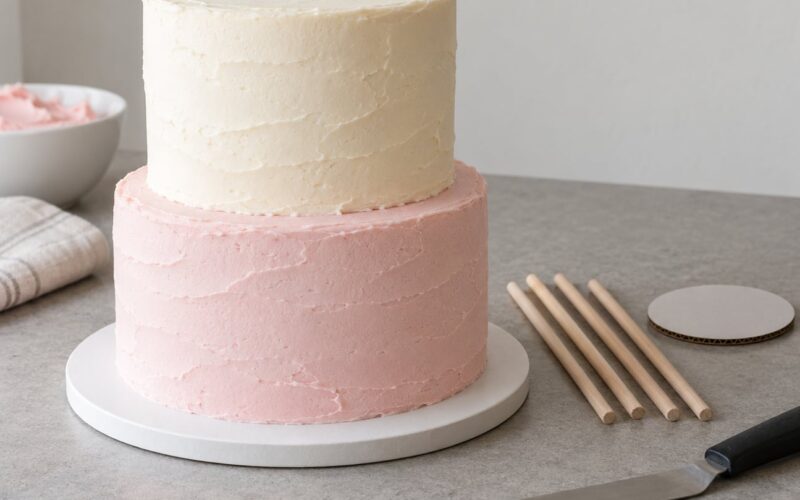
Plan backwards from the moment you want the cake cut. Frost no more than a few hours ahead if you have fridge space. For a large tiered cake that will not fit in your fridge, frost as late as possible, chill each tier in whatever cold space you have, and stack on site.
If you can have air conditioning anywhere near the display, take the cake indoors about 30 minutes before serving so it comes up to eating temperature without going soft.
Common Mistakes
- Frosting a cake that is not fully cool. Fix: cool on a rack, then chill the layers for an hour.
- Using all-butter American buttercream for an outdoor event. Fix: replace at least half the butter with high-ratio shortening.
- Adding liquid food colour. Fix: use gel colour, which carries almost no water.
- Decorating in direct sun through a window. Fix: move the table, close the blind, and run a fan on the frosting.
- Thin frosting applied too generously in one pass. Fix: crumb coat, chill, then a firm final layer.
- Holding the finished cake at room temperature for photos. Fix: shoot photos in batches and return the cake to the fridge between takes.
- Leaving the cake in the car. Fix: a parked car climbs fast even on a mild day.
- Ignoring humidity. Fix: air conditioning, a dehumidifier, or move the dessert table indoors. Humidity is what ruins American buttercream crusts.
How to fix buttercream that has already started to melt
If the frosting is soft but still on the cake, move the cake into the coldest space you have right away. Do not put it in the freezer unattended, and do not try to scrape and re-pipe it while it is warm.
For frosting in the bowl, chill the bowl itself. Scrape the frosting onto a cold plate, then beat it briefly with a paddle until it comes back together. If it has separated and looks greasy, adding a little more sugar or a splash of cold water brings it back.
There is a point of no return. If a fully liquefied cake has sat above 90°F (32°C) for more than about an hour, the fat has separated out of the structure and the cake will not recover. Scrape it off, serve the cake in pieces, and plan the shortening ratio up for next time.
Frequently Asked Questions
How to stabilize buttercream for hot weather?
Replace at least half the butter with high-ratio vegetable shortening, add one tablespoon of meringue powder per batch, and keep the sugar quantity as written. Then chill the cake layers before frosting, refrigerate the finished cake, and keep it out of direct sun. Shortening is the single biggest lever because it stays solid up to about 115°F (46°C), while butter gives out near 90°F (32°C).
What type of buttercream holds up best in heat?
American buttercream made entirely with high-ratio shortening is the most heat-resistant. For flavour, half butter and half shortening is the better compromise, followed by German or ermine buttercream, then Italian meringue, then Swiss. Cream cheese frosting also performs surprisingly well because its protein firms under heat, though it must stay refrigerated. Coconut oil and vegan butter are the weakest choices for a warm display.
Does meringue powder stabilize buttercream?
Yes. Meringue powder is dried egg white protein with added starch that absorbs loose moisture and stiffens the frosting. One tablespoon per batch is enough for a noticeable improvement in body and heat resistance. It will not rescue an all-butter frosting on its own, and bakers on CakeCentral raise the fair question of whether it makes the icing crusty or hard; keep the quantity small and the sugar unchanged.
How far in advance can I put buttercream on a cake?
With fridge space, frost up to a day ahead and refrigerate in a box or under a dome. Without enough cold room, frost as late as possible, chill each tier separately, and assemble on site. For a large cake that will not fit in a home fridge, decorating the day before and stacking within a few hours of the event is the usual compromise.
Is Swiss meringue buttercream more stable than American buttercream?
Not in high heat. Swiss meringue is smoother and lighter, and Italian meringue is steadier still because the boiling syrup cooks the egg proteins into the foam. But an American buttercream built on high-ratio shortening outlasts both in warm conditions, because its fat stays solid to roughly 115°F (46°C). Choose meringue for flavour and smoothness, shortening for an outdoor event.
How do I fix buttercream that has already melted?
Chill the bowl, scrape the frosting onto a cold plate, and beat it briefly until it pulls back together. A greasy, separated bowl of frosting often recovers with a little extra sugar or a splash of cold water. Once melted onto a cake, put the cake in the coldest space you have immediately. If it has liquefied above 90°F (32°C) for over an hour, the fat has separated and it will not come back.
Conclusion
Four actions fix most melting cakes. Build the frosting on high-ratio shortening, at least half replacing the butter, with a tablespoon of meringue powder. Frost only a chilled layer, and give it a firm crumb coat plus a generous final layer. Keep the finished cake refrigerated until the last possible moment, in shade, out of any car. And let it come up to temperature indoors for half an hour before serving, so condensation beads instead of softening the icing.
The rest is just reading the room. If the display area will sit above about 82°F (28°C) for hours, change the frosting rather than fight the temperature.