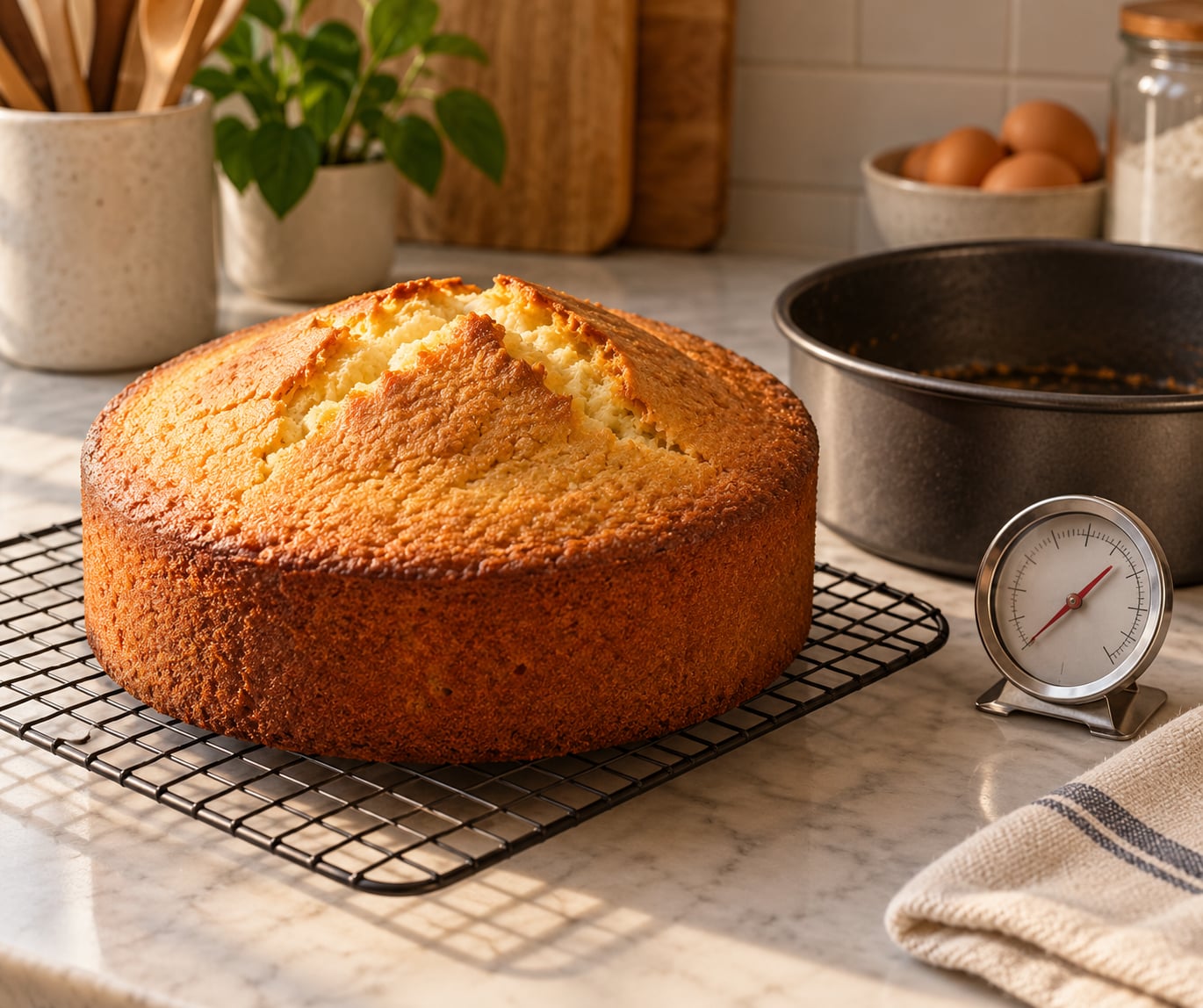
If your cake rose into a hill in the middle and then split across the top, the edges set before the center finished rising. Too much bottom heat, an oven that runs hot, extra leavening, and a pan that is too deep are the usual reasons. Almost all of them are fixable, and the cake underneath is usually perfectly good.
Nobody sets out to bake a dome. You follow the recipe, the oven is preheated, the timer goes off, and out comes a cake with a hill in the middle and a split running across it like a fault line. Doming is not one single mistake, so the search for why did my cake dome and crack on top really comes down to six possible fixes.
So let us go in the order you should check things, starting with the oven, then the pan, then the batter. It takes about five minutes to narrow it down.
Table of Contents
- What Does It Mean When a Cake Domes and Cracks on Top?
- Why Did My Cake Dome and Crack on Top?
- 1. Excess bottom heat or a hot spot in the oven
- 2. An oven that is hotter than the dial says
- 3. Too much leavening
- 4. Overmixing
- 5. The wrong pan size
- 6. Pan preparation
- Which Cake Ingredients Most Often Cause Oven Doming?
- How Can I Tell Whether the Problem Is the Pan, Batter, or Oven?
- How Do I Stop a Cake from Doming and Cracking?
- How to make sure cake doesn’t dome next time
- Can I Fix a Cake That Already Has a Dome or Crack?
- Frequently Asked Questions
- Why is the center of my cake cracking while the edges stay low?
- Should I lower the oven temperature if my cake domes and cracks?
- Does a cake need to come out of the pan immediately after baking?
- Will cake strips prevent a domed or cracked cake top?
- Can I use a domed cake for a layer cake?
- Why does the same cake dome in my oven but not at a higher temperature?
- What to Do First Next Time
What Does It Mean When a Cake Domes and Cracks on Top?
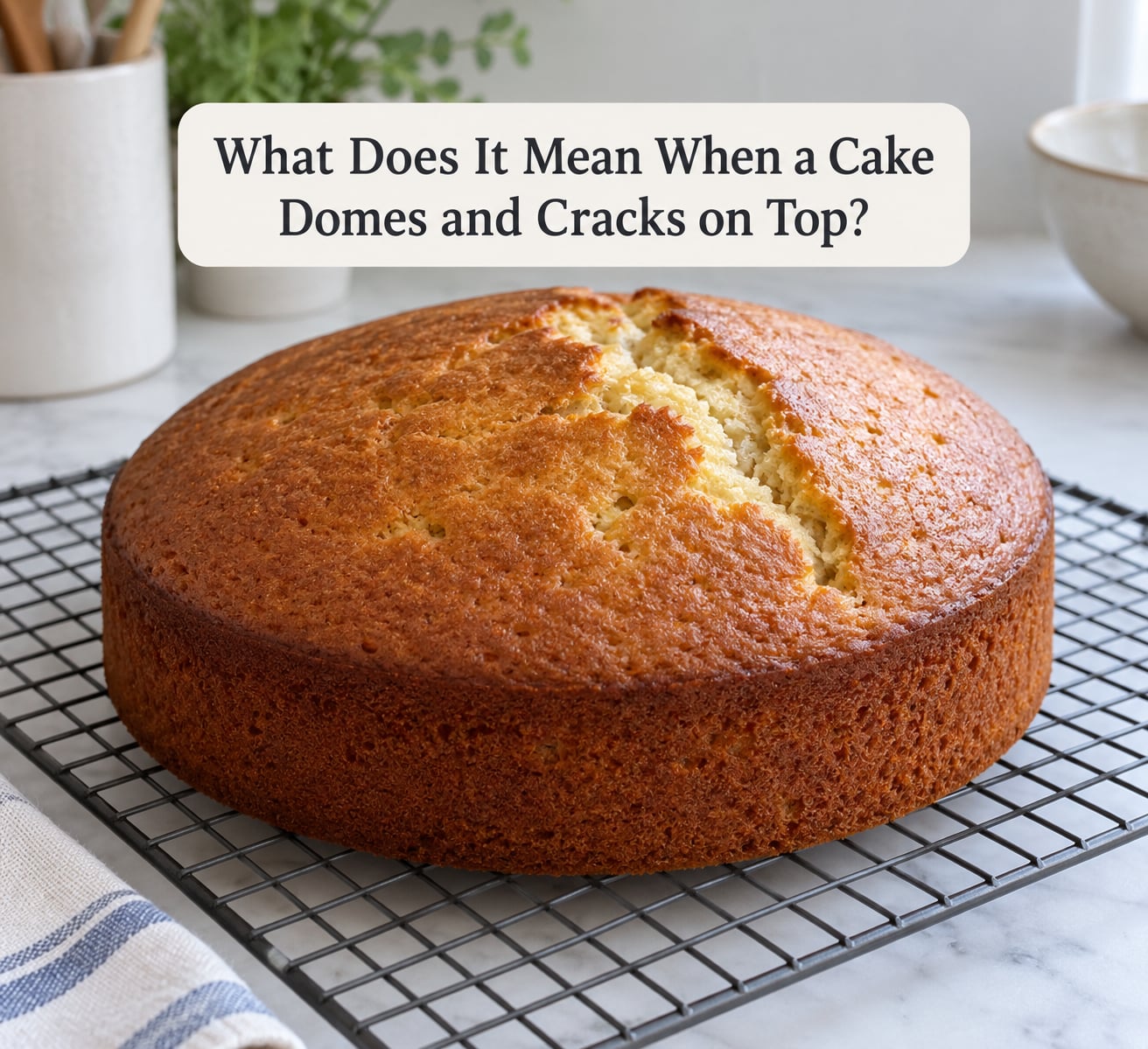
A dome and a crack are usually the same event in two stages, not two separate problems. First the cake rises fast and the center bulges upward. Then the top surface, which has already dried and set into a crust, can no longer stretch, so the still-expanding center bursts through it.
Here is the mechanism in plain terms. Heat enters through the metal pan, and metal conducts it sideways much faster than it conducts it straight up to the center. The thin outer ring of batter hits temperature first, the flour proteins there coagulate and the crumb firms, and that ring is locked in place while the middle is still liquid. Gas from the leavening keeps expanding in that liquid center, so it pushes up and up until something gives.
The important thing: a crack is not proof that your cake is underbaked. Plenty of bakers pull a fully baked cake with a perfect crumb and a cracked top, and plenty of underbaked cakes crack without a single split. Judge doneness with a skewer, not with the top surface.
One more nuance worth having, because online advice contradicts itself on this. In a pound cake, a banana bread, or a rustic loaf, a center crack is a sign of strong oven spring and a well-risen crumb. In a layer cake that has to stack and frost flat, the same crack is a problem. The difference is what you need the cake to do next.
Why Did My Cake Dome and Crack on Top?
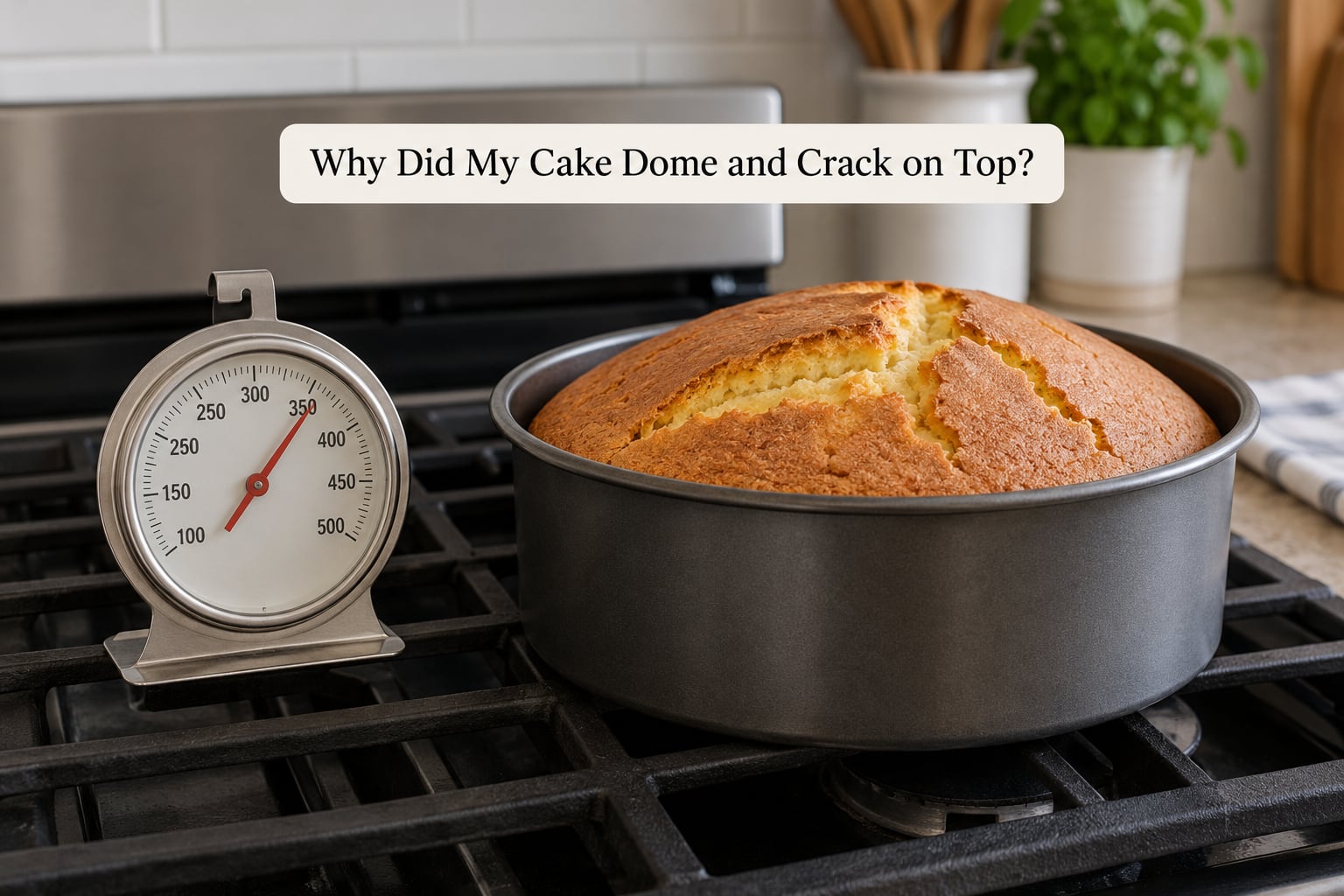
Check these six causes in this order, because the earlier ones explain most domed cakes.
1. Excess bottom heat or a hot spot in the oven
The single most common culprit. A baking element or a heating coil below the rack drives heat straight up into the base of the pan, so the center of the cake cooks and rises from underneath before the top has a chance to set evenly. That is what produces a raised middle with a crack straight across it.
2. An oven that is hotter than the dial says
Home ovens are notoriously inaccurate, and plenty run 25 to 50 degrees hotter than the setting. Bakeries verify with a thermometer for exactly this reason. If your oven has never been checked, suspect it before you suspect your recipe.
3. Too much leavening
Extra baking powder or baking soda floods the batter with gas. The structure cannot hold it, so the cake rises fast, overextends, and splits at the weakest point, which is normally the center line of the top.
4. Overmixing
This is the answer that shows up again and again on baking forums, and editorial baking sites tend to skip it. Flour contains two proteins, glutenin and gliadin; when water and movement bring them together they link into gluten, and that network needs time to relax. Beat flour hard after liquid goes in and you build a tight, tough web. The result is a heavy cake that still rises but cannot stretch, so it cracks instead of settling into a gentle crown. The clue is a batter that felt stiff and springy and a crumb that eats like bread.
5. The wrong pan size
Too much batter in a small pan means extra depth. A thicker layer takes longer to set all the way through, so the middle stays fluid longer and domes more. Pouring a two-layer recipe into one pan is the classic version of this mistake.
6. Pan preparation
Cake needs to grip the sides of the pan as it rises, the same way it grips the bottom. Skip the grease and flour on the walls, or use a springform whose sides are designed to release, and the edges can slide outward and the top splits to relieve the pressure.
Which Cake Ingredients Most Often Cause Oven Doming?
Leavening is gas production, and too much of it is the ingredient answer to your question. Baking powder releases carbon dioxide when liquid and heat activate it. Baking soda needs an acid such as buttermilk, yogurt, brown sugar or cocoa to start working, and if it is used alone or in excess it can create a lot of gas very fast.
A workable benchmark is roughly 1 teaspoon of baking powder, or a quarter teaspoon of baking soda plus an acidic ingredient, per cup of flour. Treat that as a checkpoint rather than a formula, because a recipe with eggs, chocolate or fresh fruit already brings extra structure and moisture. The useful habit is to level the measuring spoon with a finger and a knife instead of scooping and shaking.
Whipped egg whites and yeast act the same way. Whites folded into a sponge hold air that expands fast in the first minutes of the oven, which is what gives a good sponge its lift. Take that lift too far, or build too much of it in a heavy batter, and you get a blowout rather than a dome.
The balance that matters just as much as the amount is fat and liquid. Fat shortens gluten and tenderizes, and liquid keeps everything mobile. A batter that is too lean and too dry sets its crust early and hard, and the top loses the ability to stretch when the center keeps rising. That is the mechanism behind the classic chocolate sponge that splits down the middle, and the reason fruit cakes and banana breads get a foil collar or a low oven.
How Can I Tell Whether the Problem Is the Pan, Batter, or Oven?
Look at the shape of the dome and where the crack sits. The location of the damage tells you which system misbehaved.
| What you see | Most likely cause | What to change |
|---|---|---|
| Dome centered, one split straight across the top | Oven runs hot or bottom heat is too strong | Oven thermometer, rack moved up one position, temperature down 25 degrees |
| Dome pushed toward one side | Hot spot in the oven | Move the pan to the other side of the rack, or bake on a middle rack |
| Crack in a ring around the outer edge | Oven too cool or too little leavening to set the rim | Raise temperature 25 degrees, check the leavening amount |
| Random blowouts and holes in an uneven surface | Overmixed batter or large air pockets | Stop mixing as soon as the flour disappears, tap the pan to release air |
| Bottom peeled away from the pan, gap under the cake | Grease failure or wrong oil, or a springform being used | Grease and flour the sides, or line with a parchment round |
| Top cracked but center sunken afterward | Oven too cool or the cake was underbaked inside | Use a skewer, extend the bake, raise temperature |
| Tall dome but sides shrank away from the pan | Too much leavening | Cut the leavening back to the benchmark ratio |
Then check the pan itself. Look down the inside: if it is noticeably warped or the base is not flat when you set it on a counter, replace it. Darker metal absorbs heat faster and is likelier to give you a domed bottom-heavy cake, so light-colored aluminum or anodized aluminum is the safer choice when the top needs to stay flat.
| Pan material | How it handles heat | Doming risk |
|---|---|---|
| Dark metal or nonstick | Very fast absorption, strong bottom browning | Highest, especially near a lower element |
| Light-colored aluminum | Moderate, forgiving absorption | Low, the safest choice for flat tops |
| Anodized aluminum | Even, slower absorption, resists staining | Low |
| Glass | Insulates; slow to heat and slow to cool | Low, but bakes more slowly |
| Cast iron or steel | Heavy heat storage, heats fast and holds it | High for delicate cakes |
If the dome shows up in every recipe you bake, the oven or the rack position is the problem. If it only happens with one recipe in one pan, the problem lives in that formula.
How Do I Stop a Cake from Doming and Cracking?
Work through these in order, and change one thing at a time so you know which one worked.
How to make sure cake doesn’t dome next time
- Put an oven thermometer in the middle of the oven and note the gap between the dial and the real reading. If it runs hot, drop the recipe temperature by 25 degrees rather than guessing.
- Move the pan up one rack position and away from any lower element or heating bar.
- Use the pan size and depth the recipe was written for. Fill no more than about two-thirds full for a single layer.
- Level the batter before it bakes. Pour to the center, then push the edges slightly higher so the batter is even all the way around.
- Tap the pan firmly on the counter three or four times before it goes in the oven to knock out large air pockets.
- Check the leavening with a level spoon. Too much is easier to fix than too little, so resist the urge to add extra.
- Mix until the flour is just incorporated. Beat dry ingredients into the fat first, then add liquid and stop.
- Grease and flour the sides of the pan, or line the base with a parchment round, so the rising edges have something to grip.
Two extra tools are worth knowing about. Fabric cake strips go around the outside of a pan dampened with water; they slow the heating of the outer wall so the edges set at the same pace as the center, which is the entire problem in one move. A foil collar folded up around the outside of the pan does a similar job, and it works on a pan that is already in the oven as long as you get it on early.
Rotating the pan is useful for uneven browning, but only in the first 20 minutes or so, before the structure has set. After that, opening the door and turning a half-set cake can cause a drop. Do it early, or not at all.
Can I Fix a Cake That Already Has a Dome or Crack?
Yes, in most cases. The bake cannot be undone, but a crack is a cosmetic problem and a dome is a shaping problem, and both can be managed.
First, confirm it is actually done. Push a skewer into the deepest part of the center; if it comes out clean or with a couple of moist crumbs, the cake is baked through. If there is wet batter, it needs more time, not more frosting.
Let it cool in the pan for the full time the recipe specifies, usually 10 to 15 minutes. Pulling a hot cake out gives you a structural crack rather than a bake crack, and it is the one crack you cannot fix with a knife. If it sticks, run a knife around the edge and wait a few more minutes before turning it out onto a rack.
Once cold, deal with the dome. A serrated knife held low and almost flat shaves the high points off in shallow passes, and a leveler with an adjustable wire does the same job in a single pull. Sanding with a fine grit over a fine-mesh sieve smooths the crumb afterwards. Turning the cake dome-side-down onto the serving board and letting gravity do the flattening is the version nobody expects, and it works well for a layer that is slightly domed rather than badly domed.
For the crack itself, buttercream is a glue. Pipe a layer of buttercream into the split, press the two halves gently together, chill for 20 minutes, then frost as usual so the seam disappears under a crumb coat. For a crack wide enough to see into, a filling or ganache laid in the gap works better than buttercream alone.
On safety: a domed or cracked cake is not spoiled. It is exactly as safe to eat as the same cake without a split, so store it as you normally would and take it out of the pan once cool.
It is worth separating two kinds of crack, because they need different fixes. A bake crack is a split in the crumb that happened in the oven, usually along the top. A structural crack happens later, from frosting, stacking tiers, cutting dowels, or carrying the cake. A structural crack is a support problem rather than a baking problem, and a thin layer of buttercream spread under the tier fixes it where trimming would not.
If the damage is beyond saving for a layer cake, a domed quick bread still makes excellent toast pudding, a crumb cake, or a cake trifle, where every slice gets buried under fruit and cream anyway.
Frequently Asked Questions
Why is the center of my cake cracking while the edges stay low?
Metal conducts heat sideways through the pan much faster than it conducts it upward to the center. So the outer ring of batter reaches temperature, sets, and locks first, while the middle is still liquid and full of expanding gas. The center keeps pushing up against that fixed edge until the set top splits. It is oven spring running out of room, not underbaking.
Should I lower the oven temperature if my cake domes and cracks?
Usually yes, but check with an oven thermometer first rather than adjusting blind. A small 10 degree drop helps when the top browns fast while the center stays pale. A larger drop of 25 degrees, along with moving the pan up a rack, helps when the bottom is dark and the cake domes heavily. Also move the pan away from any lower heating element, since bottom heat is behind a lot of doming.
Does a cake need to come out of the pan immediately after baking?
No, and pulling it early is one of the easiest ways to create a crack you did not have before. A hot cake is still fragile, and the shock of leaving the pan can split the crumb or tear the bottom. Wait the 10 to 15 minutes the recipe gives, run a knife around the edge if it sticks, and turn it onto a wire rack when it feels firm enough to hold its shape.
Will cake strips prevent a domed or cracked cake top?
They help more than most bakers expect, because they target the actual cause. Dampened fabric strips around the outside of the pan slow the heating of the outer wall, so the edges set at the same pace as the center instead of locking in first. They will not rescue a badly overheated oven or far too much leavening, but they are a solid second tool once the temperature is right.
Can I use a domed cake for a layer cake?
Yes, if the dome is mild. Chill the layer, then shave the high spots off with a serrated knife held low and almost flat, turning the cake as you go. Frost to a thin crumb coat, chill again, and add the final layer. If the dome is more than about a quarter inch, the layers will slide once you cut them, so fill between the layers with firm buttercream to lock them in place.
Why does the same cake dome in my oven but not at a higher temperature?
Convection ovens circulate hot air, so the outside of the cake sets faster and the temperature effects get stronger. If it domes in convection, try the same recipe in convection off with the temperature 25 degrees lower than the recipe states, since a convection setting usually already assumes that reduction. The reverse can also happen, which is another reason an oven thermometer is the fastest way to know what your oven is actually doing.
What to Do First Next Time
Put a thermometer in the oven and find out how far off your dial is. That single check solves more domed cakes than any ingredient change, and it takes five minutes. Once you know the real temperature, adjust from there and change one thing at a time.
And if you have a domed cake sitting on the counter right now, eat it. A crack does nothing to flavor or safety, it just makes the cake harder to frost.