If your question is how to figure out cake serving sizes for a party, it comes down to one multiplication: guest count times the servings the cake size yields. Pick a slice convention (a 1.5 by 2 inch party slice is the usual default), read that total off the chart for your shape, then round up one size for cutting loss and seconds.
It takes about ten minutes of planning, and it is the difference between a cake that disappears by eight o’clock and one you are still eating on Thursday. Most sizing disasters trace back to two mistakes: trusting a number without knowing what slice size produced it, and planning for the invitations you sent instead of the people who actually show up.
Table of Contents
- What You Need
- Step-by-Step: How to Figure Out Cake Serving Sizes for a Party
- 1. Confirm Your Guest Count
- 2. Choose the Serving Style
- 3. Match the Cake to the Guest Count
- 4. Adjust for Cake Height and Shape
- 5. Add a Leftover and Host Buffer
- 6. Make a Final Shopping and Baking Plan
- Common Mistakes
- Frequently Asked Questions
- How many servings of cake do I need for 20 guests?
- How much cake do I need for 30 guests?
- How big of a cake do I need for 50 guests?
- What size cake feeds 100 guests?
- How do I calculate how many cupcakes I need?
- Do leftovers change how much cake I should make?
- Conclusion
What You Need
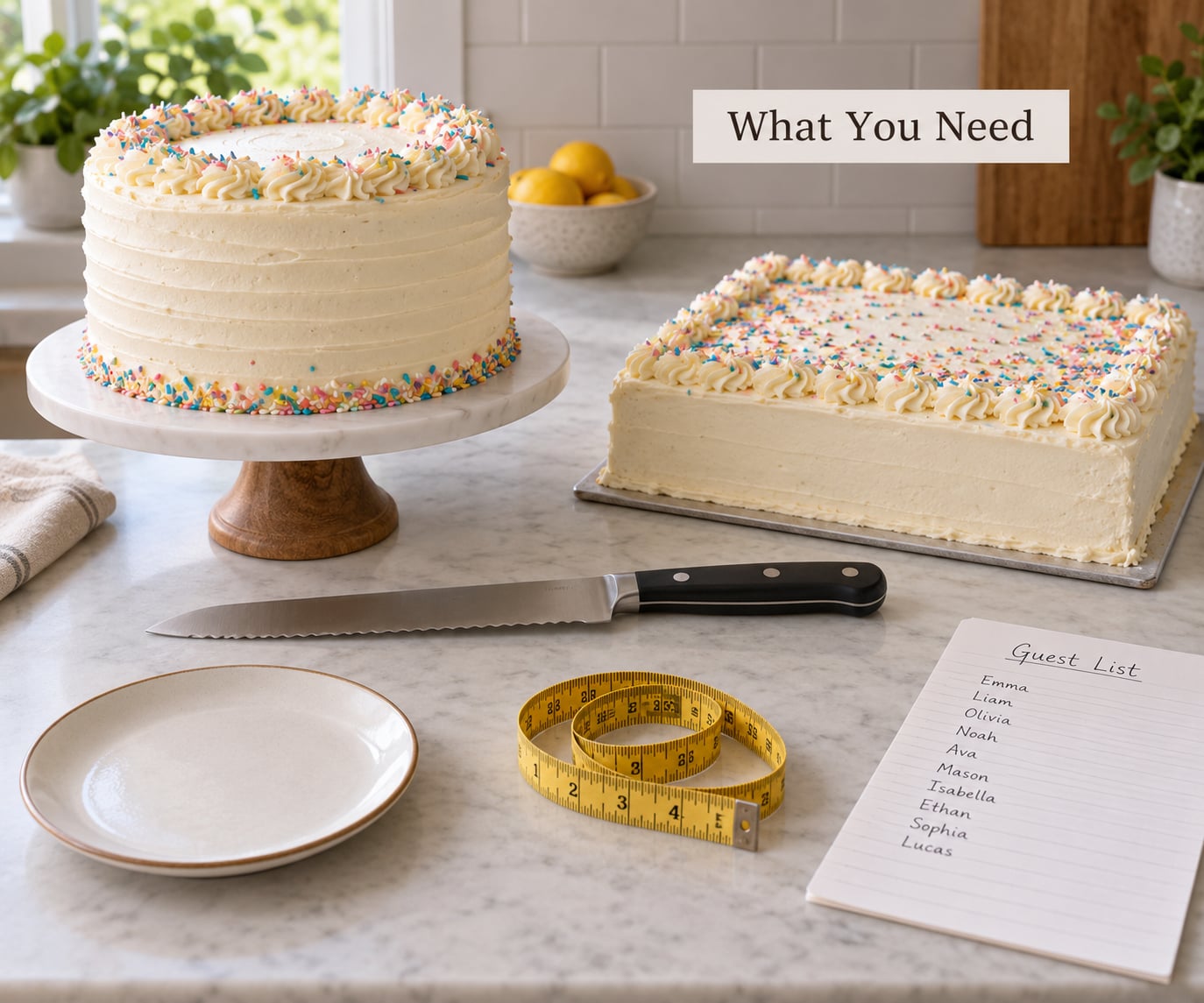
You need less than people expect: a realistic head count, the cake dimensions you are considering, a decision about slice size, and a note on whether cake is the only dessert. Everything else is arithmetic on those four things.
A realistic head count means the number of people eating cake, not the number of invitations. That is usually the confirmed RSVPs plus a margin, minus guests who will skip dessert entirely.
Cake dimensions matter because a 9 by 13 inch pan, a quarter sheet and a 10 inch round all sound substantial and yield very different numbers. Note the size and shape you are leaning toward, and the height if you are baking it yourself.
A serving style decision means choosing party, wedding or hearty slices before you look at any chart. That single choice swings the totals by a third.
A note on the rest of the dessert table changes everything. When brownies, cookies, pie or fruit are also being served, most hosts cut cake about a third smaller than they would at a cake-only party.
Then the small kit: a long serrated knife, an offset spatula or cake server, a ruler or a firm finger-width reference for judging slice width, one plate per guest plus five, and small labels if the cake contains nuts or dairy.
Step-by-Step: How to Figure Out Cake Serving Sizes for a Party
1. Confirm Your Guest Count
Start with the most reliable number you have and plan a range around it. Confirmed RSVPs give you a floor, not a ceiling, and for most parties the guests who did not reply eat cake at a higher rate than the guests who did.
Adjust the head count in both directions. Children under about five usually eat half to two-thirds of an adult slice, and older kids eat close to a full portion. Adults watching their figure, plus anyone on a no-sugar plan, may take a very small piece or skip the plate entirely.
Add the people who are not on your list. Staff, helpers, sitters and neighbors who drift in typically account for four to six servings at a home event and more at a large catered one. Where cake is one dessert among several, trim the count by roughly ten percent.
A workable method is to plan for the high end of your range and accept that leftovers are part of the deal. Freezing them well-wrapped makes that leftover portion a plan rather than a problem.
2. Choose the Serving Style
A serving is defined by its dimensions, and that is where most of the disagreement on the internet comes from. Three conventions cover nearly every event:
Party slice, about 1.5 by 2 inches. The standard birthday party and office party piece. It is generous enough to feel like a treat and modest enough that a 10 inch round still feeds a good-sized group.
Wedding slice, about 1 by 2 inches. Slimmer, because cake at a wedding is one dessert among many and the cake needs to stretch. A 10 inch round that yields 24 party servings yields closer to 38 wedding servings.
Hearty slice, about 2 by 3 inches. For smaller guest counts, or when the cake is the main event rather than one item on a table.
This is the answer to why two charts give different numbers for the same cake. Most industry charts, including the widely circulated Wilton chart, assume a party slice on a cake roughly four inches tall. A bakery calculating for a wedding uses a smaller slice. A grocery bakery counting the pieces it already cut, often smaller than its own label implies, reports a third number entirely.
None of them is wrong. They are measuring different slices on possibly different cake heights. Once you know which convention a chart assumes, the numbers become comparable.
3. Match the Cake to the Guest Count
Take the adjusted guest count, find the closest total in the chart below, and then step up one size. Here is the standard cake serving chart, assuming a four inch tall cake and party slices.
Cake serving chart: round, square and sheet sizes
| Cake size | Party servings (1.5 x 2 in) | Wedding servings (1 x 2 in) |
|---|---|---|
| 6 inch round | 8 | 12 |
| 8 inch round | 12 | 17 |
| 10 inch round | 24 | 38 |
| 12 inch round | 38 | 54 |
| 8 inch square | 18 | 24 |
| 9 inch square | 24 | 32 |
| 10 inch square | 30 | 40 |
| 12 inch square | 42 | 54 |
| 9 x 13 home pan | 12 | 18 |
| Quarter sheet (13 x 18) | 24 | 32 |
| Half sheet (18 x 26) | 38 | 54 |
| Full sheet (18 x 36) | 54 | 76 |
The naming confusion around sheets is worth one sentence: a home 9 by 13 pan is often called a quarter sheet by cake shops, but a true commercial quarter sheet is roughly 13 by 18. The home pan is close to a third smaller, which is why a sheet cake regularly runs out sooner than people expect.
Here is the same thing turned around, by guest count. This is the table most hosts actually want.
Guest count to cake size lookup, servings per cake shown in brackets
| Guests | Combination that covers it with room to spare |
|---|---|
| 10 | One 8 inch round (12) or 12 standard cupcakes |
| 15 | One 9 x 13 home pan (12) plus 6 cupcakes, or one 8 inch square (18) |
| 20 | One quarter sheet (24) or one 9 inch square (24) |
| 25 | One 10 inch round (24) plus a half dozen cupcakes |
| 30 | One quarter sheet (24) plus 12 cupcakes, or one 10 inch square (30) |
| 40 | One 12 inch square (42) or two quarter sheets (48) |
| 50 | One half sheet (38) plus one 8 inch round (12) |
| 60 | One half sheet (38) plus one 10 inch round (24) |
| 75 | One full sheet (54) plus one quarter sheet (24) |
| 100 | Two full sheets (108) or one full sheet plus two quarter sheets (102) |
Two combinations earn a note. A tiered cake is mostly decoration, so a stacked two-tier display cake rarely serves a crowd on its own; it is the reason to plan a matching sheet cake in the kitchen and cut from that one. Above about 100 guests, sheet cakes are the sane answer, because a tiered display plus kitchen sheet gives you the photograph and the servings.
4. Adjust for Cake Height and Shape
Every number in those charts assumes a cake about four inches tall, which is roughly a two-layer cake with filling and frosting. A cake that is six inches tall yields around fifty percent more servings than the chart says. A three-inch single-layer cake yields about a quarter fewer.
Adjusting is simple arithmetic. Work out the actual volume as a multiple of the four inch baseline and scale the servings: a six inch tall cake is about one and a half times the chart number, a three inch cake about three quarters of it.
Tiered cakes follow the same logic, and stacking changes nothing about slice size, only about height and shape. What you may see called the 1-2-3-4 cake rule refers to building tiered displays from progressively smaller tiers holding one, two, three and four layers, which is a construction method rather than a serving rule. Treat it as a decorating decision, then use the chart for the total.
Home bakers should also plan pans. A two-layer 8 inch round lands near 12 party servings, a two-layer 10 inch round near 24, and a home 9 by 13 single-layer cake near 12 with more height or filling. For 30 servings from scratch, the usual answer is one 10 inch round plus a dozen cupcakes, or one quarter-sheet pan if your oven will take it.
5. Add a Leftover and Host Buffer
Add roughly fifteen percent to your serving total, then round up to the next available size. That covers second helpings, uneven end pieces, guests who arrive late and a host who eats breakfast on the leftovers for a week.
You can scale the buffer. Ten percent is enough when cake is one of several desserts and the crowd is mostly adults. Twenty percent makes sense for a kids party, a long afternoon event or any occasion with a cake-cutting ceremony that will slow the line down.
The buffer only works if the cake actually gets cut into that many pieces. For a sheet cake, mark a grid first: measure the top, divide the length into strips about 1.5 inches wide, then divide each strip into 2 inch lengths. For a round cake under about twenty servings, mark wedges from the center. Above that, the end wedges are too narrow to pass off as servings, so cut the round in two halves, then into even strips across each half.
Cold cake cuts cleanly, so refrigerate it briefly or let it chill on the counter before cutting, and wipe the blade between cuts. For a display cake, transport it whole and let the kitchen sheet cake do the serving.
When cake is finished, refrigerate it within two hours. Frosted or filled cake generally keeps three or four days in the fridge; unfrosted or simpler cakes keep longer at room temperature. Wrapped slices freeze well for several months, which is the cleanest answer to over-ordering.
6. Make a Final Shopping and Baking Plan
Turn the number into a list, so nothing gets missed on the day. Write down the total servings needed, the cake sizes you settled on, and the slice convention behind them.
For an ordered cake: add plates one per guest plus five, a cake knife and server if the bakery does not supply them, and labels for any allergens in the frosting or filling.
For a baked cake: add the pans and layer count that hit your serving target, frosting quantity based on the surface area you are covering rather than the volume, and a spare pan in case the first bake runs late.
For a sheet cake: confirm whether it arrives sliced or whole, and whether the stated serving count matches the party slice convention. If the bakery cuts in the kitchen, ask for it unsliced and slice it yourself.
Finally, tell whoever needs to know, including any venue, caterer or co-host, in one sentence: the guest count, the serving total you are planning for and the slice convention. If the guest count changes afterwards, recalculate rather than improvising.
Common Mistakes
Planning for invitations sent rather than guests attending is the first and most common error. Ten unopened invitations do not need ten servings. Recheck the count the day before and add a few pieces if the replies came in high.
Cutting thin decorative slivers is the second. A dainty slice looks elegant on a plate and disappears before it registers. Cut to the convention you planned with: 1.5 by 2 inches for a party.
Ignoring cake height is the quiet one, because nobody checks. A tall homemade layer cake or a stacked display cake produces noticeably more pieces than a flat sheet cake of the same footprint. Adjust before you buy frosting, not after.
Trusting a chart without reading its assumption is why people end up convinced no two sources agree. Look for the slice dimensions and the cake height in the notes. If they are missing, treat the number as a range.
Cutting too early is a logistics problem rather than a math one. A cake sliced an hour early dries at the edges, loses its shape, and makes it obvious where the good pieces went. Cut when guests are ready to eat.
Failing to label allergens matters more than most hosts expect. Nut-free households are common enough that a small card beside the cake costs nothing and prevents a genuinely bad moment.
One last tip: if you are ordering rather than baking, call the bakery with your guest count and ask which convention they use. It takes a minute, and it is the single best way to find out what their number actually means before you pay for it.
Frequently Asked Questions
How many servings of cake do I need for 20 guests?
For 20 guests, one quarter sheet or one 9 inch square cake covers it at party slice size, giving roughly 24 servings. One 10 inch round gives the same 24 but is far harder to buy in a single piece. Add a buffer of about 15 percent if second helpings are likely, or serve a smaller slice when other desserts are on the table.
How much cake do I need for 30 guests?
Plan for 34 servings after a buffer. One quarter sheet (24 servings) plus a dozen standard cupcakes does it, as does one 10 inch square cake at 30 servings. If you are baking, a 10 inch round paired with a dozen cupcakes is the easier combination, since most home ovens handle round pans more reliably than full sheet pans.
How big of a cake do I need for 50 guests?
For 50 guests, a half sheet (38 servings) plus one 8 inch round (12 servings) gives 50 before any buffer. If you want the buffer built in, go to a half sheet plus a 10 inch round, which comes to 62. A single cake that large becomes awkward to transport and to cut evenly, so two cakes is usually the smarter plan.
What size cake feeds 100 guests?
Two full sheet cakes yield about 108 party servings, which covers 100 guests with a small buffer built in. One full sheet plus two quarter sheets gives about 102. Above 100 guests, sheet cakes beat stacked round cakes on every practical measure: they are cheaper per serving, they slice into even squares and they are far easier to move.
How do I calculate how many cupcakes I need?
Treat one standard cupcake as one serving and one mini cupcake as two servings. So 30 adult guests calls for 30 standard cupcakes plus a 15 percent buffer, or about 34. Matching a sheet cake to cupcakes is the same arithmetic: a half sheet at 38 party servings equals 38 standard cupcakes.
Do leftovers change how much cake I should make?
Plan for them rather than around them. Add about 15 percent to your serving total, which covers second helpings and uneven end pieces, then round up to the next size you can actually buy. For cake-only parties, kids parties or long afternoon events, 20 percent is a reasonable figure instead of guessing your way through a shortage.
Conclusion
Start with the number of people who will actually eat cake, then choose your slice convention, because that decision moves the totals by a third. Find the closest match in the chart, adjust for the height of the cake if you are baking it yourself, add about fifteen percent, and round up one size.
That is the whole method. Once you know which slice size sits behind a number, the conflicting charts stop being confusing and become comparable, and sizing a cake takes about the same effort as ordering flowers.