Learning how to store decorated sugar cookies comes down to three things: let the icing dry completely, seal the cookies airtight, and match the container to the frosting type. Fully dried royal icing or glaze keeps about 2-3 days at cool room temperature, 5-7 days refrigerated, and 2-3 months frozen.
The whole job takes five minutes of active work. Most of the work is waiting, which is the annoying part when you have 100 cookies to decorate and an event on Saturday.
Cookies spoil from moisture moving in and out, not from bacteria at room temperature. A sugar cookie has almost no water activity to begin with, so once it is dry and sealed, time works slowly in your favour. What ruins a batch is a sealing mistake: a lid closed too early, a stack built before the icing set, or a frozen batch opened in a warm kitchen.
I have ruined batches in most of those ways myself. The star cookies I stacked after four hours looked perfect on top and came out of the tin with every point pressed flat, which is why the drying gate below matters more than any container you buy.
Table of Contents
- What You Need
- Step-by-Step
- How to Store Decorated Sugar Cookies at Room Temperature
- How to Store Decorated Sugar Cookies in the Fridge
- How to Store Decorated Sugar Cookies in the Freezer
- How to Protect Icing and Decorations
- How to Thaw Frozen Sugar Cookies
- How to Check Decorated Cookies Before Serving
- Common Mistakes
- Final Tips
- Frequently Asked Questions
- How long do decorated sugar cookies last at room temperature?
- Can I stack sugar cookies with royal icing?
- Do decorated sugar cookies need to be refrigerated?
- Can I freeze sugar cookies with icing or fondant?
- How do I thaw frozen decorated cookies without condensation?
- Conclusion
What You Need
The right gear depends on which method you are using, and you need less than you think.
- Parchment paper or wax paper. Cut to the size of your container so every layer sits flat. Wax paper resists butter better; parchment handles warmth.
- Rigid cookie sheets or trays. Flat, unbent trays stop a stack from leaning into the icing below it. Sheet pans work if they are not warped.
- An airtight cookie container. A snap lid with a gasket seal is worth more than a decorative jar with a loose lid.
- A food-safe shallow box for refrigeration. Shallow keeps the cookies from being crushed under heavier items on the same shelf.
- Freezer-safe bags or containers. Rigid containers hold shape better than bags when cookies are stacked, and they protect delicate piping from pressure.
- Plastic wrap or toothpicks for stacking. Wrap shields icing from the sheet above; toothpicks act as posts so a lid never touches tall decorations.
- Small labels or a marker. A date on the container matters as soon as more than one batch exists in your kitchen.
A note on materials: skip airtight plastic at room temperature if your kitchen gets humid. Sugar pulls moisture out of the air, and a sealed box in a humid room traps damp air with your cookies in it.
Step-by-Step
How to Store Decorated Sugar Cookies at Room Temperature
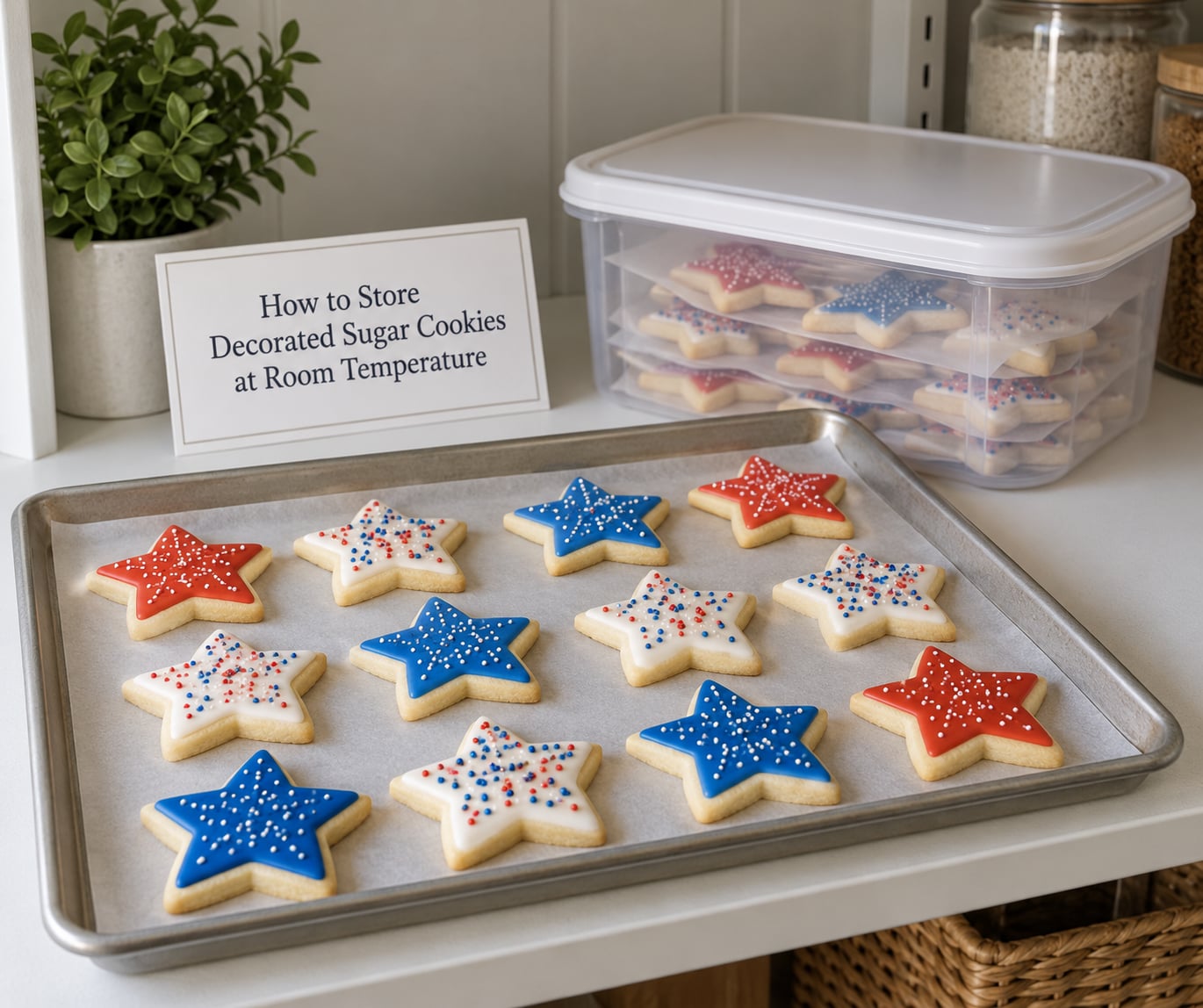
Fully dried cookies with royal icing, a thin glaze or a firm decoration can stay in a cool, dry place for roughly 2-3 days in typical conditions. Give them a single layer on parchment while they cool, then close the container once nothing feels tacky when you press the icing lightly with a fingertip.
Royal icing with meringue powder usually passes the touch test in 6-8 hours. Raw-egg royal icing is thinner and softer, so give it a full 24 hours before you trust a lid on it.
Stack with a sheet of parchment between layers, and never more than two or three layers high. Tall piped borders, florals and anything with a 3D element should sit in a single layer with toothpicks around them so the layer above has nothing to press down on.
Shrink the timeline in warm or humid rooms. If your kitchen runs above about 72°F in summer, plan on a day and a half instead of three, or move the whole container to the air-conditioned part of the house.
Another baker told me the practical version of this: she keeps half-decorated cookies in a single layer in a cool room until she can finish and box them, which sidesteps stacking entirely.
How to Store Decorated Sugar Cookies in the Fridge
Refrigeration covers about 5-7 days, and it is the right choice for buttercream, cream cheese frosting or any decoration that you know will soften in a warm room.
Here is what actually happens in there. Cold air holds less moisture, so the moment a warm, humid cookie box meets the fridge, condensation forms on the icing. On royal icing that means a tacky surface, blurred edges and colors that bleed where two cookies touch.
Cookies should only touch when the frosting is firm enough to take the pressure. Same rule as at room temperature, just with less margin for error.
For odor control, seal the container fully and keep it away from anything strong in the fridge. Butter and raw onion are the usual offenders, and decorated cookies absorb smells faster than undecorated ones because the frosting is porous.
If your icing was made with raw egg white rather than meringue powder, the food-safety argument for refrigerating gets stronger. Meringue-powder royal icing removes the question entirely, which is why most home bakers have moved that way.
How to Store Decorated Sugar Cookies in the Freezer
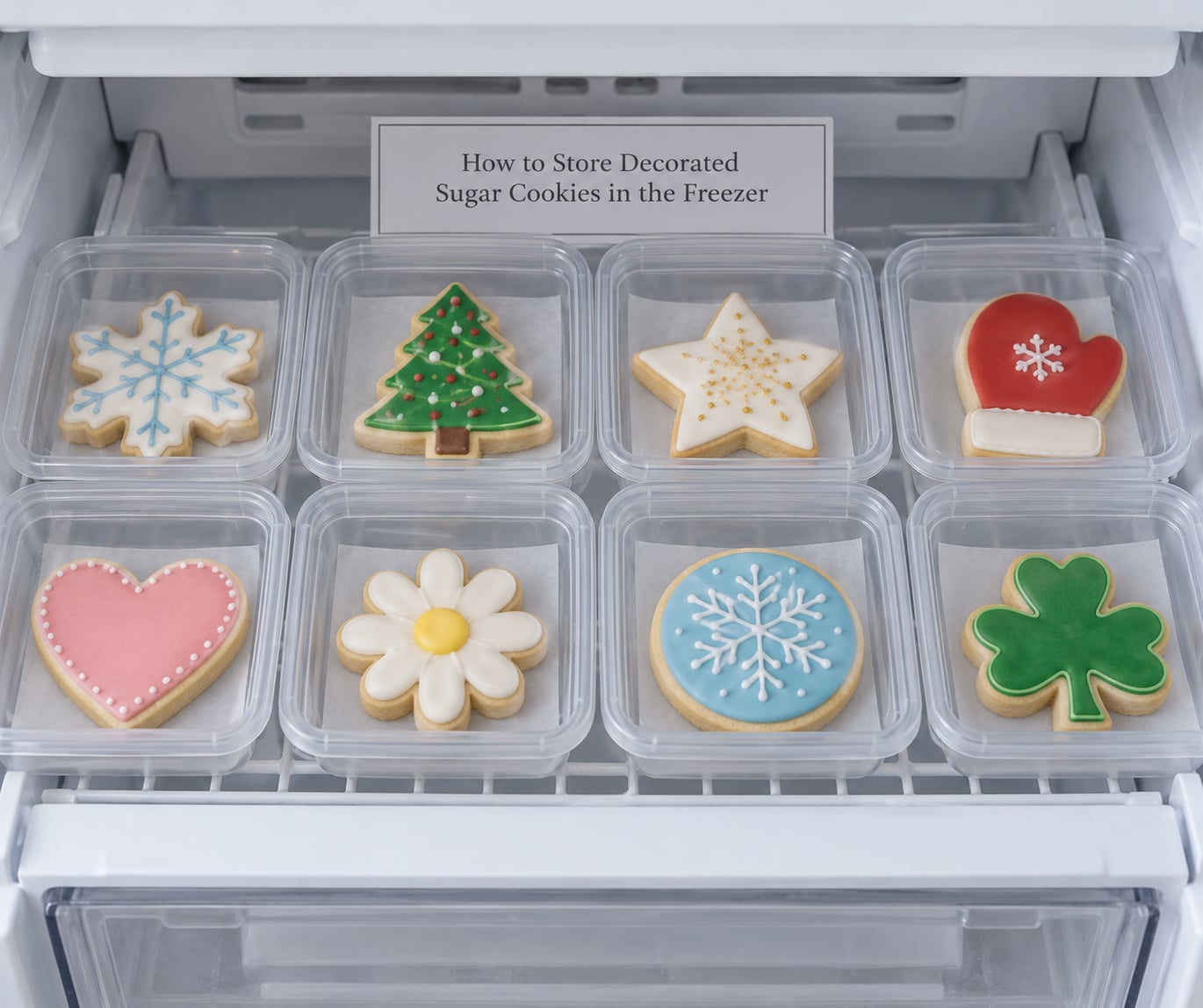
Freezing is safe for roughly 2-3 months once the cookies and every decoration are fully set. Longer stretches start costing you texture, and the cookie is only as good as the frosting you froze.
Wrap each cookie individually where sticking is likely, which realistically means royal icing with piped borders or tight stacked cookies. Then double-protect: a second wrap or a bagged layer over the first, so a small tear in the outer wrap still traps the cookies.
Freeze flat in a single layer first. Once that layer is solid, you can stack containers on top of it, because the weight rests on the container rather than on the icing.
Label the container with what is inside and the month you froze it. Label and date is the difference between using cookies in February and finding them in October still wrapped and unopened.
Keep the most delicate pieces separate. Stacked royal icing details, thin florals and anything with edible glitter on top can crack or flatten against the cookie underneath, and a single flat layer is the only real fix.
Bakers on r/cookiedecorating report freezing decorated cookies and finding they came out fine on thaw, with one condition repeating: the icing was completely dry first. A common home pattern is three freeze cycles in one project, dough discs first, then baked undecorated rounds, then the finished cookies.
How to Protect Icing and Decorations
Add a protective parchment layer between every level so icing never touches the cookie below it. Slide the sheet on rather than lifting it, and pull it off slowly at the same angle.
Use toothpicks or food-safe supports when decorations stand proud of the surface, so the lid or the layer above rests on the toothpicks instead of on your piped work.
Keep icing away from the container wall where you can. Wax paper or a strip of parchment around the edges stops a condensation droplet on the plastic from landing on a design.
It sounds obvious once you know it: the whole point of learning how to store decorated sugar cookies is protecting the hours of work, not just the cookie. Three layers of parchment cost nothing and save a whole batch.
How to Thaw Frozen Sugar Cookies
Move the container straight from the freezer to the refrigerator. Leave it sealed and closed while it comes up to fridge temperature, usually several hours.
Only then take it out to finish reaching room temperature, still wrapped. Opening a frozen container in a warm kitchen dumps condensation onto the icing, and that water is what makes royal icing sticky and soft.
Do not use artificial heat. A microwave melts frosting and dries the cookie out, and a warm oven does the same thing faster.
If you only have room-temperature counter space, close the container tightly and wait until there is no fog on the lid and no cool patch on the outside before you open it. Condensation on the inside of the lid is your cue that water is still forming.
The rule people argue about most, in cookie-decorating groups, is whether to open in the fridge or on the counter. Both work if the lid stays shut until the whole container matches room temperature. Trouble shows up when it gets opened halfway, and then only on some cookies, which matches why it feels random.
How to Check Decorated Cookies Before Serving
Look before you serve, every time. Press the icing lightly: it should feel hard and not leave a fingerprint. Check the base of each cookie for dampness or a soft edge, which points to moisture getting in rather than out.
Smell the batch. An off, sour or musty smell is not staleness, and neither is a spot of grey, green or black fuzz. Ordinary staleness means a dry, hard cookie with no icing problem, and a slightly soft decoration is usually a humidity issue.
Mold, an off odor, insects or a slimy texture mean you discard the cookies. Sugar does not make that decision for you, and no container makes those cookies safe.
For cookies that went dull rather than bad, a five-second blast in the microwave on a paper towel softens a hardened cookie. A slice of apple or a piece of white bread in the container overnight is the older trick for the opposite problem, cookies that dried out.
Common Mistakes
Stacking before the icing is set. This is the most common error by a wide margin, and the one that dents points and smudges borders. Wait 8-24 hours and run the fingertip test before any lid goes on.
Storing warm cookies. Even 20 minutes of residual warmth creates condensation inside the closed container, and you get a tacky cookie and a wet lid for the next day.
Using an oversized flexible bag. A big soft-sided freezer bag lets cookies shift and press on each other. Match the container to the cookie so everything stays where you put it.
Wrapping fondant directly. Fondant needs a non-stick surface between it and anything that touches it, or it picks up texture and sticks. Parchment, a silicone mat or a light film in the same box solves it.
Failing to protect delicate details. Piped flowers and stacked royal icing need toothpicks or their own single layer. No amount of parchment fixes pressure from above.
Refrigerating royal icing for too long. It works for a few days with buttercream. Drag it to eight days with royal icing and the condensation damage usually shows up as blurred piping and soft color.
Thawing in an open container. Any exposed frozen surface collects water out of the air. Keep it wrapped and closed until it is fully at room temperature.
Bringing frozen cookies straight into a warm room. A 20°F temperature difference guarantees wet icing. The fridge-first step exists for a reason.
Final Tips
- Label every container with the date it was sealed, and eat the oldest batch first. A date turns a guess into a decision.
- Keep strongly scented cookies elsewhere entirely. Cookies are porous, and a cookie tin does not block odors reliably.
- For travel, use a single layer in a flat rigid box with a non-slip liner under it, and skip loose ice packs, which wet everything they touch.
- Store leftover royal icing in an airtight tub with plastic wrap pressed directly onto the surface so no air sits against it.
- Use airtight containers only when the cookie and the frosting suit it. For cookies that went hard and dry in a tight seal, a piece of apple in the box gives back some moisture overnight.
Frequently Asked Questions
How long do decorated sugar cookies last at room temperature?
Roughly 2-3 days for fully dried royal icing or glaze in a cool, dry room, kept in an airtight container with parchment between layers. Buttercream and cream cheese frosting do better, usually 3-5 days, but warm kitchens shorten that noticeably. Humid weather pulls moisture into a sealed box and softens icing faster than dry weather does. If you need more than a few days, freezing is the reliable option.
Can I stack sugar cookies with royal icing?
Yes, if the icing passes the fingertip test and you put parchment between layers. Keep stacks to two or three layers, because every layer adds weight to the one below. Cookies with piped borders, florals or 3D decorations should go in a single layer with toothpicks standing around them as posts. Stacking sooner than 8-24 hours after decorating is what causes smudging, dents and stuck layers.
Do decorated sugar cookies need to be refrigerated?
Usually not. Royal icing, glaze and fondant harden fully in a sealed container at cool room temperature, and refrigeration adds condensation that makes royal icing tacky and blurs piped detail. Refrigerate when the frosting is buttercream or cream cheese based, when the decoration softens in a warm room, or when the icing was made with raw egg white. Meringue-powder icing removes the raw-egg concern.
Can I freeze sugar cookies with icing or fondant?
Yes, and they thaw well once the icing is completely dry first. Wrap each cookie individually where sticking is likely, add a second layer of protection, then freeze flat in a single layer before stacking containers. Plan on 2-3 months for good texture. Fondant holds up well; royal icing with piped details holds up best in a single layer so nothing presses on it.
How do I thaw frozen decorated cookies without condensation?
Move the sealed container from the freezer to the refrigerator and leave the lid shut. After several hours, let it come to room temperature still wrapped, and only open once there is no fog inside the lid and no cool patch outside. Opening a frozen container in a warm kitchen drops water onto the icing, which is what makes royal icing sticky and lets colors bleed.
Conclusion
Fully dried royal icing cookies belong in a sealed container in a cool room for two or three days, single layer or parchment-separated. Buttercream and cream cheese frosting want the fridge for up to a week, and anything longer than that goes in the freezer for two to three months.
Whatever the method, three things decide how it turns out: cool the cookies completely, wait until the icing is genuinely dry, and keep each layer from touching the one above it. Get those right and the container barely matters.