An overbaked cake is almost always fixable, and knowing how to rescue an overbaked cake comes down to three moves: put moisture back into the crumb, trim away anything that tastes bitter, and finish it with a filling or frosting generous enough to hold that moisture in. The active work takes about ten minutes, plus however long the cake needs to drink, and the real skill is deciding which of those three moves your cake actually needs.
Before you do anything, know that a dry cake is a texture and flavour problem, not a safety one. So do not bin it out of panic. A sunken middle, a cracked top, hard edges and a crumb that crumbles when you touch it can all be improved today, as long as nothing in the house smells burnt.
Table of Contents
- What You Need to Rescue an Overbaked Cake
- Step-by-Step
- How to tell what went wrong
- Cool the cake completely
- How to rescue an overbaked cake that is dry throughout
- Fix a sunken center, cracks, or a domed top
- Treat browned edges or a burnt taste
- Finish, serve, and store the rescued cake
- Common Mistakes
- Frequently Asked Questions
- Can I still eat a cake that is overbaked?
- Can I soften an overbaked cake in the microwave?
- Will frosting make an overbaked cake taste better?
- Why did my cake crack or sink in the middle?
- How can I prevent a cake from being overbaked next time?
- Conclusion
What You Need to Rescue an Overbaked Cake
The method depends on the cake’s symptoms, not on baking time alone. Two cakes that came out of the oven at the same moment can need completely different treatment, so decide what is actually wrong before you reach for a bottle of syrup.
Most rescues need the same short list:
- A completely cooled cake, out of the pan and sitting on a wire cooling rack
- A serrated knife for levelling and trimming, and a microplane or zester for shaving stubborn edges
- A clean bowl, a whisk or hand mixer, and a spatula
- A pastry brush, or a clean small paintbrush if you do not own one
- One or two pantry liquids: sugar, water, milk, cream, sweetened condensed milk, fruit juice, or softened butter
- A wooden skewer or toothpick for making holes and testing
- Frosting, buttercream or ganache if the cake needs structural or flavour repair on top
That is genuinely the whole kit. Some cakes need one liquid and one knife, and the rest of the list is there for the ones that need more.
Step-by-Step
Work through these six actions in order. The most common mistake is skipping the diagnosis and going straight to liquid, which is how a dry cake turns into a soggy one.
How to tell what went wrong
Start by touching the crumb, then comparing the middle with the outside. Dryness at the edges with a moist centre means the outside cooked faster than the middle, usually a dark pan or a hot ring element. A dry, crumbly centre all the way through means the whole bake ran long or the oven was hotter than the dial claimed.
A sunken middle is a structural problem, not a moisture one. So is a deep crack across a domed top. And if the crust is dark brown to the point of smelling toasty, that is browning, which sits on a different scale from a cake that is merely golden.
Look for a gap between the cake and the side of the pan, and lift one edge gently to see whether the crumb holds or crumbles away in your fingers. One cake can easily have three of these problems at once, and that is normal. Deal with the shape first, then the dryness, because frosting a domed cake just freezes the dome in place.
Cool the cake completely
Let the cake rest in the pan for the time your recipe called for, usually 10 to 15 minutes, then turn it onto a wire rack and peel off the lining while it is still slightly warm. Now leave it alone until it reaches room temperature, which takes one to two hours depending on size.
Residual heat keeps driving moisture out of a cake after the oven door closes, which is why a just-baked cake can feel damp and then turn dry and firm as it finishes cooking on the rack. Applying syrup or frosting while that heat is still working against you wastes your effort, and warm cake will melt buttercream into a slide.
Warm cake does accept syrup readily, though, so if you want to work fast you can brush a warm cake lightly and let it finish cooling. Just do it in thin passes, and hold the frosting back until the cake is cool to the touch.
How to rescue an overbaked cake that is dry throughout
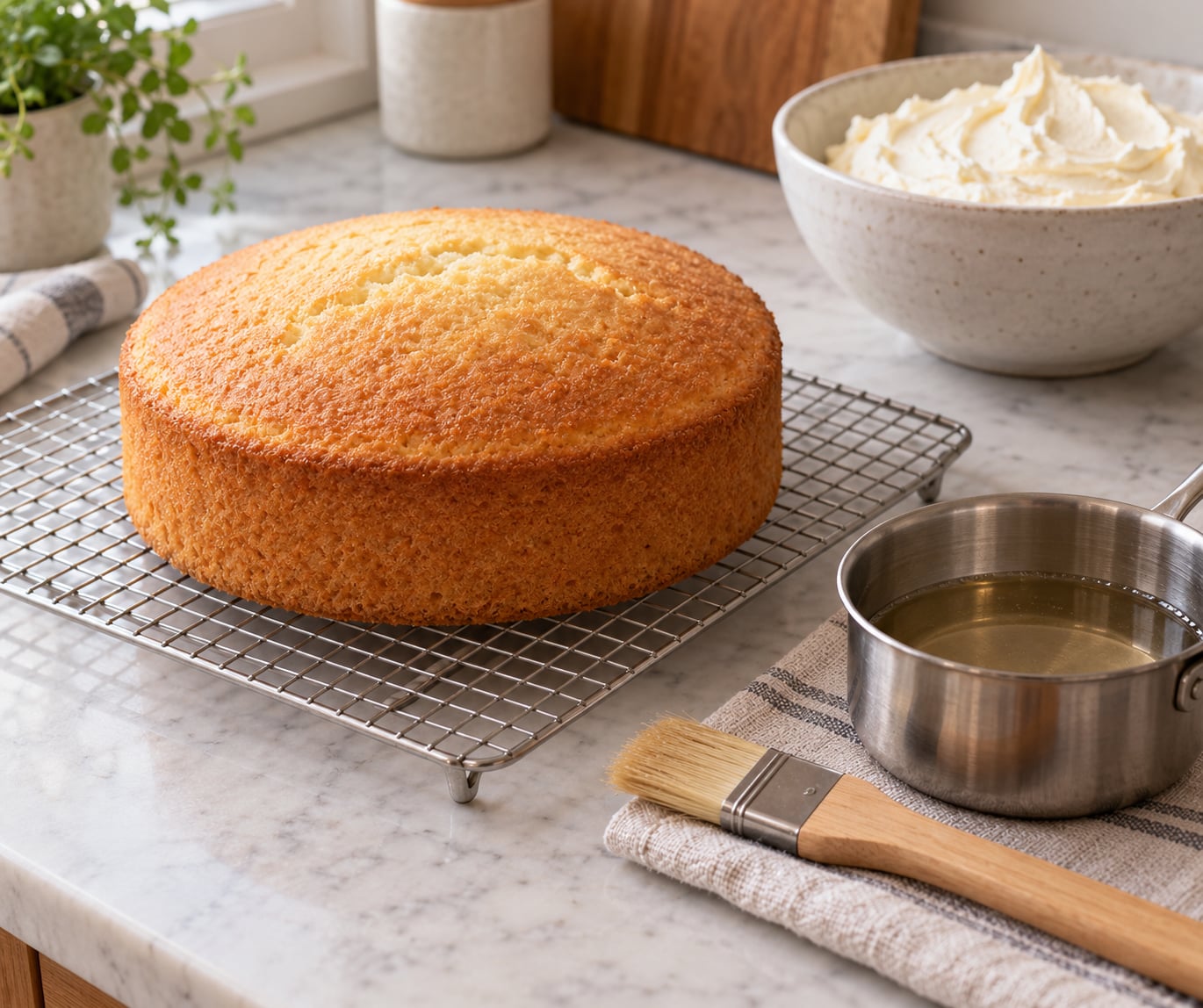
The fix is simple syrup, mixed in equal parts by weight. Combine 100g sugar and 100g water in a saucepan, swirl over low heat until the sugar dissolves, then cool it to warm. It takes about five minutes to make and keeps in a jar in the fridge for a month.
Poke holes all over the cake with a skewer, going most of the way down but not through the base. Then brush or spoon the syrup on in three or four thin layers, waiting a minute between each so it soaks in rather than pooling. Stop the moment the surface looks damp rather than glossy.
Give it 30 minutes at room temperature, or wrap it in cling film and give it two hours, before you frost. That absorption time is the part people skip, and it is the whole difference between a revived cake and a wet one.
For a dairy-free version, use water, fruit juice, or an alcohol-free flavoured syrup in place of the milk option below. If you skip the syrup entirely, a tablespoon or two of milk, orange juice, sour cream or yogurt dotted over the warm cake and allowed to soak is the community shortcut that comes up most often on baking forums, and it does help.
Fix a sunken center, cracks, or a domed top
You cannot reverse the bake, but you can make the surface read level. Trim loose or badly browned edges with a serrated knife held vertically, then cut a pronounced dome off the top the same way, a few millimetres at a time, checking after every pass.
Fill the cracks and any shallow sunken area with buttercream, ganache, a thick fruit preserve, or a simple butter and sugar paste. A jam or preserve filling is the most forgiving option because it stays soft and spreads into a dip without dragging the crumb apart.
Then lay a thin crumb coat over the whole thing to seal the edges and level the surface, chill it briefly, and finish with a proper frosting. A deeply collapsed centre can still taste excellent, but it will not look perfectly level, and pretending otherwise is how cakes get levelled in the wrong place.
Treat browned edges or a burnt taste
Trimming is worth it when the dark area is hard or smells strongly of toast, because those edges are also the driest part of the cake. Take off about 1cm from a rim that is genuinely scorched, and less if the colour is only deeper golden than you wanted. Shaving with a microplane gives you fine control over a small removal.
What will not work is hiding bitterness under frosting. A smoky, acrid taste comes from the inside of the burnt compounds, not the surface, so no amount of syrup or icing will move it. If the whole house smells of smoke when the cake comes out, trim to the last crumb that tastes clean and serve that generously covered with strong buttercream, whipped cream, and sharp fruit or a pouring sauce.
Golden browning is not burnt. Most of the flavour people mistake for a burnt edge is simply the Maillard reaction doing its job, and it hides under frosting without any trouble.
Finish, serve, and store the rescued cake
Finishing choices do real work here. A thin crumb coat followed by smooth buttercream or a ganache shell traps the moisture you just added, a whipped topping adds back some of the lost softness, a glaze adds sugar and shine, and fresh fruit contributes juice as you eat.
Store the finished cake covered, and refrigerate anything made with cream cheese frosting, whipped cream, custard or fresh fruit, eating it within a day or two. Plain frosted cakes keep about a day or two covered at cool room temperature, or up to three to four days refrigerated in a cake box. Take slices out of the fridge 30 to 60 minutes before serving, because cold cake reads as dry even when it is not.
Common Mistakes
Almost every failed rescue comes down to one of these, and each has an easy fix:
- Pouring too much liquid at once. Syrup that sits on the surface turns the crumb to paste. Apply it in thin layers and stop when the surface is damp, not shiny.
- Frosting a warm cake. Buttercream melts and slides before it can set. Cool fully first, or accept a thinner glaze instead.
- Cutting into the crumb too soon. An unabsorbed soak lets moisture escape as you slice. Wait 30 minutes at room temperature, or two hours wrapped.
- Using strong flavouring to cover bitterness. Vanilla, coffee or liqueur cannot hide a burnt taste, and they make a good cake taste artificial. Trim instead.
- Leaving a trimmed or cut surface uncovered. Exposed crumb dries out fast. Frost, glaze or wrap the same day.
- Trying to rebuild a badly collapsed or burnt cake. Once the middle has collapsed all the way through or the crumb tastes smoky, cutting the sound portion into cubes for a trifle or cake pops is a better use of it.
Make small adjustments and taste as you go. One layer of syrup, then a check, then another. The condition of the cake should choose the method, not the other way round.
Frequently Asked Questions
Can I still eat a cake that is overbaked?
Yes. Overbaking changes texture, flavour and colour, but it does not by itself make a cake unsafe. The exception is a cake that smells acrid or smoky from a single burnt spot, where the bitter compounds have spread through the crumb. Trim that area away and the rest is fine. The cake is also perishable if it was frosted with cream cheese, whipped cream or custard, so refrigerate it and eat it within a day or two.
Can I soften an overbaked cake in the microwave?
You can, but only gently. A ten to fifteen second burst on medium power warms the crumb and makes a firm cake taste softer for a few hours, and it is a decent last-minute trick for a slice. It does not put moisture back permanently, because the microwave pushes water to the surface where it evaporates. For a lasting fix, use a syrup soak, then warm the slice briefly before serving.
Will frosting make an overbaked cake taste better?
Frosting helps in two ways: the sugar and fat cover the dryness, and a thick layer seals the crumb so any moisture you add cannot escape. Bakers pair a syrup soak with frosting rather than choosing one or the other. If you are learning how to rescue an overbaked cake, trim and fill first, then frost generously, because frosting cannot fix a bitter or smoky taste or level a sunken middle on its own.
Why did my cake crack or sink in the middle?
A dome and a crack usually mean the oven ran hot, the batter was overworked, or the pan sat too close to the heating element, so the outside set before the centre finished rising. A sunken middle points the same way with an oven that was too cool and baked too long, or a leavener that expired. Neither is caused by the frosting. Neither is reversible either, so the answer after the fact is trimming and filling.
How can I prevent a cake from being overbaked next time?
Put an oven thermometer inside the oven and check it against the dial, because a door that reads 20 degrees high is the most common cause of dry cake. Bake 10 to 15 degrees lower than the recipe states and add time if needed, use a timer with a bell, and pull the cake while a skewer still comes out with a few moist crumbs rather than completely clean. Loaf and sponge cakes keep cooking in the hot pan after they leave the oven, so a clean toothpick is a late signal.
Conclusion
Work out whether the problem is dryness, shape, or flavour, then let the cake cool fully before you touch it. Trim only what needs trimming, add syrup or milk in thin layers with time to absorb, and finish with a filling or frosting generous enough to lock it in. An overbaked cake is usually worth serving. Just do not force a badly collapsed or genuinely burnt one back into shape, because there are better ways to spend those ingredients.