Doubling a cake recipe means multiplying every ingredient by two, then cutting back the ingredients that do not scale in a straight line: baking powder, baking soda, salt, strong spices and extracts. It also means matching the batter to pans that keep roughly the same depth, because depth is what drives bake time. Here is how to double a cake recipe correctly, pan by pan, with the numbers worked out for you.
Most of the fear around this comes from cakes that rise like a souffle and then sink, or ones that go dark at the edges while the middle stays raw. Both failures trace back to the same thing: treating a doubled batter as if it were still the original batch.
Table of Contents
- What You Need
- Step-by-Step: How to Double a Cake Recipe Correctly
- 1. Confirm Whether You Are Doubling the Batter or the Cake
- 2. Multiply Every Ingredient Accurately
- 3. Keep Leavening and Flavorings in Proportion
- 4. Choose the Right Pan Rather Than Simply Making It Larger
- 5. Mix the Doubled Batter Without Overworking It
- 6. Adjust Baking Temperature and Time
- 7. Check Doneness Before Removing the Cake
- 8. Cool and Store the Extra Cake Safely
- Common Mistakes
- Frequently Asked Questions
- Can I double a cake recipe and use one bigger pan?
- Should I double the baking time when I double a cake recipe?
- Do I need to double the baking powder or baking soda?
- How many eggs should I use when doubling a cake recipe?
- Can I bake two cakes at the same time?
- How long does a doubled cake stay fresh?
- Conclusion
What You Need

Start with the original recipe in front of you, including the yield it was written for. A recipe for two 8 inch layers is a different starting point from one for a single 9 inch round.
- The original recipe, with its stated yield and pan size
- A calculator, and ideally a digital kitchen scale so you can work in grams
- The written dimensions of the pan your recipe calls for, plus the pans you actually own
- Enough pans to hold the doubled batter at roughly two-thirds full
- An oven thermometer, if you have one, so you know how far your oven drifts from the dial
- A skewer, tester or instant-read thermometer for the doneness check
A pencil and a clean counter matter more than people expect. Write the doubled figures out before you start weighing, because the small quantities are the ones that get skipped.
Step-by-Step: How to Double a Cake Recipe Correctly
1. Confirm Whether You Are Doubling the Batter or the Cake
Doubling the recipe means multiplying every ingredient, which gives you twice the batter. Doubling the cake is a different job: it means producing two finished cakes, and the way you get there depends on your pans.
If you own a second pan of the same size, divide the doubled batter between the two and bake them the same way you always have. That is the safest path and the one most bakers should take. If you own only one pan, you can still get there, but the cake takes longer to bake, the middle takes longer to set, and your chances of an underbaked centre go up. I will cover that in step 4.
2. Multiply Every Ingredient Accurately
Structural ingredients double cleanly: flour, granulated sugar, brown sugar, cocoa powder, milk, buttermilk, water, oil, melted butter, sour cream, yogurt and eggs. Multiply each line by two and you are done with the easy part of this guide.
Work in one system if you can. Mixing cups and spoons with grams is where doubled fractions get ugly, and a kitchen scale removes the problem entirely. If you have no scale, double the volume figures and then measure carefully, because a cup of flour packed or feathered differently can swing a doubled batch by a noticeable amount.
Useful anchors while you work: 1 cup is 240 ml, 1 cup of flour weighs about 125 g, 1 cup of granulated sugar about 200 g, 1 cup of butter about 225 g, and 1 tablespoon of butter about 14 g. So 1 1/3 cups of milk becomes 2 2/3 cups, and 3/4 cup of cocoa becomes 1 1/2 cups.
When the arithmetic gives you an awkward fraction, measure the closest clean amount instead of guessing. A doubled 1/8 teaspoon of salt is a quarter teaspoon. A doubled 1 1/4 teaspoons of vanilla is 2 1/2 teaspoons. Nobody is grading the difference between 2 1/2 and 2 3/4 teaspoons of extract.
3. Keep Leavening and Flavorings in Proportion
This is the step that separates a doubled cake from a collapsed one. Leavening agents do not scale linearly, because doubling them does not double the rise, it doubles the speed of the rise. The gas forms faster than the crumb can set, the middle sags under its own weight, and you get a dense crater in the middle.
Use these multipliers when you double a cake:
| Ingredient | Multiplier for a doubled recipe | Why |
|---|---|---|
| Flour, sugar, cocoa, milk, water, oil, butter, eggs | 2x | Structural; they build the cake itself |
| Baking powder | 1.5x | Double it and the batter over-rises and collapses |
| Baking soda | 1.5x | Same reason, and a bitter taste if it doubles |
| Salt | 1.5x, then taste | Doubling salt flattens the sweetness and can taste soapy |
| Strong spices, ginger, cinnamon, cloves | 1.5x | Spice intensity grows faster than the batter does |
| Vanilla extract and other extracts | 1.5x to 1.75x | Alcohol and depth do not need to double |
| Thickeners: cornstarch, arrowroot, gelatin, yeast | 1.5x | Over-thickened batter bakes dense and cracks |
So a recipe calling for 2 teaspoons of baking powder gets 3 teaspoons, not 4. A recipe with 1 teaspoon of baking soda gets 1 1/2 teaspoons. The 1-2-3-4 method and the 3:2:1 ratio rule you may have seen referenced are useful for building a formula from scratch, but when you are scaling a working recipe you already trust, the 1.5x rule is the one that matters.
One exception belongs to the original recipe, not to you. Some cakes specifically call for a reduced amount of leavener because the batter is meant to rise slowly. If your recipe gives you that method, follow the recipe rather than doubling or scaling by a fixed ratio.
4. Choose the Right Pan Rather Than Simply Making It Larger

Pan width matters far less than batter depth. Widening a pan shortens the distance heat has to travel into the middle, so a wider cake actually bakes slightly faster. Deepening the batter does the opposite: the center sits further from the heat, so it needs more time and can stay raw.
That is why a pan twice as deep is not the same as two pans. It is a different cake, and a harder one to get right.
Round and square pan conversion factors, based on the area of an 8 inch pan, so you can see how a batch grows:
| Going from an 8 inch pan to | Multiply the recipe by |
|---|---|
| 8 inch round or square | 1.00 |
| 9 inch round or square | 1.27 |
| 10 inch round or square | 1.56 |
| 11 inch round or square | 1.89 |
| 12 inch round or square | 2.25 |
Rectangular pans, again from an 8 inch round or square:
| Pan | Multiply the recipe by | Notes |
|---|---|---|
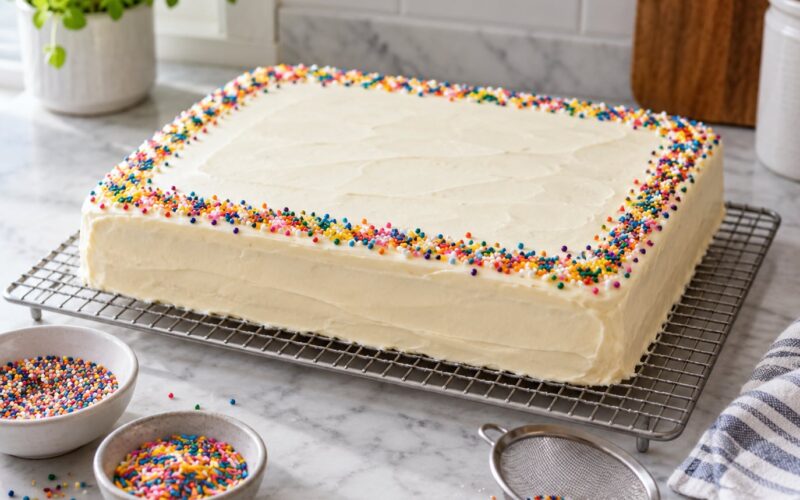
| 9 x 13 inch | 2.3 | The standard birthday sheet pan |
| 9 x 18 inch | 3.2 | Bake on two racks, swap and rotate at the halfway mark |
| 11 x 14 inch | 3.0 | Good for a large party sheet |
| 12 x 18 inch | 4.3 | Very deep; needs an extra 20 to 30 minutes and a firm doneness check |
If you have one pan and a doubled batch, your realistic options are to bake two layers in sequence and refrigerate or freeze the first while the second bakes, to ask a neighbour for a pan, or to bake one thick cake and accept the longer bake. The freezer option is easier than it sounds: cool the first cake completely on a rack, wrap it well, and it will wait patiently for the second.
Whatever pan you choose, fill it about two-thirds full. A doubled cake in a pan with no headroom will overflow, and the overflow goes on the floor of a hot oven.
5. Mix the Doubled Batter Without Overworking It
Use a bowl with real headroom. A stand mixer bowl filled to the top makes flour dust fly everywhere and prevents proper mixing, which pushes a big batch straight onto the counter. If your largest bowl looks tight, split the batch and mix it in two goes.
Keep the order the recipe gives you. Dry first, wet into the dry, then the eggs, then the fats, and beat only until combined. A doubled batch takes longer to mix because there is more mass moving, and that longer time is exactly how cake batter turns tough.
If you see dry pockets in the bottom of the bowl, give it another fifteen seconds at low speed rather than a full minute at high. Scrape the bowl down once halfway through, and check the batter texture against the original: it should drip slowly and look the same, just more of it.
Drop the mixer speed a notch when the bowl is more than three-quarters full. Flour near the top of the mass needs a moment to hydrate, and a gentler speed gives it time without forcing air into the flour.
6. Adjust Baking Temperature and Time
Two cakes in two pans: keep the temperature exactly as written and check them at the same time. You are running the same bake, twice, so nothing about the oven changes.
One deeper cake: keep the temperature the same as well. The instinct to turn it up comes from stovetop thinking, and it is wrong for cakes. Higher heat sets the outside faster, which drives moisture outward, which is how you get a dry crumb and a dark crust before the middle is set. If anything, an oven that runs hot is a good reason to drop the dial by 25 F.
Time is where the change shows up, and there is no clean multiplier. A pan that is wider but the same depth bakes about the same, maybe ten to fifteen percent faster. A pan with noticeably more depth needs considerably longer, often 20 to 30 extra minutes on a deep sheet. Treat every number as a starting point and let the cake tell you when it is done.
If you are baking two cakes at once on separate racks, rotate and swap them halfway so both get even heat. They will not finish at the same moment, which is normal.
7. Check Doneness Before Removing the Cake
Colour is not a doneness test. A cake can be beautifully golden and still be raw in the middle, and a pale cake can be fully baked.
Look for these instead:
- The center springs back lightly when you press it and no longer feels wet
- A tester or skewer comes out clean, or with a few moist crumbs and no wet batter
- The edges have pulled slightly away from the sides of the pan
- The surface is set and no longer glossy or liquid-looking
An instant-read thermometer gives you a number, which helps when a doubled cake is deep and you are nervous. Insert it into the thickest part of the center without touching the pan base, and look for roughly 200 to 210 F for a fully baked cake with its structure set.
Start checking ten minutes before the recipe’s stated time rather than at the end, so you are not standing at the oven with a timer going off and no plan B. If the outside is darkening fast and the center still feels soft, tent the cake loosely with foil and continue.
Pull the cake when it passes the check, not when the timer says so. Ten extra minutes in a hot oven is the difference between a moist cake and a dry one.
8. Cool and Store the Extra Cake Safely
Cool layers in their pans for 10 to 15 minutes, then turn out onto a rack. Cooling happens faster when the cake is divided, which is another small argument for two pans over one deep cake.
Frosting, filling and ganache scale differently from the cake. A standard buttercream doubles cleanly or you can multiply it by 1.5 and add liquid to reach the right consistency. A ganache made by weight doubles cleanly, since it is a ratio of cream to chocolate. A whipped cream, curd or meringue-based frosting does not hold double well, so make two smaller batches and keep the second cold until you need it.
Once frosted, most cakes sit fine at room temperature for about two days if the frosting is buttercream or ganache. Refrigerate anything with cream cheese, whipped cream, custard or mousse, and use it within three to four days. Unfrozen cake layers wrapped tightly keep about a week refrigerated and two to three months frozen, which is the answer to the one-pan problem for most people.
Chilled cake is denser and firmer. Bring a slice to room temperature for 20 or 30 minutes before serving if you want the texture you baked.
Common Mistakes
Skipping the small quantities. The half teaspoon of salt, the quarter teaspoon of vanilla and the 1/8 teaspoon of something acidic get dropped when the numbers stop being clean. Weigh them instead of eyeballing them.
Using one oversized pan. A pan twice as deep is not equivalent to two pans. Bake two layers if you possibly can.
Assuming double the batter means double the time. It does not. A wider pan barely changes the bake; a deeper one adds real minutes. Check doneness instead of following a rule.
Filling the mixing bowl to the brim. You will spill dry ingredients and end up with pockets of flour in the batter. Mix in two batches instead.
Overmixing the larger batter. More mass means more mixing time, and extended beating on high speed makes the crumb tight and the cake heavy.
Opening the oven early. Every opening drops the temperature, and a doubled cake that spends ten minutes below temperature rises unevenly. Wait until your checking window.
Judging by colour alone. A dark crust says nothing about the center. Use a tester, and start checking before the stated time.
Not checking the original yield. If the recipe never says how many it makes, decide what one batch is worth to you before you scale. A recipe written for one 9 inch round and served at eight slices does not double into a cake for a party.
Frequently Asked Questions
Can I double a cake recipe and use one bigger pan?
You can, but the cake will not behave like two cakes. A deeper pan means the center sits further from the heat, so it needs more time and a careful doneness check. Expect to add 20 to 30 minutes for a deep sheet pan, and check with a tester before pulling. If you can split the batter into two pans of the original size, the result is more even and far easier to bake.
Should I double the baking time when I double a cake recipe?
No. Baking time is tied to batter depth, not to the size of the batch. Two cakes in two pans bake in the same time as one cake. A wider pan with the same depth bakes about the same or slightly faster. Only a deeper pan needs extra time, and even then no fixed multiplier works reliably, so start checking ten minutes before the recipe time and pull when a tester comes out clean or with moist crumbs.
Do I need to double the baking powder or baking soda?
No, multiply baking powder and baking soda by 1.5 instead of 2. Doubling leavening does not double the rise, it doubles the speed of it, and the batter collapses in the middle as the crumb cannot set in time. A recipe with 2 teaspoons of baking powder gets 3 teaspoons when doubled. Apply the same 1.5x multiplier to salt, strong spices and gelatin, and keep extracts nearer 1.5x to 1.75x.
How many eggs should I use when doubling a cake recipe?
Eggs double cleanly, so a recipe calling for 2 eggs gets 4. Use them at room temperature, and beat them in as the recipe directs rather than adding them all to the dry mix. If a recipe needs an odd number doubled, use one whole egg plus one yolk rather than two whole eggs, since the extra yolk adds fat and structure without thinning the batter the way an extra white would.
Can I bake two cakes at the same time?
Yes, on separate racks in the centre of the oven, provided the pans do not touch each other or the oven walls. Rotate and swap the pans halfway through so both get even heat. They will rarely finish at exactly the same moment, so start testing the one that went in first. Crowding the oven blocks airflow, which is why two racks spaced apart work better than two pans sitting side by side on one rack.
How long does a doubled cake stay fresh?
An unfrosted cake layer wrapped tightly keeps about a week refrigerated and two to three months frozen. Frosted cake stays at room temperature for roughly two days if the frosting is buttercream or ganache, while anything with cream cheese, whipped cream, custard or mousse must be refrigerated and used within three to four days. Let a chilled slice return to room temperature for 20 or 30 minutes before serving.
Conclusion
Here is what to do first: double every ingredient accurately in one system, and hold baking powder, baking soda, salt and strong spices at about 1.5x instead of 2x. Then protect the batter-to-pan relationship by choosing a pan that keeps the batter roughly the same depth, and let doneness cues rather than a doubled baking time decide when the cake comes out. Updated for 2026, and still the same three rules that worked last year.