Yes, a broken cake can almost always be saved. Freeze the pieces so they stop shedding crumbs, spread buttercream or ganache generously over both faces, press them back together like a puzzle, then crumb coat and finish. Twenty minutes of work, and nobody at your party will know.
I know the panic. You are holding a cake that came out of the oven fine and came out of the pan in three pieces, and the party is tomorrow. Here is the good news: almost every cake failure is mechanical, not culinary. The cake still tastes good. Only its shape is ruined, and shape is the easiest thing to fake.
There is no fondant in this method and no turntable, no dowels, no special equipment. Just a spoon, some buttercream and a fridge.
Table of Contents
- What You Need
- Step-by-Step: How to Fix a Cake That Broke Apart
- How to Reassemble a Cake That Split in the Middle
- How to Repair a Cake With a Cracked or Uneven Top
- How to Fix a Cake That Is Crumbly or Broken Into Pieces
- How to Make a Cake That Broke Apart Look Finished
- Common Mistakes When Repairing a Broken Cake
- Tips for a Cleaner Repair and Easier Serving
- Frequently Asked Questions
- Can I fix a cake that broke apart without throwing it away?
- What is the best way to repair a cake with a big crack?
- How do I keep a broken cake from falling apart while frosting it?
- Can I fix a cake that broke after it was already frosted?
- How long should I chill a repaired cake before decorating or serving it?
- Can I freeze broken cake pieces for later use?
What You Need
The full kit depends on how badly the cake broke, so pick the row that matches your situation.
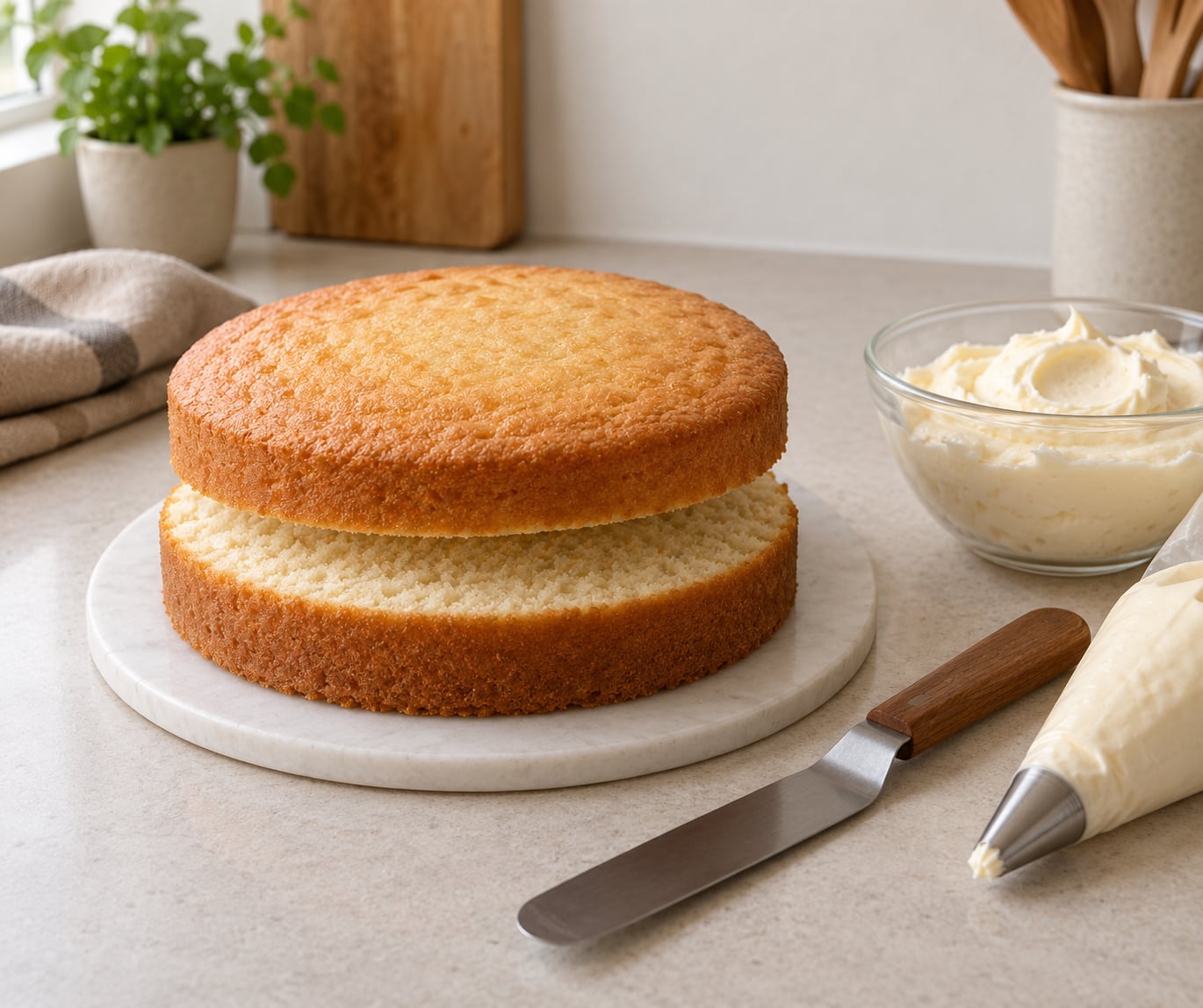
For a clean break into two or three big pieces — you need cling film, a flat board or tray slightly larger than the cake, an offset spatula or the back of a spoon, a bowl of buttercream or ganache, and a knife. This is the setup for reassembling a layer and it covers most of what goes wrong.
For a crumb coat and finish — you will also want a piping bag with no tip cut off (snip 1 cm from the corner) to lay a thick, controllable bead of frosting, a turntable if you have one, or a plain non-slip mat if you do not, and a bench scraper or a tall straight-sided jug for the sides. Chill time is a tool too, and it is the one people skip.
For a cake that has shattered into crumbs or chunks — you need a large bowl, a wooden spoon or a stand mixer with the paddle, and either milk, a splash of water or extra frosting to bind the crumbs. That path turns the cake into cake pops, a trifle or a cake salad rather than a layered cake.
Two more things worth having to hand: a pastry brush and a small pot of simple syrup, which is equal parts sugar and water stirred until dissolved. That is the fix for layers that crumble into dust the moment you touch them.
Step-by-Step: How to Fix a Cake That Broke Apart
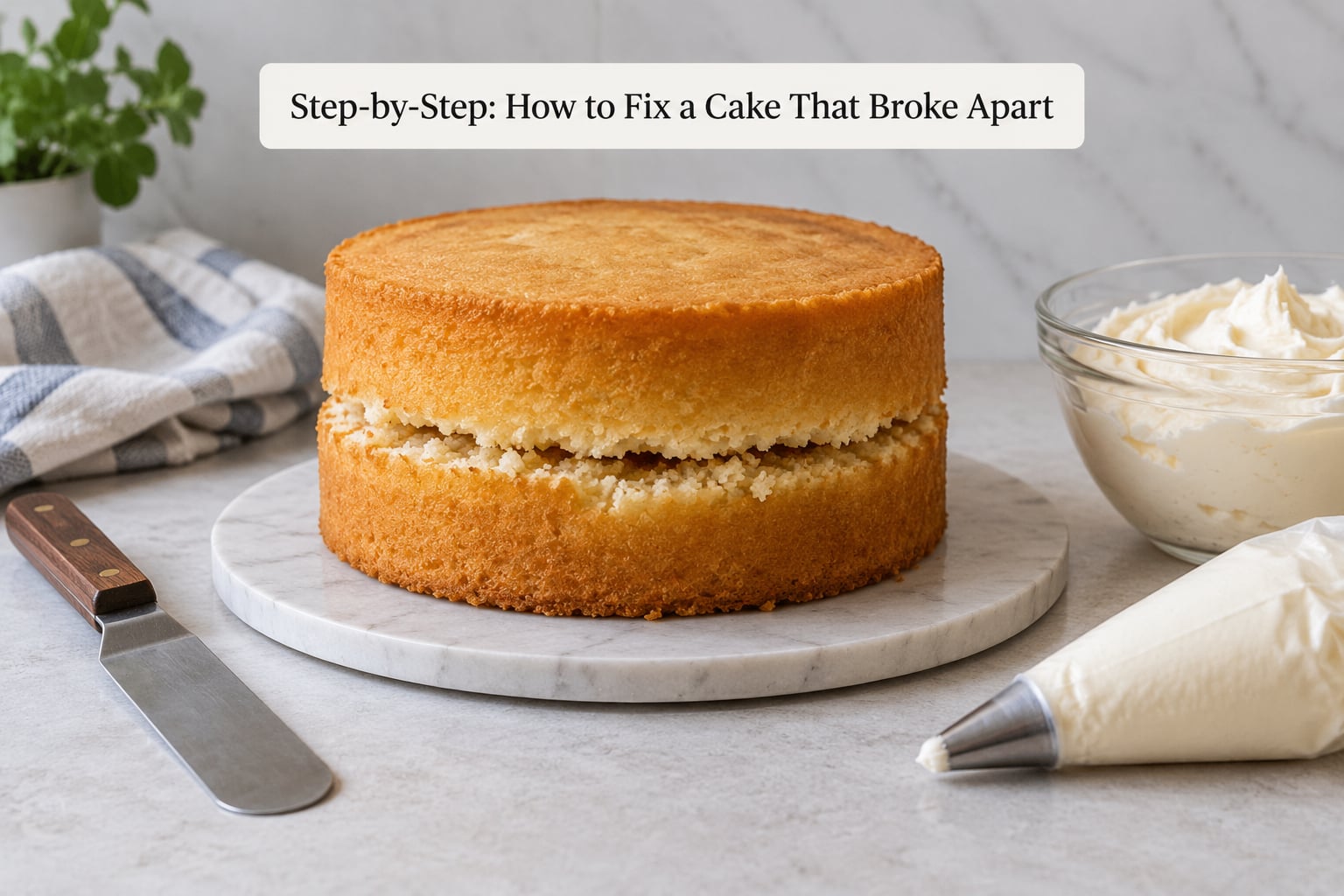
Here is the core method. Skip to the subheading that matches your damage if you already know what went wrong.
- Freeze the pieces. Wrap them tightly in cling film and put them in the freezer for at least two hours, or overnight if you have the time. Cold cake is firm cake, and firm cake can be handled, aligned and pressed without shedding crumbs.
- Cover the board. Tape a thin layer of buttercream onto the board or tray where the cake will sit. This glues the bottom piece down so it cannot slide while you work on the seams.
- Frost the broken faces and press them together. Spread a generous layer of buttercream or cooled ganache across both faces, line them up, and press down firmly with your palms until the seam disappears under the frosting. Be generous here. Too little frosting is the number one reason a glued cake splits apart again.
- Put the fragile layer in the middle. If you are stacking more than one repaired layer, sandwich it between intact layers so its weight is supported rather than carrying it.
- Fill the gaps. Use a piping bag with no tip to squeeze frosting into any crack or missing corner, then sweep the surface level with the back of a spoon. For a bigger hole, mix cake crumbs with buttercream and a spoon of jam into a stiff paste and press it in before you frost.
- Chill, crumb coat, finish. Refrigerate the reassembled cake for 10 to 15 minutes so the frosting sets into a firm shell. Apply a thin crumb coat to trap loose crumbs, chill again for another 10 to 15 minutes, then lay on your final coat.
How to Reassemble a Cake That Split in the Middle
Take the halves straight from the freezer and, while they are still cold, brush or blow away any loose crumbs from the cut faces. Loose crumbs under the frosting are what make a seam show up as a line of grit.
Spread frosting on one face, lay the other half on top, and press down with two hands for a solid thirty seconds. Then look at the cake from eye level on every side. If one side is thicker than the other, take it apart and shave a little off the fattest piece with a serrated knife held flat against the counter. Once it sits level, put it back together and reinforce the seam with another bead of frosting.
Take your fingers off before you check. Frosting that has been smeared and re-smeared loses its tack, and that is where repairs fail.
How to Repair a Cake With a Cracked or Uneven Top
A cracked top is usually the least serious failure, because the crack can simply be hidden. First, turn the cake so the crack runs somewhere nobody is likely to look, ideally down the back or along the side.
Where a piece has lifted or flaked, press it back into place with a little buttercream underneath and hold it down until the frosting grabs. Then run a serrated knife across the whole top while the cake is level, cutting only as deep as the deepest crack. You are flattening it, not amputating it, and the crumbs that come off become spackle for any gaps.
Crack on the top covered. Crack in the side gets filled with a piping bag. Bakers who decorate regularly put a cracked layer at the top of the stack on purpose, since the top layer carries no weight and a seam in the middle has to hold the whole thing up.
How to Fix a Cake That Is Crumbly or Broken Into Pieces
If the cake shatters when you pick it up, stop trying to repair the shape. That kind of damage means the crumb is too dry or too fragile to hold an edge, and no amount of frosting will change it. You have two choices.
Brush a light coat of simple syrup over the cut faces if the cake is dry, then reassemble and let the moisture do the holding. If the cake is already moist and still disintegrating, the crumb was overworked or overbaked, so syrup will not help. Go to pieces.
For cake pops, break the cake into roughly 1-inch pieces, add just enough frosting to hold a ball together, and roll. For a cake salad or trifle, cut the pieces into cubes, toss them with a little frosting or syrup so they clump, and pile them in a bowl or a glass dish. Moist cake needs almost no added liquid. Dry cake needs enough to bring it back, added a spoonful at a time, or you end up with sweet porridge.
How to Make a Cake That Broke Apart Look Finished
The crumb coat is what hides everything, and it is a thin coat, not a thick one. Its job is to glue loose crumbs to the cake so the final coat slides over a sealed surface. Scrape off every crumb that comes off the cake as you apply it, and let the coat sit for 10 to 15 minutes in the fridge before you go over it again.
You do not need fondant to make a repaired cake look finished. A smooth buttercream coat on a turntable is the most forgiving option, and it forgives a lumpy repair better than any other finish. Other routes that disguise damage well: a ganache drip, where the chocolate runs over the edge and covers the base of the cake; a semi-naked finish, where you deliberately leave a thin stripe of crumb showing and it reads as a style rather than a mistake; or a textured piped finish, where a star tip covers the entire side in rows.
Toppings do more work than people expect. Heavy sprinkles, a ganache drip, a ring of fruit or a topper over the worst seam draws the eye somewhere else. Skip anything delicate and white directly over the repair.
Common Mistakes When Repairing a Broken Cake
Skipping the freeze. Warm cake crumbles and the repair fails within minutes. Two hours minimum in the freezer fixes it.
Using too little frosting between the pieces. If the seam is dry when you press, it is not glued. Coat both faces fully.
Frosting over loose crumbs. Crumbs trapped under the topcoat make every bump visible. Do the crumb coat, chill, wipe the surface with a damp cloth if needed, then finish.
Putting a fragile layer on the bottom. Bottom layers carry the whole stack. Repaired cake goes in the middle or on top.
Forcing badly uneven pieces together. Trim the fattest side before you glue, not after.
Cutting into the cake straight after finishing. Give the final coat 20 to 30 minutes to set in the fridge, and cut with a warm, dry knife wiped between every slice.
Tips for a Cleaner Repair and Easier Serving
Work on a level surface with a damp cloth under your board. A tray that rocks is why seams slide open halfway through.
Keep the cake cold while you decorate. Buttercream stays workable straight from the fridge for a few minutes, then starts to stiffen, so work in short bursts rather than fighting a warming cake.
For carrying, put the cake on a board with a dab of frosting underneath, refrigerate it for 20 to 30 minutes, and carry it level with two hands underneath the board. A repaired cake is stronger cold than warm.
For storage, a frosted cake keeps at room temperature for a day or two, or about a week refrigerated, covered so it does not pick up fridge odours. Freeze unfrosted broken pieces for up to two months and thaw them in the fridge overnight before using them.
Slice cold and wipe the blade between cuts. Warm cake compresses, and compression is what pulls a repaired seam apart in front of everyone.
Frequently Asked Questions
Can I fix a cake that broke apart without throwing it away?
Nearly always, yes. If the cake is fully baked, not burnt and not raw in the middle, the damage is structural and frosting can rebuild it. Freeze the broken pieces for two hours, glue them with buttercream or ganache, fill the cracks, then crumb coat. The only cakes I would not bother repairing are burnt ones and ones with wet batter in the middle.
What is the best way to repair a cake with a big crack?
Squeeze frosting into the crack with a piping bag with no tip, then fill anything deeper with a stiff paste of cake crumbs, buttercream and jam. Press the layers together and let the whole cake chill for 10 to 15 minutes so the frosting hardens before you frost the outside. If the crack is on the top, fill it and set the cake so the crack faces the back of the cake.
How do I keep a broken cake from falling apart while frosting it?
Work on a frozen or very cold cake, hold it together with a crumb coat rather than pressure, and never push the spatula down between the pieces. Spread frosting flat against the side with the bottom edge of the blade and let the coat do the holding instead of your hand. If the crumb is dry and dusts off as you touch it, brush on simple syrup first.
Can I fix a cake that broke after it was already frosted?
Yes, and the frosting may even help. Peel off any frosting around the break, then push the pieces back together and smooth fresh buttercream over the seam so it blends into what is already there. Chill for 30 minutes, then dust off crumbs and re-frost the whole cake so the repair is not the smoothest part of the finish.
How long should I chill a repaired cake before decorating or serving it?
Give it 10 to 15 minutes in the fridge to set the frosting glue, then a further 10 to 15 minutes after the crumb coat before the final coat. Before serving or carrying it anywhere, chill the finished cake for 20 to 30 minutes. Cold frosting is firm, and a firm repair holds together in transit far better than a soft one.
Can I freeze broken cake pieces for later use?
Yes. Freeze the pieces flat on a tray first so they keep their shape, then bag them so they do not collect freezer burn. They keep for about two months and thaw best overnight in the fridge. That makes them useful for cake pops, trifles or stuffing, since a dry thawed piece blends more easily than a fresh one.
Stop reading and go do this: put the pieces in the freezer, then make the frosting. While both sit there, clear a flat corner of the counter and find your board.
The freeze does the hard work, the frosting does the gluing and the crumb coat does the pretending. Give it two hours and the cake is back.