Halving a baking recipe is simple arithmetic: divide every ingredient by two, move to a pan with roughly half the batter, then start checking for doneness early. The only real difficulty sits in the fractions — half of 1/3 cup is not something any measuring cup will show you. Knowing how to halve a baking recipe accurately is mostly about deciding which measurements to weigh, which to eyeball, and which to leave alone.
It takes about two minutes of math before you start mixing, and it works for cakes, cookies, cupcakes, muffins, frostings and quick breads. Yeast dough is the exception, and I’ll get to that later.
Table of Contents
- What You Need to Halve a Baking Recipe Accurately
- Step-by-Step
- 1. Read the Whole List Before You Calculate
- 2. Divide Weights and Large Volume Measurements
- 3. Handle Teaspoons, Eggs, and Other Awkward Amounts
- 4. Protect Proportions That Affect the Batter
- 5. Choose a Comparable Pan and Check the Scale
- 6. Adjust Baking Temperature and Time Conservatively
- 7. Verify the Halved Batch Before and During Baking
- Common Mistakes
- Frequently Asked Questions
- Should I halve baking ingredients by weight or volume?
- What should I do if a recipe calls for an odd amount of an ingredient?
- How do I halve a recipe that needs only half an egg?
- Does halving a recipe change the baking temperature or time?
- Can I use a different pan size instead of halving a recipe?
- Conclusion: Check the Math, Then Trust the Recipe
What You Need to Halve a Baking Recipe Accurately

Four things, and only one of them is optional. A digital kitchen scale, a set of measuring cups and spoons, a phone or calculator, and the original recipe in front of you.
The scale is the item that changes your results. Volume measures are a guess baked into a cup size — a cup of flour weighed out on a scale gives you a repeatable number, while scooping gives you whatever amount happened to sit in the spoon. When you halve, that guess gets halved too, and a 20% error in the flour becomes a 20% error in the structure of your cake.
Leavening is the other one worth weighing. Baking powder and baking soda are small amounts doing large work, so rounding is the mistake that actually ruins a halved cake. Weigh them if you can.
Measuring spoons still matter. A 1/2 teaspoon is a real, marked thing, and for most recipes 1/8 teaspoon is close enough to a pinch that nobody will ever notice. The scale matters more for flour, sugar, fat and leavening than it does for vanilla extract.
Step-by-Step
1. Read the Whole List Before You Calculate
Before you calculate anything, look at how each amount is written down. Some will be in grams, some in cups, some in ounces or pounds, and a few in fractions like 1/3 cup or 2/3 teaspoon.
Split the list into two groups. Weight measurements — grams, ounces, pounds — divide cleanly, and 240 g becomes exactly 120 g. Volume measurements need converting first if you want to weigh them, because a cup of flour and a cup of sugar are not the same weight.
Keep dry ingredients in the measurements the recipe gives you. Do the math in those measurements, and only switch to grams when you’re ready to weigh. Mixing measurement styles is where most small mistakes hide.
2. Divide Weights and Large Volume Measurements
Weights halve by simple division. Cups and tablespoons halve almost as easily, because most home measuring sets give you half of a cup and half of a tablespoon.
| Original amount | Half of it |
|---|---|
| 1 cup | 1/2 cup |
| 2 cups | 1 cup |
| 3 cups | 1 1/2 cups |
| 3/4 cup | 3/8 cup (about 6 tablespoons) |
| 1/2 cup | 1/4 cup (4 tablespoons) |
| 1/3 cup | 1/6 cup (2 tablespoons plus 2 teaspoons) |
| 1/8 cup | 2 tablespoons |
| 1/4 cup | 2 tablespoons |
| 1 tablespoon | 1 1/2 tablespoons |
| 1 1/2 tablespoons | 3/4 tablespoon (1 tablespoon plus 2 teaspoons) |
| 1 teaspoon | 1/2 teaspoon |
Once the flour is weighed, the rest is mostly rounding decisions. Here are common halved amounts by weight, using a standard all-purpose flour weight of about 120 g per cup:
| Ingredient | Halved weight |
|---|---|
| All-purpose flour | 60 g |
| Granulated sugar | 50 g |
| Packed brown sugar | 50 g |
| Unsalted butter (half a stick) | 57 g (just over 2 ounces) |
| Vegetable oil | 60 ml |
| Whole milk | 60 ml |
| Large egg | 25 g (about 1 1/2 tablespoons of beaten egg) |
| Cocoa powder | 10 g |
| Baking powder | 2 g |
| Baking soda | 2.5 g |
| Instant yeast | 3.5 g |
| Fine salt | 1.5 g |
| Vanilla extract | 2.5 ml |
| Chocolate chips | 90 g |
Brown sugar deserves a note. It’s weighed packed, straight from the measuring cup, so halving 100 g means 50 g packed. Spooning it loosely into the scale gives you a drier cake than the recipe intended.
3. Handle Teaspoons, Eggs, and Other Awkward Amounts
Teaspoon measures are the easiest part. 1 teaspoon becomes 1/2 teaspoon, 1/2 teaspoon becomes 1/4 teaspoon, and 1/4 teaspoon becomes a small pinch. Nobody is grading your pinch.
Eggs are the part people get stuck on. Here’s the process for halving eggs accurately:
1. Crack the egg into a small bowl or cup.
2. Beat it with a fork until the yolk and white are completely uniform, with no streaks.
3. Weigh the whole egg. A large egg is usually about 50 g, so half is 25 g. Alternatively, half of a beaten large egg is 1 1/2 tablespoons.
4. Use the amount you need and discard or refrigerate the rest for up to a day.
A hand mixer or immersion blender makes step two faster, but a fork genuinely works. The point is to destroy the yolk-white boundary, because a spoonful of yolk and a spoonful of white are not the same thing.
For odd numbers, weigh them. Three eggs at roughly 150 g total becomes 75 g of beaten egg, and that is more accurate than one whole egg plus a guessed half. If a recipe separates yolks from whites, measure each group separately: half of three yolks is one yolk plus one measured yolk, and a scale handles both without drama.
Don’t halve an egg by scooping half the shell contents. You have no way to know how much white came with that yolk.
4. Protect Proportions That Affect the Batter
Not everything scales in a straight line, even when the math is right. A few ingredients need judgment rather than division.
Salt, spices and extracts are the group that behaves worst. Baking soda loses potency fast, and rounding 1/2 teaspoon up to a full teaspoon can leave a soapy taste that ruins the whole cake. Weigh it if the amount goes below about 1/4 teaspoon.
Chocolate chips, nuts and dried fruit are fine halved, but a small batch concentrates them. If your original recipe used 180 g of chips in a full cake, 90 g in a smaller pan means more chips per bite. That’s a texture difference, not an error. Tossing the chips in a light coat of flour before folding them in helps them stay suspended.
Butter stays butter. Fat is structure in a cake crumb, so keep it in proportion even if the small number is awkward — 57 g is fine, and so is a scant tablespoon melted.
If several tiny measurements get rounded in the same direction, the batter drifts. Rounding baking soda up and salt up and vanilla up in the same bowl adds up to something noticeably stronger than the original. Rounding in different directions is the safer habit.
5. Choose a Comparable Pan and Check the Scale
Half a recipe needs half a pan. Most pans sold as substitutes aren’t exactly half, so it’s worth doing a little geometry instead of guessing.
What matters most for a cake is the base area, since that’s the surface the batter spreads across and where the edges set. Roughly, half the base area means half the batter at the same depth. For loaves and thin layers, total capacity matters more.
| Original pan | Base area | Good halved substitute | Share of original area |
|---|---|---|---|
| 9 x 13 inch rectangular | 117 sq in | 8 x 8 inch square | about 55% |
| 9 x 13 inch rectangular | 117 sq in | 7 x 9 inch rectangular | about 54% |
| 9 inch round | 64 sq in | 6 inch round | about 45% |
| 8 inch square | 64 sq in | 6 inch round | about 44% |
| 8.5 x 4.5 inch loaf | 38 sq in | 5 x 3 inch loaf | about 44% |
If you want an exact match instead of a close one, multiply each pan dimension by about 0.7 and look for the nearest pan size you own. Two-thirds in each direction gives you the same base area, then the cake bakes a little deeper because the batter is thicker.
Also consider depth. A thinner cake layer sets faster and browns sooner, so a short wide pan changes the result more than the numbers suggest. When in doubt, fill the substitute pan a bit less than you would the original.
6. Adjust Baking Temperature and Time Conservatively
Keep the oven temperature unless you have a specific reason to change it. The batter is thinner and there’s less of it, so it usually needs less time, not less heat.
Two temperature changes do earn their place. A dark metal pan runs hotter than a light one, so if you’re swapping a light pan for dark, drop the temperature by about 25°F (15°C). Glass is the biggest jump — around 25°F (15°C) lower than metal, and glass pans also mean the batter cooks faster because the side walls conduct heat.
For time, don’t halve it. The original 35 minutes might become 22, or it might still need 30. Start checking 5 to 10 minutes earlier than the recipe states and judge the cake by what you see and feel rather than the clock:
The edges pull away from the sides of the pan and look dry. The center springs back when you press it lightly. A toothpick or skewer in the center comes out with only a few moist crumbs, never wet batter. If you’re frosting it, the surface should feel like a soft sponge rather than a crumbly one.
Wet crumbs mean give it more time. A cracked, over-browned top usually means your pan is smaller in area than the original, which concentrates the batter and puts the top in the heat longer.
7. Verify the Halved Batch Before and During Baking
Before you mix, do a quick sum: add up the halved flour and make sure your pan holds about that much batter at the depth the original recipe used. This single check catches most halving failures, because mismatched pans are the most common reason a small cake bakes into a dome or a dense brick.
While mixing, watch the consistency rather than the clock. Batter that ribbons off the spoon in a slow, steady stream is the texture you’re aiming for, and that’s the same ribbon the full recipe should have given you. If yours looks noticeably thicker, your flour weighed light.
Whisking the dry and wet separately, then combining just until the flour disappears, is the most reliable way to keep a small batch even. Small batches have less mixing headroom, so overmixing shows up faster — the batter gets tight and tough.
Arithmetic is only the first check. Learning how to halve a baking recipe accurately really means knowing what the dough should look like when it’s right, because a recipe that was tested at twice the size can tell you the numbers but not the texture.
Common Mistakes
Weighing flour after halving a volume measure. If the original says 2 cups and you scoop 1 cup to weigh, you’ve already lost precision before the scale got involved. Either halve the volume and use a proper measuring cup, or convert the full 2 cups to grams and halve the gram weight.
Rounding every small measurement the same way. Halving a recipe that needs 3/4 teaspoon baking soda gives you 3/8, which no spoon marks. Rounding it up to 1/2 teaspoon changes the chemistry noticeably. Weigh it, or round down and let the other ingredients carry the flavor.
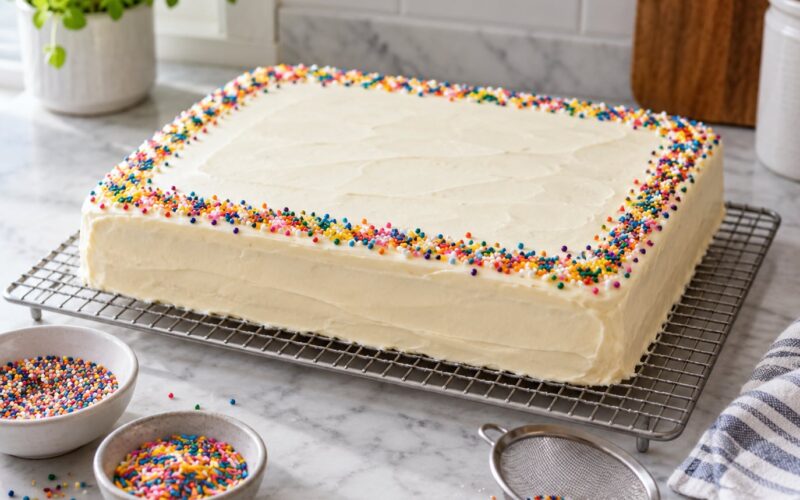
Guessing at pan size. An 8 x 8 pan is about 55% of a 9 x 13, not half. That gap is small enough to look right and large enough to produce a cake that rises fast in the middle and burns on the ridges. Compare the printed dimensions before you commit.
Halving the baking time. The clock measures heat and depth, not quantity. A smaller cake often finishes in roughly 70% of the original time, and sometimes barely sooner. Start early, test often.
Halving every ingredient when you only need part of a batch. If the issue is a stray half cup of flour, make the full batch and freeze it. Dough freezes well, and cookie dough balls freeze better than baked cookies. It’s less arithmetic and no risk to the results.
Using a stand mixer for a tiny batch. Most mixers need a minimum volume to circulate properly, and a small dough will just sit in the bottom of the bowl. Hand mixing, or a hand mixer, gives you the control you want at this size.
Filling a muffin pan in a staggered pattern. Bake the front-left, back-right, then middle pair first. The empty cups give the heat a clear path to each portion, and all twelve finish closer to the same time.
Frequently Asked Questions
Should I halve baking ingredients by weight or volume?
Halve by weight whenever you can. Grams and ounces divide exactly, and flour weighed on a scale is more consistent than flour scooped into a cup, which can vary by 20 percent. Volume is fine for liquids, where measuring cups are accurate, and for small amounts of spices. If you only have cups, halve the volume number and measure carefully rather than converting to grams first.
What should I do if a recipe calls for an odd amount of an ingredient?
Convert it into something measurable instead of rounding blind. Half of 3/4 teaspoon is 3/8 teaspoon, which no spoon marks, so either weigh it or round it down to 1/3 teaspoon. For eggs, crack the whole number into a cup, beat them together, weigh the total and add half. Rounding several small amounts all in the same direction is what makes a halved recipe taste off.
How do I halve a recipe that needs only half an egg?
Beat the egg until the yolk and white are fully combined, then measure what you need. A large egg weighs about 50 g, so half is roughly 25 g, which is also close to 1 1/2 tablespoons. Weigh it if you have a scale, or eyeball the tablespoon measure for the yolk and white together. Never try to scoop half an egg out of the shell, because yolk and white don’t divide evenly.
Does halving a recipe change the baking temperature or time?
Keep the temperature the same in most cases, and expect less baking time rather than half of it. Change the heat if you swap a light pan for a dark metal one, which runs hotter, or for glass, which runs hotter still and needs about 25°F less. Start checking 5 to 10 minutes early and use a toothpick plus the spring-back test, since a small cake can look done on top and still be wet in the middle.
Can I use a different pan size instead of halving a recipe?
You can bake the full batch in a smaller pan, but the cake will be thicker and need longer, and the sides will brown sooner. Halving the recipe and matching the pan is the more reliable route. When you do substitute, match the base area rather than the capacity: an 8 x 8 square is about 55 percent of a 9 x 13, so a halved batch needs a little less than a full one in it.
Conclusion: Check the Math, Then Trust the Recipe
Halving a recipe comes down to three things. Divide every number by two, weighing flour, sugar, fat and leavening instead of trusting your scoop. Pick a pan with about half the base area, not just half the label. And leave the temperature alone while starting your doneness checks early.
The math takes two minutes. It’s also only the first half of the job, because a recipe written for a full batch tells you the numbers but not what the finished texture should feel like. Learn how to halve a baking recipe accurately by watching for the ribbon of batter, the clean toothpick, and the edges pulling away from the pan.
Start with the original recipe and your scale. Weigh the flour first, convert the rest while the scale is already out, and compare your pan against the original before you mix anything. That one comparison catches most of the mistakes people make, and the batch that comes out of the oven is a real half rather than a small cake that happened to be near enough.