Pumpkin cupcakes with cream cheese frosting take about 50 minutes from counter to cooling rack, and they are one of the most forgiving bakes in the kitchen. There is no mixer required for the batter, no frosting that needs to be heated, and nothing here is hard to buy. If you have never baked from scratch, this is a good one to start with.
The trick to a moist pumpkin cupcake is pumpkin puree plus neutral oil and no milk. The trick to a frosting that holds a piped swirl is full-fat brick cream cheese beaten smooth with softened butter, with confectioners’ sugar added one cup at a time. Get those two things right and the rest is just timing.
Total time is roughly 50 minutes: 15 minutes of prep, 18 to 22 minutes in the oven, and about 30 minutes of cooling before you frost. That cooling time is not optional, because frosting a warm cupcake is the fastest way to end up with a puddle on the board.
Table of Contents
- What You Need
- Why Each Ingredient Earns Its Place
- Which Cream Cheese to Buy
- Safe Substitutions and Swaps
- Step-by-Step
- How to Mix the Pumpkin Cupcake Batter
- How to Bake Pumpkin Cupcakes Without Going Dry
- How to Make Cream Cheese Frosting That Holds Its Shape
- Common Mistakes
- Frequently Asked Questions
- Can I use canned pumpkin instead of fresh pumpkin in these cupcakes?
- How long do pumpkin cupcakes with cream cheese frosting stay fresh?
- Can I freeze pumpkin cupcakes with cream cheese frosting?
- Why is my cream cheese frosting runny?
- Can I make pumpkin cupcakes without eggs?
- How do I keep the cupcakes from tasting too sweet?
- Conclusion
What You Need
This recipe makes exactly 12 standard cupcakes plus enough frosting for a generous swirl on all of them. It also scales down cleanly to 6 if you halve everything, including the frosting, which is the part most bakers get wrong.
For the pumpkin cupcakes you need: 1 3/4 cups (220 g) all-purpose flour, 1 teaspoon baking powder, 1 teaspoon baking soda, 1/2 teaspoon salt, 2 teaspoons pumpkin pie spice, 3/4 cup (150 g) granulated sugar, 1/3 cup (67 g) light brown sugar, 2 large eggs, 1/2 cup (120 ml) neutral oil such as canola or avocado, 1 cup (245 g) canned pumpkin puree, and 1 teaspoon vanilla extract.
For the cream cheese frosting: 8 ounces (226 g) full-fat brick cream cheese, 1/2 cup (113 g) unsalted butter, 3 cups (360 g) confectioners’ sugar, 1 1/2 teaspoons vanilla extract, and a small pinch of salt.
You will also want a 12-count muffin pan, paper cupcake liners, two mixing bowls, a whisk or spatula, a hand mixer for the frosting, a wire rack, and a piping bag with a round tip if you want the bakery swirl.
Why Each Ingredient Earns Its Place
The pumpkin puree supplies moisture and a soft, almost custardy crumb that plain flour and sugar alone will not give you. It is the main reason these are cupcakes rather than muffins.
Oil is there for tenderness and it keeps the crumb from drying out a day later. Unlike butter, it stays workable when the batter chills, and it does not need creaming.
Brown sugar adds molasses depth that plain white sugar cannot, and it plays well with cinnamon. Both sugars are needed: white sugar for structure, brown sugar for flavor.
Eggs bind and give lift. Baking powder and baking soda do two different jobs here, and using both is what makes the crumb fine rather than gummy in the middle.
There is no milk in this batter. The pumpkin is already around 80 percent water, and adding liquid on top of that is the single most common reason pumpkin cupcakes come out dense.
The cream cheese in the frosting is a dairy ingredient, and it is also what makes the flavor work. Its tang cuts the perceived sweetness of pumpkin and brown sugar, so the pumpkin reads as pumpkin instead of as cloying sugar.
Which Cream Cheese to Buy
Buy full-fat brick cream cheese, sold in a foil-wrapped block. Not the tub, not the spreadable whipped variety, and not low-fat. Those contain more water and less fat, and the extra liquid is the number one reason cream cheese frosting ends up soupy in the bowl and weeping down the sides of the cupcake.
As for temperature, room temperature wins for this frosting. Cold cream cheese and cold butter beat into a stiff, crumbly paste that spreads like glue and traps air pockets. If your kitchen runs cold, cut the block into small cubes and leave them out for 30 minutes with a bowl over them; that is usually enough.
There is one exception. If you want a frosting stiff enough to hold a very tall piped swirl in warm weather, chill the finished frosting for 20 minutes before you pipe, then work in small batches.
Safe Substitutions and Swaps
| Swap | Use instead | Notes |
|---|---|---|
| All-purpose flour | A 1-to-1 gluten-free baking flour | Measure exactly as written. Do not use almond flour alone; it needs a different ratio and will not rise the same way. |
| Half the oil | Unsweetened applesauce | Replace 1/4 cup oil with 1/4 cup applesauce and keep the rest. Home bakers report the crumb stays just as moist. |
| Canola oil | Avocado, grapeseed, or olive oil | Use a light olive oil. A strong one will taste through the frosting. |
| Brown sugar | Maple syrup | Use 1/3 cup plus 1 tablespoon and cut the granulated sugar to 2/3 cup. |
| Pumpkin pie spice | Diy blend below | Adjust cloves down if you dislike the forward clove note. |
| Eggs | See the egg-free note in the FAQ | The cupcake will still rise but the crumb will be slightly more tender and less springy. |
To skip the bottled spice, stir together 1 teaspoon ground cinnamon, 1/2 teaspoon ground ginger, 1/4 teaspoon ground nutmeg, 1/4 teaspoon allspice, and 1/8 teaspoon ground cloves. That is a close match to a 2 teaspoon scoop of pumpkin pie spice.
One warning worth repeating: pumpkin pie filling is not pumpkin puree. The filling is pre-sweetened and pre-thickened, so a can of it will make your cupcakes cloyingly sweet, dense, and wet. Plain puree is the only correct choice here.
Step-by-Step
Here is the whole process in order. The sequence matters more than the speed: prep, mix, portion, bake, cool completely, frost, decorate.
Start by heating the oven to 350°F (177°C) and setting the rack in the middle. Lining the pan while the oven heats takes about two minutes and saves you a hot-pan batter moment later. Place a paper liner in each of the 12 wells.
While the oven comes up, bring the eggs to room temperature. Cold eggs from the fridge make the batter tighter and slower to rise, and the difference is noticeable in a cupcake this small.
How to Mix the Pumpkin Cupcake Batter
Whisk the flour, baking powder, baking soda, salt, and pumpkin pie spice together in a large bowl until no streaks of flour remain. Whisking the spices into the flour first does two jobs: it disperses the cinnamon evenly and it gives you the leavener and salt already distributed through the dry mix.
In a second bowl, whisk the pumpkin puree, both sugars, the oil, the eggs, and the vanilla until smooth. It should look like a thin, uniform orange batter with no glossy oil pooling at the edges. If you see oil sitting on the surface, keep whisking until it disappears.
Add the wet mixture to the dry one and fold with a silicone spatula. Stop as soon as the last streak of white flour disappears. Scrape the bottom and the sides, and expect about 15 to 20 strokes.
Overmixed pumpkin batter is the reason for two separate complaints, so it is worth saying clearly: dense cupcakes and ones that sink in the center. Gluten is a network, and beating it after the flour hydrates develops that network into something tough. Also, the baking soda starts reacting the moment it meets the wet ingredients, so a slow, careful fold protects your rise.
The finished batter should look thick, matte, and uniform, with a slight dome when you scoop it. It should not be pourable like a pancake mix. Divide it between the liners, filling each about two-thirds full, which is roughly 60 g per liner.
How to Bake Pumpkin Cupcakes Without Going Dry
Bake at 350°F (177°C) for 18 to 22 minutes. The clock is a rough guide, and the cupcake itself is the real test.
Insert a toothpick into the center of one cupcake, not near the edge. It should come out clean, or with a couple of moist crumbs stuck to it. If you pull it out covered in wet batter, give it three more minutes and check again.
The second cue is the top. A done cupcake is domed, matte, and springs back immediately when you press the center lightly with a fingertip. If it leaves a dent that stays, it needs more time. If it is domed and cracked in a deep line, it has gone a minute or two too far and the crumb will be drier.
Overbaking pumpkin cupcakes is expensive because the puree has already supplied plenty of moisture and pumpkin is high in fiber. Extra heat drives that moisture out faster than it can replace it, and the crumb turns dense and chewy rather than just dry. Pull them on the early side of the stated time if your oven runs hot.
Move the pan to a wire rack and let the cupcakes cool in the pan for 5 minutes, then turn them out onto the rack to cool completely. Plan on about 30 minutes. Frosting a cupcake that is even slightly warm will melt the butter in the frosting and slide it off the cake.
How to Make Cream Cheese Frosting That Holds Its Shape
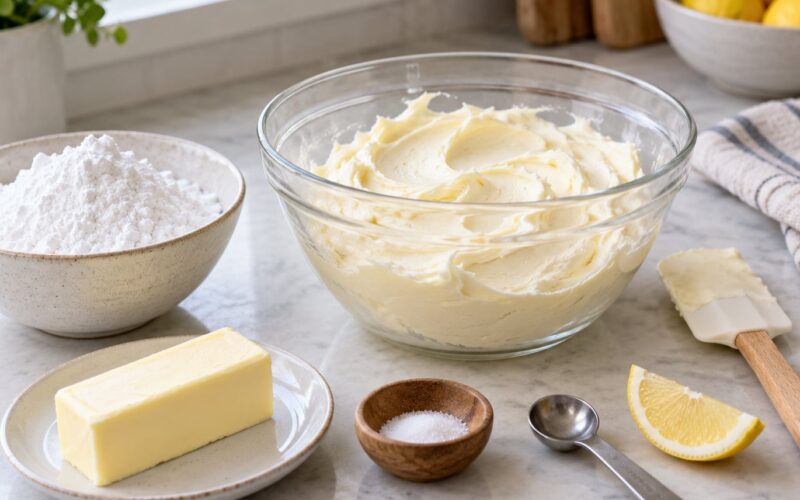
Put the cream cheese and the butter in the bowl of a hand mixer and beat on medium-high for 2 to 3 minutes, until there are no lumps and the mixture looks like thick, smooth cream. Scrape the bowl twice while you work, because the butter likes to hide against the sides.
Turn the mixer to low and add the confectioners’ sugar one cup at a time, mixing until each addition is fully absorbed before the next. Adding all three cups at once is what produces a frosting that is either gluey or grainy, because the sugar cannot distribute evenly before the fat is saturated.
Add the vanilla, the salt, and mix 30 seconds more. The frosting is done when a lifted beater leaves a soft peak that holds its shape for a few seconds before folding over on itself. That is the right consistency for a round-tip swirl.
If the frosting looks a little loose, the fix is a tablespoon of confectioners’ sugar at a time, mixing fully between additions. If it looks a little stiff, the fix is a teaspoon of heavy cream or whole milk at a time. Do not pour in a whole splash of liquid to save time; you cannot take liquid back out.
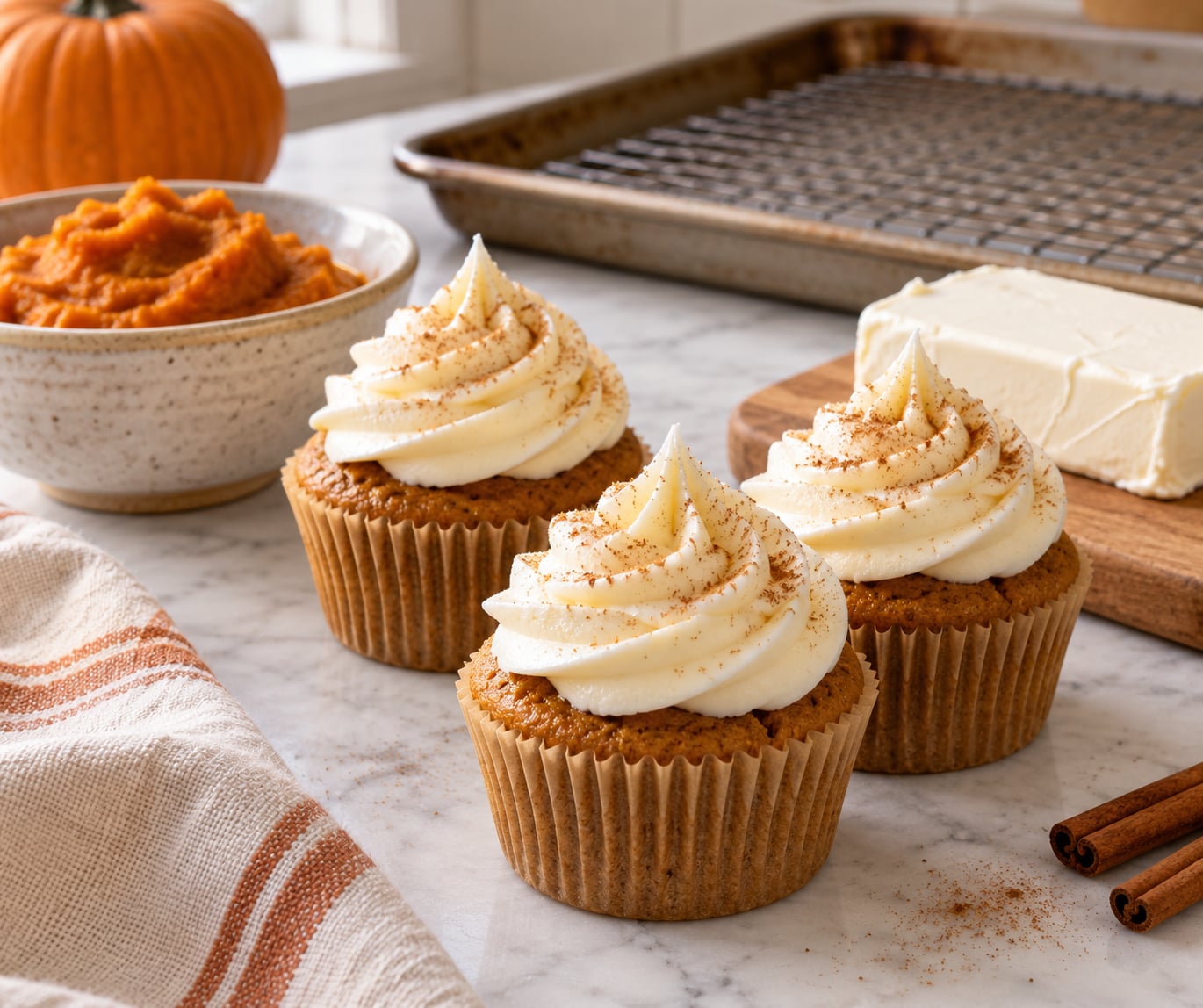
Scoop with a cookie scoop or spoon onto each cooled cupcake, then swirl with a large round tip for a bakery look. For a flatter, more rustic finish, just swirl the back of the spoon in a single motion.
Common Mistakes
Almost every disappointing pumpkin cupcake traces back to one of a handful of things. Find the row that matches what you are seeing and fix that line next time.
| What went wrong | Why it happened | How to fix it |
|---|---|---|
| Frosting is runny or weeping | Low-fat or spreadable tub cream cheese, or too much added liquid | Use full-fat brick cream cheese next time. To fix now, chill the frosting 20 minutes, then add confectioners’ sugar one tablespoon at a time. |
| Frosting is gluey and pulls off in strings | Sugar added too fast, or the butter was overbeaten before the sugar went in | Add a teaspoon of heavy cream and beat briefly to loosen, then chill before piping. |
| Cupcakes are dense or gummy in the middle | Overmixed batter, or milk added to a batter that already had watery pumpkin | Fold gently and stop at the first no-streak point. Leave out the milk entirely. |
| Centers sank | Underbaked, or the liners were filled past two-thirds full | Bake the full time even if the top looks done, and test with a toothpick in the center. |
| Tops cracked in a deep line | Oven too hot, or batter spread to the pan edge | Check your oven with a thermometer and drop the temperature to 325°F (163°C) for tall cupcakes. |
| Everything tastes too sweet | Sweet pie filling used instead of puree, or too much frosting | Use plain pumpkin puree and pipe a thinner layer on each cupcake. |
For storage, keep frosted cupcakes in the refrigerator, since cream cheese frosting is a perishable dairy product. They keep about 4 to 5 days that way, loosely covered so the frosting does not pick up refrigerator odors. Frosted cupcakes left out sit safely for roughly 2 hours before they should go back into the cold.
Unfrosted cupcakes freeze far better than frosted ones. Wrap them individually in plastic wrap, then in a freezer bag, and freeze up to 3 months. Thaw them in the fridge overnight, frost once fully thawed, and the frosting stays smooth.
Frequently Asked Questions
Can I use canned pumpkin instead of fresh pumpkin in these cupcakes?
Plain canned pumpkin puree is what this recipe is built on, and it is what I use almost every time. Fresh pumpkin has to be cooked and strained first, and it carries more water, so it thins the batter and makes the crumb gummy. One 15-ounce can is about 1 cup of puree, which is the amount called for here. Just check the label says puree, not pie filling.
How long do pumpkin cupcakes with cream cheese frosting stay fresh?
Because cream cheese frosting is perishable, frosted pumpkin cupcakes belong in the refrigerator. Stored in a loosely covered container, they stay good for about 4 to 5 days. At room temperature they are fine for roughly 2 hours before needing to be chilled. The unfrosted cakes keep longer, around 3 days covered, and freeze up to 3 months.
Can I freeze pumpkin cupcakes with cream cheese frosting?
You can, but the frosting goes slightly grainy after a thaw, so I freeze them plain instead. Wrap the cooled cupcakes individually in plastic wrap, then bag them, and freeze for up to 3 months. Thaw overnight in the refrigerator, then frost as if they were fresh. The crumb is actually better after freezing and thawing, since the pumpkin sets more firmly.
Why is my cream cheese frosting runny?
Low-fat cream cheese and the spreadable whipped kind both carry extra water, and that water is almost always the cause. Chilling and adding more sugar thickens it, but the durable fix is buying full-fat brick cream cheese. Also make sure you beat the cream cheese and butter smooth first, and add the confectioners’ sugar one cup at a time rather than all at once.
Can I make pumpkin cupcakes without eggs?
Yes, and they still rise, though the crumb comes out slightly more tender and a little less springy. For each egg, use 1 tablespoon of ground flaxseed mixed with 3 tablespoons of water, rest 10 minutes, then stir in. Aquafaba works too, at 3 tablespoons per egg, whipped to soft peaks. Keep the baking powder at 1 teaspoon and do not reduce the sugar.
How do I keep the cupcakes from tasting too sweet?
The usual culprits are sweetened pumpkin pie filling instead of plain puree, and piping a very thick layer of frosting. Use plain puree, keep brown sugar at 1/3 cup, and pipe roughly 2 tablespoons per cupcake. A small pinch of salt in the frosting sharpens the tang, and a squeeze of lemon juice in the cream cheese makes it taste noticeably less sugary.
Conclusion
Start by heating the oven to 350°F (177°C), lining the pan, and setting out your full-fat brick cream cheese so it has time to come to room temperature. Everything after that follows from two rules: fold the batter until the flour streaks are gone and no longer, and let the cupcakes cool completely before the frosting touches them.
Mix in about 15 minutes, portion two-thirds full, bake 18 to 22 minutes, cool 30, beat the frosting 5, and pipe. From that, you know how to make pumpkin cupcakes with cream cheese frosting that are moist at the center, tangy rather than sugary, and sturdy enough to survive the trip to a party in a cupcake carrier.