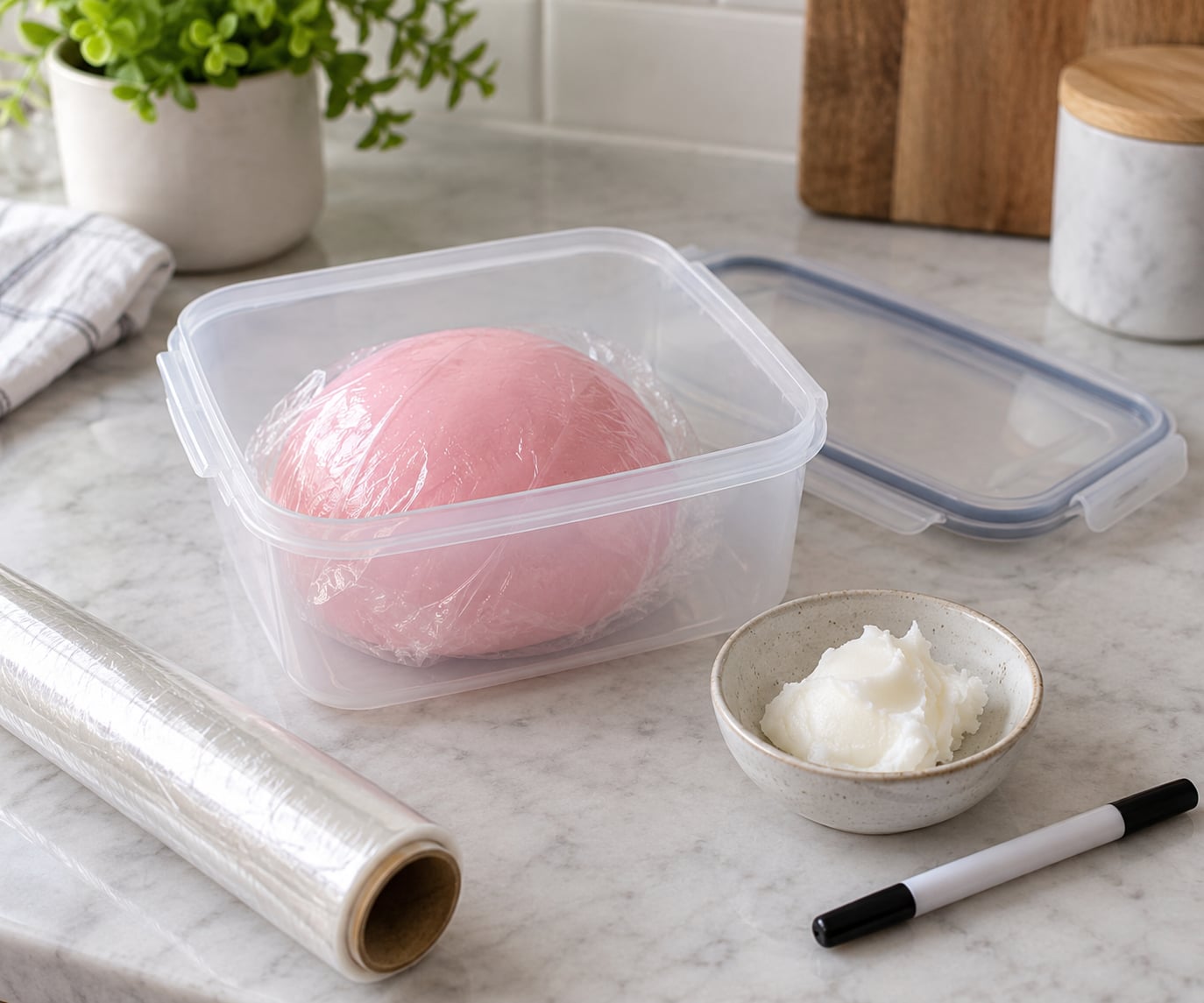
To store fondant so it does not dry out, press it into a smooth ball, wrap it tightly in plastic wrap with no air pockets, seal that inside an airtight container or zip-top bag, and keep it in a cool, dark, dry cupboard at room temperature. Loose fondant never belongs in the fridge.
The fridge rule is where most guides go wrong, because they say never refrigerate fondant without telling you what they mean. A wrapped, finished cake can go in the fridge for a day or two. A bag of unused fondant should not. Cold draws moisture out of sugar paste, and that moisture condenses on the surface when the fondant comes back to room temperature, which is where sticky, weeping, colour-bleeding fondant comes from.
Everything below assumes the same two jobs: keep air away from the surface, and keep heat and light away from the whole thing. Fondant is a sugar paste with enough moisture to stay pliable. Expose that surface to moving air and it firms up, then cracks, then tears instead of rolling smoothly.
Table of Contents
- What You Need
- What Makes Fondant Dry Out?
- How to Store Fondant So It Does Not Dry Out: Step by Step
- How to Store Fondant in Its Original Package
- How to Store Fondant in an Airtight Container
- How Long Can Fondant Stay Stored?
- Common Mistakes
- Storing fondant in the fridge
- Leaving it in a bowl or on a board
- Keeping scraps in small pieces
- Wrapping loosely and leaving air pockets
- Storing next to the oven or in a window
- Forgetting to label it
- Writing off rock-hard fondant too early
- Frequently Asked Questions
- Can I store fondant in the fridge?
- How long does a cake last when covered with fondant?
- How do you store leftover fondant icing?
- How do you make hard fondant soft again?
- Can you freeze fondant?
- Why is my fondant sweating or sticky after it was refrigerated?
- Start With the Container, Not the Fridge
What You Need
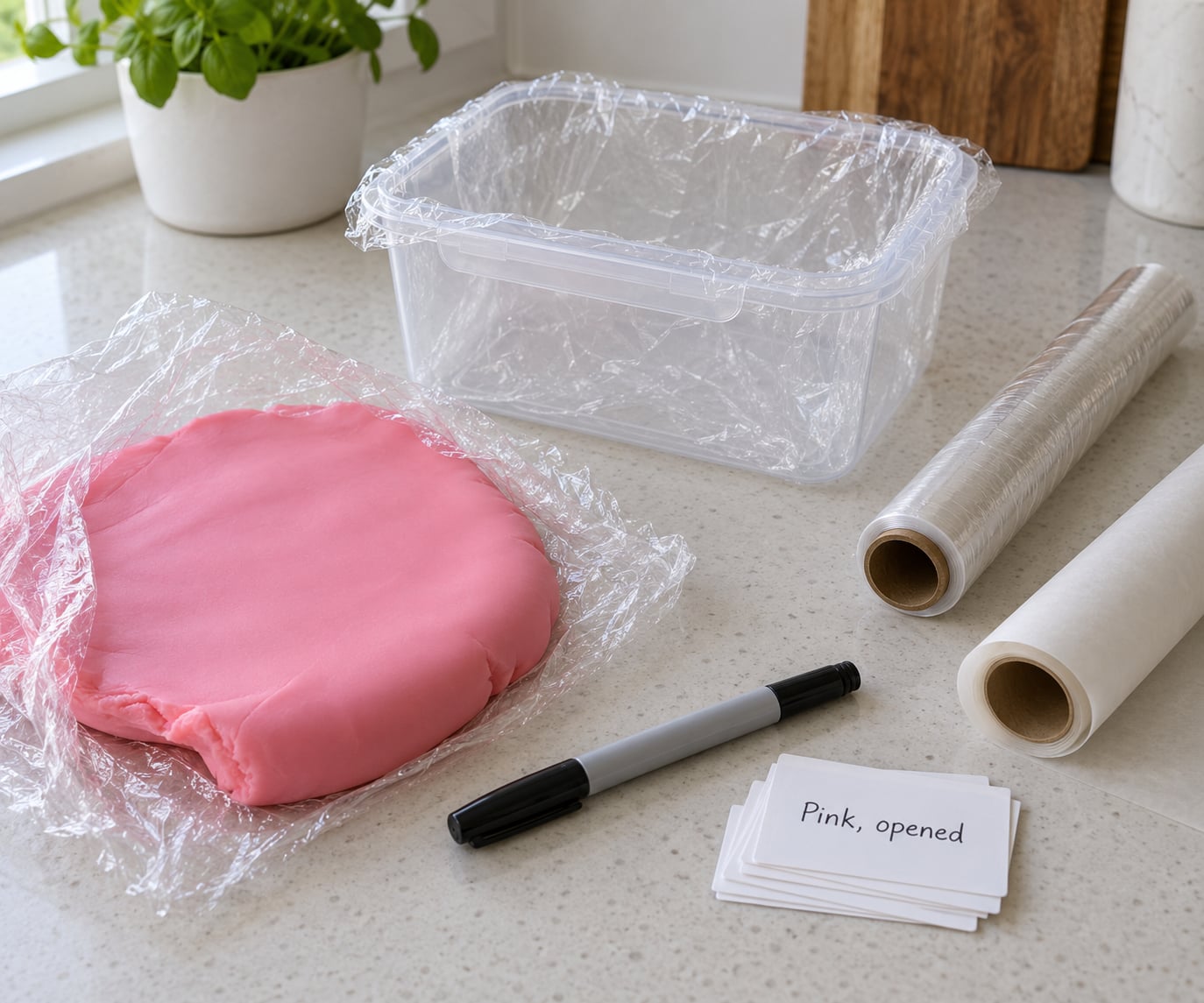
You do not need anything clever. Everything on this list is either blocking air or slowing down moisture loss, and cheap versions work exactly as well as expensive ones.
- Plastic wrap or cling film for the first barrier. If it stretches and clings without lifting at the corners, it is the right roll.
- A food-safe airtight container for the second barrier. Any rigid tub with a gasket seal does the job, and a square tub fits more shapes than a round one.
- Zip-top or freezer bags as a cheap alternative to a tub, or as an extra layer inside one.
- A pastry brush and a thumb of vegetable shortening to coat the fondant before wrapping, which stops a skin forming on the surface.
- A pastry board or flat baking tray for rolling scraps into one thick sheet, because small pieces dry out far faster than a single solid piece.
- Freezer paper or parchment between different colours so nothing touches something it can stain.
- A marker pen and masking tape for the date and the colour. Two balls of pale pink look identical three months later, and guessing wrong wastes both.
The whole kit fits in one drawer. I keep the tub, the wrap and the shortening together in the corner of the kitchen so the container never ends up on the counter while the fondant sits in it unwrapped for an afternoon.
What Makes Fondant Dry Out?
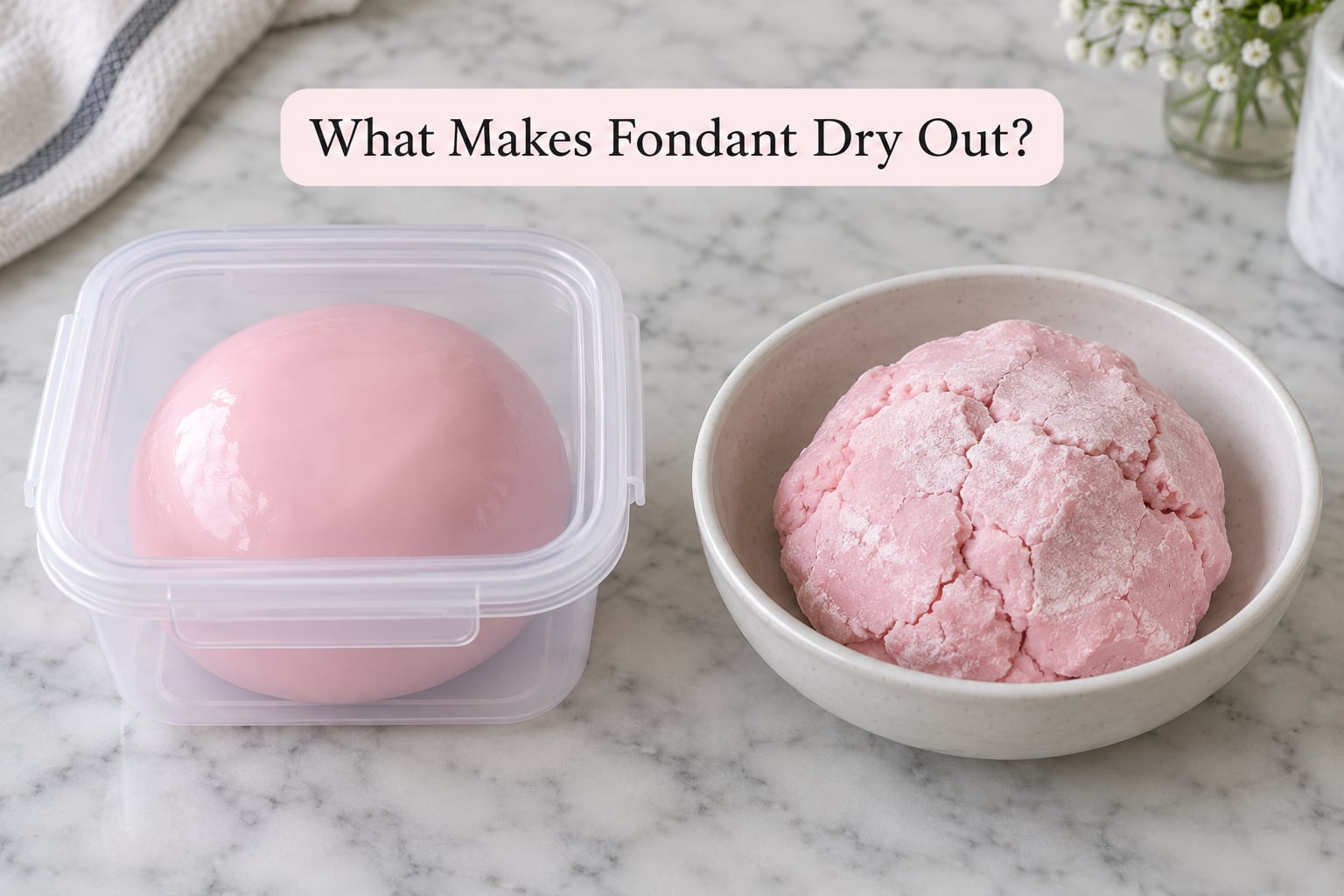
Air exposure is the obvious cause, and it is not the only one. These are the things that turn soft fondant into a cracked brick.
- Open surface area. Twenty small offcuts dry out in days. One rolled ball the size of your fist holds its moisture for months. This is the single biggest factor and the cheapest to fix.
- Heat and light. A cupboard above the kettle or next to the oven works twice as fast as one in a hallway. Direct sunlight also fades colour long before the texture changes, so a pale pink ball stored on a windowsill goes grey before it goes hard.
- The fridge. Cold air holds very little water. Fondant loses moisture to it, then collects condensation on the way back to room temperature. That is the sticky, weeping surface that sends people looking for a fix when the real problem was the storage.
- Repeated opening. Every time you dig a bit out of the tub, you let a fresh layer of air in. Decanting a measured amount into a separate small container is better than repeatedly dipping into the main one.
- Colours touching. Different colours stored together keep bleeding into each other. Marbled grey-and-pink fondant that nobody ordered is the usual result.
- Humid rooms. In a damp kitchen or a bathroom cupboard, fondant absorbs moisture from the air and goes tacky and sticky. Somewhere above 60% relative humidity is where sweating usually starts.
- Fondant that was never kneaded properly. Air bubbles trapped inside during the original kneading push moisture outward from the centre. The ball looks fine, then goes hard from the inside out a month later.
Notice that six of those seven are about the environment rather than the fondant. Storage is mostly about picking the right cupboard.
How to Store Fondant So It Does Not Dry Out: Step by Step
Five steps cover almost every situation with loose fondant, whether you have 200 grams of a commercial block or a bowl of coloured scraps.
- Make one solid piece. Gather every scrap and push them together into a single ball, then knead briefly until the surface is smooth with no visible seams. Roll it into a neat sphere, because a sphere has the least surface area for its volume. If the pieces are too stiff to combine, warm them in your hands first.
- Coat and wrap. Rub a thin film of vegetable shortening over the ball with your palm, then wrap it in plastic wrap. Press the wrap firmly against the fondant all the way around, especially at the poles, until it looks taut. Any pocket of trapped air becomes a dry spot later.
- Add a second barrier. Put the wrapped ball into an airtight container or a zip-top bag, then seal it completely. If you use a tub and a bag together, that is not excessive. Two barriers means one accidental gap does not ruin the contents.
- Store it cool, dark and dry. A pantry, a linen closet or a high kitchen cupboard all work. Skip anywhere near the oven, the dishwasher, a sunny window or a steamy corner, and skip the fridge for anything that is not a finished cake.
- Knead before you reuse it. When you are ready to decorate again, unwrap and knead for a minute or two until it is soft and stretchy. Fondant that has been sitting for a few weeks will need more kneading than fresh fondant, and it feels slightly tacky while you work it. That is normal.
You will know the wrapping worked when the fondant comes out of the container looking the same as it went in: same colour, still soft to the touch, no crust on the surface. If you find a dry skin or a hard ring, it was exposed for too long somewhere in the chain.
How to Store Fondant in Its Original Package
Commercial blocks in a sealed tub are the easy case, since the tub is already airtight. The moment you open it, treat the clock as started.
- Push the block back into the shape of the tub if it has slumped, so the lid seats properly instead of hovering over a dent.
- Press cling film directly onto the fondant surface so no air sits between the block and the film.
- Close the lid and run a layer of film around the seam for extra insurance.
- Store it in the tub at room temperature and check the date label on the side. Manufacturers print a best-before date, and that date beats anything written here.
For a factory-sealed block you have not opened, the unopened shelf life on the label is what you are working with. It will sit in a cool cupboard without any special handling at all.
How to Store Fondant in an Airtight Container
This is the method for fondant you have already worked with, and the container choice matters more than people expect. Shape beats tidiness every time.
- Ball it up or roll it flat. One solid ball for plain colours; a thick flat sheet about half a centimetre deep for scraps and offcuts, because a sheet dries at the edges first and the edges are the bits you want anyway.
- Wrap in plastic wrap. Get right into the corners of the tub so the film grips the base and sides. Leave no loose flap hanging over the rim.
- Separate colours. Put a sheet of parchment or freezer paper between each colour, and do not let a red ball touch a white one. Dark pigments stain on contact and the stain does not wash off.
- Decant small amounts. If you only need a little for one cake, move that into a separate small tub and keep the main container sealed in its cupboard.
- Label it. Date and colour on masking tape on the lid. Get it right once and you will thank yourself in three months.
When you unwrap, the fondant should lift out rather than stretch. If it clings and tears, it fused to the wrap while it sat, which means a thin film of vegetable shortening before wrapping next time will solve that permanently.
How Long Can Fondant Stay Stored?
These are realistic windows for properly wrapped fondant at room temperature. Unopened fondant lasts to the date printed on the tub, and that label takes priority over every number in the table below.
| What you are storing | Container | Where | How long |
|---|---|---|---|
| Unopened block, commercial tub | Original tub | Cool dry cupboard | To the printed best-before date |
| Opened block or tub | Plastic wrap inside a sealed tub | Cool dry cupboard | 2 to 3 months |
| Wrapped fondant ball | Airtight container or zip bag | Closet or pantry | 1 to 2 months |
| Rolled sheet or scraps | Between parchment, sealed | Cool dry cupboard | 3 to 6 weeks |
| Dried toppers and figures on a board | Box or tub, not touching | Dry room, room temperature | Several months to a year |
| Finished decorated cake | Cardboard cake box, sealed | Room temperature, cool and shaded | 3 to 5 days |
| Finished cake with perishable filling | Cake box or covered tray | Refrigerated | 1 to 2 days |
| Wrapped fondant, frozen | Double-wrapped, freezer bag | Freezer at minus 18C or colder | Up to 6 months |
| Decorated cake, frozen | Box wrapped in two layers of film | Freezer | Up to 3 months |
Two notes on that table. Finished fondant cakes are best kept at room temperature in a cool, air-conditioned room, and only refrigerated when the filling demands it. Cream cheese, custard, whipped cream and fresh fruit fillings are perishable, so those cakes go in the fridge and come back out within two hours of serving.
And when a cake does come out of the fridge, leave it sealed in the box at room temperature for two to four hours before touching it. Warm fondant is soft and fingerprints go straight into it.
Common Mistakes
Storing fondant in the fridge
Correct it by moving the container to a cupboard today. Any fondant that has been refrigerated goes tacky on the surface as it warms, so give it a proper knead before rolling, and expect to work a little shortening through it.
Leaving it in a bowl or on a board
A bowl with a plate on top is not airtight. Fondant needs contact with film or a sealed lid, and a rigid tub beats a soft bag for anything long-term because it cannot be punctured by a stray corner in a cupboard.
Keeping scraps in small pieces
Small pieces have a huge ratio of surface to volume, and they dry first. Roll them together into one thick sheet with a little shortening if they will not stick to each other. Batch your colours separately too, so one container is one colour.
Wrapping loosely and leaving air pockets
Air trapped under the film is the single most common cause of a hardened layer. Press the wrap on until the fondant shape shows through clearly and the film looks drum-tight.
Storing next to the oven or in a window
Heat speeds drying and sunlight fades colour. Move the container to an interior cupboard away from appliances. If your kitchen stays above 60% humidity in summer, a small dehumidifier or a sachet of silica gel in the cupboard helps more than anything else you can do to the fondant itself.
Forgetting to label it
Two pale colours, one tub, no clue. Colour fades slightly with age even in good storage, so a ball stored for months will be a slightly duller version of the one next to it. Label the colour and the date and put the older one in front.
Writing off rock-hard fondant too early
Dry fondant is usually recoverable rather than rubbish. Cut it into pieces, warm them for 10 seconds in the microwave, and knead with a little vegetable shortening, adding a few drops of water or glycerin if it stays crumbly. Work in small amounts and stop as soon as it is pliable; too much water makes it sticky and you will be back where you started. Modelling paste and gum paste store the same way but hold far longer once dry, so figures made from them usually need no reviving at all.
Frequently Asked Questions
Can I store fondant in the fridge?
Only as a finished cake, and only for a day or two. Unused fondant belongs in a cool cupboard: cold air holds little moisture, so the fondant dries out and then sweats condensation as it warms. If a decorated cake must be chilled, seal the box in two layers of film, refrigerate, and leave it sealed at room temperature for two to four hours before you touch the surface.
How long does a cake last when covered with fondant?
A plain fondant-covered cake keeps for three to five days at room temperature in a cool, air-conditioned room, stored under a cake dome or in a sealed box. If the filling is perishable, such as cream cheese, custard or fresh fruit, refrigerate it and eat it within one to two days. Bring the cake back to room temperature, still sealed, before serving.
How do you store leftover fondant icing?
Push every scrap into one ball, knead until smooth, then wrap it tightly in plastic wrap with no air pockets and seal it in an airtight container in a cool dark cupboard. Store each colour separately with parchment between them so colours do not bleed. Label the container with the colour and the date, and knead the fondant briefly before rolling it out again.
How do you make hard fondant soft again?
Cut it into pieces, microwave them for 10 seconds, and knead straight away with a little vegetable shortening. If it stays crumbly, add a few drops of water or glycerin at a time. Shortening makes it supple and water softens it, so add whichever the texture needs rather than both in full. Stop as soon as it rolls without cracking.
Can you freeze fondant?
Yes, as long as it is wrapped first. Wrap the fondant ball tightly in plastic wrap, seal it in a freezer bag, label it, and freeze at minus 18C or colder for up to six months. Thaw it sealed at room temperature for several hours so condensation forms on the bag rather than on the fondant. Unwrapped fondant goes frosty and crumbly in the freezer.
Why is my fondant sweating or sticky after it was refrigerated?
Condensation. Cold fondant draws in moisture from the fridge air and then collects water on its surface as it warms, leaving it tacky and possibly stained where colours ran. Let the container sit sealed at room temperature for two to four hours, then knead the fondant with a little vegetable shortening until it is smooth again. Next time, keep loose fondant in a cupboard.
Start With the Container, Not the Fridge
The next time you finish a decorating session, ball up every scrap before anything else, wrap it drum-tight, seal it in an airtight tub and put that tub in a dark cupboard away from the oven. That single habit fixes most of what people complain about. Everything else on this page is a detail on top of it.