If you want to know how to soften butter quickly for frosting, the microwave-plus-cubes method gets you there in about five minutes. Cut a cold stick into cubes, warm them in short five-second bursts, and stir between each burst. You are after butter that dents under a fingertip but still holds its shape.
The reason it matters is the creaming step. Buttercream gets its volume from air trapped in softened butter, and only butter around 65°F (18°C) can hold that air. Too cold and the frosting turns dense, too melted and it goes greasy and slides off the cake.
Here are the methods that work, fastest first, plus what to do when a stick gets past soft and into puddle.
Table of Contents
- What You Need
- Step-by-Step: How to Soften Butter Quickly for Frosting
- Cube and Gently Microwave the Butter
- Roll or Grate Cold Butter
- Use Room Temperature or Warm Water
- Check the Texture Before Frosting
- Common Mistakes
- Frequently Asked Questions
- Can I soften butter in the microwave for frosting?
- How long should I microwave butter to soften it?
- What temperature should butter be for frosting?
- Why did my butter turn oily when I softened it?
- Can I soften butter in warm water instead?
- Can I frost with slightly softened butter if it is not fully pliable?
What You Need
Almost nothing. For the fastest route you want one or two sticks of butter, a sharp knife, a cutting board, a fork, and a microwave-safe bowl.
Unsalted butter is the usual choice for frosting, though salted works fine if you adjust the salt in the recipe. Take it out of the fridge five minutes before you start so it is not rock solid when you cut it.
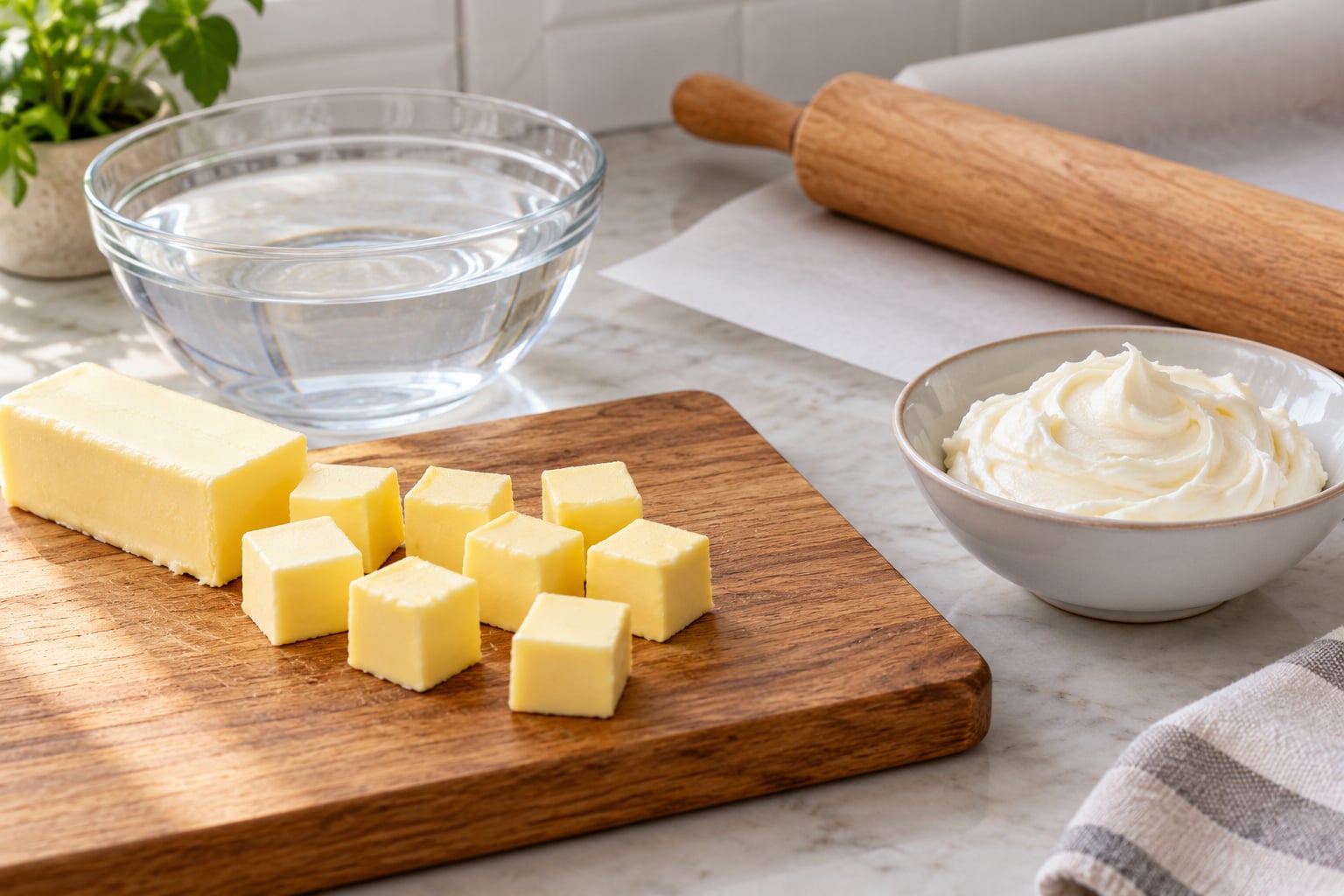
For the slower methods you may also want a rolling pin and a sheet of wax paper, a box grater with large holes, or a heatproof glass bowl you can warm with hot water. A kitchen thermometer makes guessing a non-issue if you have one lying around.
Have your sugar and other frosting ingredients measured and ready before you start softening. Butter softens while you are measuring, and you will lose that window otherwise.
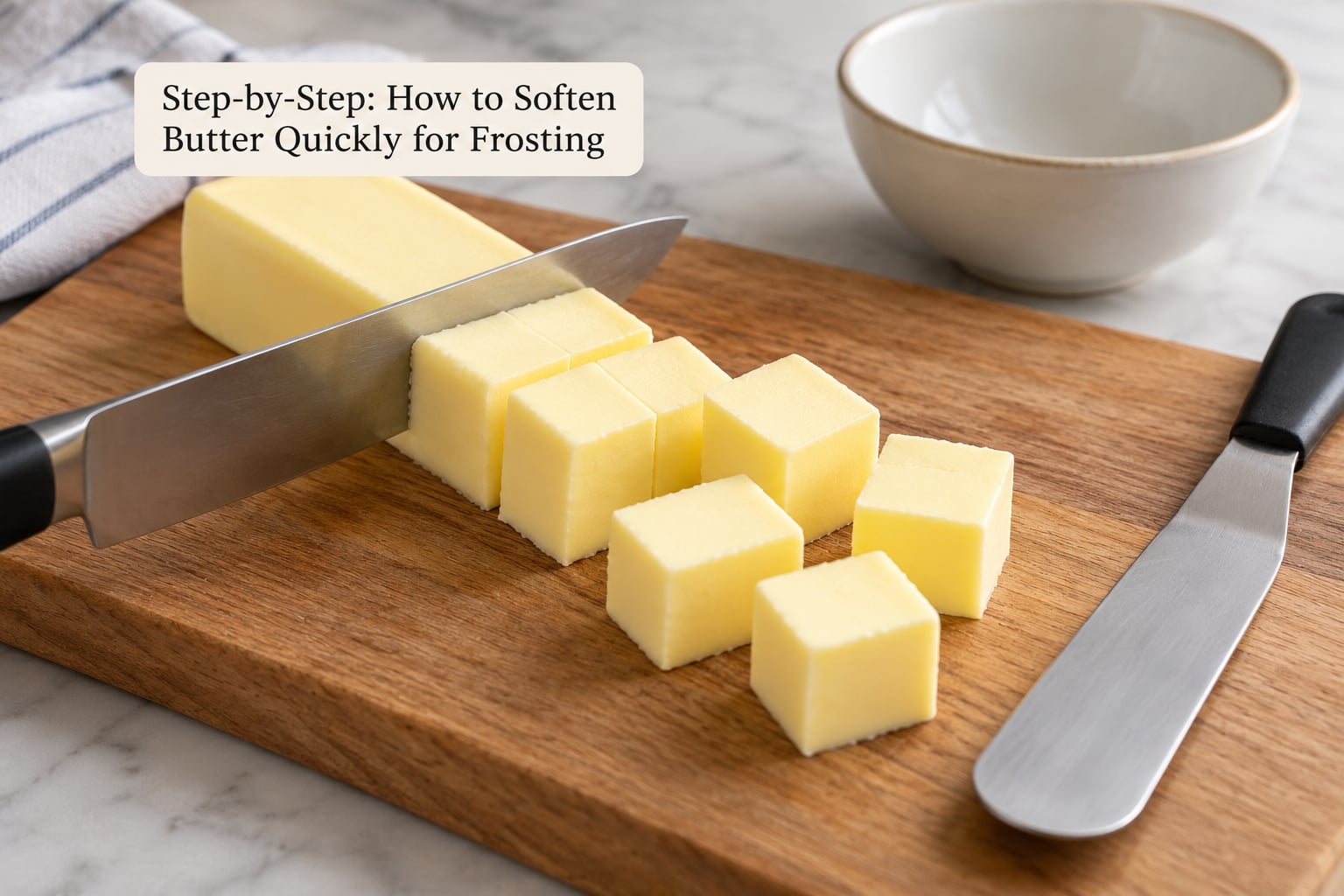
Step-by-Step: How to Soften Butter Quickly for Frosting
Cube and Gently Microwave the Butter
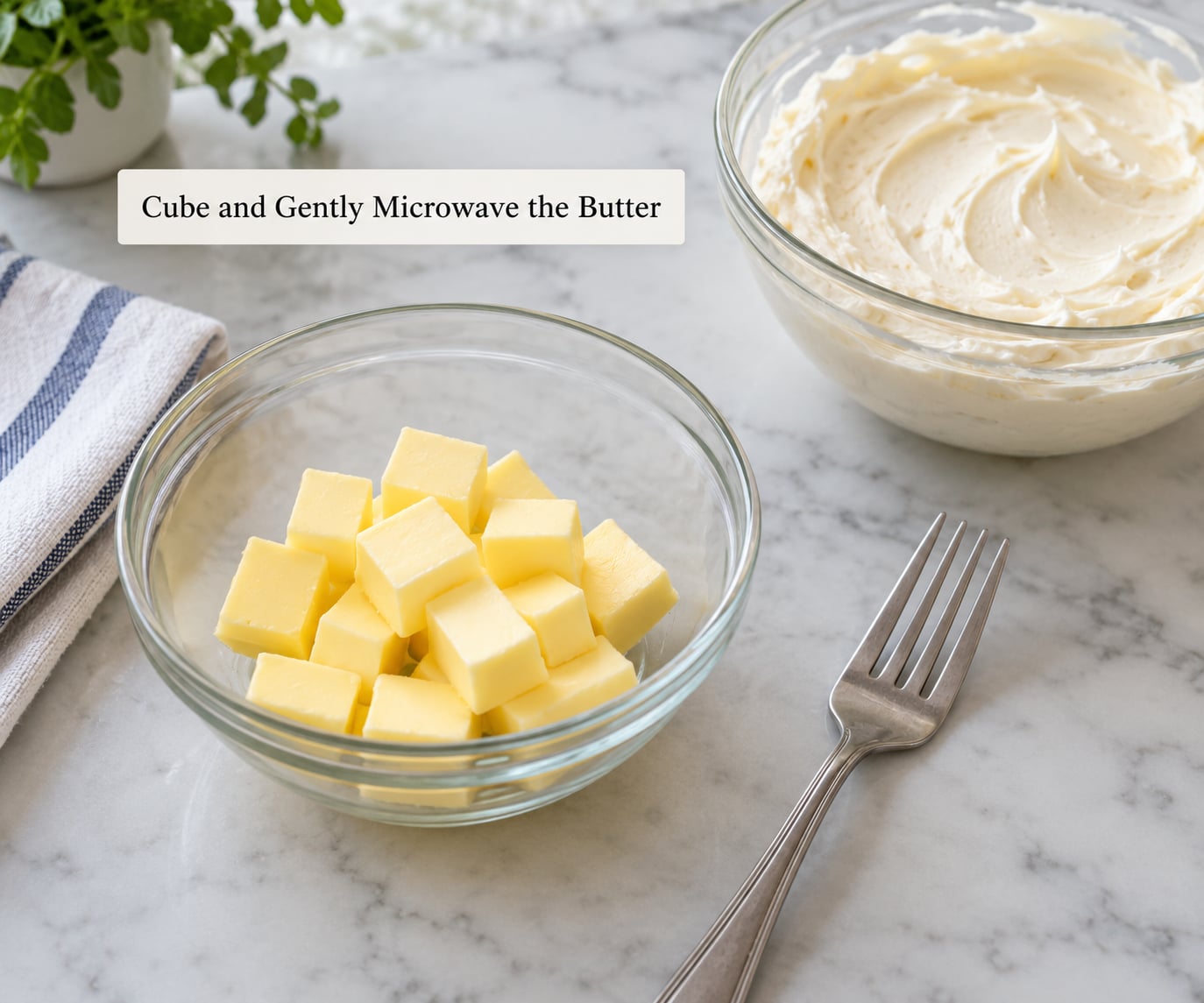
Cut the stick into 1-inch cubes and drop them into a microwave-safe bowl. Microwave on full power for five seconds, stir with a fork, then repeat.
Two or three bursts usually does it. Test between every round rather than guessing, because microwave output varies and a thinner cube softens twice as fast as the rest of the batch.
Cubing is the whole trick. More surface area means the outside and the center warm at close to the same rate, which is what stops you getting a ring of melted butter wrapped around a cold solid core.
If the butter is still firm after three bursts, give it another five seconds. If you see any glossy liquid pooling at the bottom of the bowl, stop and move on to the chill-and-re-whip fix below.
Roll or Grate Cold Butter
No microwave? Put the cold stick between two sheets of wax paper and roll it with a rolling pin until it is about 1/8 to 1/4 inch thick. That takes five minutes or less with a meat pounder.
The butter stays cold while you work, which is the trade-off: it cannot overheat, but it also softens slower than a warmed cube. Leave the flattened sheet on the counter and it is frosting-ready in ten minutes.
The other zero-heat option is a box grater with large holes. Shred a cold stick the way you would cheese, then gather the shreds into a bowl. Surface area does the rest, and cake decorators credit this one for working with butter straight from the fridge.
Shreds warm unevenly if you pile them deep, so spread them in a single layer. Five minutes of hands-off time is usually enough.
Use Room Temperature or Warm Water
The reliable version is leaving the butter on the counter. One to two hours in a normal kitchen, closer to three in a cold house at 50°F, since butter softens by absorbing room heat and there is not much of it in winter.
For a shortcut, fill a heatproof glass bowl or a wide-mouth jar with hot tap water, empty it, then set the butter inside face down against the warm glass. The radiant heat and a little steam do the work in 10 to 15 minutes.
Leave the butter in the water for 30 to 45 seconds at most, then drain and dry it completely before use. Any water left on the fat keeps frosting from emulsifying and leaves it with a slick, broken texture.
Warming the container and then pouring the water out is safer than holding butter under the tap, and it gives you the same gentle heat without the risk of a splash.
Check the Texture Before Frosting
Press a fingertip into the stick. You want a clear dent that stays put, and the butter should bend without cracking when you press it with your thumb.
It should still feel cool to the touch. Softened butter that feels warm is already past the point, and that gap between 65°F and 70°F is where frosting starts going greasy.
If the dent springs straight back, you need more time or more surface area. If the butter slumps or leaves butter on your finger, it is melted, and no amount of mixing will bring the air back.
Common Mistakes
The most common mistake is heating the butter directly for too long in one go. Twenty seconds on full power melts the edges long before the middle turns pliable, and the result is unusable for creaming. Short bursts with a stir between them are the fix.
Cutting cold butter with a knife you just rinsed under hot water has the same effect. The warm blade smears instead of slicing, so the pieces end up uneven and still too firm in places. Dry knife, cold board.
Skipping the drying step after a water bath is the quiet killer of good frosting. Butterfat and water do not emulsify, so a wet stick gives you frosting that separates in the bowl and weeps on the cake.
Over-softened butter is recoverable. Chill the stick for 15 to 20 minutes until it firms up to a workable consistency, then beat it on its own for a minute before adding sugar. You will not get back the air from the melted stage, but you will save the batch.
Under-softened butter has its own fix. Rather than fighting the mixer, grate it or cube it and give it another short burst, then re-test. Beating butter that is too hard can strain most home mixers, and it is not worth the risk for a five-minute fix.
People also mix up soft and melted. Soft is cool, pliable, and dentable. Melted is liquid, glossy, and pools in the bowl. If in doubt, put the stick back in the fridge for 15 minutes.
If you bake in a cold kitchen, treat the counter method as a two-hour job and lean on the microwave or warm glass instead. Bakers in 10-12°C rooms report the standard wait stretching well past two hours, which is exactly why the faster methods are worth learning.
Frequently Asked Questions
Can I soften butter in the microwave for frosting?
Yes, if you use short bursts and never a single long one. Cut the stick into 1-inch cubes first so the outside and center heat at a similar rate, then microwave five seconds, stir with a fork, and repeat. Two or three bursts gets you to roughly 65F (18C). Warming the butter alone on high for twenty seconds gives you melted edges and a cold core that will not cream.
How long should I microwave butter to soften it?
Five seconds per burst, three bursts for a cubed stick, is the usual answer. Test between rounds instead of trusting the clock, since microwave power and cube size both change the result. In a high-watt machine you may only need two bursts. If the butter slumps or leaves a glossy puddle in the bowl, it has gone too far and needs chilling.
What temperature should butter be for frosting?
Around 65F (18C) is the target for buttercream, and up to about 70F (21C) for softer American-style frosting. Between 65 and 70 the butter dents under a fingertip and bends without cracking while still feeling cool. Above roughly 98.6F the butter is fully melted and the fat can no longer trap the air that gives frosting its volume.
Why did my butter turn oily when I softened it?
Oily frosting almost always means the butter went too far, or water got into the fat. Melted butter cannot hold air, so the sugar has nothing to cling to and the mixture turns slick. Fix it by chilling the butter for 15 to 20 minutes, beating it alone for a minute to re-aerate it, then adding the sugar slowly with the mixer on low.
Can I soften butter in warm water instead?
A warm water bath works and takes about 30 to 45 seconds, but keep it short and dry the butter thoroughly afterward. Any water left on the fat stops the butter and sugar from emulsifying, which gives you a broken, greasy frosting. Warming a heatproof bowl with hot water and setting the butter in the dry vessel gives you gentler heat with less chance of a splash.
Can I frost with slightly softened butter if it is not fully pliable?
You can, but thin or grated butter works far better than a cold stick. If the butter dents but does not bend, cube or grate it and warm it briefly, or it will overwork your mixer and leave you with a dense, heavy frosting. Frosting made with butter that is merely dented rather than pliable is still usable, just less voluminous.
Start with cubes and three five-second bursts, stirring each time, and you will have frosting-ready butter before your sugar is measured. That single habit solves the problem that sends most people searching for how to soften butter quickly for frosting in the first place.