A “may contain nuts” warning is a voluntary precautionary allergen label. It tells you the food may have come into contact with peanuts or tree nuts during manufacturing, and it does not mean nuts are an ingredient. If you are learning how to read labels for may contain nuts warnings, the key is to check this line every single time, because formulas and equipment change without notice.
This guide is educational. It cannot tell you whether a specific product is safe for you, because tolerance thresholds and risk decisions belong to the person managing the allergy and their clinician.
Table of Contents
- What Does a ‘May Contain Nuts’ Warning Mean?
- The short answer to “can I eat it?”
- How to Read Labels for May Contain Nuts Warnings
- Where the warning hides on the package
- The questions worth asking the manufacturer
- What Is the Difference Between ‘Contains Nuts’ and ‘May Contain Nuts’?
- What counts as a nut on the label
- Names that hide nuts in an ingredient list
- Which Nut Warnings Should People with Nut Allergies Avoid?
- How Can Bakers Reduce Cross-Contact Risks at Home?
- Separate first, bake second
- Watch the sneaky ingredients
- Label what you hand to other people
- Frequently Asked Questions
- Can I eat something that says may contain nuts?
- Is may contain nuts safe for peanut allergy?
- Is a peanut allergy and a tree nut allergy the same thing?
- What allergens belong to the tree nut category?
- Where can I find allergens on a food label?
- Why do so many products say may contain nuts when no nuts are listed?
- Conclusion
What Does a ‘May Contain Nuts’ Warning Mean?
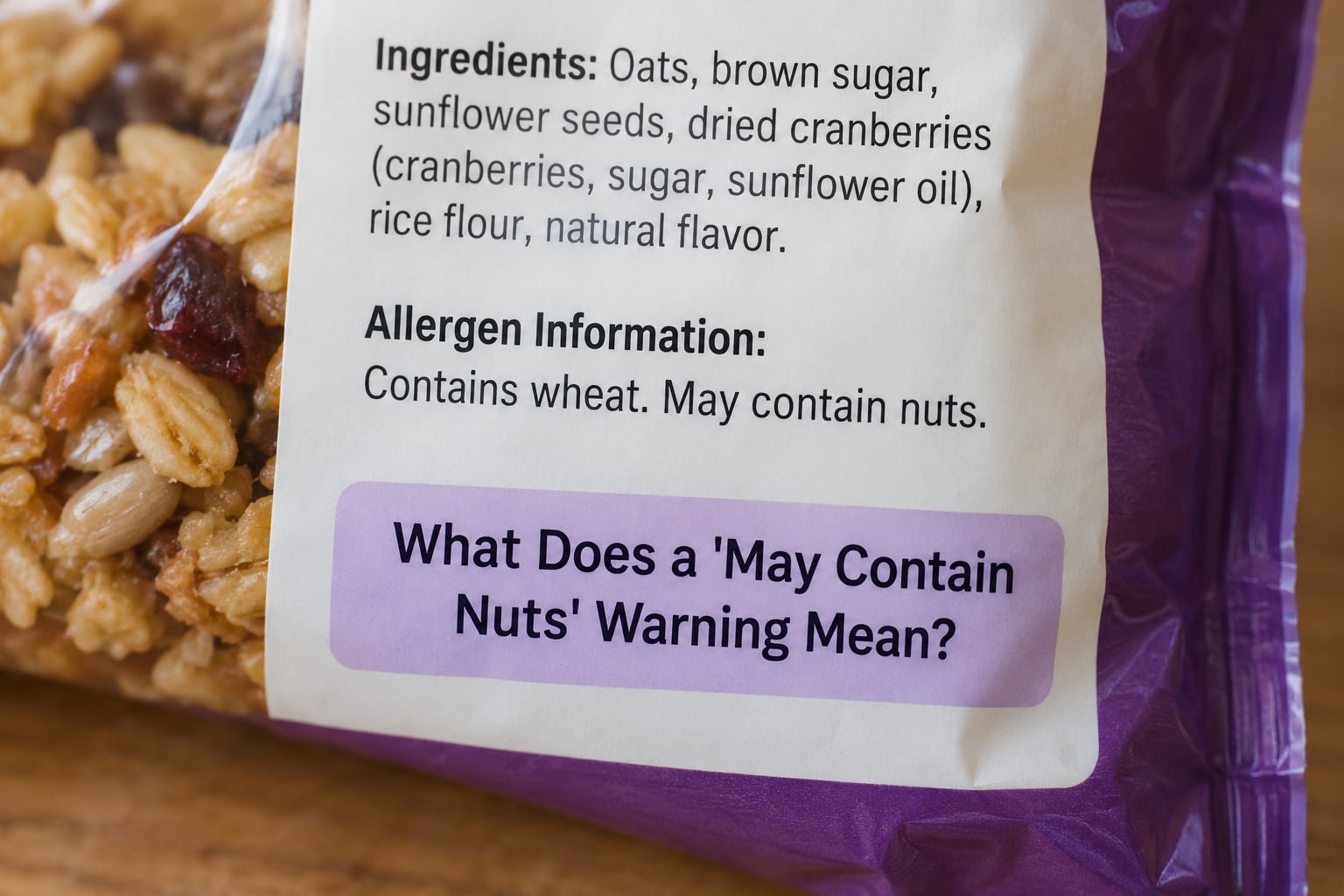
A “may contain nuts” warning is a voluntary statement, and the FDA does not require a manufacturer to print it. The company adds it because the food is made in a plant or on equipment that also handles nuts, so cross-contact is possible.
Cross-contact is the transfer of a food allergen from one food, surface, or piece of equipment to another. In a bakery or snack plant, that usually means a nut paste running on the same mixer, a conveyor belt shared between product runs, or a packaging line used for several items.
Read it as a statement about the process, not about the recipe. The warning can appear even when the ingredient list contains no nut in any form.
The short answer to “can I eat it?”
Only you and your allergist can make that call. The practical rule most allergy households apply is to avoid anything with a vague nut warning unless a clinician has said otherwise for your specific allergy. Nobody can label a precautionary warning definitively safe, because the label itself says the manufacturer cannot rule contact out.
How to Read Labels for May Contain Nuts Warnings
- Find the ingredient list first. If peanuts or a tree nut appear as an ingredient, the product is a direct nut product, not a cross-contact question.
- Read the ingredient list twice. Nut derivatives hide under names like marzipan, praline, almond extract, nut oil and natural flavorings.
- Look for the Contains statement, usually right under or near the ingredient list. That line names allergens that are actual ingredients and is required by law.
- Scan the whole package for a precautionary statement. It can sit at the end of the ingredient list, in the preparation section, or in a boxed note near the barcode.
- Note the exact wording, not just the presence of a warning. “May contain” and “processed on shared equipment” carry different levels of information.
- Check whether the product you bought last time carried the same wording. A new or changed line can signal a recipe or equipment change.
- If the wording is unclear or the nut is unnamed, call the manufacturer’s customer service number before serving it to anyone.
Where the warning hides on the package
The precautionary statement does not have a fixed spot. Check the end of the ingredient panel, the cooking or preparation instructions, the front-of-pack callout box, and the fine print near the barcode.
Bulk and bakery-counter goods are the worst case. Scoops are shared between products and the printed label often covers a whole tray rather than the scoop you watched being used.
The questions worth asking the manufacturer
- Are peanut and tree nut products run on the same equipment as this product?
- Is the equipment cleaned between allergen runs, and does the plant run a documented changeover?
- Do you run a dedicated peanut-free or nut-free production line?
- Has the recipe or the packaging supplier changed in the past year?
What Is the Difference Between ‘Contains Nuts’ and ‘May Contain Nuts’?
“Contains” lists an allergen that is a deliberate ingredient. “May contain” flags possible cross-contact from equipment, a production line, or a facility. The first is legally required disclosure, the second is a voluntary safety measure the manufacturer chose to print.
The Food Allergen Labeling and Consumer Protection Act of 2004 (FALCPA) is the US law that forces ingredient-level disclosure of the major food allergens, and the FASTER Act of 2021 added sesame, bringing the US list to nine. Nothing in either act sets a legal limit for cross-contact amounts or requires a “may contain” line.
| Phrase on the pack | What it literally means | What most people do |
|---|---|---|
| Contains: Peanuts, Almonds | Nuts are ingredients of this product | Unsafe for anyone allergic to those nuts, full stop |
| May contain nuts | Cross-contact is possible somewhere in the process | Allergic people skip it unless an allergist has advised otherwise |
| May contain traces of nuts | The company expects very small amounts may carry over | Treated the same as “may contain nuts” by most households |
| May be present | Same idea, different wording | Treated the same |
| Processed on shared equipment with nuts | The same machine handles nut products | The wording most people read as the most serious cross-contact case |
| Made in a facility that also processes nuts | Same building, not necessarily the same line | Usually accepted only with an allergist’s advice |
| No warning at all | Nothing is claimed about cross-contact | Not proof of safety; the statement is optional |
That last row surprises people. Because the statement is voluntary, a product with no warning is not automatically safer than one with a warning. Read every label on its own terms.
What counts as a nut on the label
Peanuts and tree nuts are separate regulated allergens in the US, even though peanut is a legume and grows underground. Tree nuts on the US list are almond, cashew, walnut, pecan, pistachio, hazelnut, macadamia, brazil nut, chestnut and shea nut.
So a “may contain nuts” warning can mean peanuts, tree nuts, or both, and the label usually does not say which. If you are peanut-allergic but not tree-nut-allergic, that vague line still cannot clear the product for you.
Names that hide nuts in an ingredient list
Marzipan and praline are almond-based. Almond extract, hazelnut flavoring, praline paste and marzipan paste all read like ordinary ingredients. Natural flavorings and spices are also a blind spot on a label, and this is the single failure mode behind most mystery reactions described in allergy forums.
Highly refined peanut and tree nut oils are the one exemption: a highly refined oil is exempt from allergen labeling, while a cold-pressed or expeller-pressed version still has to be declared. That distinction matters when you see peanut oil listed with no warning.
Which Nut Warnings Should People with Nut Allergies Avoid?
Anyone with a diagnosed peanut or tree nut allergy should treat a vague nut warning as something to avoid unless their allergist has given them different instructions for that specific product and warning wording. The people most often advised to avoid all of it are those with a history of reactions to trace exposure, and those managing a child with a severe or newly diagnosed allergy.
That said, your tolerance is not a general fact about nut allergies. Reactions range widely, and published research on how people actually manage risk, including the peer-reviewed paper “Beyond Labelling: What Strategies Do Nut Allergic Individuals Use to Manage their Food Allergies?” by Barnett and colleagues, makes the point that labelling is only one tool people use.
Two practical notes. First, a product carrying a nut-free or allergy-friendly claim alongside a shared-facility warning is not contradictory, though it can look that way on the shelf. The free-from claim describes the recipe, the warning describes the plant. Second, if a reaction happens despite a checked label, seek emergency care for any sign of anaphylaxis and report the product, because tolerance thresholds shift over time.
Talk to a board-certified allergist about your own avoidance level. Individual advice from a clinician beats any general guide, including this one.
How Can Bakers Reduce Cross-Contact Risks at Home?
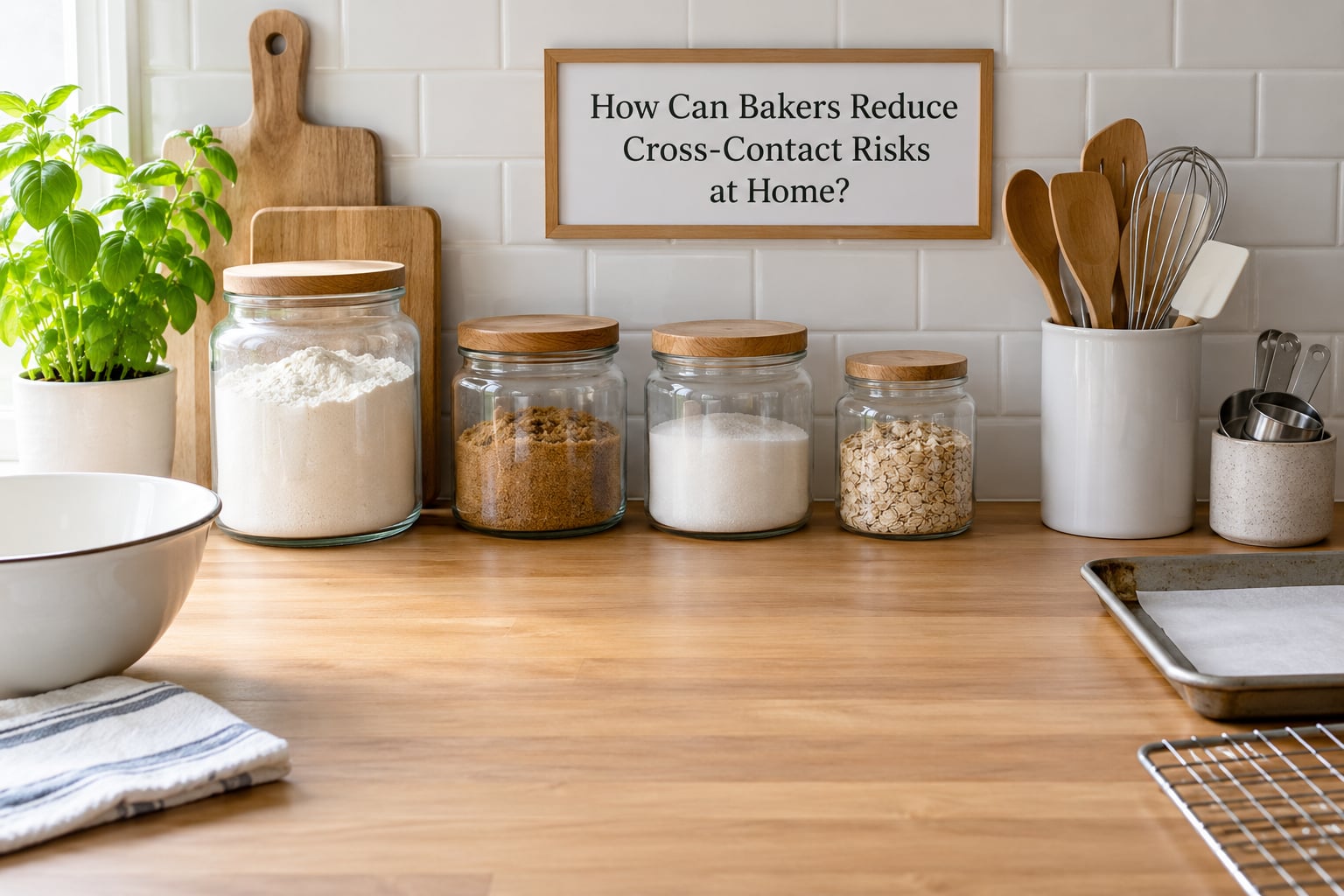
Home baking is where cross-contact quietly happens, because nobody runs a cleaning schedule. A shared scoop between peanut butter and icing is the classic version, and it is the one most households never think about twice.
Separate first, bake second
Give the nut-free work its own scoop, its own spatula set and its own measuring cups. If your household mixes nut and nut-free bakes in the same session, run the nut-free bake first, before anything else is opened.
Keep flour, cocoa and confectioners sugar in dedicated containers with their own scoops rather than scooping straight from a shared bag. Store nuts on a high shelf or in a separate cupboard, and use a nut-free zone on the counter for open nut butter.
Watch the sneaky ingredients
Sprinkles, chocolate chips and drizzle coatings arrive from manufacturers with their own shared-equipment warnings, and they arrive into a cake already on the bench. Read the bakery-supply labels the way you read the grocery ones.
Shared equipment shows up in a toaster rack, a stand mixer bowl, a sieve dusted with flour that also went through nut recipes, a bench scraper, and a cooling rack. Wash and dry any of those before a nut-free bake, not just wipe them.
Label what you hand to other people
If you bake for a school, a market stall or a party, write the ingredients and any shared-equipment caveat on the label. Say plainly that the kitchen also handles nuts if it does. A label that overstates the risk is far better than one that hides it.
Also tell people what you cannot promise. You can control your own bench, but you cannot control what a donated ingredient or a supplier changed this month.
Frequently Asked Questions
Can I eat something that says may contain nuts?
Only if your allergist has told you that this specific type of warning is acceptable for your allergy. The warning means cross-contact is possible, not that it happened, so nobody can call the product safe or unsafe on your behalf. Most allergy households avoid vague warnings as a standing rule, and reactions to trace exposure vary widely between people. Confirm your own avoidance level with a board-certified allergist.
Is may contain nuts safe for peanut allergy?
Not as a general answer, because the wording does not say which nut. It can refer to peanuts, tree nuts, or both, and peanut is a separate regulated allergen from tree nuts. If you react to peanuts, a vague nut warning is a reason to skip the product unless your clinician has advised otherwise for that specific food and that specific wording.
Is a peanut allergy and a tree nut allergy the same thing?
No, they are different allergies even though both are treated as nut allergies on packaging. Peanut is a legume that grows underground, not a tree nut, and the FDA lists them separately among the nine major food allergens. Some people are allergic to both, and many are allergic to only one. Ask your allergist which categories you need to avoid before assuming a nut-free product suits you.
What allergens belong to the tree nut category?
The US list covers almond, cashew, walnut, pecan, pistachio, hazelnut, macadamia, brazil nut, chestnut and shea nut. Peanuts are not on that list, even though they sit next to tree nuts on most packaging. If a warning says tree nuts only, it may still not tell you whether peanut is handled in the same plant, so read the full statement rather than the nut name alone.
Where can I find allergens on a food label?
Start with the ingredient list, then look for the Contains statement immediately after it. Both are required disclosure. After that, scan the end of the ingredient panel, the preparation instructions, any callout box on the front of the pack, and the fine print near the barcode, because a precautionary may contain line can sit in any of those places.
Why do so many products say may contain nuts when no nuts are listed?
Because the warning describes the plant, not the recipe. Nut products are made in the same facility or on the same equipment, and the manufacturer prints a voluntary precaution because traces cannot be ruled out. Because the statement is optional, it is also printed over-broadly on many products. That is why a missing warning does not prove a product is free from cross-contact.
Conclusion
Start with the ingredient list and the Contains statement on every pack, then read the precautionary wording exactly as printed rather than paraphrasing it in your head. Once you know whether you need strict avoidance of any cross-contact warning, the rest is a simple rule: match the label to your own required level, and ask the manufacturer when the wording is vague.