Most home decorators charge 24 to 48 dollars for a dozen standard decorated cookies in 2026, and 42 to 54 dollars for a dozen of specialty or gluten-free ones. The dependable way to price custom cookies by the dozen is to cost one full dozen, add your decorating time, packaging and overhead, then apply a markup of three to four times.
That last part is where most home bakers get stuck. They know the flour and the butter cost something, and they have a vague idea that decorated cookies should sell for more than grocery store cookies, but there is no number in between. So they pick a round figure, win the first few orders, and discover a year later that the work never paid for itself.
This guide walks through the whole method: what to gather, how to build the cost of one dozen, how to price your own hours, how to layer in packaging and overhead, and how to adjust for a five-design wedding order versus a dozen drop cookies. Everything is a set of arithmetic you can run in a notebook.
Table of Contents
- What You Need
- Step-by-Step: How to Price Custom Cookies by the Dozen
- Choose the cost basis for one dozen
- Add labor and time
- Cover packaging and overhead
- Add a profit margin
- Set minimum orders and customization fees
- Check the final price before quoting
- Common Mistakes
- Frequently Asked Questions
- How much should I charge for 12 custom cookies?
- How do I calculate the cost per cookie?
- How much should I charge per decorated sugar cookie?
- Should I price cookies by the dozen or by the design?
- What is a reasonable minimum order for custom cookies?
- How do I raise my prices without losing customers?
- Conclusion
What You Need
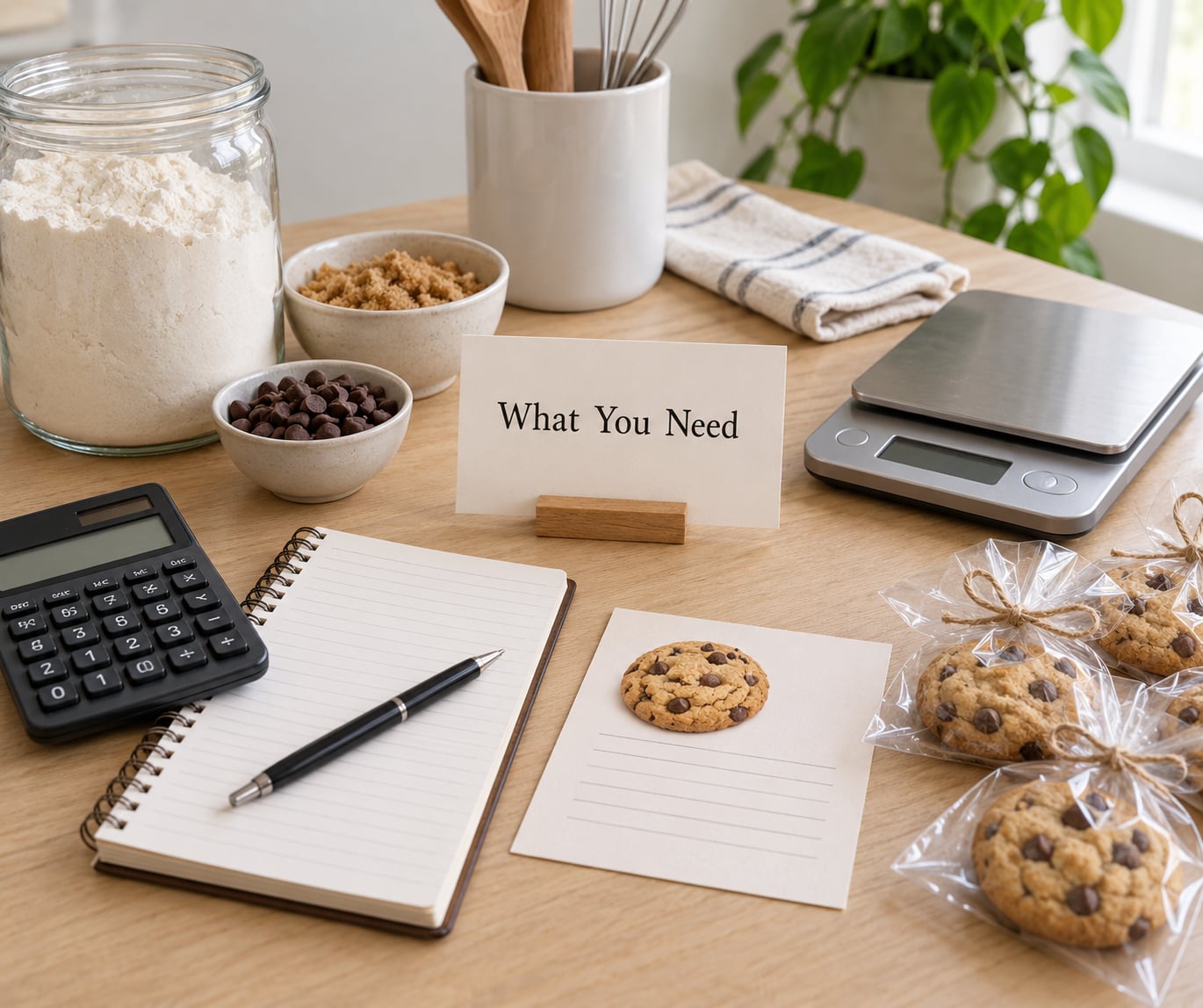
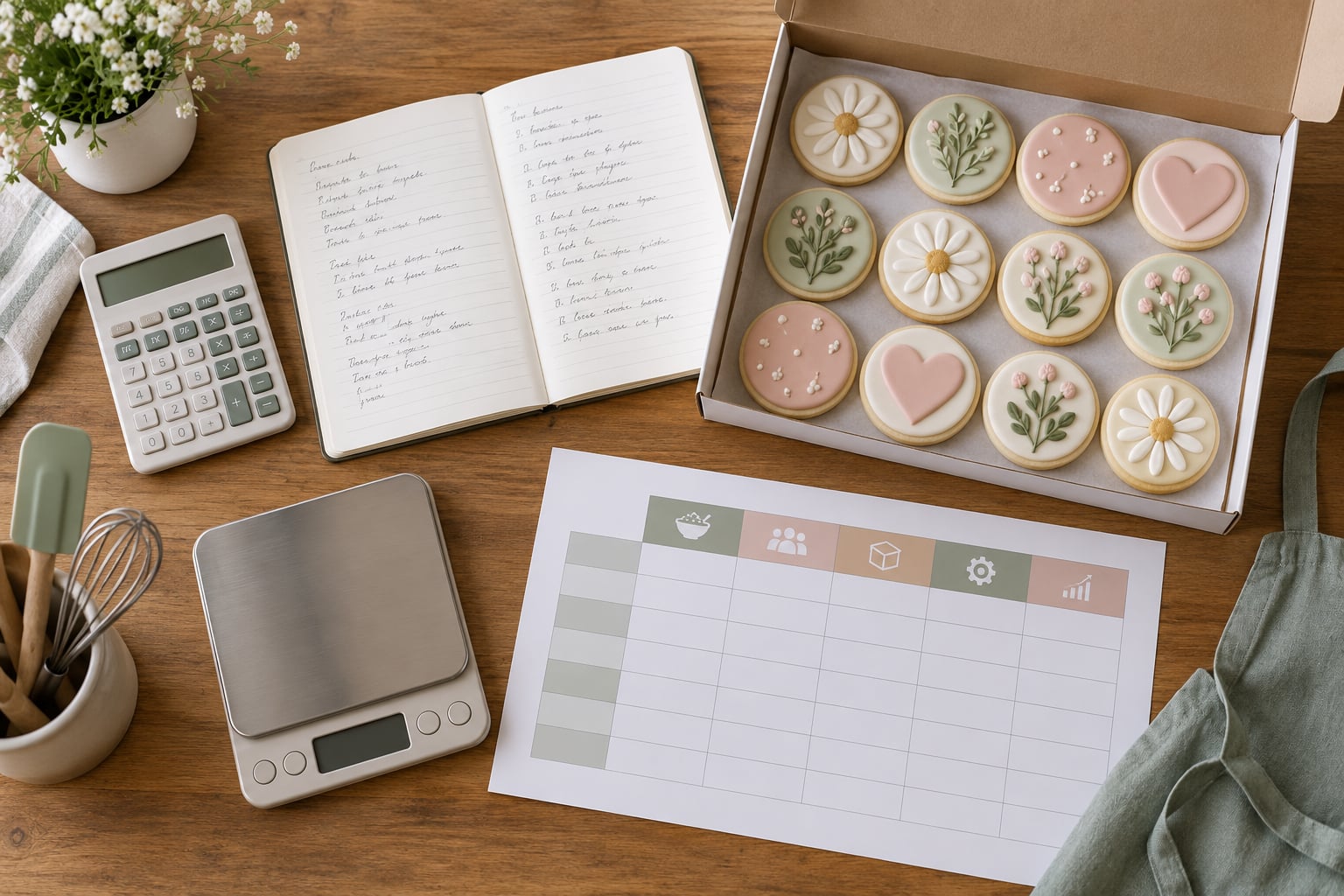
Before you do any math, gather six things. Miss one and your final price is a guess wearing a spreadsheet’s clothes.
- Your ingredient receipts. The number on the bag is what you need, not the number in the recipe. Keep the current package price for flour, butter, sugar, powdered sugar, eggs, vanilla, food coloring and any edible materials.
- A tested batch yield. Bake the recipe once and count. Most sugar cookie dough yields 20 to 26 medium cookies depending on size, and guessing low is the fastest way to lose margin.
- Packaging costs. The box or bag, the liner or cellophane, the sticker or label, the ribbon, the tissue. Add the shipping materials if the order ships.
- A time log. For one order, write down mixing, baking, decorating, drying, cleanup, packing and every email or message you send about it.
- An overhead list. Registration or cottage food fees, insurance, utilities, the share of your kitchen you use for baking, and a small monthly allowance for tools that wear out.
- The order details. How many cookies, how many different designs, the size, any dietary restriction, the date needed, and whether it is pickup or delivery.
One optional item pays for itself: a one-page cost sheet you keep in your phone. Fill it in once per recipe and update it when butter prices move, which they do.
Step-by-Step: How to Price Custom Cookies by the Dozen
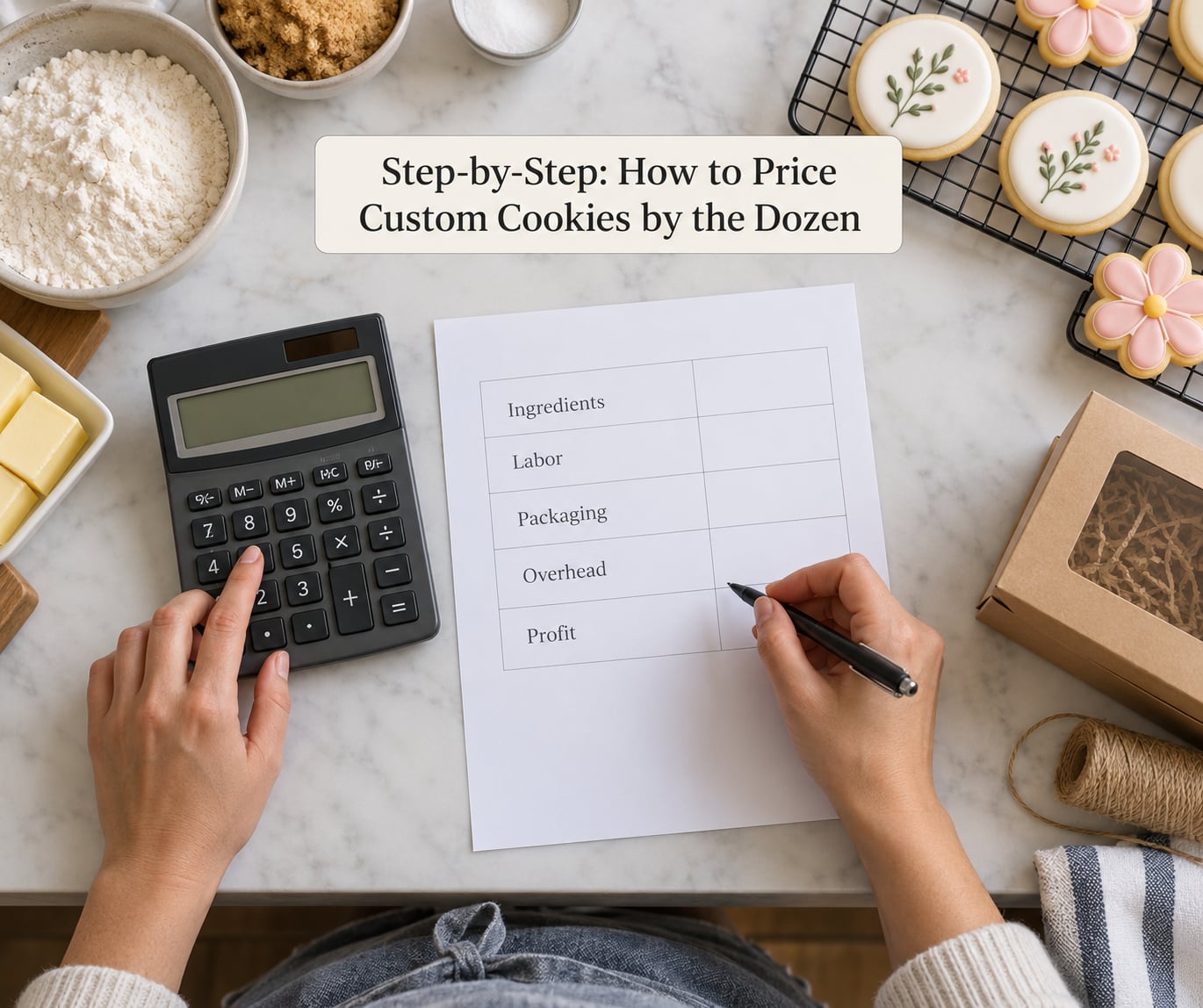
Choose the cost basis for one dozen
Cost per batch, then divide by yield, then multiply by twelve. Convert each ingredient to a cost per gram using the package price and the package weight, because a 1.36 kg bag of flour and a 907 g bag hold the same flour at different per-gram prices.
Here is a filled-in example for a standard medium sugar cookie with royal icing, one batch yielding 24 cookies:
| Ingredient | Amount used | Package price (USD) | Cost per batch (USD) |
|---|---|---|---|
| All-purpose flour | 512 g | 1.29 per 1.36 kg | 0.49 |
| Butter | 227 g | 4.29 per 454 g | 2.14 |
| Granulated sugar | 200 g | 2.49 per 2 kg | 0.25 |
| Powdered sugar (icing) | 480 g | 3.79 per 1.36 kg | 1.34 |
| Eggs | 2 | 0.35 each | 0.70 |
| Vanilla, coloring, gum paste | mixed | assorted | 0.90 |
| Batch total | 24 cookies | 5.82 |
That is 0.24 per cookie, or 2.90 for one dozen. These are typical grocery prices; run the sheet with your own receipts, since butter and premium chocolate move the most. Highly detailed cookies with fondant, modeling chocolate or sprinkles land closer to 0.65 per cookie.
Add labor and time
This is the step almost every pricing guide skips, and it is the one that decides whether you are running a business or a very expensive hobby. Pick an hourly rate for yourself and hold to it. Beginners often start at 15.00 an hour and raise it as skill improves.
Then time the work honestly. For a dozen cookies with one design, a realistic breakdown is 15 minutes baking and cooling, 25 to 30 minutes decorating, 10 minutes packaging and cleanup, and 10 minutes of messages and payment handling. That is roughly 60 to 65 minutes, so the labor line at 15.00 an hour is about 15.00 to 16.25 per dozen.
Complexity changes it fast. The same dozen in four different designs can take two to three hours instead of one, because each new design carries its own sketching, mixing of colors, and dry time. Hand-painted and airbrushed cookies add more again. Price the second design as a setup charge rather than pretending it costs the same as the first.
Cover packaging and overhead
Packaging is easy to measure and easy to forget. A plain bakery box with a liner runs roughly 1.50 to 2.50 a dozen at typical wholesale quantities. Individually wrapped cookies in cellophane bags with a printed sticker push that to 4.00 to 6.00. Ribbon, tissue and a small thank-you card add a little more.
Overhead is everything that is not ingredients, labor or packaging. Add your monthly cottage food registration or home bakery permit, any liability insurance, the utility share for the oven running several hours a week, and a small tools allowance. Divide the monthly total by the dozens you expect to make that month.
For a home kitchen, 2.50 to 5.00 a dozen covers most of this. If you rent a shared commercial kitchen, add the hourly rental fee for your baking and decorating sessions before anything else.
Add a profit margin
Markup is the multiplier you apply to your full cost. Margin is the share of the final price left over. They are not the same thing, and confusing the two is how sellers end up convinced a 3x markup produces a 66 percent profit.
Take a simple decorated dozen with 2.90 ingredients, 15.00 labor, 2.50 packaging and 3.00 overhead. Total cost is 23.40. Here is what different multipliers produce:
| Markup | Selling price per dozen (USD) | Profit per dozen (USD) | Profit margin |
|---|---|---|---|
| 2.5x | 58.50 | 35.10 | 60% |
| 3x | 70.20 | 46.80 | 67% |
| 4x | 93.60 | 70.20 | 75% |
| 5x | 117.00 | 93.60 | 80% |
A high margin is not greed. It is what pays for the months you have no orders, the equipment that breaks, and the slow season. Two and a half times is a reasonable entry point while you build a repeat base; three times is the standard most editors recommend; four times covers hand-painted or multi-color work.
Set minimum orders and customization fees
Minimums protect you from the order that eats three hours for one dozen. Set yours based on the labor of a single design, not on twelve cookies. A reasonable floor is two dozen for full custom work, or the equivalent of about three hours of your time.
Then price the extras separately, in writing, on the order form:
- Each additional design: a flat 6.00 to 10.00 per dozen, because the setup happens once and the repetition is faster.
- Airbrushing or hand-painted detail: 8.00 to 12.00 per dozen, or a per-cookie rate on smaller sets.
- Filled cookies: 0.70 to 0.90 per cookie extra, covering filling, sealing and the extra bake.
- Gluten-free or allergen-aware recipes: 8.00 per dozen, since these cost more to buy and often go wrong more often.
- Rush orders under seven days: 25 to 30 percent, and only if you have open capacity.
- Delivery: 0.60 to 0.90 per mile, or a flat local fee inside your delivery radius.
For volume, discount gently so the per-cookie cost still clears. Two dozen at 5 percent off, three dozen at 8 percent, six dozen or more at 12 percent. Beyond three dozen, switch to a flat design fee per set of four cookies instead of per cookie, which protects your time on large wedding and corporate orders.
Check the final price before quoting
Run one complete order end to end. Here is a decorated dozen, one design, collected at pickup:
| Line item | How it was calculated | Cost (USD) |
|---|---|---|
| Ingredients | 0.24 per cookie x 12 | 2.90 |
| Decorating labor | 60 minutes at 15.00 an hour | 15.00 |
| Packaging | Box, liner, sticker, tissue | 2.50 |
| Overhead | Monthly fees and utilities divided by dozens made | 3.00 |
| Total cost | 23.40 | |
| Price at 3x | 23.40 x 3 | 70.20 |
Now compare that to the market. Forum threads from around 2010 had bakers arguing that 10 to 20 dollars a dozen was fair, and a 2011 CakeCentral thread cited a national retailer at roughly 8 dollars a cookie for a 12-cookie gift basket, box included. Neither number is wrong; both ignore something. The 2010 rates left decorating time at zero dollars an hour. The retail basket carries a nameplate, a storefront, and an eight-dollar price per cookie that no home kitchen can match on volume.
Your number sits between those poles, and where it sits depends on how detailed the work is and how much of your own time you choose to price in. Beginners often start nearer the low end by valuing their hours at a low rate. As your hand gets faster and your orders fill up, quote closer to the top of the range.
Before you send the quote, check four things. Does the price clear your hourly rate after every line is subtracted? Does it hold if the batch yields two cookies fewer than planned? Does it include packaging and delivery? And can you say the number out loud without apologizing? If you find yourself explaining why a dozen costs what it costs, your price was too low the day you set it.
Raising prices on customers who already know your old number needs a script, not an apology. Tell them your costs changed, give the new price plainly, and offer something that offsets it: four designs instead of two, or a hand-written card, or first pick of the next drop. Old forum advice still holds: you can raise a price later, but you cannot easily come back down, so set it right the first time.
Common Mistakes
Most losing cookie orders trace back to one of these eight errors. Each has a straightforward fix.
- Leaving decorating time at zero. This is the big one, and it is why some decorators do three hours of work per order and wonder why they feel behind. Fix: price every hour at a stated rate, including the emails.
- Using the package price instead of the cost per gram. A 2 kg bag of sugar is not the same unit cost as a 907 g bag. Fix: convert everything to cost per gram or per ounce before you start.
- Guessing the batch yield. Dividing ingredient cost by twelve when the dough actually makes twenty-four cookies halves your ingredient accuracy. Fix: bake once, weigh or count, write the number down.
- Charging the same price for five designs as one. Labor multiplies; the price does not. Fix: flat setup fee per additional design.
- Forgetting packaging and labels. Individually wrapped cookies with custom stickers cost real money per unit. Fix: include packaging in the per-dozen price, not as a hidden add-on.
- Ignoring delivery and rush time. An hour of driving is unpaid labor with gas on top. Fix: a flat local delivery fee plus a stated rush percentage.
- Comparing yourself to grocery store cookies. A packaged dozen from a shelf is not a custom order. Fix: name the difference out loud when a customer raises it.
- Pricing below your own hourly rate. Underpricing failure has simple math: at a 15.00 price against a 23.40 cost, every dozen you sell loses money before you open the box. Fix: know your break-even price and refuse orders under it.
Two smaller habits help. Print a deposit requirement and a cancellation window on every order form, since a canceled custom order leaves you with unusable decorated cookies. And check your local cottage food rules, since the permitted products, your kitchen wording, and your registration fee all feed into the overhead line.
Frequently Asked Questions
How much should I charge for 12 custom cookies?
For standard decorated cookies, most home decorators charge 24 to 48 dollars per dozen in 2026, with specialty or gluten-free dozens running 42 to 54 dollars. Rather than anchoring to a market range alone, cost your own dozen first: ingredients, decorating time at an hourly rate, packaging and overhead. Multiply that total by three, then round to a clean number. Starting at the low end while you build repeat business is reasonable, as long as you plan the raise.
How do I calculate the cost per cookie?
Work out the cost per batch, then divide by the tested yield. Convert every ingredient to a cost per gram using the package price and the package weight, add the batch total, then divide by the number of cookies the dough actually produces. A typical medium sugar cookie with royal icing lands near 0.24 dollars each, while a detailed cookie using fondant or modeling chocolate can reach 0.65. Test the yield once rather than trusting the recipe.
How much should I charge per decorated sugar cookie?
Divide your per-dozen price by twelve, but publish a per-cookie rate only as a mental shortcut for your own quoting. Minis often sell for 2 to 3 dollars each, medium simply decorated cookies 4 to 6, and highly detailed or hand-painted cookies 7 to 12. The per-cookie number only holds if all twelve are the same design. A dozen with four different designs costs far more, so charge the extra designs as a flat setup fee.
Should I price cookies by the dozen or by the design?
Charge by the dozen for one repeating design, and by the design set for anything with more than one. A flat fee per set of four cookies scales cleanly from a single dozen up to six dozen, and it protects you on bulk wedding or corporate orders where a per-cookie price would quietly underpay you. Many decorators quote the base dozen first, then add a setup fee for each additional design in the order.
What is a reasonable minimum order for custom cookies?
Two dozen is a common floor for full custom work, or the equivalent of roughly three hours of your time. Below that, the setup eats the margin. You can offer a lower minimum on drop days when every cookie is the same design and you are baking anyway. Put the minimum on the order form, take a deposit up front, and state your cancellation window, because a canceled custom order leaves decorated cookies you cannot resell.
How do I raise my prices without losing customers?
Raise the price plainly and change one thing about the offer at the same time. Tell existing customers that ingredient costs changed, state the new number without qualifying it, and add something they notice: an extra design, a handwritten note, or first pick of the next drop. Avoid apologizing for the price, since that reads as an error. Raising a price is normal, and customers who left over a small increase rarely go anywhere.
Conclusion
Pricing custom cookies by the dozen comes down to one line: total cost per dozen, times your markup. Total cost is ingredients from a tested batch, plus every hour you spend at an hourly rate, plus packaging, plus a slice of overhead. Multiply by three and round to a number you can say without wincing.
Start today by baking one batch, weighing it, and filling in the cost sheet. Then time yourself through a single dozen from start to finish, including the messages. That one hour of honest bookkeeping is usually the difference between a business that pays you and one that does not.