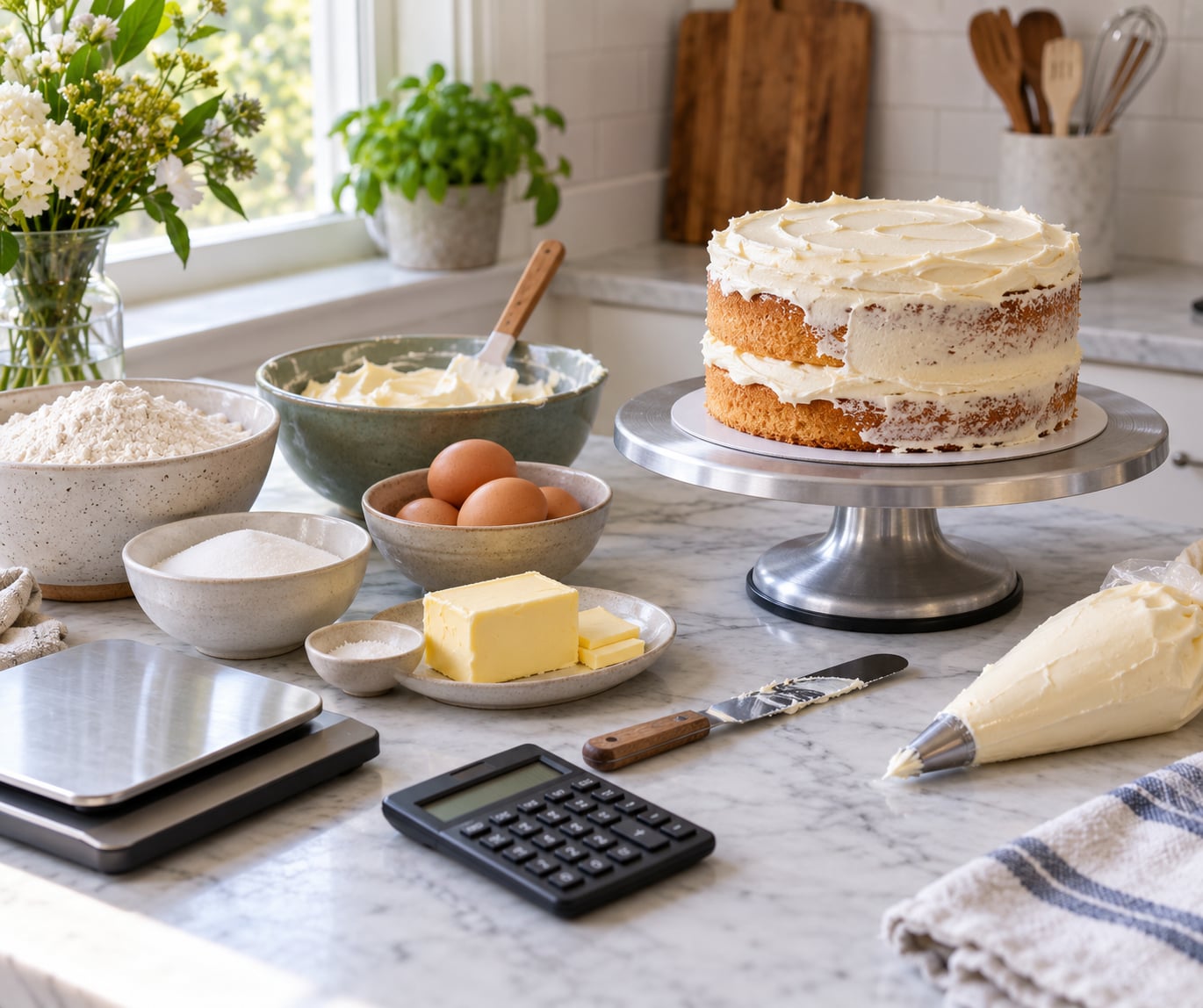
To figure out the cost of a cake recipe, convert every ingredient price into a unit cost, multiply by the quantity the recipe uses, add up the batch total, then divide by the number of servings the cake actually yields. From there you add labor, overhead and a margin to turn a cost into a price.
The whole job takes about 20 minutes with a kitchen scale and a spreadsheet, and the only hard part is being honest about what the recipe actually costs instead of what a bag of flour feels like it should cost. Get that wrong and a beautiful party cake quietly becomes the most expensive thing on the table.
All the ranges below are typical US grocery averages. They change by region and shift with ingredient prices, so treat them as a starting point and replace each number with what you actually paid.
Table of Contents
- Cake Recipe Cost at a Glance
- How to Figure Out the Cost of a Cake Recipe by Size
- How to Build the Costing Table in Google Sheets
- What Is the 3:2:1 Rule?
- What Affects the Price
- Ways to Save
- Frequently Asked Questions
- Should I include labor when pricing a cake?
- How do I price a cake for a party?
- How do I calculate cost per serving?
- What if my recipe makes too few or too many portions?
- Should I use sale prices when costing a recipe?
- Is there a free spreadsheet that calculates baking costs?
- Start With One Batch and Multiply
Cake Recipe Cost at a Glance
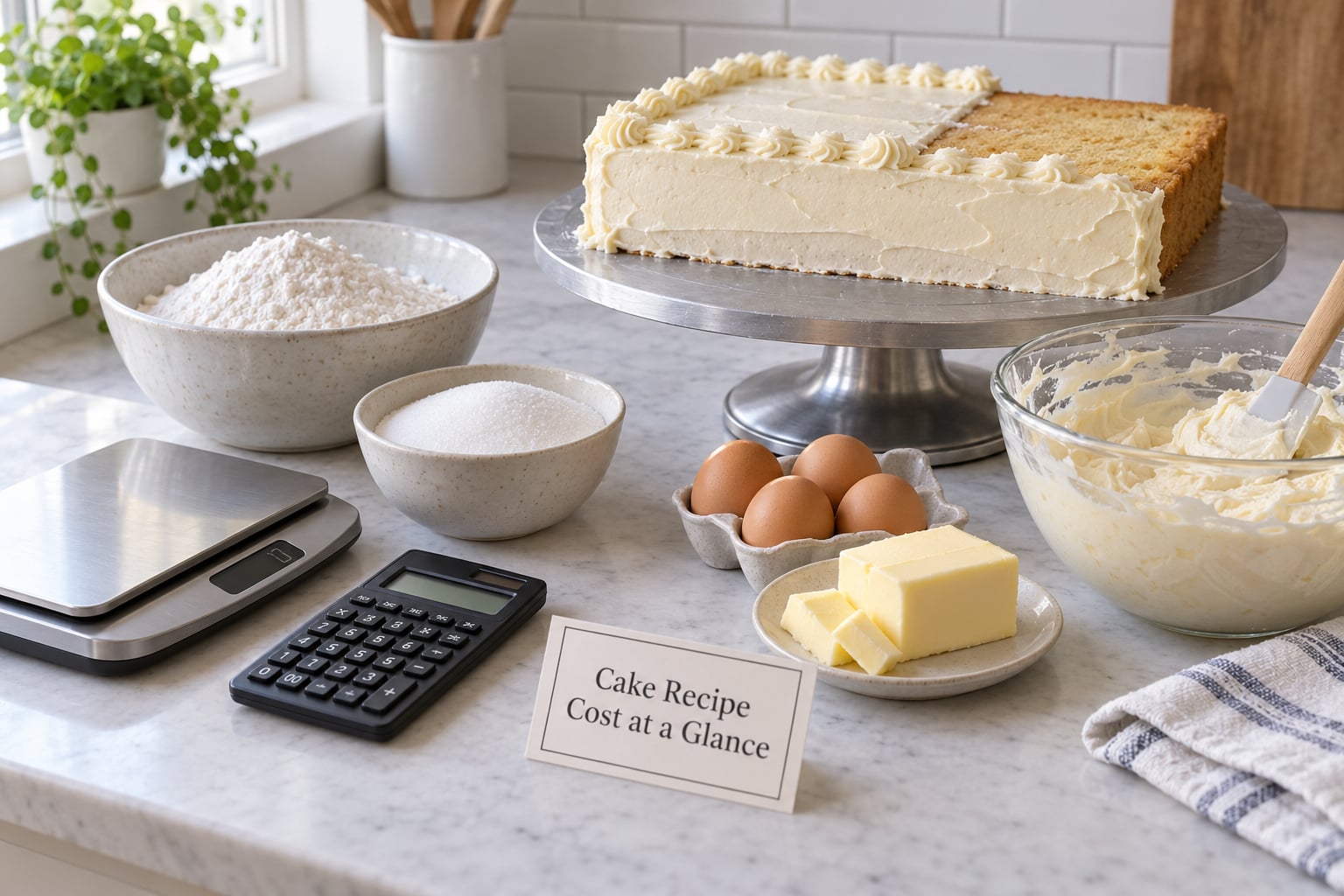
Most pantry ingredients used in cake are cheap per gram, and the finished cake is not. A two-layer 8-inch cake built on a scratch recipe typically lands somewhere between 8 and 16 dollars in ingredients and consumables before a single minute of labor. Decorated and tiered cakes sit far higher because frosting weight, fondant, boards, dowels and toppers are what push the number up.
| Cost area | Typical range for a 8-inch party layer cake |
|---|---|
| Cake layers (dry and wet ingredients) | 3.50 to 6.50 dollars |
| Frosting (buttercream, ganache or fondant) | 1.50 to 9.00 dollars |
| Fillings, if used | 0.75 to 4.00 dollars |
| Board, box and any dowels | 1.00 to 3.50 dollars |
| Decorations and topper | 0.00 to 12.00 dollars |
| Trim loss and spillage allowance | 5 to 10 percent of ingredients |
| Labor at 20 dollars an hour | 30 to 60 dollars for 1.5 to 3 hours |
| Overhead allocated at 15 percent of labor | 5 to 10 dollars |
| Finished price at a 35 percent margin | roughly 1.5 times total cost |
That last row is the one most home bakers skip. Ingredients plus labor plus overhead is your cost floor, and a cost floor is not a price.
How to Figure Out the Cost of a Cake Recipe by Size
The conversion runs in four moves, and every recipe costing problem is the same four moves with different numbers.
- Convert the package price into a unit cost. Take what you paid for the package and divide by the package size. A 5 pound bag of flour at 3.49 dollars is 2268 grams, so the unit cost is 0.0015 dollars per gram.
- Multiply unit cost by the quantity the recipe uses. 240 grams of flour in the recipe times 0.0015 gives 0.37 dollars for that one line.
- Add every line together. The sum is your batch cost, the true ingredient cost of one cake or one tray of cupcakes.
- Divide the batch cost by the usable yield. That gives you cost per cake, per slice or per serving before labor.
Weigh flour, sugar and butter rather than measuring by volume. A cup of flour can swing several grams depending on how tightly it is packed, and at a fraction of a cent per gram, small errors quietly erase the profit you were trying to protect. Volume measures are fine for recipe writing; weight measures are the ones that keep your costing honest.
Here is a real scratch vanilla layer cake, costed end to end with two 8-inch layers. The yield is 12 servings.
| Ingredient | Package price and size | Unit cost | Quantity used | Line cost |
|---|---|---|---|---|
| All-purpose flour | 3.49 dollars / 2268 g | 0.0015 per g | 240 g | 0.36 |
| Granulated sugar, cake | 3.29 dollars / 2268 g | 0.0014 per g | 300 g | 0.44 |
| Unsalted butter, cake | 5.49 dollars / 454 g | 0.0121 per g | 227 g | 2.74 |
| Whole eggs | 5.49 dollars / 12 | 0.46 per egg | 4 | 1.84 |
| Baking powder | 4.29 dollars / 283 g | 0.0152 per g | 8 g | 0.12 |
| Whole milk | 3.49 dollars / 3785 ml | 0.0009 per ml | 236 ml | 0.22 |
| Powdered sugar, frosting | 4.29 dollars / 907 g | 0.0047 per g | 480 g | 2.26 |
| Unsalted butter, frosting | 5.49 dollars / 454 g | 0.0121 per g | 113 g | 1.37 |
| Whole milk, frosting | 3.49 dollars / 3785 ml | 0.0009 per ml | 30 ml | 0.03 |
| Vanilla extract | 11.99 dollars / 118 ml | 0.1016 per ml | 4 ml | 0.41 |
The layers come to 5.72 dollars and the frosting to 4.07, for a batch cost of 9.79 dollars. Add an 8-inch board at 0.35, a cake box at 0.75, and an 8 percent trim loss allowance on the ingredients at 0.78, and the materials cost of one finished cake is 11.67 dollars.
Two and a half hours of mixing, baking, cooling, crumb coat, final coat and decorating at 20 dollars an hour adds 50 dollars of labor. Overhead at 15 percent of labor adds 7.50 for utilities, equipment wear, insurance and your market stall fee.
Total cost is 69.17 dollars. At a 35 percent profit margin, divide that by 0.65 and the selling price lands at 106 dollars, or 8.90 a serving across 12 servings. The same cake cost 0.97 a serving in materials before anyone lifted a whisk.
Adjusting for other sizes is arithmetic once you know the yield. A 9 by 13 inch pan roughly doubles the batter against an 8-inch round, so double the layer lines and expect 20 to 24 servings. A half-batch in two 6-inch rounds uses the same pans but halves every ingredient line, so the batch cost drops to about 4.90 while labor barely changes. That is why small cakes are expensive per slice and sheet cakes are cheap per slice.
How to Build the Costing Table in Google Sheets
Build the sheet once and every future recipe takes ten minutes. Make six columns: ingredient, package price, package size, unit cost, quantity used and line cost.
Put the unit cost in one cell as a formula, for example =B2/C2 if price sits in column B and package size in column C. Line cost is then =D2*E2, the batch total is =SUM(F2:F11), and cost per serving is =F12/G1 where G1 holds the yield. Once those four formulas are in place, changing a price updates everything downstream automatically.
Add a column for waste percentage and one for labor minutes. Most home bakers build a bare six-column sheet, discover halfway through a busy season that their prices no longer cover their time, and then add the two columns they wish they had had on day one.
What Is the 3:2:1 Rule?
The 3:2:1 rule is a quick pricing shortcut used in home bakery circles: a simple bake should sell for about three times its ingredient cost, a moderately decorated one for about two times, and an intricate or specialty one for close to one times plus a full labor charge. It is a sanity check for a stall table, not a costing method, and it silently assumes your labor is free. Use it to catch a badly underpriced item, then cost that item properly with the table above.
What Affects the Price
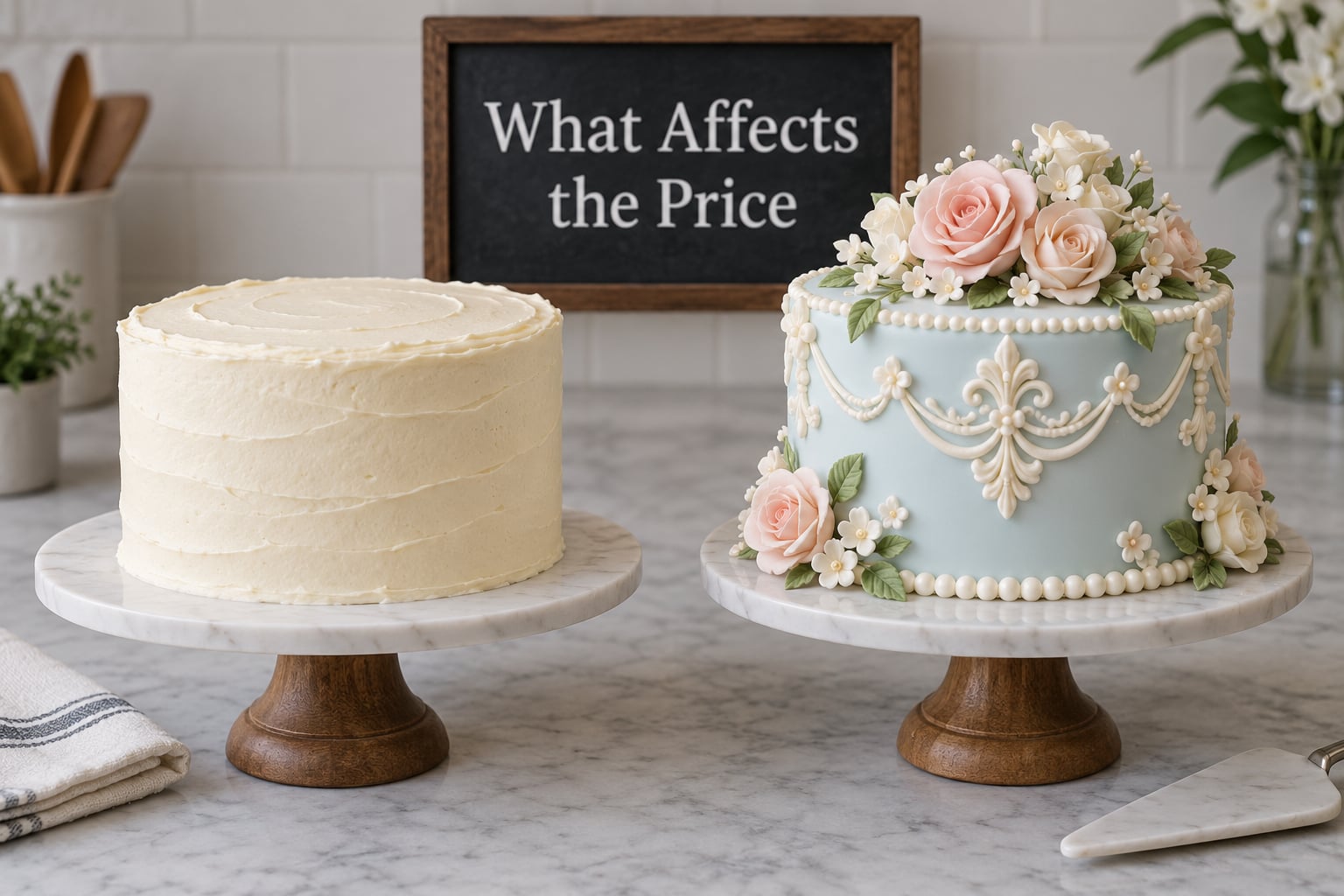
The same recipe produces very different prices depending on how it is built, and the gap is bigger than most bakers expect.
Ingredient weight and brand. Butter, chocolate, almond extract and shortening cost several times what flour does per gram, so a butter-heavy or chocolate-rich recipe has a higher floor than one built mostly on flour and sugar. Store-brand flour, sugar and shortening shift the total less than bakers expect, while the vanilla bottle in the cupboard can quietly add a dollar to every cake.
Serving count. Every price you quote is really a price per serving. A tall cake cut into twelve generous pieces costs more per person than the same cake cut into twenty thin ones, even though nothing changed in the kitchen.
| Cake format | Usable servings |
|---|---|
| 6-inch round, 2 layers | 8 |
| 8-inch round, 2 layers | 12 |
| 9 by 13 inch sheet cake | 20 to 24 |
| 10-inch round, 2 layers | 16 to 18 |
| 12-inch round, 2 layers | 22 to 26 |
| Three stacked tiers, 6 and 8 inch | 24 to 30 |
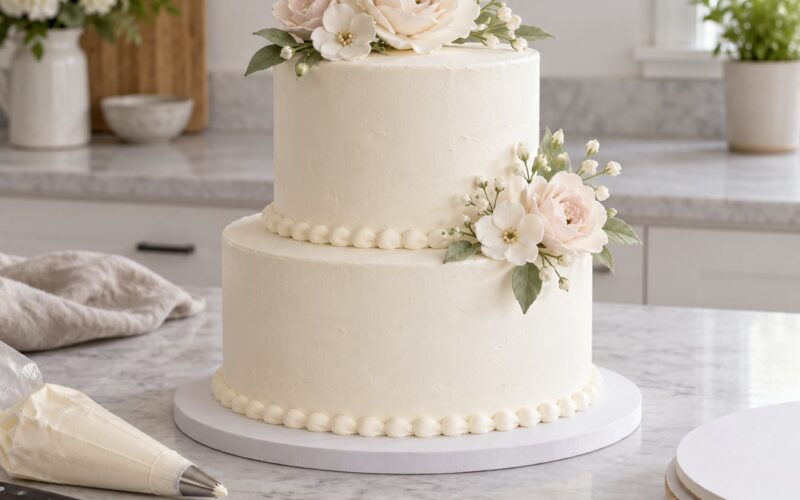
Cake format and structure. Tiered cakes need boards under every tier, dowels or supports, and more finishing time. A simple frosted layer cake and a three-tier cake can share the same flavor profile and differ by a hundred dollars in materials and hours, and structure is the reason.
Frosting type. American buttercream is mostly sugar and butter and costs pennies per cake. Fondant runs two to four dollars a pound before labor, and it is heavy enough to change your yield and your serving size. Swiss meringue and ganache sit between them, expensive in ingredients but lighter, which changes the number of slices.
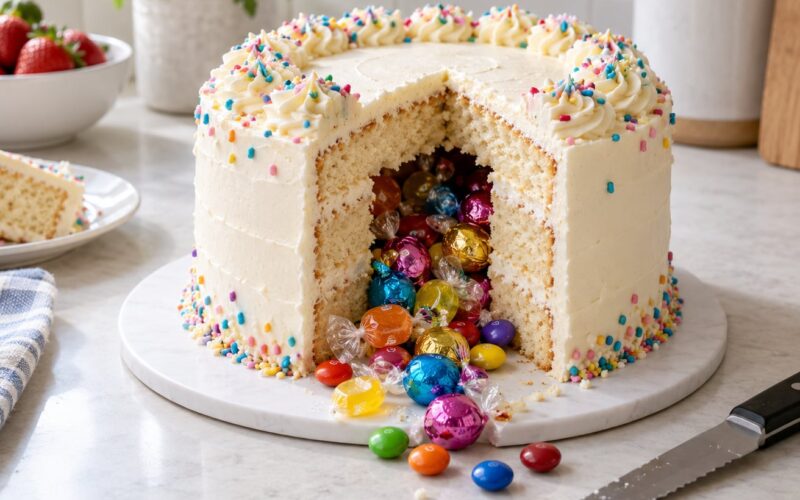
Fillings and specialty ingredients. Curd, curd filling, fruit compote, ganache pockets, sprinkles and edible prints all add cost per serving in ways that are easy to forget. Allergen-aware or specialty flours cost multiples of what plain flour costs, and they are worth pricing honestly rather than absorbing as a favor.
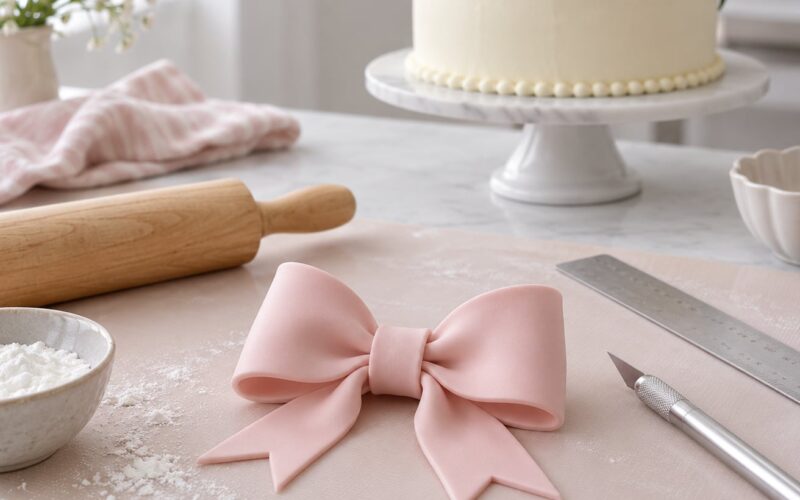
Decoration and toppers. Piped borders and simple sprinkles are labor, which you have already priced. Fondant florals, hand-modeled sugar work, printed toppers and anything custom are materials plus significant labor, and custom sugar work is usually the single biggest jump from an ordinary cake to a premium one.
Packaging and delivery. Boards, boxes, ribbon, tissue, cake inserts and any delivery mileage or paid courier belong in the cost. A cake that needs a rigid box and a level car seat is not the same product as one carried by hand in a sedan.
Labor. Track the clock from mixing bowl to cleanup. Baking forum threads keep circling the same point: excluding your time is the fastest way to convince yourself a sale was a good one when it was not.
Trim loss and spillage. Every cake loses batter to the bowl sides, the mixer paddle and the piping bag, and some cakes fail entirely. Adding 5 to 10 percent for waste, or a failure rate of one cake in ten if you are new to a shape, keeps your numbers from looking optimistic.
Cost and price are two different numbers. Cost is what the cake consumes in materials and time. Price is what the customer pays, and it exists so you can cover that cost, absorb overhead and still be paid for the work. Bakers who confuse the two end up either giving their labor away or convincing themselves an expensive recipe is unprofitable when the real problem is that labor was never counted.
Ways to Save
Buy the flour, sugar and shortening in bulk. These three are the backbone of almost every cake and the least glamorous place to cut. A 25 pound bag of flour and a 50 pound bag of sugar drop the per gram cost noticeably if you bake weekly. If you bake twice a year, skip this entirely, because the flour will go stale long before it saves you anything.
Use seasonal and frozen produce. Frozen berries for filling cost a fraction of fresh out of season and often perform better, since they hold their shape through baking.
Make a scratch cake only for cakes that earn it. A well-made cake mix with good butter and real vanilla produces an excellent party cake. Compare the mix against your scratch cost per serving before deciding the scratch version is worth the extra time.
Simplify the decoration, not the finish. A smooth crumb coat and a clean piped border read as professional. Fondant florals read as expensive work. Choose one point of decoration and spend the hours there instead of spreading thin effort across a design you cannot finish.
Pick a shape that yields more servings. A sheet cake feeds far more people per batch of batter than a stack of small rounds. Round layers waste more batter to the sides of the pans, so the same oven time produces fewer servings.
Reuse your parchment, boards and boxes. Boards and boxes are consumables you buy by the case. Keep a stock, count what is on hand before quoting, and include the replacement cost in the price even when the physical box gets reused.
Scale batches deliberately. Doubling a recipe cuts the cost per unit, because the same weighing, mixing and washing covers twice the output. Labor does not double when you bake two cakes at once in the same oven, and that is exactly why per-slice cost drops as batch size rises.
Frequently Asked Questions
Should I include labor when pricing a cake?
Yes. Labor is usually the largest single line in a homemade cake price, and leaving it out is what makes bakers wonder why selling cakes feels like a hobby that loses money. Track prep, baking, decorating and cleanup separately, then multiply total minutes by an hourly rate you would be happy being paid in cash. Most home bakers start somewhere in the 15 to 25 dollar range per hour and custom decorators charge considerably more.
How do I price a cake for a party?
Cost the cake exactly as you would for any other bake, then decide whether your order is priced per cake or per serving. Per serving is easier for a client with forty guests to understand, and it protects you when they ask for extra slices. Give a total built on a stated serving count, and write that count into the quote so nobody argues about it on delivery day.
How do I calculate cost per serving?
Add materials, labor and overhead to get your total cost, then divide by the number of servings the cake actually yields after trimming and stacking. Do not divide by the serving count printed in the recipe, since frosted and layered cakes usually yield fewer usable pieces than a plain bake. Round up when the answer has decimals, and never quote a price that depends on a serving count you did not write down.
What if my recipe makes too few or too many portions?
Both are a yield problem, and fixing it is cheaper than repricing. If you need more servings, scale up and recalculate the batch, since doubling a recipe lowers the cost per unit while barely changing active time. If you end up with too many, consider serving the extra as cupcakes, a petit four or a snack box, and cost those at their own per-piece price rather than absorbing them into the cake.
Should I use sale prices when costing a recipe?
Use the price you actually paid, including what you spent on the whole package even if you only used part of it. Sale prices make your cakes look cheaper than they are and quietly remove your profit. Update the numbers when a staple goes on sale, and recalculate every few months, since flour, butter and eggs move enough during a year to change a price that was right last winter.
Is there a free spreadsheet that calculates baking costs?
You do not need one to start. A six-column table in Google Sheets or Excel with a unit cost formula, a line total formula and a sum is all the recipe cost calculator this method requires, and building it yourself takes about ten minutes. Free online cost calculators are useful once you have dozens of recipes, but the on-page table keeps the math visible and stops the numbers hiding in a tab.
Start With One Batch and Multiply
Start with a single recipe. Weigh each ingredient, convert the package price into a unit cost, total the batch, and divide by the servings you actually produced. That one number is the beginning of how to figure out the cost of a cake recipe, and it is also the number most bakers never write down.
Once you have it, add labor at an hourly rate you would accept, allocate overhead, and divide by one minus your margin to get the price you can say out loud without flinching. Then check that price against the servings, not the cake, because the servings are what your customer is actually buying.
Recalculate when a staple goes on sale, when your yield changes, and twice a year whether anything changed or not. Flour, butter and eggs move enough in a year that a price that felt fair last winter may not cover your time now.