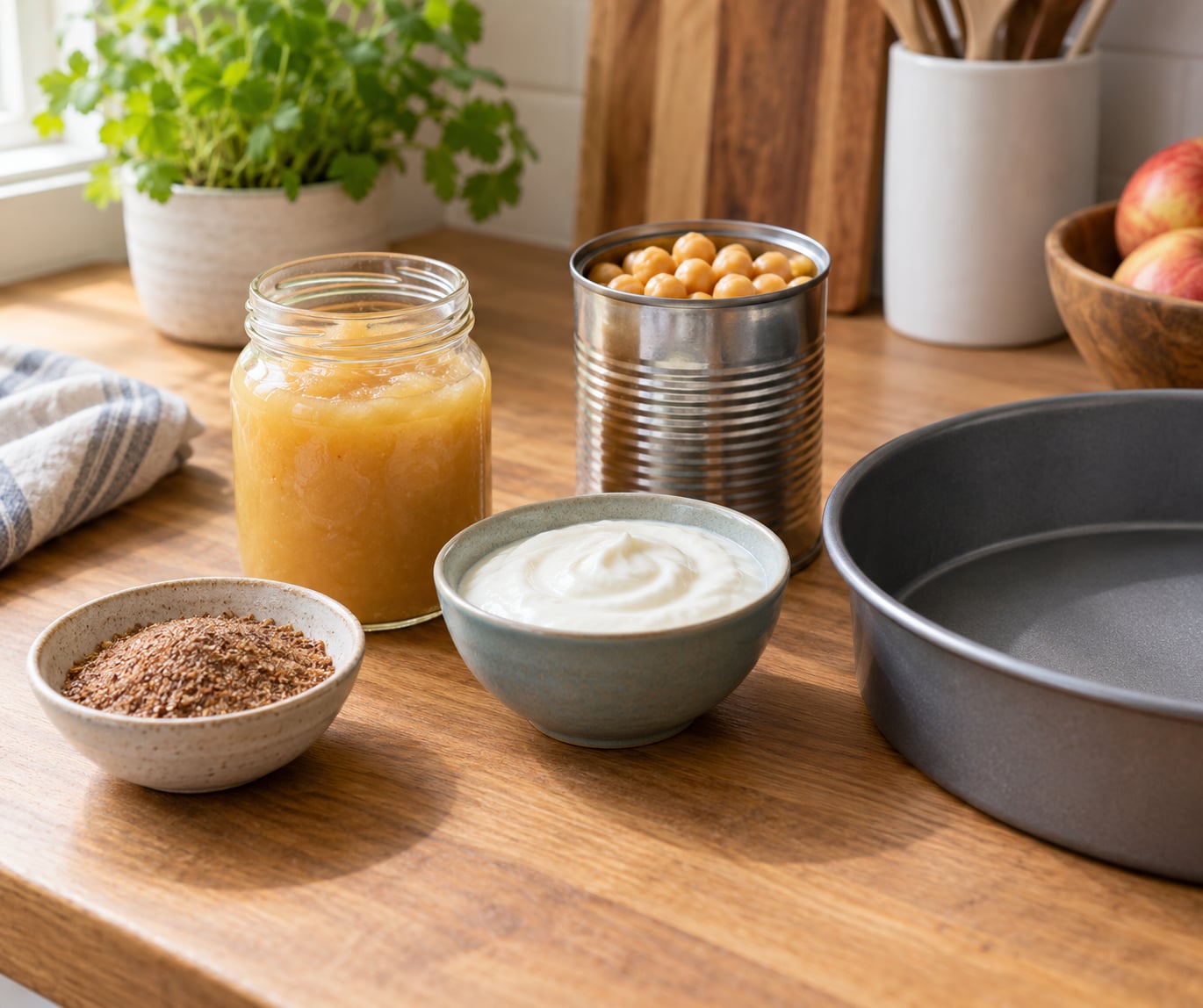
To substitute eggs in a cake recipe, match the replacement to the job the egg was doing. Use 1/4 cup plain yogurt for a light sponge cake, 1/4 cup unsweetened applesauce for a dense carrot or spice cake, 1/4 cup mashed banana for quick breads, 1 tablespoon ground flaxseed plus 3 tablespoons water when you need binding, and 3 tablespoons whipped aquafaba when the cake depends on lift.
Every egg does about five jobs at once, and the substitution that works in a moist fruit cake can leave a layer cake sitting flat in the pan. The good news is that most swaps take about five minutes of prep and a small adjustment to the baking powder and bake time. Last updated in 2026, after a run of test bakes in our kitchen.
Table of Contents
- What You Need
- Step-by-Step: How to Substitute Eggs in a Cake Recipe
- Step 1: Count the eggs and identify the job
- Step 2: Convert the amount for your egg count
- Step 3: Prepare the substitute before it goes in
- Step 4: Adjust the leavening
- Step 5: Bake a little longer and test doneness
- Use Flaxseed or Chia Egg Replacement for Binding
- Use Applesauce, Mashed Banana, or Fruit Puree for Moisture
- Use Yogurt, Sour Cream, or Buttermilk for Richness
- Use Silken Tofu for a Neutral, Smoother Batter
- Use Commercial Egg Replacer for Reliable Baking
- Cupcakes and Quick Breads Use the Same Ratios
- Substituting Egg Whites Only
- Common Mistakes
- Swapping in too much liquid
- Forgetting that some substitutes are sweet
- Skipping the rest time for flax and chia
- Overmixing after the substitute goes in
- Not adding extra leavening
- Expecting a no-egg cake to behave exactly like the original
- Baking a recipe that genuinely needs eggs
- Frequently Asked Questions
- What is the best egg substitute for a cake recipe?
- Can I just leave the eggs out of a cake?
- How many eggs can I replace with applesauce?
- What is the best egg substitute for cupcakes?
- How do I know if an egg-free cake is fully baked?
- Are commercial egg replacers safe for people with egg allergies?
- Conclusion
What You Need
The tool list is short. You need a kitchen scale if you can weigh the substitute, because a quarter cup of yogurt and a quarter cup of applesauce weigh very different amounts and a scale removes the guesswork. Beyond that: a mixing bowl, a whisk or hand mixer, measuring spoons and cups, a rubber spatula, the pan your recipe calls for, and an oven thermometer if you have one.
For the substitutes themselves, a well-stocked pantry usually covers it. Ground flaxseed and chia seeds handle binding. Unsweetened applesauce, pumpkin puree, and mashed ripe banana handle moisture. Plain Greek yogurt, sour cream, buttermilk, and silken tofu handle richness and tenderness. Aquafaba (the liquid in a can of chickpeas) handles lift. A box of commercial egg replacer powder handles everything else when you would rather not improvise.
Before you pick one, work out what your eggs are actually doing in this particular recipe, because that is the whole decision. Read the ingredient list and ask what the cake would be missing if the egg vanished.
- Binding. The egg holds the batter together and gives the crumb a scaffold. Layer cakes, cheesecakes, meatloaf-style batters and anything you need to slice cleanly lean on this.
- Lift. Beaten eggs trap air that expands in the oven. Sponge cakes, chiffon, swiss rolls and meringue-style toppings need this most.
- Moisture. Egg white is mostly water, and it keeps the crumb tender for days. Carrot cake, banana bread, pumpkin spice and brownies depend on it.
- Fat and richness. The yolk carries fat and gives a tender, almost custardy texture. Pound cake and rich chocolate cake feel the loss here.
- Flavor and color. Eggs add a mild savory note and, in a chocolate cake, they set the color as well as the structure.
Most home cakes need two or three of those at once, which is why a single substitute rarely covers everything. That is fine. You can mix substitutes across multiple eggs, as long as you keep the total liquid weight roughly the same.
Step-by-Step: How to Substitute Eggs in a Cake Recipe
Five steps cover almost every cake. Count the eggs, decide what the egg is doing there, pick the matching substitute, adjust the leavening, and give the cake extra time in the oven.
Step 1: Count the eggs and identify the job
Write down the number of eggs, not the number of cups. Most cake recipes call for two or three large eggs, and every ratio below scales from there. Then decide what you are making up for: a light sponge needs lift, a carrot cake needs moisture, a chocolate layer cake needs both structure and richness.
One large egg is roughly 3 tablespoons of liquid plus 1 tablespoon of fat. That single sentence explains most of what follows. When your replacement is mostly water like applesauce, you replace the water. When it is mostly fat like oil or nut butter, you replace the fat and expect a longer bake.
Step 2: Convert the amount for your egg count
This chart is the whole guide in one place. Measure by volume, and if you have a scale, weight it for a more repeatable result.
| Substitute | 1 egg | 2 eggs | 3 eggs | Best for |
|---|---|---|---|---|
| Plain yogurt or buttermilk | 1/4 cup | 1/2 cup | 3/4 cup | Light sponge, layer, chocolate |
| Unsweetened applesauce | 1/4 cup | 1/2 cup | 3/4 cup | Carrot, spice, fruit, quick breads |
| Mashed ripe banana | 1/4 cup | 1/2 cup | 3/4 cup | Banana bread, pumpkin spice |
| Pumpkin puree | 1/4 cup | 1/2 cup | 3/4 cup | Spice cakes, bran muffins |
| Sour cream | 1/4 cup | 1/2 cup | 3/4 cup | Cupcakes, cheesecakes, rich cakes |
| Silken tofu, blended | 1/4 cup | 1/2 cup | 3/4 cup | Chocolate cake, anything you want neutral |
| Ground flaxseed plus water | 1 tbsp plus 3 tbsp | 2 tbsp plus 6 tbsp | 3 tbsp plus 9 tbsp | Binding in muffins, quick breads, sturdy cakes |
| Chia seeds plus water | 1 tbsp plus 3 tbsp | 2 tbsp plus 6 tbsp | 3 tbsp plus 9 tbsp | Binding, no strong flavor |
| Whipped aquafaba | 3 tbsp | 1/3 cup | 1/2 cup | Light cakes needing lift |
| Baking soda plus vinegar | 1 tsp plus 1 tbsp | 2 tsp plus 2 tbsp | 3 tsp plus 3 tbsp | Quick lift in an already-leavened batter |
| Heavy whipping cream plus cornstarch | 2 tbsp plus 1 tsp | 1/4 cup plus 2 tsp | 3/8 cup plus 1 tbsp | Rich cakes, custards-style textures |
| Commercial egg replacer | Follow the label | Two egg measures | Three egg measures | Cupcakes, boxed situations, reliable results |
Step 3: Prepare the substitute before it goes in
Some swaps need a minute of prep and others need fifteen. A flax egg is ground flaxseed stirred into water and rested until it thickens into a gel. A chia egg works the same way. Aquafaba needs whipping with a hand mixer until it holds soft peaks, about 5 to 8 minutes, roughly the same time as egg whites. None of these can be dumped in dry.
For everything else, the swap is a straight pour. Stir the yogurt or applesauce into the wet ingredients first so the batter stays evenly mixed, and blend silken tofu completely smooth with a whisk or a food processor so no curd shows in the crumb.
Step 4: Adjust the leavening
Here is the rule nobody gives you clearly. Add 1/2 teaspoon of baking powder for every egg you replace in a light or sponge-style cake, and 1/4 teaspoon per egg in a dense or fruit cake. Dense batters already carry weight from fruit, flour or cocoa, so they need less help rising.
Flax and chia deserve a special note, because it is a common mistake. They bind well but they do not lift. If your recipe uses them, add the extra baking powder on top, exactly as if you had replaced the egg with applesauce.
For the baking soda and vinegar method, stir 1 teaspoon of baking soda into the dry ingredients and 1 tablespoon of white vinegar or apple cider vinegar into the wet ingredients separately, then combine. Mixing them at the same moment deflates them and you get nothing. A child’s science-fair volcano is exactly this reaction, and it works in the oven because the gas gets trapped in the batter.
Step 5: Bake a little longer and test doneness
Eggless cakes usually need 10 to 15 percent longer in the oven. Egg white is mostly water, and water sets slowly; most of the substitutes that replace it are higher in fat, and fat delays the point where the crumb firms up. If a recipe says 35 minutes, start checking at 42.
Do not rely on the timer alone. A done cake springs back when you press the center lightly, a skewer or toothpick comes out with a few moist crumbs rather than wet batter, and the surface no longer looks wet or glossy. If the top browns before the middle sets, tent it loosely with foil after about two-thirds of the bake.
Use Flaxseed or Chia Egg Replacement for Binding
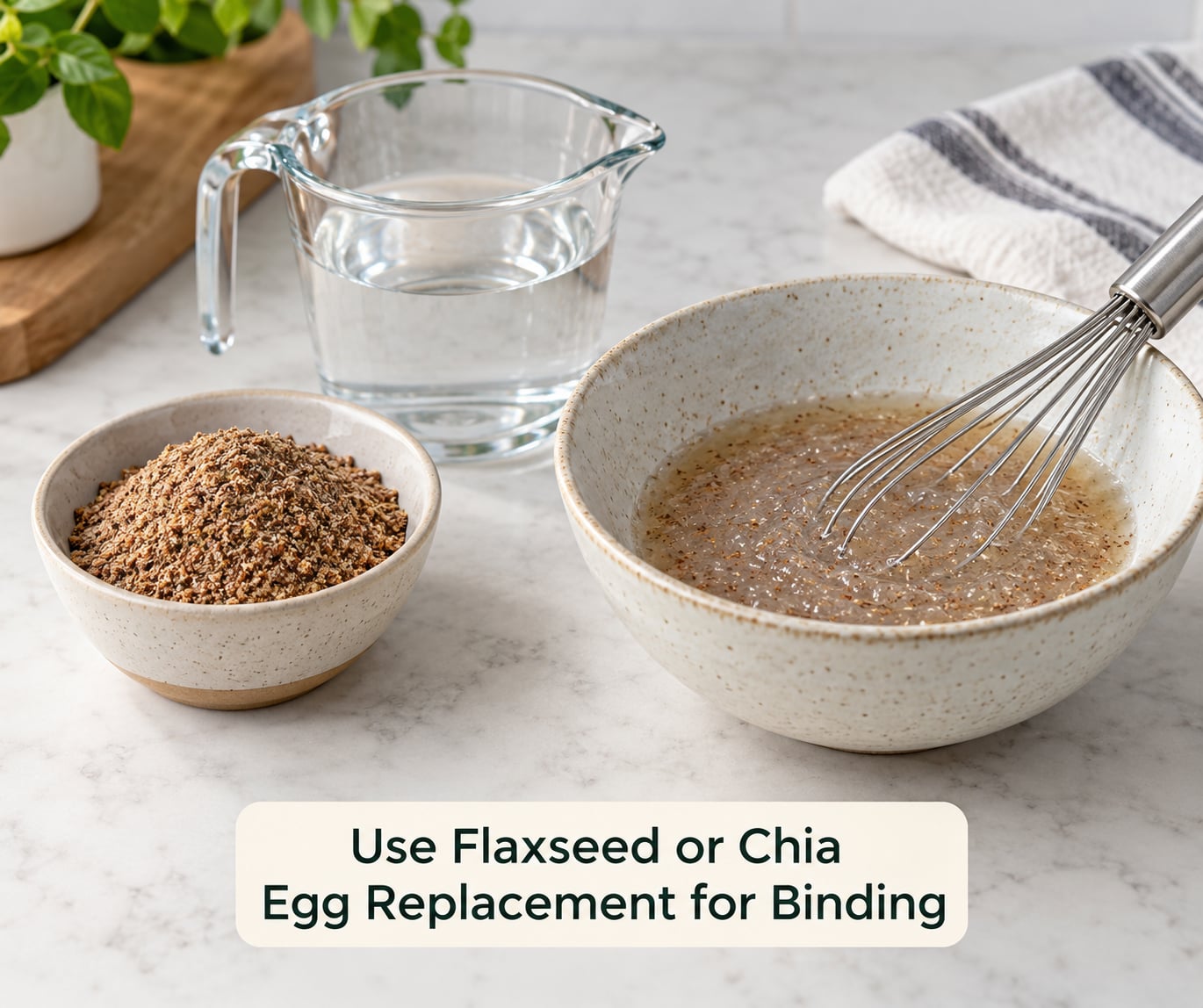
One flax egg is 1 tablespoon of ground flaxseed mixed with 3 tablespoons of water. Stir it, let it sit for 10 to 15 minutes until it turns into a loose gel, and use it wherever an egg was called for. Chia works with the same ratio and needs the same rest. Bakers on baking forums point out the same limitation repeatedly: flax and chia bind, they do not lift, so you add the baking powder separately.
This is the best binding option in muffins, quick breads, pancakes and sturdy cakes like banana bread. It is neutral in flavor, so it works in a vanilla or chocolate cake where banana or pumpkin would announce themselves. The texture is slightly denser and cakier than an egg, closer to a granola bar than a sponge.
One catch: ground flaxseed browns as it bakes, so a pale cake will pick up a faint tan tone. Chia does not do that, which is why some people reach for chia in white and yellow cakes. Grind the flaxseed in a spice grinder or coffee grinder if you have seeds rather than flour, and use it soon after grinding because the oil goes rancid.
Use Applesauce, Mashed Banana, or Fruit Puree for Moisture
Unsweetened applesauce replaces one egg with 1/4 cup, and it is the safest swap in the whole guide for a home baker. It has no strong flavor, it adds exactly the water that egg white would have, and it keeps the crumb tender for several days. Home bakers report it as the substitute that most often gets a thumbs-up with no adjustment at all.
Mashed banana is 1/4 cup per egg and works best in quick breads where banana is already the flavor. Pumpkin puree takes the same 1/4 cup and suits spice cakes and bran muffins. Both bring their own sweetness, so if you use either, cut the sugar by about 1 tablespoon per egg replaced. Applesauce sold as sweetened will make a cake noticeably sweeter, so buy the unsweetened jar.
These are for moist quick cakes, muffins, brownies and fruit cakes. They are the wrong choice for a delicate sponge or chiffon, where the extra water and zero lift will give you a flat, heavy layer. If you want a fruit swap for a light cake, go with yogurt instead and save the purée for the carrot cake it was made for.
Use Yogurt, Sour Cream, or Buttermilk for Richness
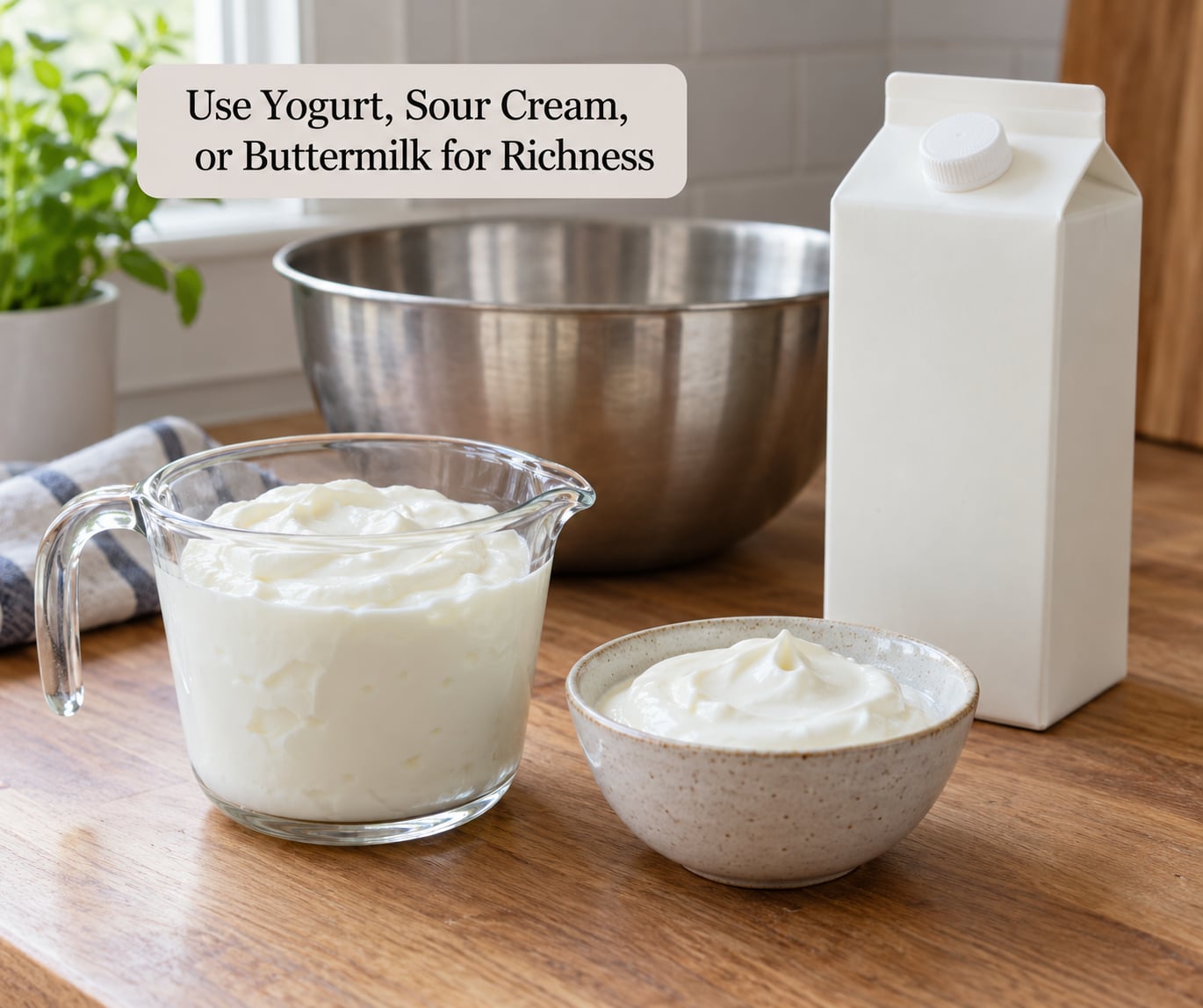
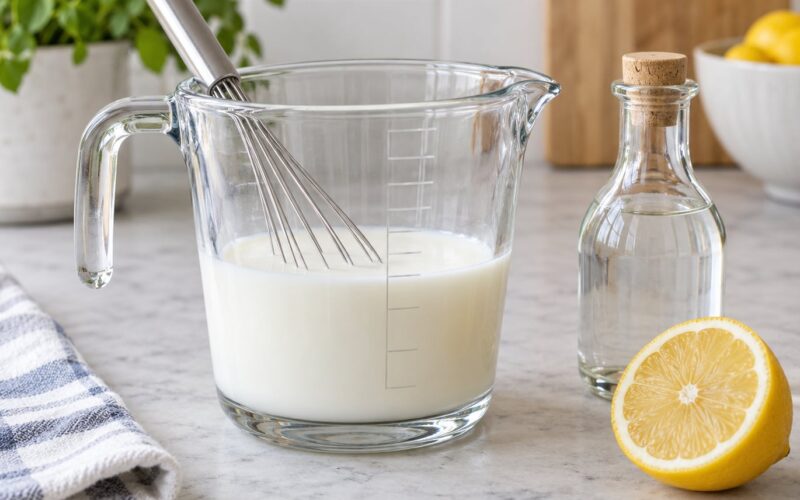
Use 1/4 cup of plain yogurt for each egg. It brings fat, moisture and a little acid, so the crumb stays tender and the cake keeps its rise. Use full-fat yogurt if you can; the fat is doing structural work, and low-fat versions leave a cake that feels thin. Buttermilk works at the same 1/4 cup per egg, and sour cream works at the same 1/4 cup, though it adds a little tang that is welcome in spice and carrot cakes.
Yogurt and sour cream are my pick for light layer cakes, chocolate cake and cupcakes, because they add structure and moisture at once. The one rule: after you add them, check the batter and pull the bake time up a little if the cake is a thin layer, since a wetter batter sets later. Keep the sugar unchanged; these substitutes are not sweet.
Dairy is not an option for a vegan or dairy-free cake. Plain plant-based yogurt works in the same position at the same volume, just check that it is unsweetened and unflavored, because vanilla varieties will flatten a chocolate cake.
Use Silken Tofu for a Neutral, Smoother Batter
Silken tofu replaces one egg with about 1/4 cup, blended until completely smooth. Drain it, weigh a quarter cup, then blend with a whisk or food processor until there is no grain left between your fingers. Any remaining curd shows up as small pale specks in the finished crumb, which is the whole reason to take the extra minute.
Tofu is the most neutral option in the guide, which makes it a strong pick for a chocolate cake, a white cake or anything where you do not want a trace of fruit flavor. Bakers like it in brownies and muffins too, because it makes a fudgier, tighter crumb that stays soft.
The tradeoff is texture. Tofu brings a different kind of fat than egg, so a cake made with it is usually denser and a little cakier, closer to a pound cake than a sponge. Firm tofu does not blend as smoothly as silken, so pick silken for this job. Any tofu recipe is also not a good fit for a cake where lift matters more than flavor.
Use Commercial Egg Replacer for Reliable Baking
A boxed egg replacer is a dry powder, usually a blend of potato starch, tapioca starch and gums, sold in a can or a small pouch. Follow the label for the amount per egg, which is normally 1.5 to 2 tablespoons, and it works best in cakes that already have baking powder or baking soda in the recipe. It is a genuinely convenient option when you need a dependable answer for a birthday batch of cupcakes and you do not have time to test a substitute.
Know the two limits before you buy. First, these products do not supply lift on their own in a cake that relies on whipped eggs, so keep the leavening already in the recipe or add the extra baking powder. Second, they do nothing for flavor or moisture, so a cake made with only a commercial replacer can taste thin next to the original.
Aquafaba, by comparison, is the substitute that does the most work of any option here. It is the liquid in a can of chickpeas, and it whips to the same volume and stiffness as egg white. Three tablespoons per egg is the standard ratio, and you fold it into the batter exactly the way you would fold in beaten whites. That makes it the pick for anything where lift is the whole point, including a sponge cake, a swiss roll or a meringue-style topping.
Cupcakes and Quick Breads Use the Same Ratios
Cupcakes and muffins are the easiest place to use up an egg substitute, because the batter is already thick, the bake is short, and nobody is tiering a cake that has to hold its own weight. Use 1/4 cup of plain yogurt, sour cream, or unsweetened applesauce per egg and skip the extra baking powder, since these batters usually carry enough already. Fill the liners about two-thirds full instead of the usual three-quarters, because an eggless cupcake has less protein to set the structure in the first few minutes and a full liner will overflow.
Quick breads like banana bread, pumpkin bread, carrot cake and zucchini bread are the most forgiving place of all. They are meant to be moist, heavy and forgiving, and 1/4 cup of mashed banana or unsweetened applesauce per egg lands right where the original did. If the top of a quick bread darkens before the loaf is set, the same foil tent from a layer cake works.
Substituting Egg Whites Only
Some recipes call for separated eggs, and then the rule changes. If a recipe wants 4 beaten egg whites for a sponge, a swiss roll or a walnut cake, an equal volume of applesauce or yogurt will not do the job at all, because those substitutes have no protein to trap air. Use 3 tablespoons of aquafaba per egg white, whipped to the same soft-peak stage as the whites would have been, or the flax and chia gel, which gives you binding but no lift. This is the decision rule that separates a whole-egg substitute from an egg-white substitute, and getting it backwards is why some eggless swiss rolls come out of the pan like pancakes.
One more case worth knowing: a recipe that calls for whole eggs plus extra whites for meringue or marshmallow topping needs two different answers. Substitute the whole eggs with yogurt or applesauce, and use whipped aquafaba for the whites.
Common Mistakes
Almost every failed eggless cake comes down to one of seven things. Here they are with the fix for each.
Swapping in too much liquid
The 1/4 cup rule is per egg, not per recipe, and it applies to one large egg. A small egg does not take a full quarter cup, and a recipe with two jumbo eggs does not take half a cup. Measure. If your batter looks looser than the original you are used to, you have gone too wet, and the fix is to add another 1 to 2 tablespoons of flour.
Forgetting that some substitutes are sweet
Mashed banana, pumpkin puree, honey and sweetened applesauce all add sugar. If you use one of those, reduce the sugar in the recipe by about 1 tablespoon per egg replaced, or the cake will read as cloying. Unsweetened varieties need no adjustment at all.
Skipping the rest time for flax and chia
They go into the batter as dry seed and water, and the gel that forms is what holds the crumb together. Stir them and wait the full 10 to 15 minutes. A batter made with un-rested flax egg crumbles when you try to cut it.
Overmixing after the substitute goes in
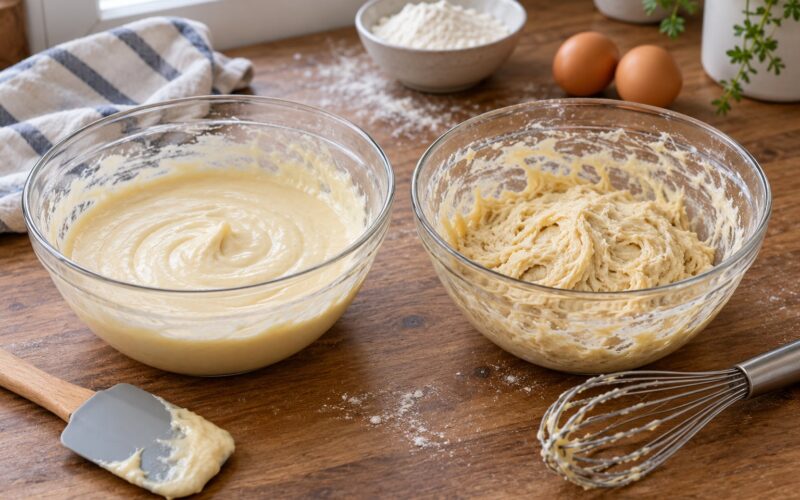
Once you add yogurt, aquafaba or anything that has already been whipped, mix gently and stop. Pushing a light batter too hard knocks the air back out, and you end up with a heavier cake than the recipe promised. This is the one place where the old advice about being gentle with a light sponge actually applies to a dense batter too.
Not adding extra leavening
Add 1/2 teaspoon of baking powder per egg replaced in a light cake, 1/4 teaspoon in a dense cake. Pulling the cake out early because you are following the original timing leaves you with a raw center and a browned top, which is the most common eggless cake failure in baking forums.
Expecting a no-egg cake to behave exactly like the original
There is no substitution that reproduces an egg perfectly. A dairy-free yogurt version will be slightly denser, an aquafaba version slightly more fragile, and a fruit-puree version moister and a day or two shorter in freshness. Set your expectation at a very good version of the cake rather than a clone of it, and you will be happy with the result.
Baking a recipe that genuinely needs eggs
Meringues, macarons, custards, French buttercream and anything that relies on the specific structure of a whipped egg white will fail with every substitute on this list. Aquafaba comes closest, and it will handle a meringue-style topping, but a custard built on temperature-set egg proteins has no equivalent. If a recipe is called a custard or a meringue, buy the eggs or choose a different dessert.
For a boxed cake mix needing three eggs, the arithmetic is simple: 3/4 cup unsweetened applesauce, 3/4 cup plain yogurt, or 3 tablespoons of ground flaxseed mixed with 9 tablespoons of water. The mix already has baking powder in it, so add 1/2 teaspoon more, expect to add 4 to 5 minutes to the bake time, and fill the pan a little lower because the batter has no egg proteins to set the structure early. A single mixed substitute is what I use here rather than three different ones, since the blend is already engineered to work.
One safety note, since egg-free baking often means baking for someone specific. Egg replacers, flax, chia, aquafaba and tofu are safe for people with an egg allergy, but a cake baked without eggs can pick up egg protein from flour, sugar or a shared mixing bowl. If the allergy is severe, check the labels on your dry ingredients and bake the first one on a clean day. Anyone with a severe egg allergy should confirm with their doctor before eating a homemade egg-free cake, and check every label including the leavening and the pan spray.
Before your first bake, run this short check. Count the eggs, pick the substitute that matches the job, measure by volume or weight, rest anything that needs resting, add the extra baking powder, and start checking doneness five minutes before the original bake time.
Two swaps sit outside the cake world entirely, and both come up constantly. For an egg wash on a pie crust or pastry, use 1 tablespoon of milk, cream or melted butter brushed on thin, and it browns just as well. For a savory bake where you only need the egg to bind, like a meatball mixture or a veggie loaf, 1 tablespoon of ground flaxseed plus 3 tablespoons of water is the standard ratio, and nobody will taste it.
Frequently Asked Questions
What is the best egg substitute for a cake recipe?
For a light or sponge cake, 1/4 cup of plain yogurt per egg is the most reliable swap because it adds fat, moisture and acid at once. For a dense fruit or carrot cake, 1/4 cup of unsweetened applesauce per egg keeps the crumb tender. For lift, 3 tablespoons of whipped aquafaba per egg is the closest match to a beaten egg white.
Can I just leave the eggs out of a cake?
Sometimes, and it depends on the cake. Dropping the eggs from a recipe that only uses them for moisture, such as a quick bread or a brownie, often needs no replacement at all. A sponge or layer cake that relies on whipped eggs for lift will sink, and a cake that relies on egg for structure will crumble when you slice it. Substitute rather than omit whenever structure or lift matters.
How many eggs can I replace with applesauce?
Measure 1/4 cup of unsweetened applesauce for every large egg, so 1/2 cup for two eggs and 3/4 cup for three eggs. Keep the sugar unchanged unless your applesauce is sweetened, in which case cut 1 tablespoon of sugar per egg replaced. Applesauce works best in moist cakes like carrot, spice and fruit cakes, not in a light sponge that needs to rise.
What is the best egg substitute for cupcakes?
Plain yogurt at 1/4 cup per egg is the top choice for cupcakes, followed by sour cream at the same amount. Both keep the crumb tender and the tops domed. Silken tofu blended smooth also works well at 1/4 cup per egg when you need a completely neutral flavor. Cupcakes bake fast, so start checking doneness two minutes before the box says.
How do I know if an egg-free cake is fully baked?
Press the center gently: it should spring back and leave only the faintest dent. A toothpick or skewer should come out with a few moist crumbs, not wet batter. Eggless cakes often need 10 to 15 percent longer than the original recipe, so start checking about five minutes early. If the top browns before the center sets, tent it with foil.
Are commercial egg replacers safe for people with egg allergies?
Yes, commercial egg replacers are made from starches and gums and contain no egg protein, so they are generally safe for people with an egg allergy. The bigger risk is cross-contact, since flour, sugar and leavening can carry trace egg. Check every label, and if the allergy is severe, have someone with a confirmed allergy-free kitchen make the cake or ask their doctor first.
Conclusion
Start by opening your recipe and asking what the eggs are doing there: moisture, lift, binding or richness. Then pick the closest match from the chart above, measure it carefully, rest whatever needs resting, add the extra baking powder, and start checking doneness a few minutes early. Every egg replacement shifts texture, flavor and bake time in small ways, so keep a note of what you used and adjust from there on the next bake.