To tell when a cake is done without a toothpick, press the top center gently with a fingertip: a springy return with slight resistance means the crumb has set, a dent that stays means more time, and a shiny surface means the batter is still wet. Add the smell test, a look at the edges pulling away from the pan, and a probe thermometer reading for a check you can trust even on a tall layer cake.
Most home ovens run hot or cold by a surprising margin, which is why the timer on a recipe is a starting point rather than an answer. You need cues you can read at a glance.
Table of Contents
- What You Need (No Toothpick Required)
- How to Tell When a Cake Is Done Without a Toothpick, Step by Step
- Check Whether the Oven Is at the Right Temperature
- Look for Spring and a Clean Edge
- Check the Surface and Edges
- Use an Instant-Read Thermometer for Extra Confidence
- Let the Cake Cool Before the Final Check
- Common Mistakes and How to Fix Them
- Opening the Oven Too Early
- Treating Color as a Doneness Test
- Testing Too Hard or Too Often
- Using the Wrong Pan Size
- Baking Well Past the Recipe Time
- Adjust for Different Types of Cakes
- What To Do If the Cake Is Underdone or Overdone
- Frequently Asked Questions
- Can I tell if a cake is done just by looking at it?
- Should a cake spring back when I touch the center?
- What does a wet cake center mean, and can I fix it?
- How do I know whether my oven is running too hot?
- Does an instant-read thermometer work for every type of cake?
- Why does my cake look done but feel heavy and dense in the middle?
- Conclusion
What You Need (No Toothpick Required)
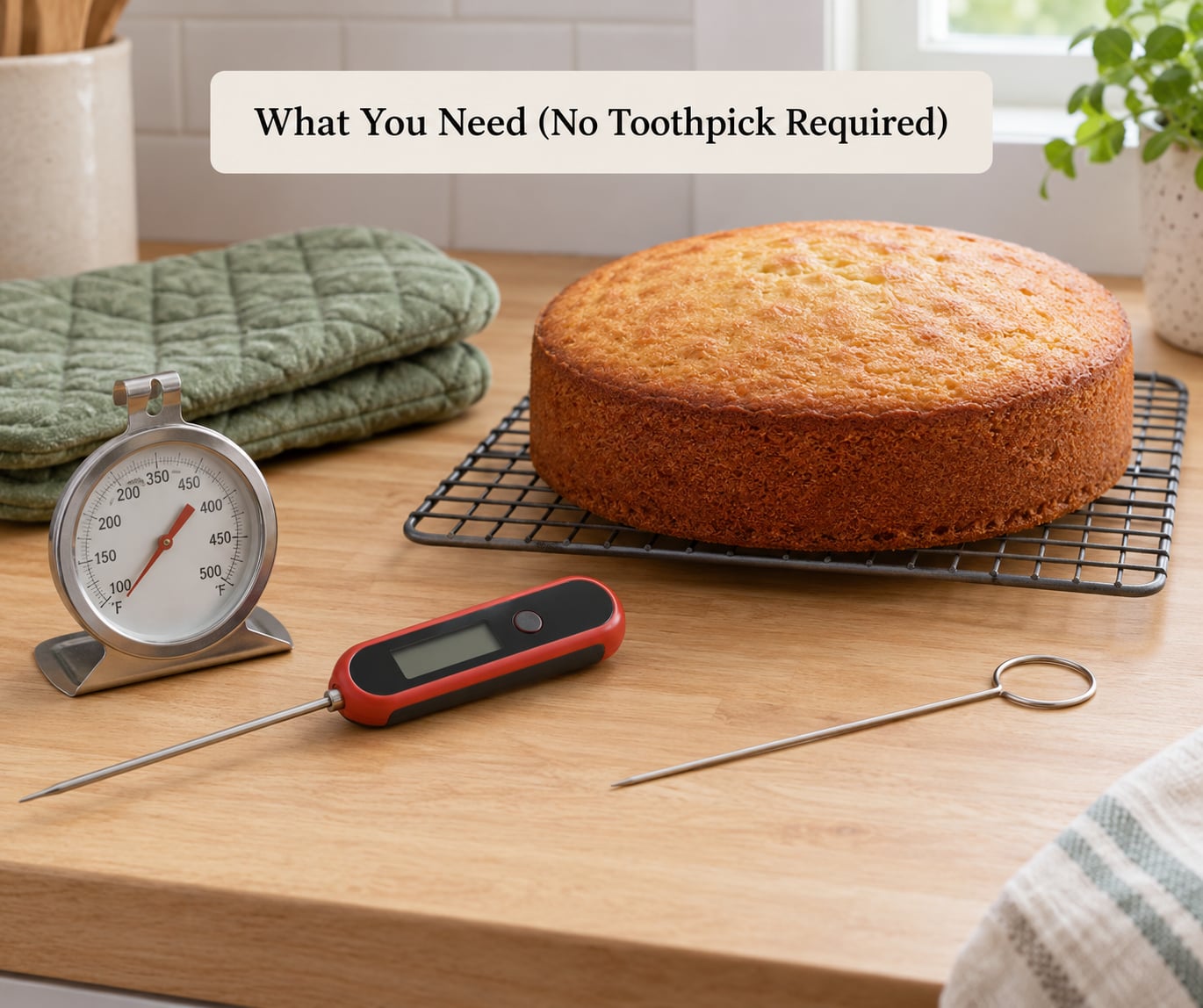
You need far less than a full baking setup to read a cake. Most of what you want already sits in a kitchen drawer.
- The right pan for the recipe. A too-small pan bakes faster and hotter at the edges, which skews every other cue.
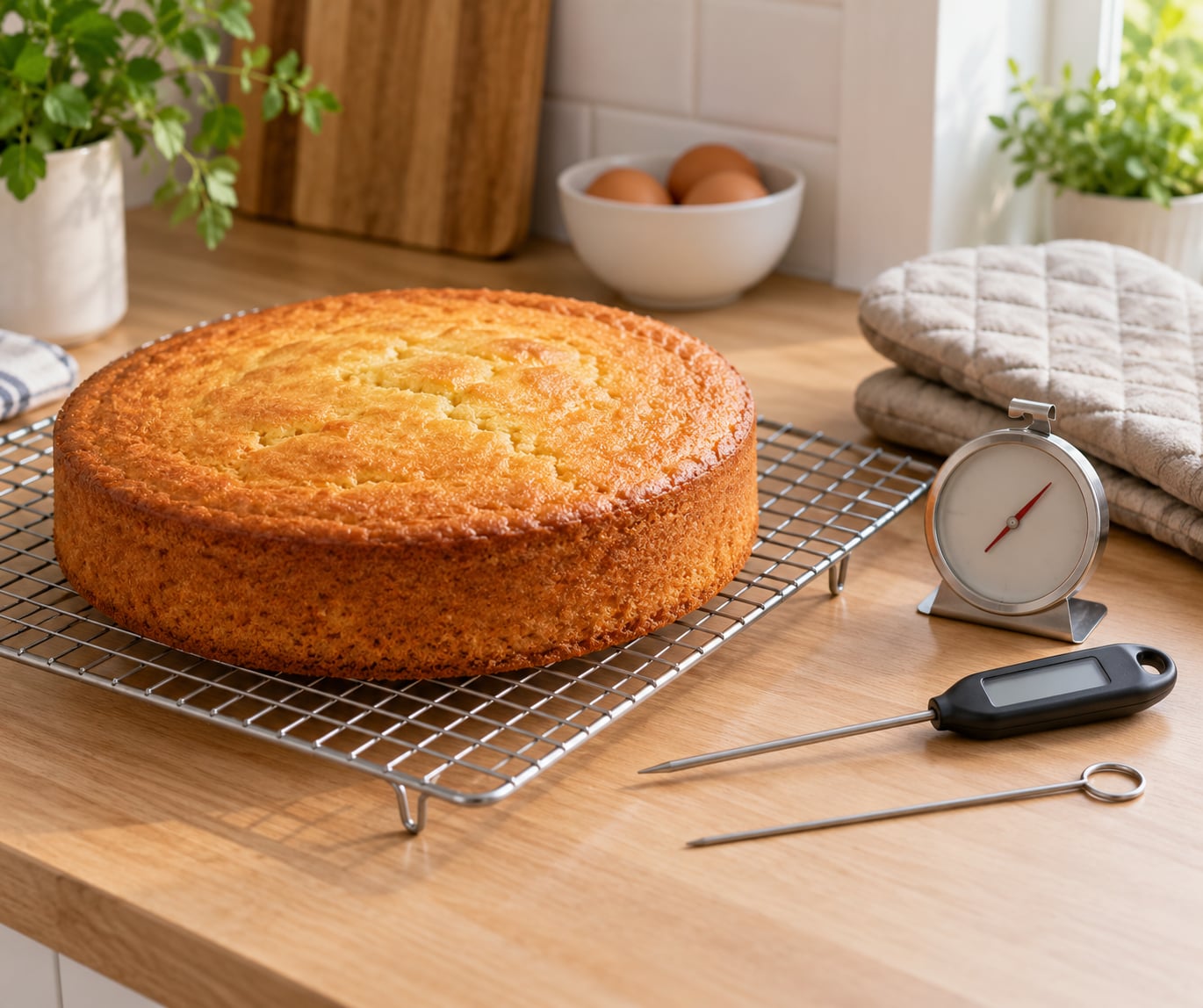
- An oven thermometer. Cheap, and it tells you whether your oven actually holds the temperature the dial claims.
- Oven mitts and a wire cooling rack. The rack matters as much as the mitts, because cooling carries the crumb the rest of the way.
- An instant-read thermometer. Optional, but it turns a guess into a number.
If you do want something to poke with, a wooden skewer, a metal cake tester, a thin paring knife, a clean chopstick or a fork all work. None of them is required for the method below, and if a hole in the finished cake would bother you, skip them entirely and work from touch, sight and smell.
One thing to skip: baking soda. It reacts with moisture and gives a false wet reading, and a microwave tells you nothing about how the crumb has set.
How to Tell When a Cake Is Done Without a Toothpick, Step by Step
Check Whether the Oven Is at the Right Temperature
An inaccurate oven makes every other clue unreliable, because a cake baked 25 degrees hot browns before its center sets. Put an oven thermometer in there on the middle rack, preheat to the recipe temperature, and read it after 15 minutes.
If it is off by more than about 10 degrees, adjust the dial forward for the rest of the bake. If it will not budge, treat the recipe time as a rough guide and lean harder on the texture cues. Convection ovens are worth calling out too: they usually shave 20 to 25 percent off the stated time, which is a lot of extra baking if you were counting on the timer.
Look for Spring and a Clean Edge
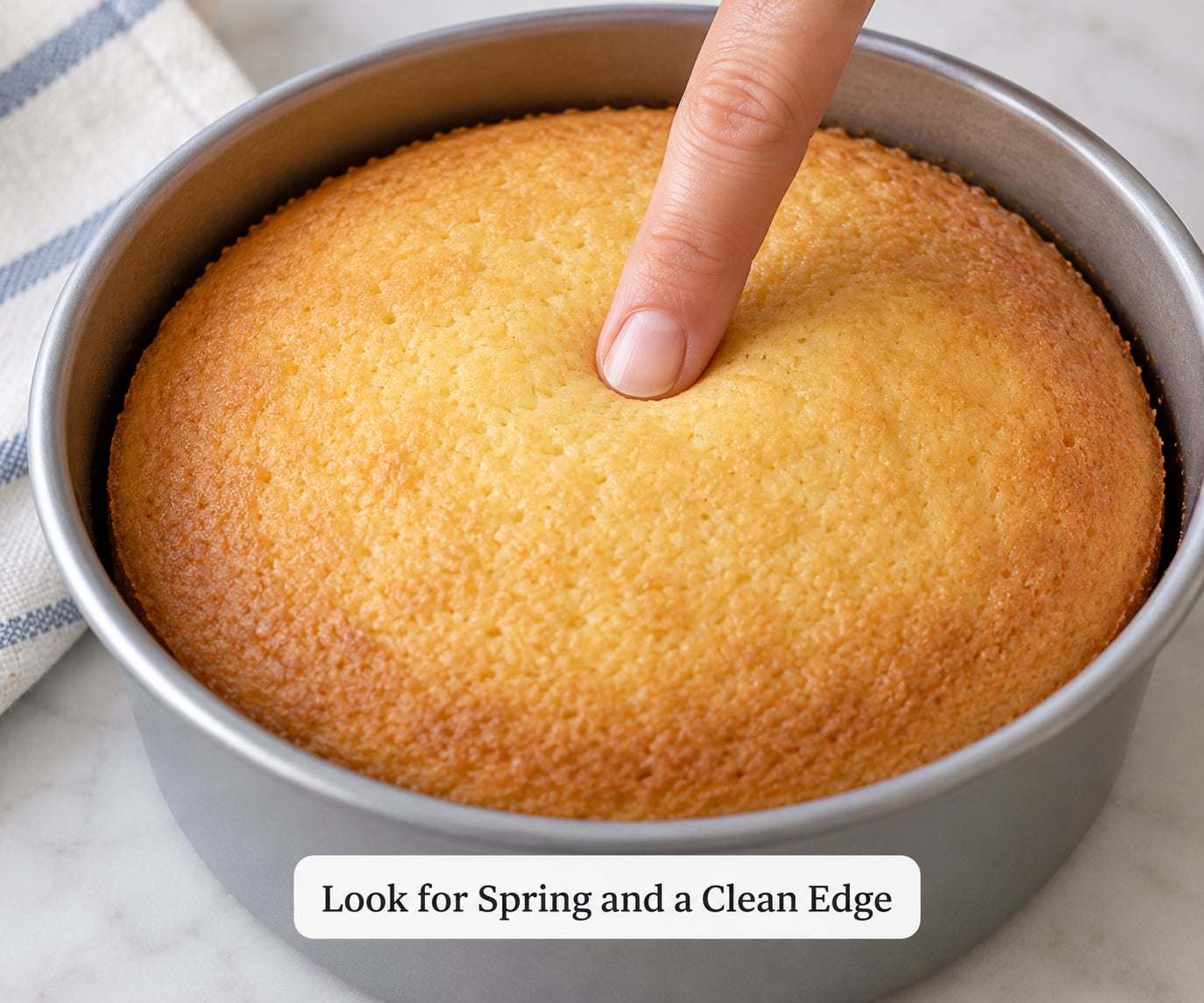
Press the top center with one fingertip, no harder than you would press a forearm. Three outcomes matter.
- Dent stays. The crumb has not set. Give it more time.
- Immediate hard bounce with no resistance. It has been in too long.
- Slight resistance, then a slow return that leaves no mark. That is the one you want.
On an underbaked cake the press also makes a faint foamy popping sound under your finger, like a soda you have just squeezed. It is subtle, and it only happens if you press gently enough to feel the crumb rather than dent the crust.
Do not press hard. You will collapse the structure you spent an hour building, and a deflated cake cannot be un-deflated.
A layer cake is taller than a cupcake, so the same press means something different. On a tall cake the top can feel firm while the middle is still fluid, which is exactly the failure that produces a gummy middle. This is also why a tester should not go all the way to the pan: the bottom sits directly on hot metal and bakes faster than the center, so a tester read at the base is misleading.
Check the Surface and Edges
Look at three things: the surface, the middle, and the sides of the pan. A matte, dry top with fine cracks running across the dome means the surface moisture has evaporated and the starches have set. A shiny, wet-looking top means there is still liquid fat and water up there.
The middle should look slightly domed or level, never hollow or sunken. A deep crack down the center is fine on a layer cake; a cake that has collapsed in the middle was either knocked by the oven door opening early or left far too long.
At the sides, the cake should have begun to shrink away from the pan wall so you can run a knife tip down the seam without resistance. That gap is one of the more reliable signals you get. It is not a sign of overbaking. A clean gap that appears while the center still springs back fine is a good thing, and the reason people ask whether pulling away from the pan is bad is that it is genuinely not.
Color alone tells you very little, especially with chocolate cake or anything with a lot of molasses. A dark crust with a pale middle is the classic underbaked look.
Use an Instant-Read Thermometer for Extra Confidence
Push the probe into the center of the cake, away from the pan wall, and read it fast. Most standard cakes are finished somewhere around 200 to 210 F at the center. These are ranges rather than rules, since a dense pound cake and an airy sponge set at different rates and recipes vary.
Cheesecake is the big exception at around 145 F. Going higher dries it out and can make it crack. Custard-style desserts land nearer 170 F, and breads finish closer to 190 F, which is useful context if you keep baking them in the same oven.
If the number and the texture disagree, trust the texture. Temperature is a confirmation, not a verdict.
Let the Cake Cool Before the Final Check
Residual heat keeps setting the crumb after the pan leaves the oven, which is the whole reason a slightly underdone-looking cake still turns out fine at the table. Let a layer cake sit in its pan for 10 to 15 minutes, then turn it onto a wire rack.
Run a knife around the edge before you turn it. If the knife slides through the seam cleanly, the cake has enough structure to hold itself up. If it resists and drags, give it another few minutes.
Common Mistakes and How to Fix Them
Opening the Oven Too Early
Every door opening drops the temperature and lets cold air hit the cake. Set your timer 10 to 15 minutes before the recipe’s stated time, so you are checking near the end rather than at the end. Early heat loss also slows the setting of the crumb structure, which is why a cake baked with constant peeking can still come out underdone.
Treating Color as a Doneness Test
Stop watching the top. It browns well before the center finishes, which is how you end up with a beautiful top and a wet middle. Check the edges and the spring-back instead, and use color only as a hint that the bake has been going a while.
Testing Too Hard or Too Often
Press once. Then stop. Repeated poking lets heat out and gives you less reliable information each time you go back to it. The same goes for a tester, since a probe hole in a cupcake ruins the thing anyway, and cupcake bakers rely on the press test almost completely.
Using the Wrong Pan Size
Batter in a pan smaller than the recipe calls for rises higher and sets in a narrower window. If your pan is deeper than the one in the recipe, lower the temperature by about 25 F and start checking earlier.
Baking Well Past the Recipe Time
Waiting for a completely clean tester is how cakes get dry. A few moist crumbs are the ideal result, because the crumb keeps setting as it cools. If you are at the far end of the stated time, test every five minutes rather than sitting on the door until it smells toasted.
Adjust for Different Types of Cakes
The cues hold across cakes, but the weights shift depending on the crumb.
- Light sponge cakes feel springy almost immediately and dry fastest at the edges. Judge them on the press, not the color.
- Dense butter and pound cakes take longer and benefit from temperature more than visual color, since they brown late.
- Chocolate cakes look done long before they are, because the dark crumb hides the raw center.
- Cupcakes and muffins need the press test, since a hole ruins them. The dome should feel springy and the edges should have pulled slightly from the liner.
- Bundt and loaf cakes brown on the raised ridges first, so foil tents the ring or the top once those ridges look done.
- Cheesecake uses the wobble test. Tap the pan with a spoon: a ripple that moves across the surface like a pond means it is set enough, while a whole-cheesecake wobble means it needs more time.
What To Do If the Cake Is Underdone or Overdone
If the center is still gummy and you have just taken the cake out, put it straight back in at the same temperature. Cover the top loosely with foil so the edges do not catch while the middle catches up, and check every five minutes with the press.
If the cake is already out and cooled with a raw middle, slice off the bottom layer or cut horizontally through the dense part and serve it as a trifle or a cake pudding. It is a good way to make it work, though it is not the same cake.
Overbaking cannot be undone. A cracked top, a dry crumb or a sunken center happens because the starches have gone past gel and the structure has collapsed. There is no way to put moisture back into a cake that has already dried out, so the only fix is to watch for it earlier next time.
If the edges brown before the center sets, the fix in the moment is the foil tent, and the fix for next time is rotating the pan once, halfway through, if your oven has a hot spot.
Frequently Asked Questions
Can I tell if a cake is done just by looking at it?
Only as a rough first check. A golden, domed top with edges pulling from the pan usually means the bake is well along, but color develops long before the center finishes setting. A firm, brown top over a gummy middle is the most common way cakes fool people. Confirm with the press test, the smell, or an instant-read reading in the center.
Should a cake spring back when I touch the center?
Yes, with slight resistance. Press the top center gently. A correct cake gives a little and comes back, leaving no lasting dent. If the dent stays put, the crumb has not set yet. If it snaps straight back instantly with no give at all, the cake has gone past done and will likely be dry.
What does a wet cake center mean, and can I fix it?
A wet center means the crumb structure had not set when the cake came out, usually because the bake was short, the pan was too small or too dark, or the oven was running cold. If the cake is just out, put it back at the same temperature under a loose foil tent and check every five minutes with the press test. Once it has fully cooled, you can only cut around the gummy part.
How do I know whether my oven is running too hot?
Put an oven thermometer on the middle rack, preheat to your recipe temperature, and read it after about 15 minutes. Anything more than 10 degrees off changes how long you should bake and how much the edges brown. A too-hot oven gives you dark edges with a pale, still-wet middle, which is a good clue on its own. Convection ovens usually cut bake times by roughly 20 to 25 percent.
Does an instant-read thermometer work for every type of cake?
For most standard cakes, yes, and it is the least ambiguous check available. Aim for roughly 200 to 210 F in the center, though recipes and cake styles vary. Cheesecake is the exception at around 145 F, and custards sit nearer 170 F. Take two or three readings across a large cake, and if the number and the texture disagree, trust the texture.
Why does my cake look done but feel heavy and dense in the middle?
A dense middle with a set top usually means the outer crumb set first while the center was still compact and underbaked, so it never had room to rise properly. Common causes are an oven running cool, a pan that is too small for the batter, overmixing the batter, or pulling the cake out on the timer instead of on the texture. Bake to the press test next time rather than the clock.
Conclusion
Start at the recipe’s minimum time, not the end of it. Check the oven, press the center, look at the surface and edges, smell the top, and only then pull a number off a thermometer. When two of those agree, the cake is done.