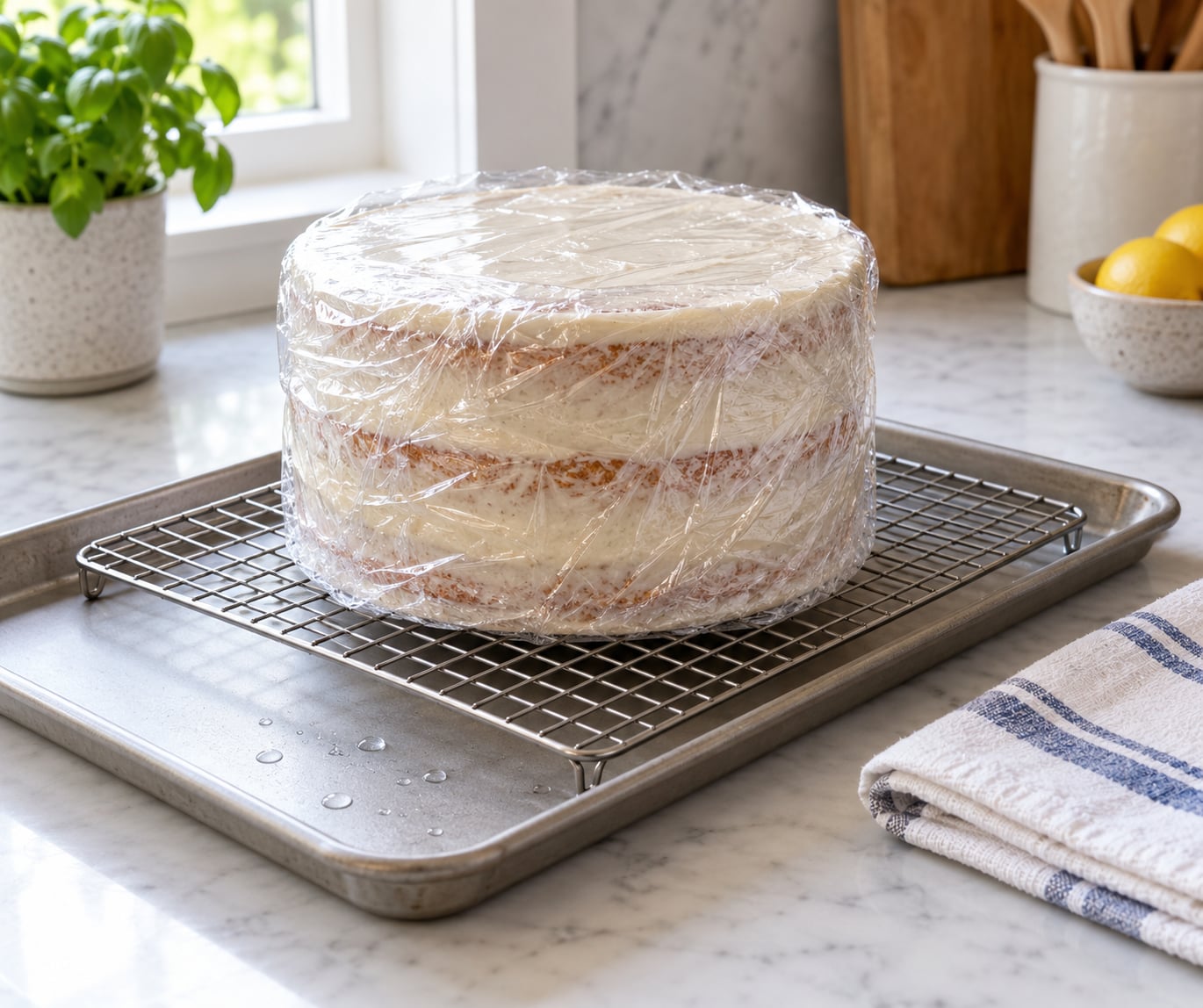
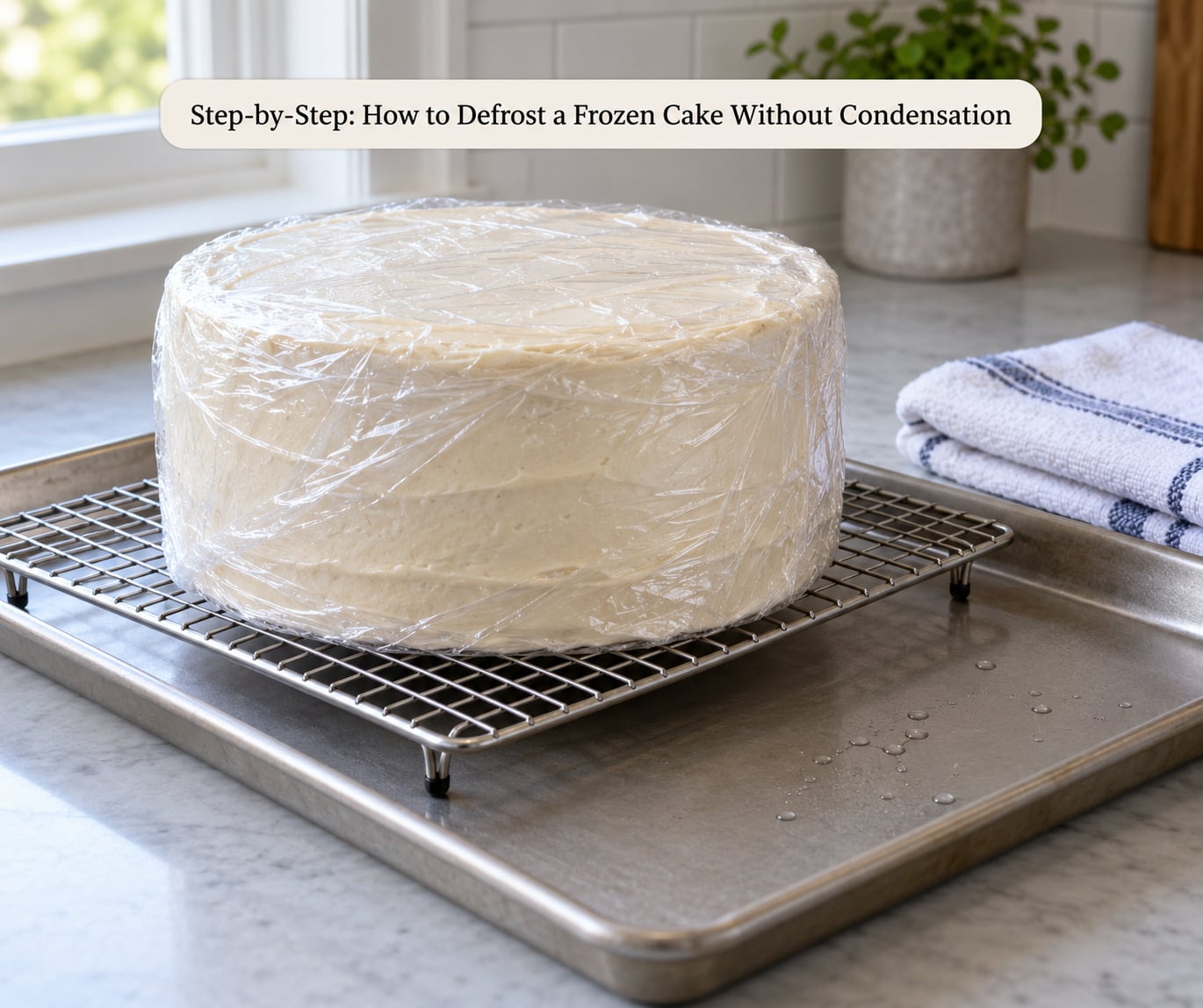
To defrost a frozen cake without condensation, move it from the freezer to the refrigerator while it is still wrapped, let it warm slowly for 8 to 12 hours, then bring it to room temperature before you take the wrapping off. The wrapping is the whole trick. A cold cake in a warm, humid room sweats, and that water lands on your frosting as beads, sticky fondant and weeping ganache. Start the thaw 24 hours before you plan to serve, and put the cake on a rack over a dry sheet so anything that does form has somewhere to go that is not the cake.
I learned this the hard way with a fully decorated layer cake for a birthday. I pulled it out, peeled back the plastic while it was still cold and within ten minutes there were beads running down the sides and my buttercream looked greasy. Same cake, same method, next time: fridge overnight, unwrap at room temperature, no sweat at all.
Here is why condensation happens in the first place. Air holds moisture, and warm air holds more of it. When that air touches a surface colder than its dew point, the water in the air turns back into liquid droplets on that surface. Your cake coming out of the freezer is colder than the kitchen, so the kitchen’s air dumps its water onto it. Slow, staged thawing keeps the cake only slightly cooler than the room air around it, so there is nothing for the moisture to land on.
Table of Contents
- What You Need
- Step-by-Step: How to Defrost a Frozen Cake Without Condensation
- 1. Choose the safest thawing method
- 2. Keep the cake covered while it warms
- 3. Check the center as it softens
- 4. Unwrap only after thawing
- 5. Store and decorate the thawed cake
- Common Mistakes and Quick Fixes
- Frequently Asked Questions
- How long does it take to defrost a frozen cake in the refrigerator?
- Why does condensation form when a frozen cake is thawed?
- Can I defrost a cake with whipped cream or cream-cheese frosting?
- Is it safe to thaw a frozen cake at room temperature?
- Can I microwave a frozen cake to defrost it quickly?
- Can a thawed cake be refrozen if I do not serve it right away?
- Conclusion
What You Need
Nothing here is specialised. You need a surface for the cake, something to hold it in, and a way to tell when the inside is actually thawed rather than just soft on the edges.
- The frozen cake, on its board if it has one
- A wire cooling rack and a dry baking sheet or tray
- Plastic wrap or cling film, or a large container with a tight lid
- Two to three sheets of parchment or greaseproof paper if the cake is undecorated
- An instant-read thermometer
- A clean, dry towel
The rack and sheet matter more than people expect. Condensation runs downhill, and a flat counter puts the wet side of the cake right onto a damp board. A rack lifts the cake so air moves underneath it and any stray drops fall to the sheet instead.
If the cake came out of the freezer inside a cake carrier, box or Tupperware, keep the container closed for the fridge stage and expect the carrier itself to be damp when you finally open it. That container is a separate condensation source and it is the one most people forget about.
Step-by-Step: How to Defrost a Frozen Cake Without Condensation
1. Choose the safest thawing method
The refrigerator is the only method I recommend for a decorated cake. Its steady cold temperature slows the melt so the cake warms evenly and its surface stays only a little below the surrounding air, which means very little condensation forms. A countertop thaw is faster, but the cake sits at room temperature with a frozen core for hours, and that gap is exactly where the sweating happens.
Use this plan: freezer to refrigerator wrapped, refrigerator overnight, then a shorter counter stage still wrapped, and unwrap last. Cheesecake owners on r/Baking call the same thing the three-stage thaw and say the staged approach noticeably cuts the pooling on top.
| Cake | In the refrigerator | On the counter before unwrapping |
|---|---|---|
| Single 6 inch layer | 4 to 6 hours | 1 to 2 hours |
| Two or three stacked layers | 8 to 12 hours | 2 to 3 hours |
| Full sheet cake | 16 to 24 hours | 3 to 4 hours |
| Bundt or tube cake | 8 to 12 hours | 2 to 3 hours |
| Cheesecake | 10 to 12 hours | 2 to 3 hours |
| Fully decorated or fondant covered | 12 to 18 hours | 3 to 4 hours |
Those numbers assume a refrigerator around 37 to 40°F. A colder fridge setting slows the thaw and a full fridge does too, since it has less warm air moving through it. If you have cut the cake into layers, the middle ones will take longer than the two on the outside, so judge by the center rather than the clock.
2. Keep the cake covered while it warms
Wrap the cake before it goes into the refrigerator. For a bare layer, slide it onto parchment, cover it completely and let the wrap sit loosely on top. If you are nervous about the plastic sticking to the surface, a thin layer of greaseproof paper between the cake and the film buys you a clean release without letting air in.
There is a genuine argument against sealing it airtight forever, and CakeCentral users raise it often. If a cake sits in a hermetic wrap while it warms, the moisture it gives off has nowhere to go and it collects against the frosting, which is where you get beads running down the sides. A middle path works well in practice: keep the cake covered in the refrigerator, then loosen or vent the wrap before the counter stage so the trapped air can escape, and remove it entirely once the cake is close to room temperature.
Also check the wrap before you seal. If condensation already formed while the cake was in the freezer, dry the surface first or you will seal fresh moisture in with the old.
3. Check the center as it softens
How to defrost a frozen cake without condensation comes down to this part as much as the wrapping: you need to know when the inside is genuinely thawed, because unwrapping even slightly early puts warm air on a cold surface. Push a thin knife or skewer into the center and look at what comes away. Firm and frosty means there is still a core. Soft crumbs with no ice crystals mean you are nearly there.
The thermometer helps more than most people expect. Push it into the middle of the cake and read it. When the center reaches room temperature, somewhere around 68 to 72°F, the whole cake is thawed, not just the outside. A cold core left behind keeps the temperature difference wide, and a wide difference is what makes condensation.
Do not cut the cake to test it. Every cut opens a route for air and every open route is another place moisture collects.
4. Unwrap only after thawing
Once the center reads room temperature, take the cake to a dry counter, pull off the parchment and any film, and set it on the rack. Do this in one motion rather than peeling slowly, because every partial opening lets a pocket of warm air onto a surface that is still a little cool.
If you see beading at this point, do not wipe it. Wiping drags the frosting and takes colour with it. Blot from the top down with a clean, dry paper towel and leave the rest. If the frosting has gone shiny and greasy, that is sweating and it will firm up again as the cake dries in cool moving air, which is why an open fridge door for ten minutes or a fan pointed at the cake helps more than any product you can buy.
Fondant takes the same rule and is less forgiving. Sticky fondant after a freeze and thaw has absorbed surface moisture and it will not return to its original finish. Setting it in a dry, cool room for a couple of hours firms it up enough to handle, and re-rolling the problem areas while it is still cold is easier than trying to smooth soft fondant later.
5. Store and decorate the thawed cake
If the cake is not being served right away, put it back in the refrigerator loosely covered. A cake box or a turned-down cake dome lets a little air move, and a fully sealed container will start a new round of moisture against the frosting. Most buttercream and fondant cakes are fine at cool room temperature for a day, while anything with whipped cream, cream cheese frosting or a ganache drip needs the refrigerator until shortly before serving.
For a cake you froze undecorated, finish frosting it from chilled rather than frozen. A crumb coat on a layer that has thawed but not warmed up holds the crumbs down and gives the final coat something dry to sit on.
| Frosting or covering | Condensation risk | How to handle it |
|---|---|---|
| American buttercream | Low | Thaw wrapped; if it glosses over, blot and let it dry in moving air |
| Swiss meringue buttercream | Low | Thaw wrapped; hold in the fridge if the day is hot |
| Ganache drip | Medium | Thaw wrapped and slowly; a fast thaw can push the drip off the edge |
| Whipped cream frosting | High | Refrigerator only, unwrapped last, serve within a few hours |
| Cream cheese frosting | High | Refrigerator only, keep cold right up to serving |
| Fondant | Medium | Thaw fully wrapped and unwrap warm; expect stickiness and let it dry |
Humidity changes the arithmetic. In a dry winter kitchen the same method may produce almost no beading, while a July afternoon at 80 percent humidity will pull moisture out of the air onto a cold cake no matter how well you wrapped it. If the forecast is humid, move the counter stage earlier, spend longer in the fridge, and skip the step of testing the cake in a warm kitchen until the very last minute.
Common Mistakes and Quick Fixes
Almost every problem with a thawed cake comes from rushing one stage. These are the ones I see most, and each has a straightforward fix.
Thawing on the counter from frozen. This is the big one. A frozen core sitting in warm air for eight hours is the worst possible setup for condensation. Fix: put it in the refrigerator first and let the counter stage handle only the final stretch, still wrapped.
Unwrapping while the cake is still cold. You have just exposed a below-dew-point surface to room air. Fix: wait until the center reads room temperature on a thermometer, then unwrap in one go.
Using the microwave. Short bursts thaw unevenly, leaving hot and frozen patches side by side, and the steam that comes off will make the frosting weep within minutes. It is the fastest option and the worst one. If you have no time at all, a cake with firm buttercream will survive a few 10-second bursts better than anything with cream or ganache, but plan for a mess either way.
Sealing a warm cake into a container. Put the lid on, the warmth traps vapour and the underside of the lid will rain onto the cake. Fix: cool it fully first, then cover loosely, and never seal a warm cake to store it longer.
Wiping sweat off the frosting. It smears and removes colour. Fix: blot with a dry paper towel and let the cake dry in air.
Reading surface moisture as a baking failure. Beading on a frozen cake that was frozen solid is a temperature problem, not a crumb problem. Fix: let it dry and reassess. If the crumb itself is gummy or the cake smells sour, that is a separate issue with freezing quality and not something thawing can fix.
Believing airtight is always better. It is not. Airtight during the fridge stage is helpful because it slows moisture loss, but airtight for the whole thaw traps the moisture the cake is giving off. Venting before the counter stage reconciles the two camps of advice.
Ignoring the cake box or carrier. A plastic carrier is a tiny greenhouse, and a cardboard board soaked through can dent or warp the bottom of a cake. Fix: empty the cake from its packaging at the counter stage, leave the board flat and dry, and keep the carrier open nearby rather than closed around the cake.
Starting too late. The most common scheduling mistake is not technique, it is timing. For an event in the evening, a decorated cake should be in the refrigerator by breakfast. Chefs on ChefTalk make the same point about baking ahead: the plan has to include the thaw, not just the bake.
Frequently Asked Questions
How long does it take to defrost a frozen cake in the refrigerator?
Most cakes need 8 to 12 hours in the refrigerator, which is why the fridge stage is done overnight. A single small layer can be ready in 4 to 6 hours, a full sheet cake wants 16 to 24 hours, and a fully decorated or fondant-covered cake should get 12 to 18 hours. Plan a further 2 to 4 hours on the counter, still wrapped, before you unwrap it. Judge by the center reading room temperature rather than by the clock.
Why does condensation form when a frozen cake is thawed?
Warm air holds more water vapour than cold air. When that warm, humid kitchen air touches a cake surface colder than its dew point, the vapour cools and turns back into liquid droplets, which is the beading you see. A frozen or fridge-cold cake is exactly that kind of surface. Thawing slowly in the refrigerator keeps the cake only slightly cooler than the air around it, so there is not enough of a temperature gap for the moisture to land on.
Can I defrost a cake with whipped cream or cream-cheese frosting?
Yes, but these are the frostings where timing matters most because they are the least stable. Keep the cake wrapped in the refrigerator overnight, unwrap only once the center is at room temperature, and serve within a few hours of thawing rather than leaving it out. If the day is hot, return it to the refrigerator while you finish other jobs. A ganache drip or fondant cake has more tolerance than a whipped cream or cream cheese finish.
Is it safe to thaw a frozen cake at room temperature?
It is safe from a food point of view, since a plain cake or cake with standard buttercream is fine at cool room temperature for a few hours. The problem is quality, not safety. Going straight from freezer to counter leaves a frozen core in warm air, and the temperature gap is what produces condensation, sticky fondant and weeping cream. Cheesecake is the exception worth noting, since it is not meant to sit out for hours; refrigerate it first.
Can I microwave a frozen cake to defrost it quickly?
You can, but it is the method most likely to ruin the finish. Microwaves thaw in patches, leaving hot and frozen areas next to each other, and the steam that forms makes frosting weep almost immediately. It is a last resort for a cake with firm American buttercream and nothing perishable in the frosting. Never use it for whipped cream, cream cheese frosting or a ganache drip, and let the cake stand afterwards so the heat evens out.
Can a thawed cake be refrozen if I do not serve it right away?
You can refreeze a plain or buttercream-frosted cake, but expect a coarser crumb the second time and a frosted cake that looks less sharp. Wrap it the way you wrapped it the first time and freeze it solid before putting it back in the refrigerator or a cool space. Cakes with whipped cream, cream cheese frosting or fresh fruit are better eaten within a day than refrozen. If you baked ahead, freezing portions and thawing only what you need avoids the question entirely.
Conclusion
The first thing to do is put the cake in the refrigerator while it is still wrapped, and stop there for 8 to 12 hours. The second thing is to wait until the center is at room temperature before the wrapping comes off, because that single habit prevents most of the condensation, sticky fondant and sweaty frosting people end up with.
From there the method bends to your cake and your calendar. Cream-based frostings want more fridge time and a short, cool counter finish. Fondant wants the full thaw wrapped and time to dry before you touch it. A humid day or a cake that has to travel means starting earlier and keeping it covered for as much of the journey as possible. Plan backwards from the moment you want to cut it, and the rest takes care of itself in 2026.