If you keep wondering why is my cake dense and heavy, the answer is usually one thing: the crumb set too tightly around too few air pockets. Read the texture and it points to one of four culprits — too much flour or too little liquid, batter mixed too long after the flour went in, fat and sugar that never trapped enough air, or leavening that produced no gas. The fix takes one change to your next bake, not a new recipe.
The crumb tells you which one. Cut a slice, look at it, and the texture names the cause before you read a single ingredient. That is how you stop guessing and start fixing, and it is also how you solve the related dry and gummy cakes in the same batch.
Table of Contents
- Why Is My Cake Dense and Heavy? Common Causes at a Glance
- How to Tell Whether Your Cake Is Underbaked, Overbaked, or Badly Mixed
- Read the crumb
- Check the top and edges
- Use doneness tests that do not involve cutting a hot cake
- Underdeveloped Gluten and Over-Mixed Batter
- What under-developed structure looks like
- Why is my cake dense and heavy when the flour is barely mixed
- Which steps deserve how much mixing
- Ingredient Ratios That Make a Heavy Cake
- Why volume measuring fails
- The liquid side of the ratio
- Leavening Problems: Too Little, Too Much, or Inactive
- Test your baking powder in 30 seconds
- Read the rise pattern
- Measure leavening like flour
- Over-Mixing, Overbaking, and the Wrong Pan
- The pan changes everything
- Check the oven with a thermometer
- Stop at doneness, not at the timer
- 8 Proven Ways to Fix a Dense or Heavy Cake
- How to adjust a cake recipe for the next bake
- What to do with a dense cake after it has baked
- How to Prevent a Dense Cake in Your Next Bake
- Frequently Asked Questions
- Why is my cake dense and heavy even when it rose in the oven?
- Can I fix a dense cake after it has baked?
- Does adding more liquid to cake batter make it lighter?
- Why is my banana cake dense and heavy?
- Do I need to use cake flour for a light cake?
- How should I store cake so it does not become soggy?
- Conclusion: Start With the Crumb, Then Change One Thing
Why Is My Cake Dense and Heavy? Common Causes at a Glance
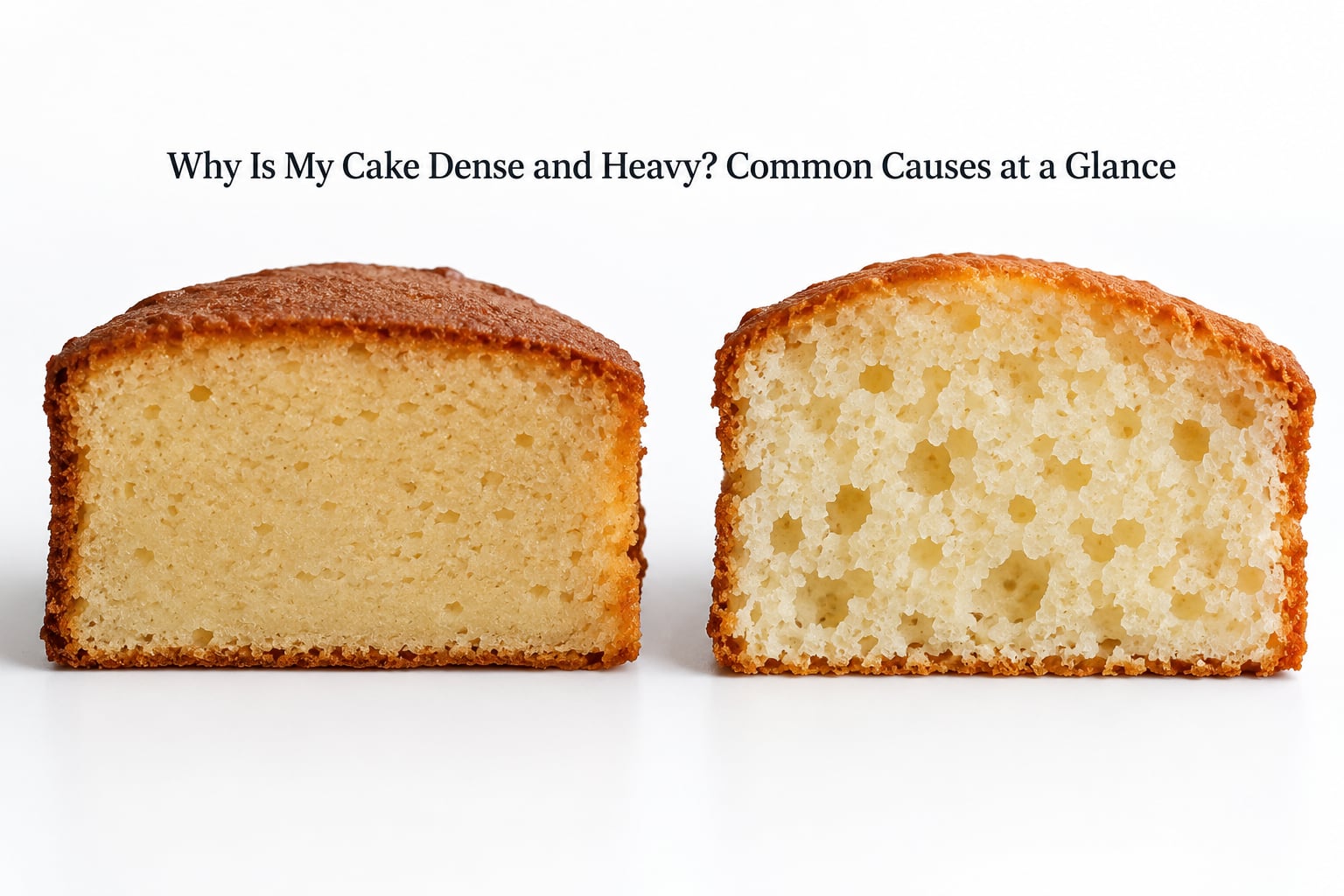
These are the causes I see most often, in rough order of how often they turn out to be the culprit.
- Flour scooped straight from the bag. A heaped cup is 15 to 20 percent heavier than a level one, and that extra starch swallows the gas the leavener made.
- Batter mixed after the flour went in. Flour needs water and a minute or two of gentle work, not two minutes on medium speed with a stand mixer.
- Fat and sugar under-creamed. Pale, fluffy, aerated butter and sugar is where a good share of your cake’s volume comes from.
- Cold ingredients. Butter straight from the fridge will not emulsify into the batter, so the mixture splits and bakes heavy.
- Weak or expired leavening. Baking powder that has lost its punch rises the edges a little and leaves the centre compact.
- Wrong pan or oven. A dark metal pan or an oven running 25 degrees cool produces a flat, tight layer that never springs.
- Baking too long. Past the point of doneness, moisture keeps leaving the crumb and it sets hard and heavy.
- Cooling wrong. Wrapping or refrigerating a warm cake traps steam, which compacts the crumb and dries the texture out.
This is the same breakdown bakers argue through on baking-forums.com, where a heavy crumb usually gets blamed on butter temperature or flour protein before anyone checks the measuring cup.
| What the cake looks like | Most likely cause | What to check | Change for next time |
|---|---|---|---|
| Dense but still moist and gummy, dull sheen | Underbaked, or too little leavening | Skewer comes out with wet batter; centre dips when pressed | Test the baking powder, extend bake by 3 to 5 minutes, check at 2 minutes early |
| Dense and dry, tight sandy crumb, dark edges | Overbaked, oven too hot, or pan too dark | Top is deep golden before you pulled it; edges pull from the pan | Drop the temperature 25 degrees, use a light pan, pull 5 minutes early |
| Dense with tunnels and craters on top | Overmixed batter, or too much leavening | Batter was beaten smooth and glossy after flour; top domed then cracked | Stop mixing when the last dry streak disappears, halve the baking powder if the recipe allows |
| Dense only in the bottom layer | Batter not spread evenly, or oven rack too low with hot element | Bottom third is compressed, top third is fine | Level the batter in the pan, use the middle rack, tap the pan once on the counter |
| Uniformly compact all the way through, sunken middle | Not enough gas: weak leavening, no acid with baking soda, or too much flour | Rise at the edges but almost none in the centre | Fresh leavening plus its acid partner, weigh the flour |
| Dense and rubbery, chewy rather than crumbly | Gluten overdeveloped | Cake bends without snapping and tears in strands | Fold dry ingredients in two or three additions, no mixer afterwards |
| Fine crumb but heavy in the hand, low height | Cold butter and sugar, or no fat for the volume | Batter looked greasy and curdled before baking | Bring butter, eggs and milk to room temperature, cream for 3 to 5 minutes |
| Dense after storage but fine the day it was baked | Cold storage or wrapping while warm | Bottom is damp, edges are dry | Cool fully on a rack, then wrap, and refrigerate only what needs it |
How to Tell Whether Your Cake Is Underbaked, Overbaked, or Badly Mixed
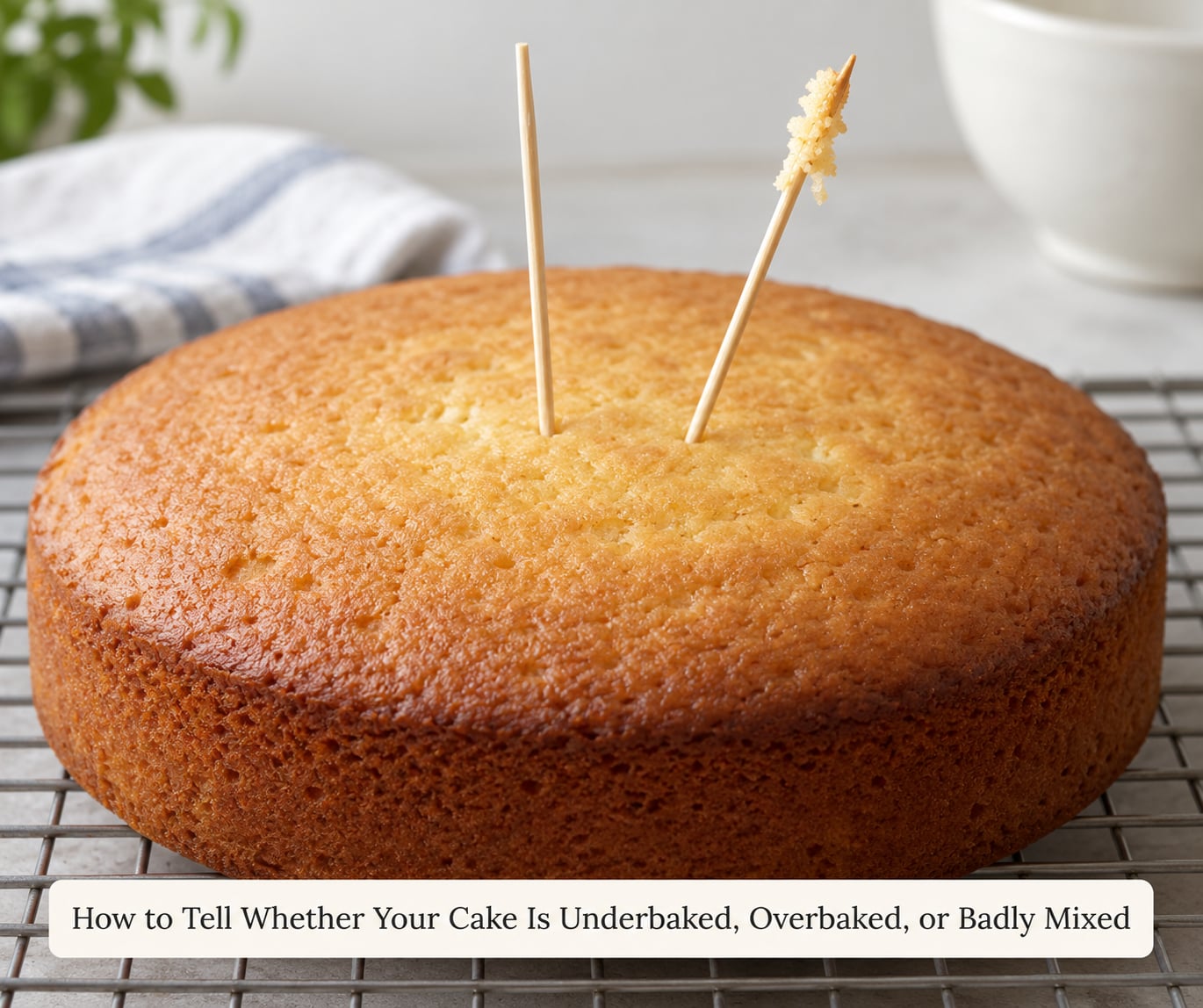
Diagnose before you adjust anything. Five things tell you what happened: the crumb, the top colour, the edges, the height, and the smell.
Read the crumb
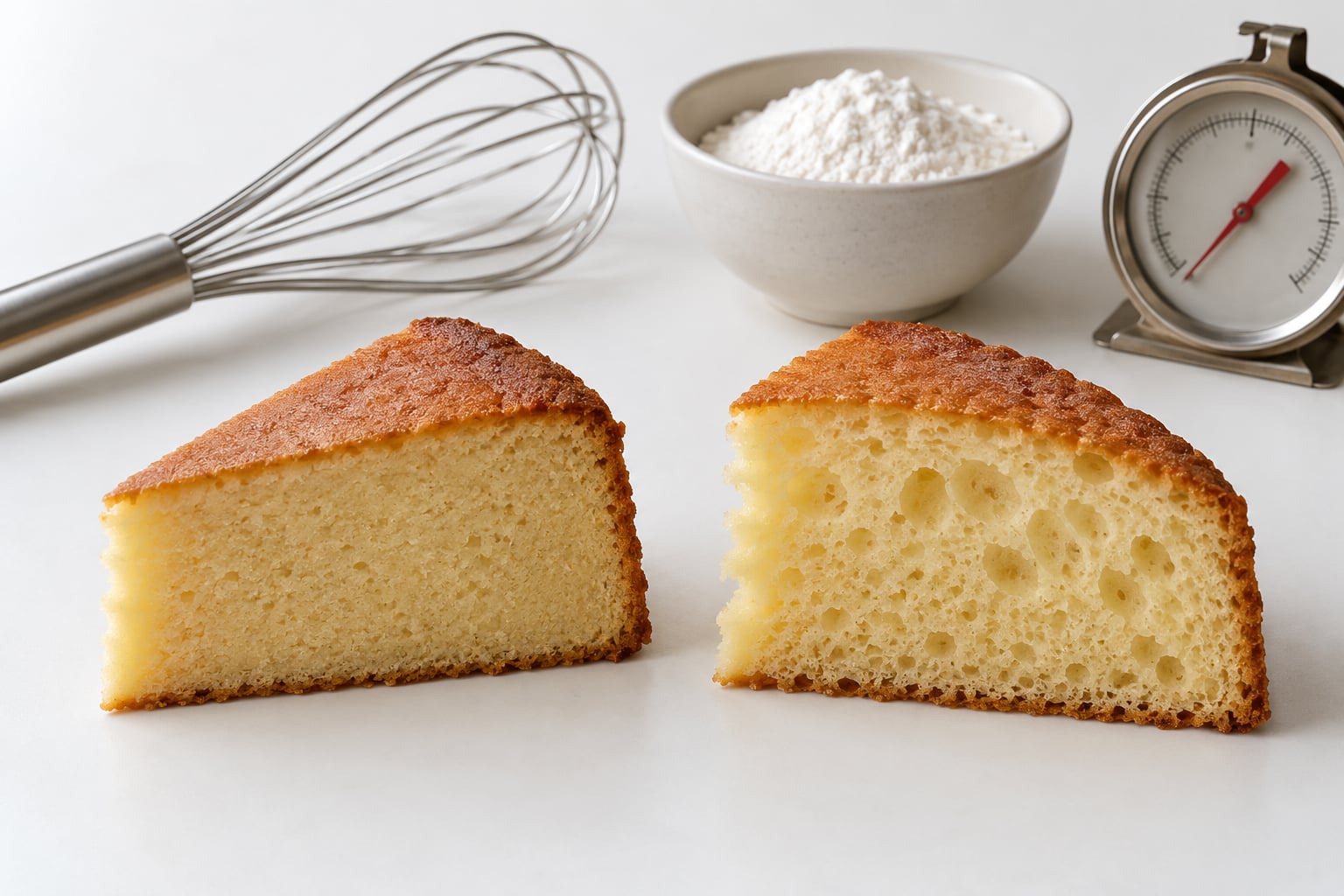
- Wet or gummy streak through the middle: underbaked, or the middle set before the heat reached it. Usually an oven that runs cool, or a large deep pan that needed more time than the recipe allowed.
- Dry and crumbly, almost sandy: overbaked, or the pan and oven together dried the surface faster than the centre could follow.
- Dense with tunnels: overmixed batter or too much leavening. The gas burst through instead of lifting evenly.
- Uniformly compact and fine: leavening too weak, or not enough air was ever beaten into the fat.
- Fine top, dense bottom: the batter was unevenly distributed, or the pan sat on a low rack under a hot element.
Check the top and edges
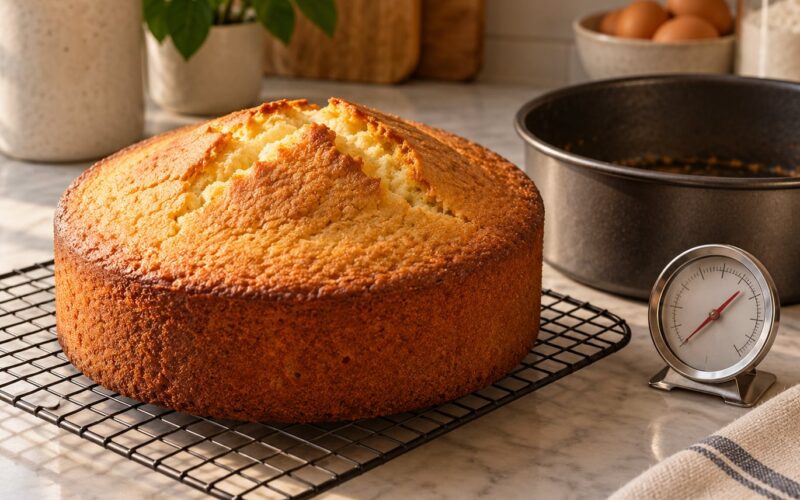
A cake that is done springs back lightly when you press the centre and settles without a dent. If it stays indented, it needs more time. Deep golden edges and a domed, cracked dome that has already started to pull from the pan mean the opposite.
Use doneness tests that do not involve cutting a hot cake
- Skewer test: insert a thin skewer in the deepest part of the centre. Come out clean or with a few moist crumbs and it is done.
- Edge pull: run a thin spatula around the edge. If it slides in without resistance, the sides are set.
- Bounce test: press the top gently with two fingers. It should spring back straight away and hold a faint print for a second.
- Aroma test: the cake should smell baked through, not raw, at the point where the tester goes in.
Start checking 2 to 3 minutes before the recipe time. Cakes keep cooking from residual heat after they leave the oven, so a cake that needs 40 minutes is usually fine at 37.
Underdeveloped Gluten and Over-Mixed Batter
Gluten is the protein network in flour. When flour meets water and you work it, those proteins link into an elastic web that traps gas bubbles. That web is the skeleton of your cake, and its strength is decided in about 90 seconds of mixing.
What under-developed structure looks like
If the flour is barely stirred in, there is no web to hold the rising gas, so the batter sets into a compact mass with no lift. It is the most common reason a recipe followed exactly still gives a brick. Look for batter that still has dry pockets of flour visible just before it goes in the pan.
Why is my cake dense and heavy when the flour is barely mixed
Once the web forms, extra beating makes it tighter and more elastic. The gas cells get squeezed smaller, and the cake bakes dense, chewy, and sometimes bouncy. Signs during mixing: the batter goes from streaky to smooth and glossy in a stand mixer, it ribbons heavily off the whisk, and it starts clinging to the bowl sides.
Which steps deserve how much mixing
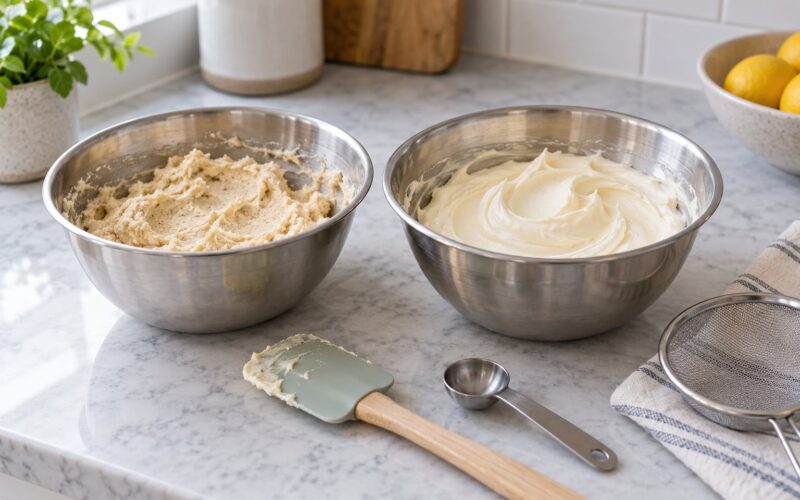
Creaming butter and sugar wants 3 to 5 minutes on medium, until it is pale and fluffy with no separate grains of sugar. The whole point is beating air into the fat. Adding eggs one at a time keeps the mixture emulsified, which is what stops the batter splitting and going greasy.
Dry ingredients get folded in, not beaten. Divide them into two or three additions, cut the bowl with a spatula, and stop the moment the last dry streak disappears. After the flour goes in, a hand whisk and 20 to 30 seconds of gentle work is plenty.
Reverse creaming is gentler and works well when you are nervous about over-creaming: whisk the dry ingredients with the softened butter until it looks like coarse sand, then add the liquid. You get structure from the flour and volume from the creaming without the long whipping.
Ingredient Ratios That Make a Heavy Cake
Cake is a balance. Flour provides the structure, sugar feeds the tender crumb, fat carries flavour and keeps things moist, liquid activates the gluten and the leavener. Push any one of those ratios off and the crumb tightens.
Why volume measuring fails
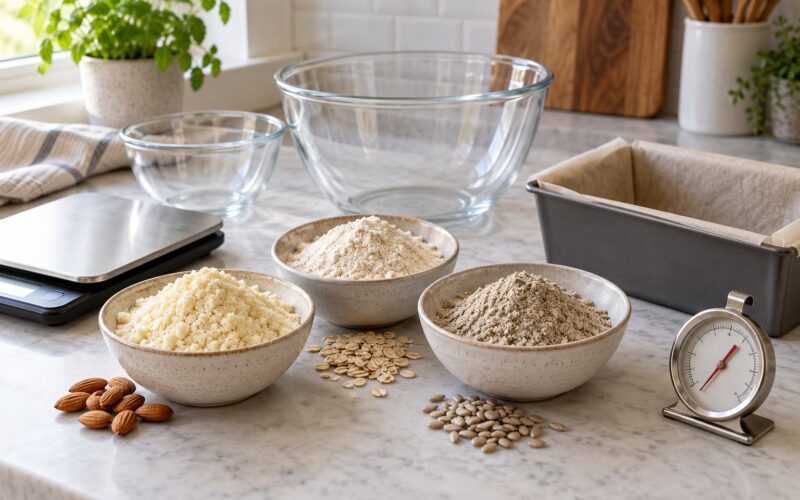
Recipes were written for a specific flour weight per cup, and that weight varies by brand. Scooping and shaking packs flour down and adds air voids you cannot see, so the level you read is heavier than intended. Spoon the flour into the cup and level it with the back of a knife, or skip the guesswork with a kitchen scale and weigh in grams.
| Flour type | Approx. protein | Best for | Density risk in cakes |
|---|---|---|---|
| Cake flour (bleached) | 6 to 8 percent | Light layer cakes, cupcakes | Lowest. Fine grind and low protein give the tender crumb |
| All-purpose flour (bleached) | 10 to 10.5 percent | Most butter cakes, chocolate cakes | Moderate. Works well if you do not overmix |
| All-purpose flour (unbleached) | 10 to 12 percent | Yeasted bakes, sturdier cakes | Moderate to high. More protein means a tighter crumb |
| Bread flour | 12 to 13 percent | Bread, not cake | High. Expect a dense, tight cake every time |
| 00 / European pastry flour | 8 to 11 percent | Delicate sponge and pastry | Low to moderate, depending on protein |
Protein matters because more protein means more gluten potential. Bakers on baking-forums.com repeatedly report denser results from King Arthur all-purpose flour at roughly 11.7 percent protein, while Gold Medal, Pillsbury and White Lily at 10 to 10.5 percent tend to give a lighter cake. That is a real pattern in home ovens, not a brand rule, so weigh your flour and treat the numbers as a starting point.
The liquid side of the ratio
- Too little liquid: the flour stays dry, hydration drops, and the crumb sets tight. Milk, water, coffee, and sour cream all count toward the liquid total.
- Melted chocolate: melted chocolate is only about half water by weight compared with its flour contribution in many recipes, so it makes a batter drier and heavier than the written flour amount suggests. Add a little extra liquid with melted chocolate bakes.
- Very high-fat butter: European-style 82 percent butter has less water than standard baking butter. The difference is small, but it is why dense European recipes often add an egg or a splash of milk.
- Overripe banana or applesauce: purees are moist and are not interchangeable with the thin liquid the recipe assumes. Drain, reduce, or cut the added fruit and replace part of the liquid.
- Oversized eggs: a large egg brings more fat and less liquid than the recipe’s sugar and liquid proportions expect. Weigh the eggs instead, or use the size on the recipe card.
- Too much sugar relative to liquid: sugar absorbs moisture, so a sweet batter needs more liquid than a plain one to hydrate fully.
Adding sour cream, plain yogurt, or 2 tablespoons of vegetable oil gives the batter a little extra fat and moisture without thinning the flour, which is why those additions show up in so many rescue recipes.
Leavening Problems: Too Little, Too Much, or Inactive
Leavening agents make gas. Baking powder releases carbon dioxide when it meets liquid and heat, and it is self-contained. Baking soda needs an acidic ingredient like buttermilk, yogurt, brown sugar, or cocoa to start the reaction. With no acid, baking soda does very little and you get a compact cake.
Test your baking powder in 30 seconds
Put 1 teaspoon of baking powder in a cup with about a third cup of hot water. Vigorous bubbling means it still has punch. Weak fizzing or nothing at all means the leavener has absorbed moisture from the open bag and lost its lift, so replace it.
Read the rise pattern
A cake that climbs at the rim and stays flat in the middle is the classic weak-leavening signature. There is gas at the edge where it meets the hot pan wall, and none in the middle.
Too much leavening gives the opposite picture: a fast rise, a domed or cracked top, large tunnels, and then a collapse as the set crumb cannot hold the gas. In that case the crumb underneath is dense even though the cake tasted fine.
Measure leavening like flour
Spoons of baking powder vary. Level them, do not scoop them, and remember that halving a recipe also halves the leavening exactly, while doubling a batter in the same pan does not. Bakers who double a recipe should bake two pans instead, because the deeper batter traps heat and bakes differently.
Over-Mixing, Overbaking, and the Wrong Pan
Density that shows up as dryness rather than guminess usually comes from the oven side of the equation.
The pan changes everything
A dark nonstick pan absorbs far more heat than a light aluminium one, so the same batter browns and sets before the centre can rise. Choose the pan the recipe specifies, in the stated size and material, and if you substitute a similar one, go lighter in colour rather than darker. Heavy cast iron and thick glass bake hotter and faster than thin light metal, and both produce a denser, drier layer.
Grease and line as directed, fill two-thirds full, and tap the filled pan once on the counter so trapped bubbles travel to the surface.
Check the oven with a thermometer
Oven dials are frequently off by 10 to 25 degrees in either direction. An oven running cool makes you extend the bake, which dries the edges while the centre stays gummy, and one running hot bakes the outside long before the middle sets.
Hang an oven thermometer on the middle rack and read it 15 minutes after preheating. If it is off, adjust the dial for the next bake, and keep in mind that many ovens run cooler once the door has been opened and the stone has cooled. Bake on the centre rack, with air circulating on all sides.
Stop at doneness, not at the timer
Bakers on r/AskBaking who extended the bake chasing a pale top usually ended up with the dry, heavy cake they were trying to avoid. Extra time does not fix a bad rise, it only removes more moisture from a crumb that has already set.
8 Proven Ways to Fix a Dense or Heavy Cake
Work down this list in order. The first three solve most dense cakes on their own.
How to adjust a cake recipe for the next bake
- Change one thing at a time. If you adjust flour, pan, temperature and mixing all at once and the cake improves, you have learned nothing for the next bake. Change one, write down the result, keep or revert.
- Weigh the flour. A kitchen scale settles volume measurement entirely, and it is the single change I would make first.
- Fix the liquid ratio. If the batter looked thick and pasty, add milk or water a tablespoon at a time until it ribbons off the spoon. If it was loose, hold back a little of the liquid.
- Mix only as directed. Cream fat and sugar 3 to 5 minutes, add eggs one at a time, fold dry ingredients in two additions, and stop at the last dry streak.
- Test the leavening. Hot water test the baking powder, and make sure any baking soda in the recipe has an acidic partner.
- Use the specified pan. Same diameter, same material, same depth. If yours differs, adjust the bake time in 3 to 5 minute steps.
- Drop the temperature 25 degrees. Especially if the top browned early. A slightly cooler, slightly longer bake gives the centre time to set.
- Shorten the bake. Start checking 2 to 3 minutes early with a skewer, and pull the moment it comes out clean or with moist crumbs.
Cool on a wire rack until the centre no longer feels warm, roughly 60 to 90 minutes for a single layer, before you wrap anything.
What to do with a dense cake after it has baked
The crumb is set, so you cannot make it light. You can make it worth eating, and the easiest options depend on how dry it turned out.
- Simple syrup: warm equal parts sugar and water or milk with a spoonful of vanilla, coffee syrup, or lemon juice, and brush it over the layers while they are still barely warm. It revives a dry cake best.
- Frosting that carries moisture: a whipped ganache, cream cheese frosting, or buttercream with extra milk thins the perception of density and adds fat to the bite.
- Trifle: cut the cake into chunks, soak it with custard or pudding, and layer with fruit and cream. Density becomes structure.
- Cake balls or pops: crumble the cake, mix with a little icing or condensed filling, and roll. Nobody is judging the crumb inside.
- Bread pudding or trifle base: dense cake is the ideal texture for soaking, since it holds liquid without dissolving.
- Slice thin and use it as a layer: thinner layers read lighter on the plate than one thick block, and a filling between them adds lift.
How to Prevent a Dense Cake in Your Next Bake
This is the workflow I follow, and it prevents most repeat failures before they start.
- Set the ingredients out 45 to 60 minutes ahead so butter, eggs, and milk reach roughly 68 to 70 F. Cold ingredients are a common hidden cause on cake-forums threads, and nothing else about the recipe changes.
- Weigh everything, especially flour and leavening.
- Confirm the leavener is fresh and that any baking soda has acid to work with.
- Prepare the pan the way the recipe says, using the specified size and material.
- Preheat fully and verify with an oven thermometer.
- Cream 3 to 5 minutes until pale and fluffy, add eggs one at a time, and fold dry ingredients in two additions.
- Bake on the centre rack and check 2 to 3 minutes before the stated time.
- Cool fully on a wire rack before wrapping. Store cake at room temperature for a day or two, and refrigerate only cakes with perishable fillings.
A dense cake also goes soggy from storage, not just heavy. Wrapping a warm cake traps steam that condenses on the crumb and softens the crust into dampness. Let the layers cool completely, wrap tightly, and keep frosting-covered cakes cool if the frosting is perishable.
Frequently Asked Questions
Why is my cake dense and heavy even when it rose in the oven?
A rise alone does not mean a good rise. If the cake climbs at the rim and stays flat in the middle, gas was produced only at the hot edges, which points to weak or expired leavening. Check your flour weight, test the baking powder in hot water, and look at the crumb for tunnels. A dome that cracked and then sank usually means the opposite problem: too much leavening or a batter that was overmixed.
Can I fix a dense cake after it has baked?
Not into a light crumb, because the starch has already set. You can improve how it eats: brush warm layers with simple syrup, choose a frosting with extra milk or whipped cream, or turn the cake into a trifle, cake balls, or bread pudding. Dense cake soaks liquid without dissolving, so those formats suit it better than serving it plain.
Does adding more liquid to cake batter make it lighter?
Only when the batter was genuinely too dry. If it sat stiff and pasty, extra milk or water a tablespoon at a time will hydrate the flour and loosen the crumb. If the batter was already fluid, adding liquid thins the mix and can make the cake gummy and prone to sinking. Judge the batter before the oven, not the finished cake.
Why is my banana cake dense and heavy?
Ripe banana puree brings a lot of water and very little structure, so a banana cake that is dense and heavy usually means too little leavening for that extra weight, or too much fruit sitting in the batter. Drain overripe bananas, mash firm ones, and check that the baking powder is fresh and measured level. Stir the puree in with the dry ingredients and fold only until combined.
Do I need to use cake flour for a light cake?
No, but it helps. Cake flour carries roughly 6 to 8 percent protein against about 10 to 12 percent in all-purpose flour, so it forms less gluten and gives a finer, more tender crumb. All-purpose works well if you measure by weight and stop mixing as soon as the dry streaks vanish. If you want the cake-flour effect from all-purpose, replace about a quarter of the flour with cornstarch.
How should I store cake so it does not become soggy?
Cool the layers completely on a wire rack before wrapping, because trapped steam is what turns a crisp crust damp. Wrap cooled layers tightly at room temperature for a day or two, and refrigerate only cakes with whipped cream, custard, or cream cheese frosting. Frozen cake thaws best wrapped at room temperature, and any condensation after thawing should evaporate before you frost.
Conclusion: Start With the Crumb, Then Change One Thing
Cut into your last cake and look at it. Wet and gummy means underbaked or weak leavening, dry and tight means too much heat or too much time, tunnels mean overmixing or too much leavening, and uniform compactness usually means flour weight or creaming. Whatever the crumb shows you, make that one correction on the next bake and leave everything else alone, because why is my cake dense and heavy is nearly always answerable from its texture, its rise pattern, and how the recipe said to mix it.